
With the ability to support packet-switched data services, especially improving data transmission rates, first of all downlink rates, 3GPP has developed and standardized in Release 5 a new technology, which is high-speed downlink packet access (HSDPA) with new features mentioned in the R5 versions of 3GPP for the WCDMA/UTRA-FDD radio access system and is considered one of the advanced technologies for 3.5G mobile communication systems. HSDPA includes a set of new features that work together to improve network capacity, and increase peak data rates above 10 Mbps for downlink packet traffic. These technical improvements allow operators to offer more high-bit-rate services, improve the quality of service (QoS) of existing services, and achieve the lowest cost. The ability to support HSDPA data rates and mobility is unprecedented in previous releases of 3GPP.
Technical aspects of HSDPA content include:
Broadcast shared channels.
Adaptive modulation and coding.
Multi-code transmission technique.
Maybe you are interested!
-
 Competing Competitive Advantages of Convenient Air and Sea Access
 -
 Mobile TV using DVB-H - 6 technology
 -
 Impact of promotional forms on the business activities of Mobifone mobile telecommunications services of VNPT Posts and Telecommunications Group - 17
 -
 The Role of Mobile Phones and Students' Needs for Mobile Phones
 -
 Factors affecting consumer behavior towards Mobile Marketing activities in Hanoi inner city area - 1
Fast Automatic Repeat Request HARQ.
The purpose of HSDPA is to support high-speed downlink packet access using a single high-speed downlink shared channel (HS-DSCH) and integrated voice support on the DCH and high-speed data on the HS-DSCH on the same carrier (similar to the DSCH in Release 99).
The benefits of HSDPA as discussed in the previous sections are for the downlink as most of the 3G data traffic is expected to be downlink first. Release 6 will talk about an uplink enhancement, called HSUPA (High Speed Uplink Packet Access). HSUPA uses the same key features as HSDPA, but instead of applying it to the downlink, it applies it to the uplink. This will increase the downlink transmission speed.
2.2.1.3 Comments
The birth of 3rd generation mobile information networks WCDMA and 3.5G generation HSDPA and HSUPA has partly met the needs of users such as: data transmission speed up to 2Mbps for WCDMA network, 10Mbps downlink for
3.5G technology), can access many services such as: video conferencing, high-speed Internet access,...
However, these mobile networks still have many disadvantages such as: low data transmission speed, so the quality of real-time services is not high, data transmission speed is still low, especially poor mobility. When users enter the coverage area of other types of networks such as WLAN, WiMAX, etc., but are not within their coverage area, the network cannot serve the users. In addition, the use of IPv4 also causes limitations such as insufficient addresses to deploy according to network requirements, etc. The ability to deploy new services on these networks is very difficult due to limitations in communication speed and bandwidth, etc.
In the future, users expect to use many different types of services with high transmission speeds of up to hundreds of Mbps, good quality, the ability to access the network from anywhere, the ability to use new services easily, etc.
2.2.2 4G mobile network model
The scope of the 4G network will cover everything from radio transmission, transmission in the core network to applications on terminal devices. With the requirement of a layered architecture for the system, to ensure openness and adaptability for the system, the functional components in the network will be standardized according to common functions and each common function will represent a function in a layer. With this requirement, we divide the network structure on the basis of 4 functional layers, corresponding to 4 functional ranges of the components in the network system.
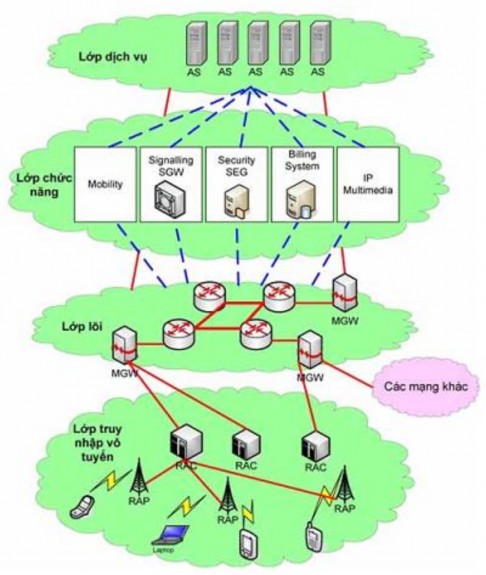
Figure 2.5 4G network structure model
With the above model, system integration has been solved at the transmission layer. Systems using the radio transmission environment are integrated into the RAN network. With this model, radio access networks are integrated into a common environment, which means that the mobile terminal subscriber, regardless of the radio transmission environment, is guaranteed to operate in the network.
The interaction between layers helps the model to be open in developing technology as well as services in the future. Handling modulation, coding and access technologies on the interaction layers also creates adaptability to service requirements, ensuring full service speed requirements in the future.
Radio access network function:
Ability to integrate between terminals
Ensure service speed
Core network functions:
Connect different networks: wireless and wired networks.
Transport traffic on routes from source to destination safely.
Traffic routing
Convert all IP data format Control function:
Provide network service infrastructure platform
System control:
Signal
Traffic
Security
Billing
Mobility and Roaming Services:
Provide user service
2.3. Functions of elements in the model
2.3.1 Radio access layer elements
The main task of the Radio Access Network is to create and maintain radio access bearers (RABs) to carry out information between mobile equipment (UE) and the core network (CN). User equipment here can be MSs, portable devices, etc. Therefore, the radio access network must be able to communicate with terminals, even when the terminal is a wireless mobile device belonging to another network.
2.3.1.1 Terminal equipment
Mobile terminals in 4G networks must be developed to run many different types of applications. This also ensures the opportunity to increase profits for service providers by providing additional value-added services. Therefore, these devices must operate with high adaptability and flexibility. Currently, mobile terminals are in the process of transitioning to a converged integrated form. Manufacturers also provide operating systems (OS) and service software that are open, have a layered architecture and are capable of running on software from third-party suppliers. The complexity of this generation of mobile terminals will have to fully contain the following hardware and software conditions: Different types of applications on
Mobile (such as email, MMS ...) - Can perform many application integration software (such as typing prediction, text editing, pronunciation checking) - Can perform on many types of operating systems (such as Symbian, SmartPhone, Linux ...) - Works on many application environments (such as J2ME, .NET) - Works on many radio coding methods (such as cdma2000, GPRS, GSM, W-CDMA, WiFi ...) - Works on many coding methods (voice, image ...). - Works on many network protocol ranges (Ipv4, IPv6 ...) - Network processor with mobile applications and general PC features.
-Has large memory.
2.3.1.2 Radio Access Point (RAP)
The main function of RAP is to perform layer 1 processing of the radio interface (channel coding, interleaving, rate adaptation, spreading spectrum, etc.). It also performs some radio resource management operations such as inner loop power control. The radio access point is similar to Node B in 3G, but there are some new techniques to increase the transmission speed, which are:
+ Use Smart Antenna
A smart antenna is a system of two or more antennas (elements of the array) that are geometrically arranged and electrically interconnected to produce a desired directional radiation pattern. In phase-controlled antenna arrays, the phase of the currents at each antenna element is controlled to obtain the coverage pattern of the array, usually focusing the largest or smallest beams in the desired directions. Controlling the phase of the currents of the elements in the array is a method for adjusting the beam direction.
A smart antenna system consists of an antenna array, with radio hardware and control units to change the coverage pattern according to radio environmental conditions to enhance the performance of a communication system.
In fact, in the Smart Antenna system, the Antenna elements themselves are not smart, but the intelligence is created by the digital signal processing of the signals to the Antenna elements.
Smart antennas are an indispensable component in 4G networks. A smart antenna system is a combination of multiple antenna elements with a signal processing capability to automatically optimize its reception and radiation pattern based on the response of the signal environment. 3.5G systems use High-Speed Downlink Packet Access (HSDPA
– High Speed Downlink Packet Access) based on W-CDMA air interface technology is intended to provide speeds of up to 10 Mbps using more efficient use of the current 3G spectrum. 4G systems will use a different spectrum (possibly 40 or 60 GHz) and can provide up to 100 Mbps for WAN cells and up to 1 Gbps for local wireless access.
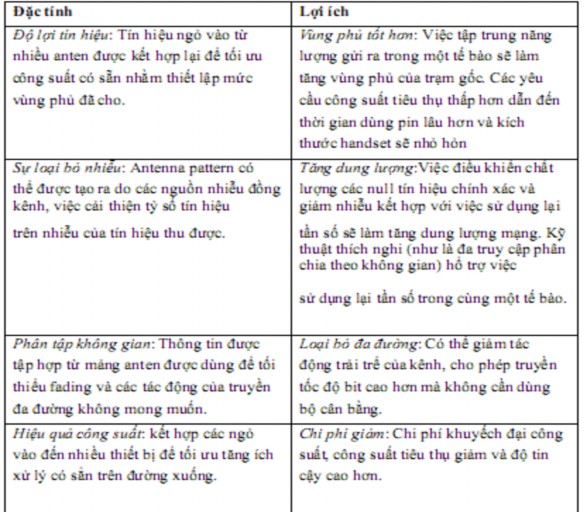
The purpose of a smart antenna system is to improve the signal quality of a radio system by concentrating the radio signals while increasing capacity by increasing frequency reuse. The following table lists the features and benefits of a smart antenna system.
Table 2.1 Features and benefits of smart antennas
+ One of the link adaptation techniques that will be discussed is called Adaptation and Modulation Coding (AMC). With AMC, the modulation and coding rate are continuously adapted to the channel quality instead of adjusting the power. Transmission using multiple Walsh codes is also used in the link adaptation process. The combination of the two link adaptation techniques above
has completely replaced the variable spreading factor technique of high-speed radio transmission.
+ Orthogonal Frequency Division Multiplexing OFDM: The outgoing signal is divided into small carriers, each of which is “narrowband” and thus avoids multipath effects, creating a guard interval inserted between each OFDM signal. OFDM also creates a gain in frequency diversity, improving the performance of the physical layer. It is also compatible with other advanced scaling technologies, such as smart antennas and MIMO. This not only provides clear benefits to the physical layer implementation, but also incorporates improvements in layer 2 performance by introducing an additional degree of freedom.
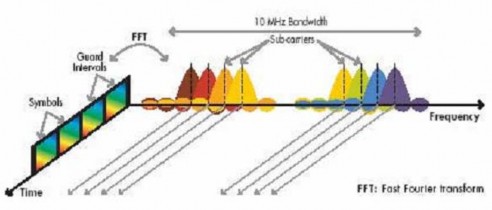
Figure 2.6 OFDM principle
+ MIMO: MIMO uses multiplexing of signals between multiple transmitting antennas and time or frequency. It combines with OFDM to process time-independent signals as long as the OFDM waveform is precisely designed for the channel. The combination of OFDM and MIMO makes processing simpler and the transmission and reception efficiency high.
In addition, the service access layer also uses some other techniques such as SDR technique,... to increase the adaptability of the UE in the general integrated network environment.
2.3.1.3 Radio Access Controller (RAC)
The Radio Access Controller (RAC) is the control element of the radio access layer. The RNC function is used to control the traffic and manage the radio resources of the radio access layer.
For a UE, the RAC terminates both the Iu link for user data transmission and the corresponding signalling to/from the core network. The RAC also terminates the radio resource control signalling, handles the data link layer data from/to the radio interface.
radio resource management operations such as mapping radio access bearer parameters with air interface transport channel parameters.
Radio Resource Management Function: RRM (Radio Resources Management) is a set of algorithms used to ensure the stability of the radio link and QoS of the radio connection by sharing and managing radio resources efficiently.
In 4G, some new features are added such as fast automatic retransmission request (HARQ: Hybrid Automatic Repeat Request), fast scheduling, short transmission time interval (TTI: Transmission Time Interval). The two most important features of WCDMA technology such as closed loop power control and variable spreading factor are no longer used.
2.3.2 Core network layer
The core network must integrate all other telecommunications networks such as mobile networks, WLAN, WiMAX, other wireless networks, etc. To achieve that, the core network must have:
Thanks to the strong development of NGN globally, people build transmission systems in the core network using IPv6 protocol, especially the flexible use of mobile IP helps to combine networks.
Multimedia Gateway (MGW): In the core network, MGW performs the main functions of:
Convert data to IP packets and vice versa.
Performs the switching function, routing data from/to a service area of the network depending on the subscriber location. The MGW is controlled by the MGCF. The transmission path for calls is made between the RNC and the MGW. Typically the MGW receives calls from the RNC, converts the data into IP packet format and routes these calls to the destination over packet backbones. In many cases the packet backbone uses “Real Time Transport Protocol” (RTP) over “Internet Protocol” (IP).
Where a call needs to be routed to another network, say the PTSN, there is a media gateway (MGW) which converts the packetized voice into standard PCM for delivery to the PTSN. Thus the code conversion only needs to be performed at the point