
The total number of key cadres is 145 comrades with seniority in current positions, 61 comrades, accounting for 42.1%, from 16-30 years, 82 comrades, accounting for 56.5%, over 30 years, 02 comrades, accounting for 1.4%; under 5 years, 86 comrades, accounting for 59.3%, from 5-10 years, 46 comrades, accounting for 31.7%, over 10 years, 13 comrades, accounting for 9%.
2.2.2. Quality assessment according to criteria and activities of grassroots staff
2.2.2.1. Advantages
* On political qualities, ethics and lifestyle
Most of the key cadres at the commune and town levels of the district grew up from the revolutionary movement of the masses, have strong political will, and are steadfast in the goals and path chosen by the Party, Uncle Ho and the people.
Dynamic, creative, enthusiastic in implementing the Party and State's innovation guidelines and policies, with experience in political leadership, mobilizing people to continue innovation. The majority of cadres still maintain ethics, revolutionary qualities, healthy and simple lifestyles, and closeness to the people.
Most of them have a progressive spirit, are positive and willing to learn, explore, be creative and strive to complete assigned tasks.
Most cadres still maintain moral qualities, character and healthy lifestyle, overcoming difficulties in conditions of low salary and large workload.
* About executive leadership capacity:
Classification of commune-level cadres, civil servants and workers 2011-2015:
* In 2011, there were 522 cadres, civil servants and employees; 522 people participated in the assessment, evaluation and classification, reaching 100% . Specifically as follows:
- Excellent task completion: 103 people, rate 19.7%;
- Completed tasks well: 389 people, rate 74.5%;
- Completed tasks: 29 people, rate 5.6%;
- Did not complete the task: 1 person, rate 0.2%;
* In 2012, there were 522 cadres, civil servants and employees; 522 people participated in the assessment, evaluation and classification, reaching 100% . Specifically as follows:
- Excellent task completion: 108 people, rate 20.7%;
- Completed tasks well: 382 people, rate 73.2%;
- Completed tasks: 31 people, rate 5.9%;
- Did not complete the task: 1 person, rate 0.2%;
* In 2013, there were 522 cadres, civil servants and employees; 522 people participated in the assessment, evaluation and classification, reaching 100% . Specifically as follows:
- Excellent task completion: 111 people, rate 21.3%;
- Completed tasks well: 372 people, rate 71.3%;
- Completed tasks: 38 people, rate 7.3%;
- Did not complete the task: 1 person, rate 0.2%;
* In 2014, there were 522 cadres, civil servants and employees; 484 people participated in the assessment, evaluation and classification, reaching 92.7%, 38 did not participate in the classification, reaching 7.3% . Specifically as follows:
- Excellent task completion: 122 people, rate 23.4%;
- Completed tasks well: 323 people, rate 61.9%;
- Completed tasks: 37 people, rate 7.1%;
- Did not complete the task: 2 people, rate 0.4%;
* In 2015, there were 547 cadres, civil servants and employees; 547 people participated in the assessment, evaluation and classification, reaching 100% . Of which, the classification agency:
- Excellent task completion: 48 people, rate 8.8%;
- Completed tasks well: 463 people, rate 84.6%;
- Completed tasks: 36 people, rate 6.6%;
- Mission not completed: 0 people;
Table 2.7. Summary of civil servant classification from 2011 to 2015
Year
SL CC | Do not participate in the review | Civil servant rating | |||||||||
Excellent | Good | HTNV | No HTNV | ||||||||
SL | % | SL | % | SL | % | SL | % | SL | % | ||
2011 | 522 | 0 | 0 | 103 | 19.7 | 389 | 74.5 | 29 | 5.6 | 1 | 0.2 |
2012 | 522 | 0 | 0 | 108 | 20.7 | 382 | 73.2 | 31 | 5.9 | 1 | 0.2 |
2013 | 522 | 0 | 0 | 111 | 21.3 | 372 | 71.3 | 38 | 7.3 | 1 | 0.2 |
2014 | 522 | 38 | 7.3 | 122 | 23.4 | 323 | 61.9 | 37 | 7.1 | 2 | 0.4 |
2015 | 547 | 0 | 0 | 48 | 8.8 | 463 | 84.6 | 36 | 6.6 | 0 | 0.0 |
Maybe you are interested!
-
 Assessing Growth Quality Based on Economic Criteria
 -
 Identify Rating Levels and Rating Scales
zt2i3t4l5ee
zt2a3gstourism,quan lan,quang ninh,ecology,ecotourism,minh chau,van don,geography,geographical basis,tourism development,science
zt2a3ge
zc2o3n4t5e6n7ts
of the islanders. Therefore, this indicator will be divided into two sub-indicators:
a1. Natural tourism attractiveness a2. Cultural tourism attractiveness
b. Tourist capacity
The two island communes in Quan Lan have different capacities to receive tourists. Minh Chau Commune is home to many standard hotels and resorts, attracting high-income domestic and international tourists. Meanwhile, Quan Lan Commune has many motels mainly built and operated by local people, so the scale and quality are not high, and will be suitable for ordinary tourists such as students.
c. Time of exploitation of Quan Lan Island Commune:
Quan Lan tourism is seasonal due to weather and climate conditions and festivals only take place on certain days of the year, specifically in spring. In Quan Lan commune, the period from April to June and from September to November is considered the best time to visit Quan Lan because the cultural tourism activities are mainly associated with festivals taking place during this time.
Minh Chau island commune:
Tourism exploitation time is all year round, because this is a place with a number of tourist attractions with diverse ecosystems such as Bai Tu Long National Park Research Center, Tram forest, Turtle Laying Beach, so besides coming to the beach for tourism and vacation in the summer, Minh Chau will attract research groups to come for tourism combined with research at other times of the year.
d. Sustainability
The sustainability of ecotourism sites in Quan Lan and Minh Chau communes depends on the sensitivity of the ecosystems to climate changes.
landscape. In general, these tourist destinations have a fairly high level of sustainability, because they are natural ecosystems, planned and protected. However, if a large number of tourists gather at certain times, it can exceed the carrying capacity and affect the sustainability of the environment (polluted beaches, damaged trees, animals moving away from their habitats, etc.), then the sustainability of the above ecosystems (natural ecosystems, human ecosystems) will also be affected and become less sustainable.
e. Location and accessibility
Both island communes have ports to take tourists to visit from Van Don wharf:
- Quan Lan – Van Don traffic route:
Phuc Thinh – Viet Anh high-speed boat and Quang Minh high-speed boat, depart at 8am and 2pm from Van Don to Quan Lan, and at 7am and 1pm from Quan Lan to Van Don. There are also wooden boats departing at 7am and 1pm.
- Van Don - Minh Chau traffic route:
Chung Huong high-speed train, Minh Chau train, morning 7:30 and afternoon 13:30 from Van Don to Minh Chau, morning 6:30 and afternoon 13:00 from Minh Chau to Van Don.
f. Infrastructure
Despite receiving investment attention, the issue of infrastructure and technical facilities for tourism on Quan Lan Island is still an issue that needs to be resolved because it has a direct impact on the implementation of ecotourism activities. The minimum conditions for serving tourists such as accommodation, electricity, water, communication, especially medical services, and security work need to be given top priority. Ecotourism spots in Minh Chau commune are assessed to have better infrastructure and technical facilities for tourism because there are quite complete and synchronous conditions for serving tourists, meeting many needs of domestic and foreign tourists.
3.2.1.4. Determine assessment levels and assessment scales
Corresponding to the levels of each criterion, the index is the score of those levels in the order of 4, 3, 2, 1 decreasing according to the standard of each level: very attractive (4), attractive (3), average (2), less attractive (1).
3.2.1.5. Determining the coefficients of the criteria
For the assessment of DLST in the two communes of Quan Lan and Minh Chau islands, the students added evaluation coefficients to show the importance of the criteria and indicators as follows:
Coefficient 3 with criteria: Attractiveness, Exploitation time. These are the 2 most important criteria for attracting tourists to tourism in general and eco-tourism in particular, so they have the highest coefficient.
Coefficient 2 with criteria: Capacity, Infrastructure, Location and accessibility . Because the assessment area is an island commune of Van Don district, the above criteria are selected by the author with appropriate coefficients at the average level.
Coefficient 1 with criteria: Sustainability. Quan Lan has natural and human-made ecotourism sites, with high biodiversity and little impact from local human factors. Most of the ecotourism sites are still wild, so they are highly sustainable.
3.2.1.6. Results of DLST assessment on Quan Lan island
a. Assessment of the potential for natural tourism development
For Minh Chau commune:
+ Natural tourism attractiveness is determined to be very attractive (4 points) and the most important coefficient (coefficient 3), so the score of the Attractiveness criterion is 4 x 3 = 12.
+ Capacity is determined as average (2 points) and the coefficient is quite important (coefficient 2), then the score of Capacity criterion is 2 x 2 = 4.
+ Exploitation time is long (4 points), the most important coefficient (coefficient 3) so the score of the Exploitation time criterion is 4 x 3 = 12.
+ Sustainability is determined as sustainable (4 points), the important coefficient is the average coefficient (coefficient 1), so the score of the Sustainability criterion is 4 x 1 = 4 points
+ Location and accessibility are determined to be quite favorable (2 points), the coefficient is quite important (coefficient 2), the criterion score is 2 x 2 = 4 points.
+ Infrastructure is assessed as good (3 points), the coefficient is quite important (coefficient 2), then the score of the Infrastructure criterion is 3 x 2 = 6 points.
The total score for evaluating DLST in Minh Chau commune according to 6 evaluation criteria is determined as: 12 + 4 + 12 + 4 + 4 + 6 = 42 points
Similar assessment for Quan Lan commune, we have the following table:
Table 3.3: Assessment of the potential for natural ecotourism development in Quan Lan and Minh Chau communes
Attractiveness of self-tourismof course
Capacity
Mining time
Sustainability
Location and accessibility
Infrastructure
Result
Point
DarkMulti
Point
DarkMulti
Point
DarkMulti
Point
DarkMulti
Point
DarkMulti
Point
DarkMulti
CommuneMinh Chau
12
12
4
8
12
12
4
4
4
8
6
8
42/52
Quan CommuneLan
6
12
6
8
9
12
4
4
4
8
4
8
33/52
b. Assessment of the potential for humanistic tourism development
For Quan Lan commune:
+ The attractiveness of human tourism is determined to be very attractive (4 points) and the most important coefficient (coefficient 3), so the score of the Attractiveness criterion is 4 x 3 = 12.
+ Capacity is determined to be large (3 points) and the coefficient is quite important (coefficient 2), then the score of the Capacity criterion is 3 x 2 = 6.
+ Mining time is average (3 points), the most important coefficient (coefficient 3) so the score of the Mining time criterion is 3 x 3 = 9.
+ Sustainability is determined as sustainable (4 points), the important coefficient is the average coefficient (coefficient 1), so the score of the Sustainability criterion is 4 x 1 = 4 points.
+ Location and accessibility are determined to be quite favorable (2 points), the coefficient is quite important (coefficient 2), the criterion score is 2 x 2 = 4 points.
+ Infrastructure is rated as average (2 points), the coefficient is quite important (coefficient 2), then the score of the Infrastructure criterion is 2 x 2 = 4 points.
The total score for evaluating DLST in Quan Lan commune according to 6 evaluation criteria is determined as: 12 + 6 + 6 + 4 + 4 + 4 = 36 points.
Similar assessment with Minh Chau commune we have the following table:
Table 3.4: Assessment of the potential for developing humanistic eco-tourism in Quan Lan and Minh Chau communes
Attractiveness of human tourismliterature
Capacity
Mining time
Sustainability
Location and accessibility
Infrastructure
Result
Point
DarkMulti
Point
DarkMulti
Point
DarkMulti
Point
DarkMulti
Point
DarkMulti
Point
DarkMulti
Quan CommuneLan
12
12
6
8
9
12
4
4
4
8
4
8
39/52
Minh CommuneChau
6
12
4
8
12
12
4
4
4
8
6
8
36/52
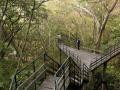
Basically, both Minh Chau and Quan Lan localities have quite favorable conditions for developing ecotourism. However, Quan Lan commune has more advantages to develop ecotourism in a humanistic direction, because this is an area with many famous historical relics such as Quan Lan Communal House, Quan Lan Pagoda, Temple worshiping the hero Tran Khanh Du, ... along with local festivals held annually such as the wind praying ceremony (March 15), Quan Lan festival (June 10-19); due to its location near the port and long exploitation time, the beaches in Quan Lan commune (especially Quan Lan beach) are no longer hygienic and clean to ensure the needs of tourists coming to relax and swim; this is also an area with many beautiful landscapes such as Got Beo wind pass, Ong Phong head, Voi Voi cave, but the ability to access these places is still very limited (dirt hill road, lots of gravel and rocks), especially during rainy and windy times; In addition, other natural resources such as mangrove forests and sea worms have not been really exploited for tourism purposes and ecotourism development. On the contrary, Minh Chau commune has more advantages in developing ecotourism in the direction of natural tourism, this is an area with diverse ecosystems such as at Rua De Beach, Bai Tu Long National Park Conservation Center...; Minh Chau beach is highly appreciated for its natural beauty and cleanliness, ranked in the top ten most beautiful beaches in Vietnam; Minh Chau commune is also home to Tram forest with a large area and a purity of up to 90%, suitable for building bridges through the forest (a very effective type of natural ecotourism currently applied by many countries) for tourists to sightsee, as well as for the purpose of studying and researching.
Figure 3.1: Thenmala Forest Bridge (India) Source: https://www.thenmalaecotourism.com/(August 21, 2019)
3.2.2. Using SWOT matrix to evaluate Quan Lan island tourism
General assessment of current tourism activities of Quan Lan island is shown through the following SWOT matrix:
Table 3.5: SWOT matrix evaluating tourism activities on Quan Lan island
Internal agent
Strengths- There is a lot of potential for tourism development, especially natural ecotourism and humanistic ecotourism.- The unskilled labor force is relatively abundant.- resource environmentunpolluted, still
Weaknesses- Poorly developed infrastructure, especially traffic routes to tourist destinations on the island.- The team of professional staff is still weak.- Tourism products in general
quite wild, originalintact
general and DLST in particularalone is monotonous.
External agents
Opportunity- Tourism is a key industry in the socio-economic development strategy of the province and Van Don economic zone.- Quan Lan was selected as a pilot area for eco-tourism development within the framework of the green growth project between Quang Ninh province and the Japanese organization JICA.- The flow of tourists and especially ecotourism in the world tends toincreasing
Challenge- Weather and climate change abnormally.- Competition in tourism products is increasingly fierce, especially with other localities in the province such as Ha Long, Mong Cai...- Awareness of tourists, especially domestic tourists, about ecotourism and nature conservation is not high.
Through summary analysis using SWOT matrix we see that:
To exploit strengths and take advantage of opportunities, it is necessary to:
- Diversify products and service types (build more tourism routes aimed at specific needs of tourists: experiential tourism immersed in nature, spiritual cultural tourism...)
- Effective exploitation of resources and differentiated products (natural resources and human resources)
div.maincontent .p { color: black; font-family:"Times New Roman", serif; font-style: normal; font-weight: normal; text-decoration: none; font-size: 14pt; margin:0pt; } div.maincontent p { color: black; font-family:"Times New Roman", serif; font-style: normal; font-weight: normal; text-decoration: none; font-size: 14pt; margin:0pt; } div.maincontent .s1 { color: black; font-family:"Times New Roman", serif; font-style: normal; font-weight: normal; text-decoration: none; font-size: 13pt; } div.maincontent .s2 { color: black; font-family:"Times New Roman", serif; font-style: normal; font-weight: normal; text-decoration: none; font-size: 13pt; } div.maincontent .s3 { color: #0D0D0D; font-family:"Times New Roman", serif; font-style: normal; font-weight: bold; text-decoration: none; font-size: 14pt; } div.maincontent .s4 { color: black; font-family:"Times New Roman", serif; font-style: italic; font-weight: normal; text-decoration: none; font-size: 14pt; } div.maincontent .s5 { color: black; font-family:"Times New Roman", serif; font-style: italic; font-weight: bold; text-decoration: none; font-size: 14pt; } div.maincontent .s6 { color: black; font-family:"Times New Roman", serif; font-style: italic; font-weight: normal; text-decoration: none; font-size: 14pt; vertical-align: -3pt; } div.maincontent .s7 { color: black; font-family:"Times New Roman", serif; font-style: italic; font-weight: normal; text-decoration: none; font-size: 14pt; vertical-align: -2pt; } div.maincontent .s8 { color: black; font-family:"Times New Roman", serif; font-style: italic; font-weight: normal; text-decoration: none; font-size: 14pt; vertical-align: -1pt; } div.maincontent .s9 { color: black; font-family:"Times New Roman", serif; font-style: normal; font-weight: normal; text-decoration: none; font-size: 14pt; } div.maincontent .s10 { color: black; font-family:"Times New Roman", serif; font-style: normal; font-weight: bold; text-decoration: none; font-size: 14pt; } div.maincontent .s11 { color: black; font-family:"Times New Roman", serif; font-style: normal; font-weight: normal; text-decoration: none; font-size: 14pt; } div.maincontent .s12 { color: black; font-family:Symbol, serif; font-style: normal; font-weight: normal; text-decoration: none; font-size: 14pt; } div.maincontent .s13 { color: black; font-family:Wingdings; font-style: normal; font-weight: normal; text-decoration: none; font-size: 14pt; } div.maincontent .s14 { color: black; font-family:"Times New Roman", serif; font-style: normal; font-weight: normal; text-decoration: none; font-size: 9pt; vertical-align: 5pt; } div.maincontent .s15 { color: black; font-family:"Times New Roman", serif; font-style: normal; font-weight: normal; text-decoration: none; font-size: 9pt; vertical-align: 5pt; } div.maincontent .s16 { color: black; font-family:Cambria, serif; font-style: italic; font-weight: normal; text-decoration: none; font-size: 14pt; } div.maincontent .s17 { color: #080808; font-family:"Times New Roman", serif; font-style: normal; font-weight: bold; text-decoration: none; font-size: 14pt; } div.maincontent .s18 { color: #080808; font-family:"Times New Roman", serif; font-style: normal; font-weight: normal; text-decoration: none; font-size: 14pt; } div.maincontent .s19 { color: black; font-family:"Times New Roman", serif; font-style: normal; font-weight: normal; text-decoration: none; font-size: 11pt; } div.maincontent .s20 { color: black; font-family:"Times New Roman", serif; font-style: normal; font-weight: normal; text-decoration: none; font-size: 10pt; } div.maincontent .s21 { color: black; font-family:"Times New Roman", serif; font-style: normal; font-weight: bold; text-decoration: none; font-size: 11pt; } div.maincontent .s22 { color: black; font-family:"Times New Roman", serif; font-style: normal; font-weight: normal; text-decoration: none; font-size: 11pt; } div.maincontent .s23 { color: black; font-family:"Times New Roman", serif; font-style: italic; font-weight: normal; text-decoration: none; font-size: 14pt; } div.maincontent .s24 { color: #212121; font-family:"Times New Roman", serif; font-style: normal; font-weight: normal; tex
Identify Rating Levels and Rating Scales
zt2i3t4l5ee
zt2a3gstourism,quan lan,quang ninh,ecology,ecotourism,minh chau,van don,geography,geographical basis,tourism development,science
zt2a3ge
zc2o3n4t5e6n7ts
of the islanders. Therefore, this indicator will be divided into two sub-indicators:
a1. Natural tourism attractiveness a2. Cultural tourism attractiveness
b. Tourist capacity
The two island communes in Quan Lan have different capacities to receive tourists. Minh Chau Commune is home to many standard hotels and resorts, attracting high-income domestic and international tourists. Meanwhile, Quan Lan Commune has many motels mainly built and operated by local people, so the scale and quality are not high, and will be suitable for ordinary tourists such as students.
c. Time of exploitation of Quan Lan Island Commune:
Quan Lan tourism is seasonal due to weather and climate conditions and festivals only take place on certain days of the year, specifically in spring. In Quan Lan commune, the period from April to June and from September to November is considered the best time to visit Quan Lan because the cultural tourism activities are mainly associated with festivals taking place during this time.
Minh Chau island commune:
Tourism exploitation time is all year round, because this is a place with a number of tourist attractions with diverse ecosystems such as Bai Tu Long National Park Research Center, Tram forest, Turtle Laying Beach, so besides coming to the beach for tourism and vacation in the summer, Minh Chau will attract research groups to come for tourism combined with research at other times of the year.
d. Sustainability
The sustainability of ecotourism sites in Quan Lan and Minh Chau communes depends on the sensitivity of the ecosystems to climate changes.
landscape. In general, these tourist destinations have a fairly high level of sustainability, because they are natural ecosystems, planned and protected. However, if a large number of tourists gather at certain times, it can exceed the carrying capacity and affect the sustainability of the environment (polluted beaches, damaged trees, animals moving away from their habitats, etc.), then the sustainability of the above ecosystems (natural ecosystems, human ecosystems) will also be affected and become less sustainable.
e. Location and accessibility
Both island communes have ports to take tourists to visit from Van Don wharf:
- Quan Lan – Van Don traffic route:
Phuc Thinh – Viet Anh high-speed boat and Quang Minh high-speed boat, depart at 8am and 2pm from Van Don to Quan Lan, and at 7am and 1pm from Quan Lan to Van Don. There are also wooden boats departing at 7am and 1pm.
- Van Don - Minh Chau traffic route:
Chung Huong high-speed train, Minh Chau train, morning 7:30 and afternoon 13:30 from Van Don to Minh Chau, morning 6:30 and afternoon 13:00 from Minh Chau to Van Don.
f. Infrastructure
Despite receiving investment attention, the issue of infrastructure and technical facilities for tourism on Quan Lan Island is still an issue that needs to be resolved because it has a direct impact on the implementation of ecotourism activities. The minimum conditions for serving tourists such as accommodation, electricity, water, communication, especially medical services, and security work need to be given top priority. Ecotourism spots in Minh Chau commune are assessed to have better infrastructure and technical facilities for tourism because there are quite complete and synchronous conditions for serving tourists, meeting many needs of domestic and foreign tourists.
3.2.1.4. Determine assessment levels and assessment scales
Corresponding to the levels of each criterion, the index is the score of those levels in the order of 4, 3, 2, 1 decreasing according to the standard of each level: very attractive (4), attractive (3), average (2), less attractive (1).
3.2.1.5. Determining the coefficients of the criteria
For the assessment of DLST in the two communes of Quan Lan and Minh Chau islands, the students added evaluation coefficients to show the importance of the criteria and indicators as follows:
Coefficient 3 with criteria: Attractiveness, Exploitation time. These are the 2 most important criteria for attracting tourists to tourism in general and eco-tourism in particular, so they have the highest coefficient.
Coefficient 2 with criteria: Capacity, Infrastructure, Location and accessibility . Because the assessment area is an island commune of Van Don district, the above criteria are selected by the author with appropriate coefficients at the average level.
Coefficient 1 with criteria: Sustainability. Quan Lan has natural and human-made ecotourism sites, with high biodiversity and little impact from local human factors. Most of the ecotourism sites are still wild, so they are highly sustainable.
3.2.1.6. Results of DLST assessment on Quan Lan island
a. Assessment of the potential for natural tourism development
For Minh Chau commune:
+ Natural tourism attractiveness is determined to be very attractive (4 points) and the most important coefficient (coefficient 3), so the score of the Attractiveness criterion is 4 x 3 = 12.
+ Capacity is determined as average (2 points) and the coefficient is quite important (coefficient 2), then the score of Capacity criterion is 2 x 2 = 4.
+ Exploitation time is long (4 points), the most important coefficient (coefficient 3) so the score of the Exploitation time criterion is 4 x 3 = 12.
+ Sustainability is determined as sustainable (4 points), the important coefficient is the average coefficient (coefficient 1), so the score of the Sustainability criterion is 4 x 1 = 4 points
+ Location and accessibility are determined to be quite favorable (2 points), the coefficient is quite important (coefficient 2), the criterion score is 2 x 2 = 4 points.
+ Infrastructure is assessed as good (3 points), the coefficient is quite important (coefficient 2), then the score of the Infrastructure criterion is 3 x 2 = 6 points.
The total score for evaluating DLST in Minh Chau commune according to 6 evaluation criteria is determined as: 12 + 4 + 12 + 4 + 4 + 6 = 42 points
Similar assessment for Quan Lan commune, we have the following table:
Table 3.3: Assessment of the potential for natural ecotourism development in Quan Lan and Minh Chau communes
Attractiveness of self-tourismof course
Capacity
Mining time
Sustainability
Location and accessibility
Infrastructure
Result
Point
DarkMulti
Point
DarkMulti
Point
DarkMulti
Point
DarkMulti
Point
DarkMulti
Point
DarkMulti
CommuneMinh Chau
12
12
4
8
12
12
4
4
4
8
6
8
42/52
Quan CommuneLan
6
12
6
8
9
12
4
4
4
8
4
8
33/52
b. Assessment of the potential for humanistic tourism development
For Quan Lan commune:
+ The attractiveness of human tourism is determined to be very attractive (4 points) and the most important coefficient (coefficient 3), so the score of the Attractiveness criterion is 4 x 3 = 12.
+ Capacity is determined to be large (3 points) and the coefficient is quite important (coefficient 2), then the score of the Capacity criterion is 3 x 2 = 6.
+ Mining time is average (3 points), the most important coefficient (coefficient 3) so the score of the Mining time criterion is 3 x 3 = 9.
+ Sustainability is determined as sustainable (4 points), the important coefficient is the average coefficient (coefficient 1), so the score of the Sustainability criterion is 4 x 1 = 4 points.
+ Location and accessibility are determined to be quite favorable (2 points), the coefficient is quite important (coefficient 2), the criterion score is 2 x 2 = 4 points.
+ Infrastructure is rated as average (2 points), the coefficient is quite important (coefficient 2), then the score of the Infrastructure criterion is 2 x 2 = 4 points.
The total score for evaluating DLST in Quan Lan commune according to 6 evaluation criteria is determined as: 12 + 6 + 6 + 4 + 4 + 4 = 36 points.
Similar assessment with Minh Chau commune we have the following table:
Table 3.4: Assessment of the potential for developing humanistic eco-tourism in Quan Lan and Minh Chau communes
Attractiveness of human tourismliterature
Capacity
Mining time
Sustainability
Location and accessibility
Infrastructure
Result
Point
DarkMulti
Point
DarkMulti
Point
DarkMulti
Point
DarkMulti
Point
DarkMulti
Point
DarkMulti
Quan CommuneLan
12
12
6
8
9
12
4
4
4
8
4
8
39/52
Minh CommuneChau
6
12
4
8
12
12
4
4
4
8
6
8
36/52
Basically, both Minh Chau and Quan Lan localities have quite favorable conditions for developing ecotourism. However, Quan Lan commune has more advantages to develop ecotourism in a humanistic direction, because this is an area with many famous historical relics such as Quan Lan Communal House, Quan Lan Pagoda, Temple worshiping the hero Tran Khanh Du, ... along with local festivals held annually such as the wind praying ceremony (March 15), Quan Lan festival (June 10-19); due to its location near the port and long exploitation time, the beaches in Quan Lan commune (especially Quan Lan beach) are no longer hygienic and clean to ensure the needs of tourists coming to relax and swim; this is also an area with many beautiful landscapes such as Got Beo wind pass, Ong Phong head, Voi Voi cave, but the ability to access these places is still very limited (dirt hill road, lots of gravel and rocks), especially during rainy and windy times; In addition, other natural resources such as mangrove forests and sea worms have not been really exploited for tourism purposes and ecotourism development. On the contrary, Minh Chau commune has more advantages in developing ecotourism in the direction of natural tourism, this is an area with diverse ecosystems such as at Rua De Beach, Bai Tu Long National Park Conservation Center...; Minh Chau beach is highly appreciated for its natural beauty and cleanliness, ranked in the top ten most beautiful beaches in Vietnam; Minh Chau commune is also home to Tram forest with a large area and a purity of up to 90%, suitable for building bridges through the forest (a very effective type of natural ecotourism currently applied by many countries) for tourists to sightsee, as well as for the purpose of studying and researching.
Figure 3.1: Thenmala Forest Bridge (India) Source: https://www.thenmalaecotourism.com/(August 21, 2019)
3.2.2. Using SWOT matrix to evaluate Quan Lan island tourism
General assessment of current tourism activities of Quan Lan island is shown through the following SWOT matrix:
Table 3.5: SWOT matrix evaluating tourism activities on Quan Lan island
Internal agent
Strengths- There is a lot of potential for tourism development, especially natural ecotourism and humanistic ecotourism.- The unskilled labor force is relatively abundant.- resource environmentunpolluted, still
Weaknesses- Poorly developed infrastructure, especially traffic routes to tourist destinations on the island.- The team of professional staff is still weak.- Tourism products in general
quite wild, originalintact
general and DLST in particularalone is monotonous.
External agents
Opportunity- Tourism is a key industry in the socio-economic development strategy of the province and Van Don economic zone.- Quan Lan was selected as a pilot area for eco-tourism development within the framework of the green growth project between Quang Ninh province and the Japanese organization JICA.- The flow of tourists and especially ecotourism in the world tends toincreasing
Challenge- Weather and climate change abnormally.- Competition in tourism products is increasingly fierce, especially with other localities in the province such as Ha Long, Mong Cai...- Awareness of tourists, especially domestic tourists, about ecotourism and nature conservation is not high.
Through summary analysis using SWOT matrix we see that:
To exploit strengths and take advantage of opportunities, it is necessary to:
- Diversify products and service types (build more tourism routes aimed at specific needs of tourists: experiential tourism immersed in nature, spiritual cultural tourism...)
- Effective exploitation of resources and differentiated products (natural resources and human resources)
div.maincontent .p { color: black; font-family:"Times New Roman", serif; font-style: normal; font-weight: normal; text-decoration: none; font-size: 14pt; margin:0pt; } div.maincontent p { color: black; font-family:"Times New Roman", serif; font-style: normal; font-weight: normal; text-decoration: none; font-size: 14pt; margin:0pt; } div.maincontent .s1 { color: black; font-family:"Times New Roman", serif; font-style: normal; font-weight: normal; text-decoration: none; font-size: 13pt; } div.maincontent .s2 { color: black; font-family:"Times New Roman", serif; font-style: normal; font-weight: normal; text-decoration: none; font-size: 13pt; } div.maincontent .s3 { color: #0D0D0D; font-family:"Times New Roman", serif; font-style: normal; font-weight: bold; text-decoration: none; font-size: 14pt; } div.maincontent .s4 { color: black; font-family:"Times New Roman", serif; font-style: italic; font-weight: normal; text-decoration: none; font-size: 14pt; } div.maincontent .s5 { color: black; font-family:"Times New Roman", serif; font-style: italic; font-weight: bold; text-decoration: none; font-size: 14pt; } div.maincontent .s6 { color: black; font-family:"Times New Roman", serif; font-style: italic; font-weight: normal; text-decoration: none; font-size: 14pt; vertical-align: -3pt; } div.maincontent .s7 { color: black; font-family:"Times New Roman", serif; font-style: italic; font-weight: normal; text-decoration: none; font-size: 14pt; vertical-align: -2pt; } div.maincontent .s8 { color: black; font-family:"Times New Roman", serif; font-style: italic; font-weight: normal; text-decoration: none; font-size: 14pt; vertical-align: -1pt; } div.maincontent .s9 { color: black; font-family:"Times New Roman", serif; font-style: normal; font-weight: normal; text-decoration: none; font-size: 14pt; } div.maincontent .s10 { color: black; font-family:"Times New Roman", serif; font-style: normal; font-weight: bold; text-decoration: none; font-size: 14pt; } div.maincontent .s11 { color: black; font-family:"Times New Roman", serif; font-style: normal; font-weight: normal; text-decoration: none; font-size: 14pt; } div.maincontent .s12 { color: black; font-family:Symbol, serif; font-style: normal; font-weight: normal; text-decoration: none; font-size: 14pt; } div.maincontent .s13 { color: black; font-family:Wingdings; font-style: normal; font-weight: normal; text-decoration: none; font-size: 14pt; } div.maincontent .s14 { color: black; font-family:"Times New Roman", serif; font-style: normal; font-weight: normal; text-decoration: none; font-size: 9pt; vertical-align: 5pt; } div.maincontent .s15 { color: black; font-family:"Times New Roman", serif; font-style: normal; font-weight: normal; text-decoration: none; font-size: 9pt; vertical-align: 5pt; } div.maincontent .s16 { color: black; font-family:Cambria, serif; font-style: italic; font-weight: normal; text-decoration: none; font-size: 14pt; } div.maincontent .s17 { color: #080808; font-family:"Times New Roman", serif; font-style: normal; font-weight: bold; text-decoration: none; font-size: 14pt; } div.maincontent .s18 { color: #080808; font-family:"Times New Roman", serif; font-style: normal; font-weight: normal; text-decoration: none; font-size: 14pt; } div.maincontent .s19 { color: black; font-family:"Times New Roman", serif; font-style: normal; font-weight: normal; text-decoration: none; font-size: 11pt; } div.maincontent .s20 { color: black; font-family:"Times New Roman", serif; font-style: normal; font-weight: normal; text-decoration: none; font-size: 10pt; } div.maincontent .s21 { color: black; font-family:"Times New Roman", serif; font-style: normal; font-weight: bold; text-decoration: none; font-size: 11pt; } div.maincontent .s22 { color: black; font-family:"Times New Roman", serif; font-style: normal; font-weight: normal; text-decoration: none; font-size: 11pt; } div.maincontent .s23 { color: black; font-family:"Times New Roman", serif; font-style: italic; font-weight: normal; text-decoration: none; font-size: 14pt; } div.maincontent .s24 { color: #212121; font-family:"Times New Roman", serif; font-style: normal; font-weight: normal; tex -
 Assessment of the Quality of Sustainable Tourism Development Factors in Nghe An Province from Provincial Tourism Management Officers
 -
 Resource Accessibility Criteria Assessment
 -
 Credit quality assessment at the Bank for Agriculture and Rural Development, North Song Huong branch, Thua Thien Hue province - 1
The key cadres of communes and towns in Ninh Giang district are basically sufficient in terms of quantity, educational level, political theory, professional expertise, leadership capacity, and work management at the grassroots level have been raised to a new level. Through practical activities, many cadres have accumulated leadership and management experience, contributing to improving the quality and effectiveness of the political system at the grassroots level. Many grassroots Party organizations have better promoted their role as political cores and leaders of the grassroots political system. The activities of People's Councils and People's Committees in communes and towns have changed, becoming more effective, especially in management, operation, and concretization of resolutions of Party Congresses at all levels into life. The Fatherland Front and mass organizations have made great efforts in mobilizing the masses and participating in solving newly arising problems at the grassroots level. These results have made important contributions to the socio-economic development of the locality.
2.2.2.2. Limitations
The strong development of the market economy has made economic and social issues increasingly complicated, beyond the leadership and management capacity of communes and towns. On the other hand, the negative side of the market mechanism has had a negative impact on the ethics and lifestyle of cadres, causing some cadres to waver, lose faith, have a vague understanding of Marxism-Leninism and socialism, and doubt the Party's guidelines.
A number of cadres have degenerated in terms of morality and lifestyle, taking advantage of their positions to commit corruption, illegally enrich themselves, waste public resources, become bureaucratic, oppress the people, and are authoritarian. They have personal ambitions, are local, opportunistic, compete for position, have a poor sense of organization and discipline, speak and work arbitrarily, causing serious internal disunity. It is noteworthy that these negative manifestations are tending to develop, eroding the revolutionary nature of the cadre team in general and grassroots cadres in particular, reducing the prestige of the Party and reducing the people's trust in the regime.
Many leaders do not seriously self-criticize and accept criticism. They have poor fighting spirit, are deferential, avoidant, do not speak frankly and honestly with each other, and are not in agreement.
Local and clan ideology still occurs a lot in communes. Especially when it comes to elections, ideology has more and more opportunities to manifest. The lack of democracy or formal democracy is still very clearly manifested in the cadre team. Manifestations of opportunism, individualism, and selfishness tend to increase. Some evils such as "buying positions, buying power, buying crimes, buying degrees" are still manifested in the cadre team in general and in the key cadre team at the grassroots level in particular.
The age of key cadres at the grassroots level of Ninh Giang district is still too high, so the thinking of innovation is too slow. They still have the mindset of the period of centralized planning and bureaucracy, which has been deeply rooted in them, so it is very difficult to approach the period of innovation, integration, and market economy mechanism. There is a sense of jealousy towards the flexibility and maturity of the young cadres. Therefore, they do not care about young cadres, the young cadre force is very small, so it cannot create momentum for the innovation process.
In general, the current core staff of Ninh Giang district in terms of structure and quality are not up to par with the requirements of industrialization and modernization of rural agriculture. The level of knowledge, leadership capacity and economic and social management are still limited, lacking in knowledge.
State management knowledge, legal knowledge, administrative skills, and information technology have not kept up with the requirements, so labor productivity and efficiency are still low, not meeting the requirements of new tasks, especially market economy management. Many cadres are lazy to study and research. Some cadres are not qualified enough to understand the directives and resolutions of superiors, so they are very confused when implementing. There is still a situation of both surplus and shortage of cadres. There are many cadres, but there is a serious shortage of cadres who are truly competent: good at professional expertise, good at management, good at organization and operation, and knowledgeable about the law to work. In reality, there is still a large number of cadres with poor professional expertise and management capacity, very confused in running the work. Some cadres lack the will to improve, lack responsibility in their work, have degraded moral qualities, are bureaucratic, arrogant, authoritarian, corrupt, wasteful, etc., causing discontent among the people.
Because of their advanced age, the male-dominated ideology is still very evident. In the whole district, only 3/145 key leaders are female, and there is not enough attention paid to female leaders. That structure and age are very much related to the capacity of the key grassroots cadres.
The arrangement and use of cadres still has many shortcomings: The arrangement and use of cadres is not according to their strengths, so it is difficult to promote their capacity. The situation of "choosing jobs for people" still occurs a lot at the grassroots level due to kinship relationships, because there is still a strong ideology of factionalism, localism, and regionalism.
The level of qualifications is far different from the actual level, so a number of key cadres at the grassroots level are not fully equipped with knowledge of law, administrative management, and economic management. Therefore, they manage and operate not based on the law but mainly based on their own feelings and experiences.
In summary, the quality of the key leadership team at the commune and town levels of Ninh Giang district still has many weaknesses, the structure is not reasonable, many are of old age,
The proportion of female cadres is too low, the level of capacity in all aspects is still limited, not meeting the requirements of the cause of industrialization and modernization of agriculture and rural areas. The ability to forecast and orient development is still weak. There is a lack of strategic cadres. Most local leaders are old, so the ability to adapt to market mechanisms and integration is limited, not meeting the requirements of the country's innovation.
2.2.3. Causes of limitations in capacity and quality of key grassroots leadership staff
2.2.3.1. Objective causes
Party committees and organizations of Ninh Giang district have not yet properly recognized the meaning and importance of cadre strategy and the urgency of building cadre teams in each new period.
The process of implementing the cadre strategy has not been carried out simultaneously with the process of innovation and organization of the Party and State agencies at all levels, creating a synchronous change in both organization and cadres.
Because the intellectual level of the people in communes and towns is still low, it is very difficult to select highly qualified people to create a source of key cadres at the grassroots level. On the other hand, the policies for the grassroots cadre team still have many shortcomings, low income does not meet the minimum needs, so those with capacity will never accept to stay in the locality to work as cadres or are working and ask to quit to do private business (farms, labor export...). During the work process, they always contact with the people to resolve conflicts between personal interests and collective interests, which gives rise to hatred towards cadres. Therefore, only when they have no other choice will they have to stay. This greatly affects the capacity of commune cadres.
The key cadres are elected by the people, the standards are still general, not specific, so the selection of cadres is still based on emotions, not really objective. On the other hand, due to the impact of village culture, clan culture
leading to competition and division of key positions in the commune. The negotiation to select representatives as well as the election process is also a compromise between villages and clans.
The ideology of tenure is still very heavy, they think that tenure is only 5 years, this term holds this position, next term may not hold it so there is no need to study, the main thing is how much can be earned or how much leisure.
The people's control mechanism for key officials is not strong enough to restrain the violations of the cadres. The assessment of the cadres' capacity is still general, formal, respectful, and evasive. When cadres make mistakes, they are still resolved emotionally, lacking strict sanctions, leading to the mentality that before the election, they find every way to please the people, and when they are elected, they distance themselves from the people, freely doing as they please to meet the requirements of the assigned tasks, in the style of whoever waves the flag, waving it according to their will.
The negative side of the market mechanism has a significant impact on social ethics in general, including the key grassroots cadres. The actual income of grassroots cadres is still low, so it is difficult to avoid taking advantage of their positions for corruption.
2.2.3.2. Subjective causes
The Resolution of the 5th Conference of the 9th Central Committee clearly pointed out the cause of the weakness of the grassroots political system: " The weakness of the grassroots political system is partly the responsibility of the grassroots political system itself, partly the responsibility of the entire political system. An important cause is that from the central to the sectoral levels, the position and role of the grassroots have not been properly recognized, the bureaucracy is not close to the grassroots, close to the people, and it is not timely to discuss and propose policies to consolidate and build grassroots organizations and cadres [19]
Personnel work in general and personnel work of Ninh Giang district in recent years still have many shortcomings.
Firstly , the work of evaluating cadres is not thorough and is still formal.
Pursuant to Decision No. 50/QD-TW dated May 3, 1999 of the 9th Politburo, the Standing Committee of Hai Duong Provincial Party Committee issued Regulation No. 05/QC-TU dated April 20, 2003 on cadre evaluation.
Party committees and grassroots Party organizations have specified and developed standards for each type of cadre as a basis for cadre evaluation. Cadre evaluation has basically been carried out according to public procedures and regulations based on the principle of democratic centralism, the principle of the Party's unified leadership of cadre work and management of cadres. Cadre evaluation is considered the most important prerequisite but still the most difficult and weakest step in localities. The most difficult is to evaluate the "heart", "reach" and political capacity of cadres.
The work of evaluating cadres of communes and towns in Ninh Giang district is still formal, not reflecting the true nature of cadres, not taking work efficiency as the main measure in evaluating cadres, still emotional, formal, superficial, lacking in fighting spirit, lacking in constructive spirit in evaluating cadres.
The evaluation of cadres in many communes is still arbitrary, undemocratic, even undemocratic, and is still jealous and does not properly evaluate the capacity of young and female cadres.
The reality is that the quality of grassroots cadres is poor and work efficiency is very low, but the annual evaluation results are still very high, usually over 70% of cadres excellently complete assigned tasks, 20% complete tasks well, 10% complete tasks, less than 1% or no cadres fail to complete tasks.
Obviously, the evaluation results and the actual situation of the team are completely contradictory. Because the evaluation is inaccurate, the staff cannot see their strengths to promote and their weaknesses to overcome, which greatly affects the team.