
Government and investment expenditures to determine what is DTC and use that data for assessment and analysis. In addition, the challenge of determining the scope of DTC becomes much more complicated when the private sector participates in the provision of public goods and services and participates in investment projects using capital from the State budget.
According to the 2014 Law on Public Investment of Vietnam, “Public investment is the State's investment in programs and projects to build socio-economic infrastructure and invest in socio-economic development programs and projects. Public investment projects are projects that use all or part of public investment capital. Public investment capital stipulated in this Law includes: State budget capital, national bond capital, government bond capital, local government bond capital, official development assistance (ODA) capital and preferential loans from foreign donors, State development investment credit capital, capital from revenue sources retained for investment but not yet included in the State budget balance, other loans from local budgets for investment. The public investment sector includes: investment in socio-economic infrastructure programs and projects; investment to serve the activities of state agencies, public service units, political organizations, and socio-political organizations; Investing and supporting the provision of public products and services; State investment in project implementation in the form of public-private partnership.
The concept of public investment in the Law on Public Investment can be considered a breakthrough change to change the model and management methods, improve public investment efficiency; associated with public finance and closer to the world's concept. However, perhaps the biggest limitation in the viewpoint and concept of public investment in the Law on Public Investment is that it does not mention investment from the state enterprise sector. Meanwhile, state-owned enterprises in Vietnam, in addition to being funded by the state budget or having operating capital originating from the state budget, are holding the majority of resources of the entire economy and operating in key areas, especially the development of economic-technical-social infrastructure (transportation, communications, electricity, clean water, environment, etc.) to serve socio-economic growth and development. Therefore, when conducting empirical research in the conditions of Vietnam, if we do not mention state-owned enterprise investment, it is difficult to fully assess the effectiveness of FDI, especially from the perspective of FDI's impact on economic growth and development.
Maybe you are interested!
-
 Applying a Suitable Port Investment and Operation Management Model
 -
 Results of the Impact of Factors on the Efficiency of Public Investment Management in Tien Giang
 -
 General Assessment of the Current Situation of Public Investment Capital Management at the Ministry of Health in the Period 2016 - 2020
 -
 Results of Developing a Qualitative Scale on “Investment Intention” Symbol Name of Measured Variable Source
 -
 Factors affecting the development of public passenger transport services by bus in urban areas in Vietnam: a case study of Hanoi city - 2
improve social welfare. In addition, investment in the form of PPP is considered one of the important solutions to improve public investment efficiency in the context of limited State resources, but has not been mentioned in the Law on Investment.
Thus, the above viewpoints have not explained or clarified a number of issues: is investment with the participation and combination of the state and the private sector considered public investment? Is investment by state-owned enterprises considered public investment or which part of investment by state-owned enterprises is considered public investment? In fact, public investment must always be associated with the State as the subject, serving the main function of the State which is to provide public goods, promote economic development and improve social welfare and aim for the common benefit of the whole society. Resources and methods of implementation are not limited to the scope of the state sector and are only implemented by the State. In other words, public investment is aimed at public goals, not for profit on the basis of synthesizing social resources.
Therefore, the author believes that: " Public investment is an investment activity chaired by the State to implement socio-economic development programs and projects based on State resources and other resources ". This concept affirms the leading role of the State in implementing public investment programs and projects and will include a part of state-owned enterprise investment in infrastructure development, public utilities, investment in the form of PPP, public spending for national target programs (of investment nature) as well as solving the non-profit nature (public nature) of public investment. However, for a long time, in Vietnam, public investment has been identified with investment of the State sector with 3 main sources of capital: State budget, loans, capital of state-owned enterprises and the entire database and statistical system is designed based on this point of view. Current conditions in Vietnam also cannot separate data and figures on public investment for infrastructure development, public utilities in overall investment and production activities of state-owned enterprises and investment activities in the form of public-private partnership (PPP). Therefore, the calculation indicators in the thesis are based on data sources currently being managed and monitored according to the current statistical system, although they have shown the current situation of public investment in Vietnam, they still have certain limitations.
1.1.2. Characteristics of public investment
1.1.2.1. Public investment subjects
From the perspective of public finance, public investment is the Government's public expenditure. The State decides on the use of investment capital to implement socio-economic development projects, from establishing, appraising, approving, allocating capital for implementation and directly inspecting, checking, and supervising to ensure that investment activities are public, transparent, effective, and achieve investment goals. In addition, public investment has a close relationship with public debt. Ineffective public investment increases the burden of public debt and when public debt exceeds the safety threshold, it will have a negative impact on all investment behaviors, including public investment, and cause macroeconomic instability, even leading to a public debt crisis when the Government is unable to pay its debts.
1.1.2.2. Public investment goals
Originating from the role of the State is to ensure the public interests of society such as: creating, upgrading, and strengthening the service capacity of the economic infrastructure system; ensuring self-security and national defense; developing the public welfare career of society such as education, training, health care, culture, social infrastructure and environmental protection and market failure in providing public goods; Public investment is carried out to serve public goals, providing public goods and services to society and not for profit (Aschauer, 1989).
The CPC does not aim for profit but for the purpose of ensuring economic efficiency and maximizing social welfare.
1.1.2.3. Public investment capital
Public investment capital is owned by the State. Public investment is always associated with public spending and the subject is the State. Meanwhile, the State is a rather general concept, representative and not a real investor.
1.1.2.4. Public goods
Public goods are goods whose consumption by one person does not prevent consumption by another person with two basic properties: non-excludability and non-rivalry in consumption. Because of these two properties, the private economic sector is unwilling or unable to provide this type of goods.
These goods. Pure public goods are goods that have both properties, while impure public goods have only one of the two properties mentioned above or both but within certain limits. For pure public goods, because there is no possibility of exclusion and there are always beneficiaries who do not have to contribute anything to society, the Government undertakes to provide them, such as national security. For public goods that are not excludable or have the possibility of exclusion but the cost is too high, they will be provided publicly and the Government will undertake to provide them. For public goods that are not competitive but have the possibility of exclusion (through collecting money), they can be provided privately and can be provided by the private sector or the private sector in combination with the public sector.
1.1.2.5. Public investment is carried out within a strict legal framework.
In terms of ownership, public investment capital belongs to the State. Public investment is always associated with public spending and the subject is the State. Meanwhile, the State is a rather general concept, representative rather than a real investor. Moreover, the goal of public investment is not for profit. Therefore, to ensure that public investment activities are properly targeted, public, transparent and effective, they must be organized and implemented within a strict legal framework and must have the participation, supervision of the community and social criticism. Accordingly, public investment must be implemented according to programs and projects in accordance with development strategies and plans, in accordance with approved plans. The implementation of public investment must ensure the right goals, progress, quality, savings and effectiveness; public, transparent and unified state management with appropriate management decentralization.
1.1.3. The role of public investment in socio-economic development
In the reality of socio-economic life, there are many fields and projects that the private sector is not capable of or is capable of but does not want to invest in, such as projects to build bridges, roads, public works; investment in development for mountainous areas, ethnic minorities, etc. Because these are all projects that require a lot of initial investment capital, a long payback period, or the ability to recover capital is not high. Therefore, state investment to ensure that the minimum needs of the community are met, maintain social stability, avoid injustice, inequality, etc.
social equality. The role of public investment is demonstrated in the following three important aspects:
- Promote economic growth based on investment in infrastructure works, minimum material and technical facilities for society. This also creates essential conditions for non-state economic sectors to invest and develop. In addition, public investment helps to have the opportunity to concentrate high resources, or the Central Government can reasonably regulate investment sources, avoiding local situations, excess in some places and shortage in others.
- Contribute to reducing the gap between rich and poor, reducing inequality and injustice in society through economic programs and projects to support disadvantaged areas, remote areas, and ethnic minorities (Programs 134 and 135 of the Government, hunger eradication and poverty reduction programs, etc.), improving and stabilizing people's lives.
- Ensure stability and continuously strengthen national defense and security. National defense and security projects and works do not bring immediate economic efficiency, so the private sector cannot and does not want to invest in this field. However, it is an important foundation for the country to protect the Fatherland, maintain national independence and sovereignty.
In public investment, investment in infrastructure is the main subject, a specific part of the technical infrastructure in the national economy with the basic function and task of ensuring the general conditions necessary for the production and expanded reproduction process to take place normally and continuously. With a synchronous and modern infrastructure, the economy will have the conditions for rapid, stable and sustainable growth. The level of infrastructure development affects the level of development of the country, has a positive impact on economic growth and poverty reduction.
Infrastructure development includes the following six important impacts:
- Developed infrastructure opens up the possibility of attracting diverse investment flows for socio-economic development.
- Synchronously developed and modern infrastructure is a condition for developing dynamic economic zones and key regions, thereby creating spillover effects that attract
adjacent development.
- Infrastructure development directly impacts poor areas and poor households through improving infrastructure and improving their living conditions.
- Infrastructure that is truly beneficial to the poor and contributes to environmental conservation.
- Investment in infrastructure, especially rural transport infrastructure, has the highest impact on poverty reduction.
- Developing infrastructure creates conditions to improve knowledge and health status for people, contributing to reducing social inequality for the poor.
1.2. Public investment management
1.2.1. Concept of public investment management
“Public investment management is a comprehensive system, starting from the formation of major orientations in public investment policy to the appraisal, selection, budgeting, implementation, and evaluation of specific investment projects, with the aim of ensuring the efficiency and effectiveness of public investment, thereby achieving the overall growth and development goals of the economy .” (OECD, 2010)
Public investment management is the organized and regulated impact by state power on the investment processes of agencies in the state apparatus to support investors in properly performing the role, functions and tasks of state ownership representatives in implementing investment in public projects; preventing negative impacts of projects; inspecting, controlling and preventing negative phenomena in the use of state capital to avoid loss and waste of the state budget; ensuring that public investment activities best achieve socio-economic development goals at the lowest cost.
1.2.2. Organization of public investment management apparatus
To manage public investment, the State often uses three main organizational models: functional organization model, specialized investment management organization model and matrix organization model. Depending on the management purpose and application field, which management model is appropriate to use. In the field of construction investment management, especially from the State budget, there are currently several main investment management organization forms as follows:
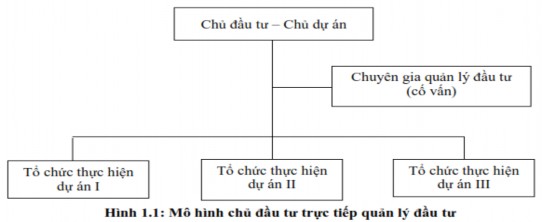
+ Form of direct investment management by the investor
Investment management in the form of direct management by the investor (project owner) is a form of management organization without specialized project management staff directly involved in project management. They are not directly responsible for the implementation and final results of the project but only play an advisory and consulting role.
Source: Vu Thanh Tu Anh (2012)
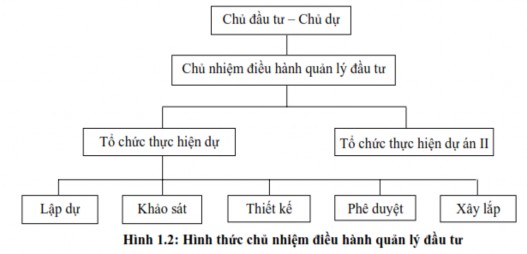
+ Investment management executive form
The organizational form of “investment management executive director” is an organizational model in which the investor assigns a specialized project management board as the executive director or hires a competent organization to operate and manage the investment and they are fully represented in all project implementation activities. The investment management executive director is an independent, competent legal entity who will be the manager, operator and responsible for the results of the entire project implementation process. All decisions of the investor on the project related to the implementing units will be implemented through the project executive director. This form
Applicable to large-scale, complex projects.
Source: Vu Thanh Tu Anh (2012)
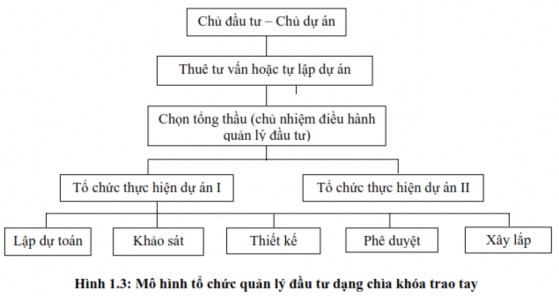
+ Turnkey form
The turnkey investment management organization model is a form of organization in which the manager is not only the full representative of the investor - project owner but also the "owner" of the project. This form is applied when the investor is allowed to bid to select a contractor to perform the entire project. They are intermediaries, accepting the contract to perform the entire investment project as if the project were their own. Unlike the form of executive director, now all responsibilities are assigned to the manager and they must take full responsibility for the implementation of the project.
Source: Vu Thanh Tu Anh (2012)