
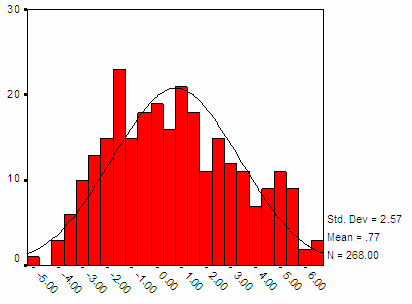
Figure 3.1: Probability distribution of discriminant scores from sample 1
Estimated results from sample 2:
Discriminant function: Z score2 = -7.625+10.09D3+1.99W1+1.63H2+4.91L9-2.97T6
Logistic distribution function:
Y2 = 1-@LOGIT(-(9.128859 + 0.042208*T6 – 8.477433*L9 - 1.492659*H2 – 13.1333*D3 -2.851907*W1))
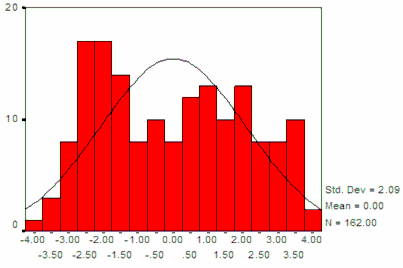
Figure 3.2: Probability distribution of the discriminant score from sample 2
Estimated results from sample 3:
Discriminant function:
Z score3 = -5.101+ 8.569D3-0.04H11+6.074L9+1.369T11
Logistic distribution function:
Y3 = 1-@LOGIT(-(0.301668 -5.383257*T11 – 1.584453*L9 – 0.125756*D3 -0.000258*H11))
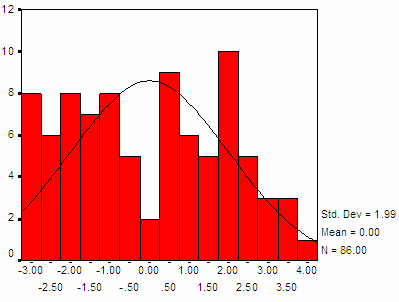
Figure 3.3: Probability distribution of discriminant scores from sample 3
Estimated results from sample 4:
Discriminant function:
Z score4 = -7.081+9.968D3+2.01W1+4.931L9-3.387T6
Logistic distribution function:
Y4 = 1-@LOGIT(-(5.122197 + 1.375133*T6 – 8.07313*L9 – 11.16904*D3 - 0.090348*W1))
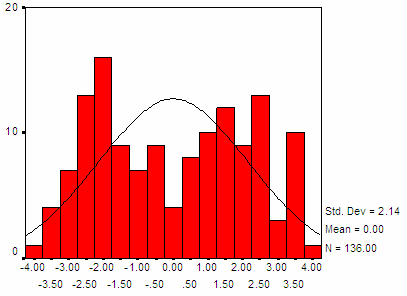
Figure 3.4: Probability distribution of discriminant scores from sample 4
Estimated results from sample 5:
Discriminant function:
Z score5 = -11.673+46.401D3+14.407H2-12.725L6+33.661L9-16.368T6+1.423T7
Logistic distribution function:
Y5 = 1-@LOGIT(-(-4.39436327*T7 + 3.247778934*T6 - 12.46452173*L9 + 5.852029625*L6 - 0.3914761718*H2 - 14.03890848*D3 + 7.398515322))
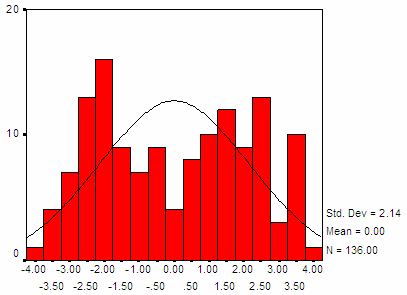
Figure 3.5: Probability distribution of discriminant scores from sample 5
Comment on estimated results
The results show that the signs of the coefficients of the independent variables in the discriminant function and the Logistic distribution function are consistent with the economic hypothesis. At the same time, it shows that the higher the Z-score, the better the businesses are evaluated. Because:
The sign of L9 in the discriminant functions is positive, so the value of this indicator increases, indicating that the profitability of equity is high and vice versa. For businesses with high profitability of equity, it shows that the turnover of equity increases, the larger L9, high revenue, low debt and effective use of working capital show that the business has very good business operations and financial situation and is at high risk of bankruptcy. Therefore, if the business can reduce total assets by reducing liabilities while maintaining scale and operating efficiency, the Z index will certainly increase significantly.
The sign of D3 in the discriminant functions is positive, the larger this ratio is and the more it tends to increase, the higher the financial initiative and the lower the risk, the higher the Z index.
The sign of T6 in the discriminant functions is negative, indicating that when T6 increases, the value of Z decreases, which is consistent with economic theory. Because the direct return rate from cash is very low. Meanwhile, the purchasing power of money always tends to decrease due to the influence of inflation. Therefore, the higher this index is, the lower it is evaluated.
The sign of T7 in the 5-discriminant function is positive, indicating that as this ratio increases, Z increases. When considering whether this ratio is positively or negatively correlated with risk, it is necessary to combine it with many other factors.
The signs of W1 in discriminant function 2, 4 and W3 in discriminant function 1 are all positive, indicating that when this ratio increases, Z will increase. Is the ratio of W1,W3 high or
Low is reasonable depending on the main business line, environment, etc. of the operating enterprise.
The sign of H2 in the discriminant function 1,2 and 5 are all positive, indicating that when this ratio increases, Z will increase. This ratio is high or low depending on the combination of many factors such as: business sector, research period, season, etc. of the enterprise.
The sign of H11 in the discriminant function 3 is negative, indicating that when this ratio increases, Z decreases, which is appropriate. Because the higher the value of this ratio, the lower the debt collection efficiency of the enterprise and the possibility of encountering bad debts.
In the Logistic distribution function, the negative signs of D3, L9, H2, T11, H11, W1 and W3 show that the influence of the ratios on the probability of a business being at risk of bankruptcy will decrease as these ratios increase. The positive signs of T6, L6 show that the influence of the ratios on the probability of a business being at risk of bankruptcy will increase as these ratios increase.
Table 3.6: Correlation matrix
Structure Matrix
Function 1 | Function 2 | Function 3 | Function 4 | Function 5 | |||||
D3 | 0.665965 | D3 | 0.785664 | D3 | 0.633984 | D3 | 0.838495 | D3 | 0.70783 |
H2 | -0.05726 | T6 | 0.065755 | T11 | 0.620085 | W1 | -0.09867 | T7 | 0.284008 |
W3 | 0.052268 | H2 | -0.06382 | S4 | -0.09344 | T6 | 0.053906 | L6 | 0.157402 |
W1 | -0.06224 | L9 | 0.008254 | L9 | -0.0016 | T6 | 0.089357 | ||
T6 | 0.036333 | L9 | 0.025746 | H2 | -0.08691 | ||||
L9 | 0.004164 | L9 | 0.037237 | ||||||
Maybe you are interested!
-

 Completing the personal credit rating model at Saigon Commercial Joint Stock Bank - 12
 -
 Internal credit rating by market segment at Vietnam Bank for Agriculture and Rural Development - 34
 -
 Bond Credit Rating System
 -
 Credit Rating Levels of Developed Economies in the 2013 - 2015 Research Data Sample
 -
 Current Status of Credit Rating of Corporate Customers at Asia Commercial Joint Stock Bank - Hue Branch
(Source of calculation from author)
Through the results in (Table 3.6) of the correlation matrix (structure matrix), the variable with a high correlation coefficient has a large impact on the discriminant function. According to this result: with discriminant function 1, D3 is the most important factor and has the largest impact on the discrimination between groups, followed by H2, W3, T6 and L9;
with discriminant function 2 respectively are D3, T6, H2 , W1 and L9; with discriminant function 3 respectively are D3, T11, H11 and L9; with discriminant function 4 respectively are D3, W1, T6 and L9; with discriminant function 5 respectively give results D3, T7, L6, T6, H2 and L9.
The discriminant fit is an estimate of a set of linear combinations of independent variables that best distinguishes differences between groups. To assess whether a discriminant fit is significant, the following pair of hypotheses can be tested:
Ho: The discriminant function is not significant H 1 : The discriminant function is significant
From the results of "Table 3.7" and using Wilks' Lambda criterion, the results are
The result rejects the null hypothesis H0 , so it can be assumed that all five discriminant functions found are suitable.
Table 3.7. Testing the suitability of the discriminant function
Wilks' Lambda
Test of Function(s) | Wilks' Lambda | Chi-square | df | Sig. |
1 | 0.193229138 | 180.0047 | 5 | 5.34E-37 |
2 | 0.228107056 | 232.77558 | 5 | 2.72E-48 |
3 | 0.248628098 | 114.12736 | 4 | 9.58E-24 |
4 | 0.216907339 | 201.73362 | 4 | 1.59E-42 |
5 | 0.232643499 | 208.52947 | 6 | 2.9E-42 |
(Source of calculation from author)
Similarly, to evaluate whether the logistic distribution function is meaningful or not, the following pair of hypotheses can be tested:
Ho: The logistic distribution function is not significant H 1 : The logistic distribution function is significant
Use the LR statistic (likelihood ratio) obtained from the agreement
The quantity of sample 1 is 126.6533; sample 2 is 141.3387; sample 3 is
111.5257; sample 4 is 115.5992; sample 5 is 170.6246 and compare with 2(df)
(df: is the number of independent variables, significance level is 5%) all give results of rejecting H 0
receive H 1 .
3.5.2. Evaluation of classification accuracy rate
From the results of the discriminant function estimates, we can make the following observations about the correct classification rate:
Table 3.8: Classification accuracy rate of discriminant function
Classification Results
Sample | Group | 0 | 1 | |||
Sample 1 | Original | Count | 0 | 56 | 1 | 57 |
1 | 1 | 56 | 57 | |||
% | 0 | 98.245614 | 1.754386 | 100 | ||
1 | 1.75438596 | 98.24561 | 100 | |||
98.2% of selected original grouped cases correctly classified. | ||||||
Sample 2 | Original | Count | 0 | 80 | 1 | 81 |
1 | 2 | 79 | 81 | |||
% | 0 | 98.7654321 | 1.234568 | 100 | ||
1 | 2.4691358 | 97.53086 | 100 | |||
98.1% of selected original grouped cases correctly classified. | ||||||
Sample 3 | Original | Count | 0 | 42 | 1 | 43 |
1 | 2 | 41 | 43 | |||
% | 0 | 97.6744186 | 2.325581 | 100 | ||
1 | 4.65116279 | 95.34884 | 100 | |||
96.5% of selected original grouped cases correctly classified. | ||||||
Sample 4 | Original | Count | 0 | 67 | 1 | 68 |
1 | 1 | 67 | 68 | |||
% | 0 | 98.5294118 | 1.470588 | 100 | ||
1 | 1.47058824 | 98.52941 | 100 | |||
98.5% of selected original grouped cases correctly classified. | ||||||
Model 5 | Original | Count | 0 | 72 | 2 | 74 |
1 | 1 | 73 | 74 | |||
% | 0 | 97.2972973 | 2.702703 | 100 | ||
1 | 1.35135135 | 98.64865 | 100 | |||
98.0% of selected original grouped cases correctly classified. | ||||||
(Source of calculation from author)
According to "Table 3.8", with discriminant function 1, the estimated classification result is 98.245614% accurate for businesses in the group with no risk of bankruptcy. With the group with risk of bankruptcy, the classification result is 98.245614%. The classification result between the 2 groups is accurate for the discriminant function is 98.2%.
With the discriminant function 2, the estimated classification accuracy is 97.6744186% for businesses in the group with no risk of bankruptcy. For the group with risk of bankruptcy, the classification accuracy is 97.53086%. The classification accuracy between the 2 groups of the discriminant function is 98.1%.
With the discriminant function 3, the estimated classification accuracy is 97.6764186% for businesses in the group with no risk of bankruptcy. For the group with risk of bankruptcy, the classification accuracy is 95.34884%. The classification accuracy between the 2 groups of the discriminant function is 96.5%.
With the discriminant function 4, the estimated classification accuracy is 98.529418% for businesses in the group with no risk of bankruptcy. For the group with risk of bankruptcy, the classification accuracy is 92.52941%. The classification accuracy between the 2 groups of the discriminant function is 98.5%.
With the discriminant function 5, the estimated classification accuracy is 97.2972% for businesses in the group with no risk of bankruptcy. For the group with risk of bankruptcy, the classification accuracy is 98.6486%. The classification accuracy between the 2 groups of the discriminant function is 98%.
Table 3.9: Calculating Eigenvalues
Eigenvalues
Function | Value | % of Variance | cumulative % | Canonical Correlation |
1 | 4.175202914 | 100 | 100 | 0.898204243 |
2 | 3.383906479 | 100 | 100 | 0.878574382 |
3 | 3.02207155 | 100 | 100 | 0.86681711 |
4 | 3.610263563 | 100 | 100 | 0.884925229 |
5 | 3.298422277 | 100 | 100 | 0.87598887 |
(Source of calculation from author)
Based on the “Canonical Correlation” in the results (Table 3.14), we see that the correlation coefficient of the discriminant function corresponding to discriminant function 1 is 0.898204243, discriminant function 2 is 0.878574382, discriminant function 3 is