
Water puppetry art, in which many typical forms with artistic and aesthetic values are exploited to serve tourism.
In addition, we must mention the traditional craft villages that have existed for a long time in this rich land such as: statue carving and lacquer painting in Bao Ha; bronze casting village in Kien Bai (Thuy Nguyen); silk weaving in Luong Quy (An Duong); wool carpet weaving in Du Hang Kenh... The rich human resources above have created unique socio-cultural characteristics of Hai Phong people, this difference has aroused the curiosity and desire to learn of tourists from many different regions and countries.
CHAPTER 1 SUMMARY
Vietnam is a country rich in festival systems, including both traditional and modern festivals. In recent years, festivals have contributed greatly to the tourism industry's budget revenue, especially the increasingly organized modern festivals that have breathed new life into the festival atmosphere nationwide. Hai Phong, in addition to its unique traditional festivals, is also blessed by nature, giving Hai Phong many rich and diverse tourism resources, which can be said to be great potentials for Hai Phong to exploit to serve tourism activities that not every locality has. The problem for the tourism industry today is how to exploit these resources in order to both preserve and maintain their true values, not damage those resources, and bring great efficiency in tourism business, ensuring to satisfy the needs of tourists, in accordance with the money they have spent. The rational exploitation of resources is not easy but not too difficult if we know their true value and have coordination between relevant sectors and levels and the participation of the community. With the current development trend of tourism festivals, the research to find a tourism festival associated with the identity, land and people of a land at the forefront of the wind and waves is one of the right suggestions, a new direction for the tourism industry of Hai Phong.
CHAPTER 2: RED POINSON FLOWER FESTIVAL IN HAI PHONG
AND THE CURRENT STATUS OF ORGANIZING THE FIRST FESTIVAL IN 2012
2.1. Premises for organizing the Hai Phong Red Flamboyant Festival
2.1.1. Current status of tourism development in Hai Phong
2.1.1.1. Management work
Hai Phong Department of Tourism (now under the Department of Culture, Sports and Tourism of Hai Phong) was established on June 3, 1994 under Decision No. 40/QD-TCCQ of the City People's Committee to perform the function of state management of tourism in the city.
With the awareness of "strong organization, good products", the Department of Tourism constantly consolidates and improves the office of the department. In 2011, the department established the department of tourism promotion and promotion, the management board of projects and tourism infrastructure. At the same time, the department always rotates and supplements qualified and capable staff to take on key positions in the agency, assigns the right people to the right jobs. The department always attaches importance to training and fostering to improve the qualifications of staff and civil servants to have extensive exposure to modern advanced science and technology, the specialized departments work together, closely coordinate to create high efficiency in work.
Hai Phong Department of Culture, Sports and Tourism currently includes the following departments:
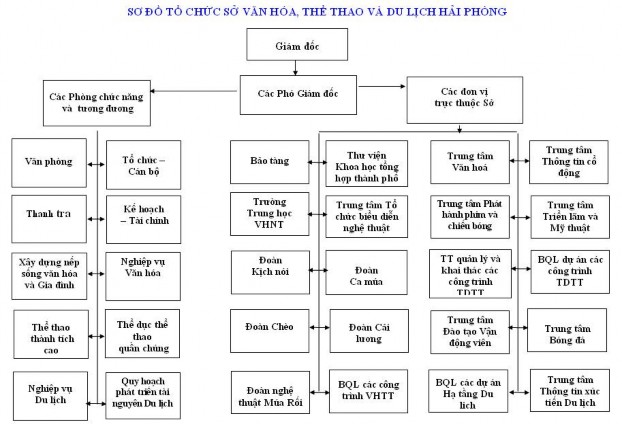
(Source: Electronic information portal of Hai Phong Department of Culture, Sports and Tourism) In which, departments such as: Cultural Affairs, Tourism Resource Development Planning, Tourism Infrastructure Project Management Board and Tourism Promotion Information Center are mainly responsible for directing Tourism. However, in order for Hai Phong tourism to change strongly in the coming time, the Department needs to increase the number of highly trained specialists and staff; need to closely manage and direct well the Departments of Culture, Sports and Tourism at District, Commune, Ward levels; as well as create friendly and supportive relationships with tourism businesses in the city; at the same time, it is necessary to develop long-term tourism development plans and strategies, in accordance with the current situation.
appropriate to the resources and tourism characteristics of Hai Phong...
2.1.1.2. Current status of accommodation and food establishments
Accommodation business:
Over the past time, with its existing position and effective exploitation of rich potential resources for tourism development, Hai Phong city has gradually affirmed itself as one of the major tourist centers of the country with many projects.
The infrastructure is built, renovated and embellished to serve tourism development and international people's life. Hai Phong's urban infrastructure changes rapidly and strongly, creating favorable conditions for socio-economic development and especially tourism activities.
Along with the current national trend, due to the increasing number of international visitors, domestic visitors have more and more demand for travel, so more hotels and motels are built to promptly meet the needs of tourists.
Hotels and motels of all economic sectors in Hai Phong are also constantly upgrading and building new ones, increasing rapidly in number, scale and method of operation.
Statistics table of accommodation establishments in Hai Phong from 2006 to 2012
2006 | 2007 | 2008 | 2009 | 2010 | 2011 | 2012 | |
Total number of storage facilities residence | 198 | 201 | 208 | 214 | 251 | 301 | 304 |
In there: 4 star hotel | 5 | 6 | 8 | 8 | 8 | 8 | 8 |
3 star hotel | 3 | 3 | 3 | 2 | 4 | 6 | 7 |
2 star hotel | 52 | 55 | 55 | 62 | 62 | 60 | 62 |
1 star hotel | 23 | 25 | 26 | 20 | 23 | 22 | 26 |
Accredited accommodation standard | 12 | 13 | 14 | 33 | 62 | 62 | 68 |
Maybe you are interested!
-
 Content and Activities of the First Hai Phong Red Flamboyant Festival – 2012
 -
 Teaching Blues to students of the electronic keyboard class at Hai Phong College of Culture, Arts and Tourism - 1
 -
 Overview of Marine Culture Associated with Tourism in Cat Hai Island District, Hai Phong
 -
 Solutions for tourism development in Tien Lang - 10
zt2i3t4l5ee
zt2a3gstourism, tourism development
zt2a3ge
zc2o3n4t5e6n7ts
- District People's Committees and authorities of communes with tourist attractions should support, promote, and provide necessary information to people, helping them improve their knowledge about tourism. Raise tourism awareness for local people.
*
* *
Due to limited knowledge and research time, the thesis inevitably has shortcomings. Therefore, I look forward to receiving guidance from teachers, experts as well as your comments to make the thesis more complete.
Chapter III Conclusion
Through the issues presented in Chapter II, we can come to some conclusions:
Based on the strengths of available tourism resources, the types of tourism in Tien Lang that need to be promoted in the coming time are sightseeing and resort tourism, discovery tourism, weekend tourism. To improve the quality and diversify tourism products, Tien Lang district needs to combine with local cultural tourism resources, at the same time combine with surrounding areas, build rich tourism products. The strengths of Tien Lang tourism are eco-tourism and cultural tourism, so developing Tien Lang tourism must always go hand in hand with restoring and preserving types of cultural tourism resources. Some necessary measures to support and improve the efficiency of exploiting tourism resources in Tien Lang are: strengthening the construction of technical facilities and labor force serving tourism, actively promoting and advertising tourism, and expanding forms of capital mobilization for tourism development.
CONCLUDE
I Conclusion
1. Based on the results achieved within the framework of the thesis's needs, some basic conclusions can be drawn as follows:
Tien Lang is a locality with great potential for tourism development. The relatively abundant cultural tourism resources and ecological tourism resources have great appeal to tourists. Based on this potential, Tien Lang can build a unique tourism industry that is competitive enough with other localities within Hai Phong city and neighboring areas.
In recent years, the exploitation of the advantages of resources to develop tourism and build tourist routes in Tien Lang has not been commensurate with the available potential. In terms of quantity, many resource objects have not been brought into the purpose of tourism development. In terms of time, the regular service time has not been extended to attract more visitors. Infrastructure and technical facilities are still weak. The labor force is still thin and weak in terms of expertise. Tourism programs and routes have not been organized properly, the exploitation content is still monotonous, so it has not attracted many visitors. Although resources have not been mobilized much for tourism development, they are facing the risk of destruction and degradation.
2. Based on the results of investigation, analysis, synthesis, evaluation and selective absorption of research results of related topics, the thesis has proposed a number of necessary solutions to improve the efficiency of exploiting tourism resources in Tien Lang such as: promoting the restoration and conservation of tourism resources, focusing on investment and key exploitation of ecotourism resources, strengthening the construction of infrastructure and tourism workforce. Expanding forms of capital mobilization. In addition, the thesis has built a number of tourist routes of Hai Phong in which Tien Lang tourism resources play an important role.
Exploiting Tien Lang tourism resources for tourism development is currently facing many difficulties. The above measures, if applied synchronously, will likely bring new prospects for the local tourism industry, contributing to making Tien Lang tourism an important economic sector in the district's economic structure.
REFERENCES
1. Nhuan Ha, Trinh Minh Hien, Tran Phuong, Hai Phong - Historical and cultural relics, Hai Phong Publishing House, 1993
2. Hai Phong City History Council, Hai Phong Gazetteer, Hai Phong Publishing House, 1990.
3. Hai Phong City History Council, History of Tien Lang District Party Committee, Hai Phong Publishing House, 1990.
4. Hai Phong City History Council, University of Social Sciences and Humanities, VNU, Hai Phong Place Names Encyclopedia, Hai Phong Publishing House. 2001.
5. Law on Cultural Heritage and documents guiding its implementation, National Political Publishing House, Hanoi, 2003.
6. Tran Duc Thanh, Lecture on Tourism Geography, Faculty of Tourism, University of Social Sciences and Humanities, VNU, 2006
7. Hai Phong Center for Social Sciences and Humanities, Some typical cultural heritages of Hai Phong, Hai Phong Publishing House, 2001
8. Nguyen Ngoc Thao (editor-in-chief, Tourism Geography, Hai Phong Publishing House, two volumes (2001-2002)
9. Nguyen Minh Tue and group of authors, Hai Phong Tourism Geography, Ho Chi Minh City Publishing House, 1997.
10. Nguyen Thanh Son, Hai Phong Tourism Territory Organization, Associate Doctoral Thesis in Geological Geography, Hanoi, 1996.
11. Decision No. 2033/QD – UB on detailed planning of Tien Lang town, Hai Phong city until 2020.
12. Department of Culture, Information, Hai Phong Museum, Hai Phong relics
- National ranked scenic spot, Hai Phong Publishing House, 2005. 13. Tien Lang District People's Committee, Economic Development Planning -
Culture - Society of Tien Lang district to 2010.
14.Website www.HaiPhong.gov.vn
APPENDIX 1
List of national ranked monuments
STT
Name of the monument
Number, year of decisiondetermine
Location
1
Gam Temple
938 VH/QĐ04/08/1992
Cam Khe Village- Toan Thang commune
2
Doc Hau Temple
9381 VH/QĐ04/08/1992
Doc Hau Village –Toan Thang commune
3
Cuu Doi Communal House
3207 VH/QĐDecember 30, 1991
Zone II of townTien Lang
4
Ha Dai Temple
938 VH/QĐ04/08/1992
Ha Dai Village –Tien Thanh commune
APPENDIX II
STT
Name of the monument
Number, year of decision
Location
1
Phu Ke Pagoda Temple
178/QD-UBJanuary 28, 2005
Zone 1 - townTien Lang
2
Trung Lang Temple
178/QD-UBJanuary 28, 2005
Zone 4 – townTien Lang
3
Bao Khanh Pagoda
1900/QD-UBAugust 24, 2006
Nam Tu Village -Kien Thiet commune
4
Bach Da Pagoda
1792/QD-UB11/11/2002
Hung Thang Commune
5
Ngoc Dong Temple
177/QD-UBNovember 27, 2005
Tien Thanh Commune
6
Tomb of Minister TSNhu Van Lan
2848/QD-UBSeptember 19, 2003
Nam Tu Village -Kien Thiet commune
7
Canh Son Stone Temple
2160/QD-UBSeptember 19, 2003
Van Doi Commune –Doan Lap
8
Meiji Temple
2259/QD-UBSeptember 19, 2002
Toan Thang Commune
9
Tien Doi Noi Temple
477/QD-UBSeptember 19, 2005
Doan Lap Commune
10
Tu Doi Temple
177/QD-UBJanuary 28, 2005
Doan Lap Commune
11
Duyen Lao Temple
177/QD-UBJanuary 28, 2005
Tien Minh Commune
12
Dinh Xuan Uc Pagoda
177/QD-UBJanuary 28, 2005
Bac Hung Commune
13
Chu Khe Pagoda
177/QD-UBJanuary 28, 2005
Hung Thang Commune
14
Dong Dinh
2848/QD-UBNovember 21, 2002
Vinh Quang Commune
15
President's Memorial HouseTon Duc Thang
177/QD-UBJanuary 28, 2005
NT Quy Cao
Ha Dai Temple
Ben Vua Temple
Tien Lang hot spring
div.maincontent .p { color: black; font-family:"Times New Roman", serif; font-style: normal; font-weight: normal; text-decoration: none; font-size: 14pt; margin:0pt; } div.maincontent p { color: black; font-family:"Times New Roman", serif; font-style: normal; font-weight: normal; text-decoration: none; font-size: 14pt; margin:0pt; } div.maincontent .s1 { color: black; font-family:"Times New Roman", serif; font-style: normal; font-weight: normal; font-size: 16pt; } div.maincontent .s2 { color: black; font-family:"Times New Roman", serif; font-style: italic; font-weight: bold; text-decoration: none; font-size: 14pt; } div.maincontent .s3 { color: black; font-family:"Times New Roman", serif; font-style: italic; font-weight: normal; text-decoration: none; font-size: 14pt; } div.maincontent .s4 { color: black; font-family:"Times New Roman", serif; font-style: normal; font-weight: normal; font-size: 14pt; } div.maincontent .s5 { color: black; font-family:"Times New Roman", serif; font-style: normal; font-weight: bold; font-size: 14pt; } div.maincontent .s6 { color: black; font-family:"Times New Roman", serif; font-style: normal; font-weight: normal; text-decoration: none; font-size: 14pt; } div.maincontent .s7 { color: black; font-family:"Times New Roman", serif; font-style: normal; font-weight: bold; text-decoration: none; font-size: 14pt; } div.maincontent .s8 { color: black; font-family:"Times New Roman", serif; font-style: normal; font-weight: normal; text-decoration: none; font-size: 9pt; vertical-align: 6pt; } div.maincontent .s9 { color: black; font-family:"Times New Roman", serif; font-style: normal; font-weight: bold; text-decoration: none; font-size: 12pt; } div.maincontent .s11 { color: black; font-family:"Times New Roman", serif; font-style: normal; font-weight: normal; tex
Solutions for tourism development in Tien Lang - 10
zt2i3t4l5ee
zt2a3gstourism, tourism development
zt2a3ge
zc2o3n4t5e6n7ts
- District People's Committees and authorities of communes with tourist attractions should support, promote, and provide necessary information to people, helping them improve their knowledge about tourism. Raise tourism awareness for local people.
*
* *
Due to limited knowledge and research time, the thesis inevitably has shortcomings. Therefore, I look forward to receiving guidance from teachers, experts as well as your comments to make the thesis more complete.
Chapter III Conclusion
Through the issues presented in Chapter II, we can come to some conclusions:
Based on the strengths of available tourism resources, the types of tourism in Tien Lang that need to be promoted in the coming time are sightseeing and resort tourism, discovery tourism, weekend tourism. To improve the quality and diversify tourism products, Tien Lang district needs to combine with local cultural tourism resources, at the same time combine with surrounding areas, build rich tourism products. The strengths of Tien Lang tourism are eco-tourism and cultural tourism, so developing Tien Lang tourism must always go hand in hand with restoring and preserving types of cultural tourism resources. Some necessary measures to support and improve the efficiency of exploiting tourism resources in Tien Lang are: strengthening the construction of technical facilities and labor force serving tourism, actively promoting and advertising tourism, and expanding forms of capital mobilization for tourism development.
CONCLUDE
I Conclusion
1. Based on the results achieved within the framework of the thesis's needs, some basic conclusions can be drawn as follows:
Tien Lang is a locality with great potential for tourism development. The relatively abundant cultural tourism resources and ecological tourism resources have great appeal to tourists. Based on this potential, Tien Lang can build a unique tourism industry that is competitive enough with other localities within Hai Phong city and neighboring areas.
In recent years, the exploitation of the advantages of resources to develop tourism and build tourist routes in Tien Lang has not been commensurate with the available potential. In terms of quantity, many resource objects have not been brought into the purpose of tourism development. In terms of time, the regular service time has not been extended to attract more visitors. Infrastructure and technical facilities are still weak. The labor force is still thin and weak in terms of expertise. Tourism programs and routes have not been organized properly, the exploitation content is still monotonous, so it has not attracted many visitors. Although resources have not been mobilized much for tourism development, they are facing the risk of destruction and degradation.
2. Based on the results of investigation, analysis, synthesis, evaluation and selective absorption of research results of related topics, the thesis has proposed a number of necessary solutions to improve the efficiency of exploiting tourism resources in Tien Lang such as: promoting the restoration and conservation of tourism resources, focusing on investment and key exploitation of ecotourism resources, strengthening the construction of infrastructure and tourism workforce. Expanding forms of capital mobilization. In addition, the thesis has built a number of tourist routes of Hai Phong in which Tien Lang tourism resources play an important role.
Exploiting Tien Lang tourism resources for tourism development is currently facing many difficulties. The above measures, if applied synchronously, will likely bring new prospects for the local tourism industry, contributing to making Tien Lang tourism an important economic sector in the district's economic structure.
REFERENCES
1. Nhuan Ha, Trinh Minh Hien, Tran Phuong, Hai Phong - Historical and cultural relics, Hai Phong Publishing House, 1993
2. Hai Phong City History Council, Hai Phong Gazetteer, Hai Phong Publishing House, 1990.
3. Hai Phong City History Council, History of Tien Lang District Party Committee, Hai Phong Publishing House, 1990.
4. Hai Phong City History Council, University of Social Sciences and Humanities, VNU, Hai Phong Place Names Encyclopedia, Hai Phong Publishing House. 2001.
5. Law on Cultural Heritage and documents guiding its implementation, National Political Publishing House, Hanoi, 2003.
6. Tran Duc Thanh, Lecture on Tourism Geography, Faculty of Tourism, University of Social Sciences and Humanities, VNU, 2006
7. Hai Phong Center for Social Sciences and Humanities, Some typical cultural heritages of Hai Phong, Hai Phong Publishing House, 2001
8. Nguyen Ngoc Thao (editor-in-chief, Tourism Geography, Hai Phong Publishing House, two volumes (2001-2002)
9. Nguyen Minh Tue and group of authors, Hai Phong Tourism Geography, Ho Chi Minh City Publishing House, 1997.
10. Nguyen Thanh Son, Hai Phong Tourism Territory Organization, Associate Doctoral Thesis in Geological Geography, Hanoi, 1996.
11. Decision No. 2033/QD – UB on detailed planning of Tien Lang town, Hai Phong city until 2020.
12. Department of Culture, Information, Hai Phong Museum, Hai Phong relics
- National ranked scenic spot, Hai Phong Publishing House, 2005. 13. Tien Lang District People's Committee, Economic Development Planning -
Culture - Society of Tien Lang district to 2010.
14.Website www.HaiPhong.gov.vn
APPENDIX 1
List of national ranked monuments
STT
Name of the monument
Number, year of decisiondetermine
Location
1
Gam Temple
938 VH/QĐ04/08/1992
Cam Khe Village- Toan Thang commune
2
Doc Hau Temple
9381 VH/QĐ04/08/1992
Doc Hau Village –Toan Thang commune
3
Cuu Doi Communal House
3207 VH/QĐDecember 30, 1991
Zone II of townTien Lang
4
Ha Dai Temple
938 VH/QĐ04/08/1992
Ha Dai Village –Tien Thanh commune
APPENDIX II
STT
Name of the monument
Number, year of decision
Location
1
Phu Ke Pagoda Temple
178/QD-UBJanuary 28, 2005
Zone 1 - townTien Lang
2
Trung Lang Temple
178/QD-UBJanuary 28, 2005
Zone 4 – townTien Lang
3
Bao Khanh Pagoda
1900/QD-UBAugust 24, 2006
Nam Tu Village -Kien Thiet commune
4
Bach Da Pagoda
1792/QD-UB11/11/2002
Hung Thang Commune
5
Ngoc Dong Temple
177/QD-UBNovember 27, 2005
Tien Thanh Commune
6
Tomb of Minister TSNhu Van Lan
2848/QD-UBSeptember 19, 2003
Nam Tu Village -Kien Thiet commune
7
Canh Son Stone Temple
2160/QD-UBSeptember 19, 2003
Van Doi Commune –Doan Lap
8
Meiji Temple
2259/QD-UBSeptember 19, 2002
Toan Thang Commune
9
Tien Doi Noi Temple
477/QD-UBSeptember 19, 2005
Doan Lap Commune
10
Tu Doi Temple
177/QD-UBJanuary 28, 2005
Doan Lap Commune
11
Duyen Lao Temple
177/QD-UBJanuary 28, 2005
Tien Minh Commune
12
Dinh Xuan Uc Pagoda
177/QD-UBJanuary 28, 2005
Bac Hung Commune
13
Chu Khe Pagoda
177/QD-UBJanuary 28, 2005
Hung Thang Commune
14
Dong Dinh
2848/QD-UBNovember 21, 2002
Vinh Quang Commune
15
President's Memorial HouseTon Duc Thang
177/QD-UBJanuary 28, 2005
NT Quy Cao
Ha Dai Temple
Ben Vua Temple
Tien Lang hot spring
div.maincontent .p { color: black; font-family:"Times New Roman", serif; font-style: normal; font-weight: normal; text-decoration: none; font-size: 14pt; margin:0pt; } div.maincontent p { color: black; font-family:"Times New Roman", serif; font-style: normal; font-weight: normal; text-decoration: none; font-size: 14pt; margin:0pt; } div.maincontent .s1 { color: black; font-family:"Times New Roman", serif; font-style: normal; font-weight: normal; font-size: 16pt; } div.maincontent .s2 { color: black; font-family:"Times New Roman", serif; font-style: italic; font-weight: bold; text-decoration: none; font-size: 14pt; } div.maincontent .s3 { color: black; font-family:"Times New Roman", serif; font-style: italic; font-weight: normal; text-decoration: none; font-size: 14pt; } div.maincontent .s4 { color: black; font-family:"Times New Roman", serif; font-style: normal; font-weight: normal; font-size: 14pt; } div.maincontent .s5 { color: black; font-family:"Times New Roman", serif; font-style: normal; font-weight: bold; font-size: 14pt; } div.maincontent .s6 { color: black; font-family:"Times New Roman", serif; font-style: normal; font-weight: normal; text-decoration: none; font-size: 14pt; } div.maincontent .s7 { color: black; font-family:"Times New Roman", serif; font-style: normal; font-weight: bold; text-decoration: none; font-size: 14pt; } div.maincontent .s8 { color: black; font-family:"Times New Roman", serif; font-style: normal; font-weight: normal; text-decoration: none; font-size: 9pt; vertical-align: 6pt; } div.maincontent .s9 { color: black; font-family:"Times New Roman", serif; font-style: normal; font-weight: bold; text-decoration: none; font-size: 12pt; } div.maincontent .s11 { color: black; font-family:"Times New Roman", serif; font-style: normal; font-weight: normal; tex -
 Exploiting the cultural value of Hang Kenh communal house - Hai Phong to serve tourism development - 1
(Source: Department of Culture, Sports and Tourism of Hai Phong)
Thus, in the period 2006 - 2012, the number of tourist accommodation establishments in Hai Phong increased by 1.5 times, of which the number of qualified accommodation establishments increased by 5.6 times. This shows that the tourism infrastructure system in Hai Phong has also been invested in, upgraded, supplemented and repaired. Besides, there are still many accommodation establishments that do not meet the standards and are mainly 2-star hotels.
large number. Therefore, tourism developers as well as city leaders need to have plans and strategies to develop the city's accommodation system to become more modern and luxurious, and build large-scale hotels that meet 5-star international standards to serve the city's tourism development.
Dining facilities:
The system of dining establishments in Hai Phong is quite diverse and rich. Most hotels, motels, and guesthouses have dining establishments to serve tourists as well as the daily needs of local people. Hai Phong's specialty restaurants are mainly concentrated in the inner city, Do Son and Cat Ba tourist areas. As a coastal city, Hai Phong has many types of seafood, so the cuisine here also has a strong sea flavor. From rustic crab noodle soup to grilled geoduck specialty dishes, all give visitors an unforgettable impression of the culinary characteristics of local people in Hai Phong, combining simplicity and high quality. Seafood in Hai Phong is diverse in types such as geoduck, sea cucumber, sea snail, mantis shrimp, striped shrimp, tuna, cobia... so visitors can enjoy them as they like and give them as gifts after each tour.
2.1.1.3. Entertainment facilities
In the whole country in general and Hai Phong in particular, entertainment and sports facilities are still relatively poor. That is one of the reasons why tourists cannot stay long term. Tourists coming to Hai Phong, besides swimming and sightseeing, also have a lot of free time.
Currently, the city has nearly 60 large entertainment facilities and dozens of small and medium-sized ones. Entertainment facilities that are attracting tourists are: Do Son Casino entertainment area; Hon Dau Island entertainment area; the city center park area...
Currently, the environmental quality at the city's central tourist attractions has been improved, the social order and safety environment is guaranteed, and the quality of services is increasingly improved. However, to leave a deep impression on visitors and keep them coming back next time, the
Cultural factors need to be given more attention in the structure of tourism products to create products with great appeal.
2.1.1.4. Means of transport
Compared to before, the quality and form of means of transport in the city have been significantly improved, with relatively modern and synchronous equipment to ensure the requirements of serving domestic and international tourists. In the city, there are currently nearly 30 taxi companies with hundreds of vehicles that are considered to be of good quality. The team of drivers has been trained to have a fairly professional service style, but still has limitations in tourism and foreign language skills.
Currently, the number of boats and cars has temporarily met the needs of the people and tourists. However, these means of transport have been degraded, do not ensure service quality, and the service staff has not been trained in basic skills to serve tourists.
In general, in recent years, the infrastructure and technical facilities serving Hai Phong tourism have been invested to develop strongly, which is an important driving force to attract tourism investment from economic sectors, diversify tourism products, and maximize the spending of tourists. However, for Hai Phong tourism to really take off, there needs to be stronger investment as well as the participation of all sectors and organizations.
2.1.1.5. Tourism promotion and propaganda work
Before 2000, Hai Phong's tourism promotion work was not focused on, the promotion content was poor, and the promotion time was short. Hai Phong's image rarely appeared in the mass media, but only stopped at compiling books and brochures introducing Hai Phong tourism, participating in some tourism fairs. Hai Phong tourism was not proactive in advising and proposing to organize major tourism events, and businesses introducing their activities did not have unified direction, focusing on promoting tourism. Therefore, tourism promotion work during this period was not very effective. To overcome this situation, the Department of Tourism Promotion under the Department of Culture, Sports and Tourism was established.
Sports and Tourism was established. Promotion is considered one of the top key tasks for tourism development.
Tourism promotion and propaganda work is carried out in many forms: regularly coordinating with Hai Phong Radio and Television Station, Vietnam Television Station (VTV1 and VTV4) to produce news and reports promoting Hai Phong tourism, maintaining websites about Hai Phong tourism, publishing Hai Phong Tourism News once a month, creating CDs introducing images and songs about Hai Phong, coordinating with districts in the city to organize events at many tourist-cultural destinations to attract and serve tourists; coordinating with domestic and foreign provinces and cities to organize tourism culinary fairs... However, in order for Hai Phong tourism's image to reach more widely to domestic and international friends, the tourism industry needs to increase participation in congresses, events and tourism promotion in major cities in the country such as Hanoi, Quang Ninh, Da Nang, Hue, Lam Dong, Ho Chi Minh City; or in major foreign tourist centers, first of all in regional markets such as Southeast Asia, Northeast Asia...
In short, although Hai Phong has abundant natural resources, relatively developed infrastructure, and technical facilities for tourism have received investment attention. However, Hai Phong tourism has not really developed commensurate with its potential. One of the main reasons is that Hai Phong tourism products are still poor, monotonous, lacking typical tourism products with Hai Phong's own identity. And that is one of the challenges for Hai Phong tourism professionals to find a new direction for Hai Phong tourism products.
2.1.2. Experience from flower festivals around the world
In the world, Flower Festival has long been no longer a strange noun. With the purpose of honoring the beauty of flowers as well as introducing the cultural identity of their country, many places in the world have successfully organized famous flower festivals. It is also an opportunity for domestic and international tourists to
flock to admire the beauty of flowers with their own eyes, and enjoy and explore unique and characteristic tourism products that are not available everywhere.
When talking about flower festivals, people often mention the following 10 typical flower festivals:
1. Floriade Flower Festival - Netherlands
The Netherlands is known as a city of brilliant flowers, so every year it often organizes special flower festivals, aiming to attract tourists as well as promote the country's high-quality flower resources to the world market. But if talking about the most typical and attractive flower festival, we cannot ignore the Floriade flower festival, which is held only once every 10 years. The flower fair is held on a 65-hectare campus with immense and colorful flower fields. Participating in the Floriade Festival, visitors will enjoy a space filled with fresh flowers, plants, vegetables, fruits... arranged like beautiful works of art.
2. Feria de las Flores Flower Festival - Medellin, Colombia
Medellin is the flower capital of Colombia, a country that supplies 70% of the flowers in the United States. Medellin's flower festival, Feria de las Flores, began in the mid-1950s as a way to promote the region's flower growers. Running from June 28 to August 7, Feria de las Flores attracts more and more visitors each year to see the flowers in bloom. Today, Feria de las Flores has become a large-scale festival, with the main event being a week-long parade of flower sculptures called Silletas that takes place around the city.
3. Madeira Festival - Funchal, Portugal
Madeira Island is ablaze with colour when the flower festival is held every year about two weeks after Easter in the capital Funchal (April or May every year).