
3.1.2 Business lines and locations
- Main business lines of the company:
+/ Rubber planting and processing. Liquidation of rubber tree gardens.
+/ Buying, selling, importing and exporting all kinds of rubber latex.
+/ Exploitation and processing of rubber wood.
+/ Livestock and poultry farming.
+/ Planting and caring for forests.
+/ Production of fertilizers and nitrogen compounds
+/Trade and commerce.
+/ Road bridge construction.
+/ Investment in construction of industrial and civil works inside and outside industrial parks; civil and industrial construction.
According to the company's financial report for 2015 and the first 6 months of 2016, the company's revenue includes the following areas: Selling finished rubber products, selling land in Cao Dong Phu residential area, selling rubber seedlings, trading industrial park infrastructure, selling liquidated rubber trees, selling cattle and providing services. In which, revenue from selling finished rubber products is the company's main source of revenue.
- Business location:
Rubber gardens are concentrated in Dong Phu district, Binh Phuoc province; some are in Dong Xoai town, Binh Phuoc and Phu Giao district, Binh Duong province.
Rubber garden area under the management of 6 farms: An Binh Rubber Farm, Tan Lap Rubber Farm, Tan Loi Rubber Farm, Tan Thanh Rubber Farm, Thuan Phu Rubber Farm, Tan Hung Rubber Farm
With two processing plants with modern technology from Malaysia and the Federal Republic of Germany:
- Tan Lap latex processing factory: Specializes in producing Latex (cream) with a capacity of 6,000 tons/year. Advanced technology from Wesftalia Group (Germany). The factory's products include Latex HA and Latex LA.
- Thuan Phu latex processing factory: Specializes in producing latex blocks SVR L, SVR 3 L, SVR 10, SVR 20, SVRCV 50, SVRCV 60. Advanced technology from Malaysia. Capacity 16,000 tons/year.
- The main business locations of the Company's products are as follows:
+ Rubber latex: traditional customers are the world's leading tire manufacturing corporations such as Michelin, Mitsubishi, .. and Safic Alcan, Tea Young corporations... With nearly 86% of total products of Dong Phu Rubber Joint Stock Company being exported directly to countries such as: France, Belgium, Netherlands, UK, Spain, Korea, Australia, USA, New Zealand, Canada, Singapore, Taiwan, China, Japan... In addition, it is also sold domestically to trading and manufacturing companies throughout the country.
+ Rubber wood: Sold mainly to wood processing companies in the Southeast provinces such as Binh Phuoc, Binh Duong, Tay Ninh, Dong Nai and Ho Chi Minh City.
3.1.3 Major shareholders
According to the financial report of the second quarter of 2016, DPR has a fairly concentrated shareholder structure with 55.81% held by the Vietnam Rubber Industry Group, in addition to 2 other major shareholders: the Halley Sicav - Halley Asian Prosperity investment fund holding about 8% and the PYN Elite Fund (Non-UCITS) holding about 6%, the rest are other shareholders. Currently, the Vietnam Rubber Industry Group is providing professional support and business operations for DPR.
Version 3.1: Collar diagram of Don Pu Rubber Joint Stock Company
STT
Name of the pedestal | Capital contribution (VND) | Number of shares | Capital contribution ratio | |
1 | Vietnam Rubber Industry Group Male | 240,000,000,000 | 24,000,000 | 55.81% |
2 | Other shareholders | 161,247,900,000 | 16,124,790 | 37.50% |
3 | Treasury stock | 28,752,100,000 | 2,875,210 | 6.69% |
ADD | 430,000,000,000 | 43,000,000 | 100% | |
Maybe you are interested!
-
 Factors Affecting Business Performance of Meiko Trading and Construction Company Limited
 -
 Some Factors Affecting the Quality of Short-Term Loan Services for Business Customers of Commercial Banks
 -
 Factors Affecting the Principle of Business Prudence
 -
 Factors Affecting Credit Activities for Business
 -
 Accounting determines business performance at Thanh Son Company Limited and factors affecting the effectiveness of this accounting work - 21
(Source: Audited financial report of Q2/2016 of Cao Corporation)
Su Dong Phu)
Also according to the financial report of the second quarter of 2016 of Dong Phu Rubber Joint Stock Company, the company currently has 05 subsidiaries in fields closely related to the operating area and business lines of the parent company. From here, it can be seen that the company's development policy is very focused on the business line and taking advantage of existing advantages to solve short-term difficulties as well as to strengthen long-term development potential.
Version 3.2: List of subsidiaries of Don Pu Rubber Joint Stock Company
STT
Subsidiary name | The place of establishment and activities | Profit rate benefit | Expression rate decide | Neurological activity main business | |
1 | Dong Phu Dak Rubber Joint Stock Company Farming | Dak Nong Province | 88.41% | 88.41% | Look for mining and product processing from rubber |
2 | Joint Stock Company Bac Dong Phu Industry | Binh Phuoc Province | 51% | 51% | Industrial Park Infrastructure Business |
3 | Technical Rubber Joint Stock Company Dong Phu Art | Binh Province Blessing | 76.83% | 76.83% | High mattress production su |
4 | Dong Phu Kratie Rubber Joint Stock Company | Binh Phuoc Province | 55.81% | 55.81% | Planting, exploiting and processing products from rubber |
5 | Wood Joint Stock Company Dong Phu | Binh Province Blessing | 52% | 52% | Wood processing |
(Source: Audited financial report of Q2/2016 of Cao Corporation)
Su Dong Phu)
3.1.4 Development orientation:
According to the 2015 Annual Report of Dong Phu Rubber Joint Stock Company, the company's development orientation includes:
- Overcome difficulties caused by the global economic crisis, utilize all resources to continue investing on schedule in projects that the company has implemented, especially the rubber planting project in the Kingdom of Cambodia.
+/ Consolidate and complete Dong Phu - Kratie Rubber Joint Stock Company (In Kratie province, Kingdom of Cambodia with current charter capital of 900 billion VND, scale of 9,000 hectares, of which rubber area will be about 6,300 hectares, the company's capital contribution is 54.09% of charter capital.
+/ Consolidate and find solutions to expand the area of rubber development project in Cu Jut district, Dak Nong province, with a total planned area of about 4,000 hectares. Due to many reasons, the planned area has now been reduced to only about 1,253 hectares. Currently, Dong Phu - Dak Nong Rubber Joint Stock Company has been established with a charter capital of 120 billion VND, of which Dong Phu Rubber Joint Stock Company holds 88.41% of the charter capital. Despite many difficulties, the project has so far planted 935 hectares.
+/ Participate in investing in Sa Thay Rubber Joint Stock Company (in Kon Tum province), with a charter capital of 740 billion VND, a scale of 10,000 hectares of rubber, in which the company contributes 10% of the charter capital.
- Strengthen research to invest in in-depth development to ensure stable and sustainable development such as: promoting intensive cultivation to increase productivity of orchards on existing areas, developing a reasonable liquidation and replanting plan to both have a new high-yield seedling orchard structure to inherit and stabilize revenue and profit for shareholders.
In the current low rubber latex price, focus on research and have solutions to reduce investment costs for replanting and basic construction gardens. At the same time, have appropriate measures to change the tapping regime for exploited gardens, strongly shift to tapping at a low pace to save on living labor costs to reduce product prices and solve the labor shortage.
- Continue to consolidate and improve production, strengthen marketing activities to develop Dong Phu Technical Rubber Joint Stock Company with a charter capital of 180 billion VND, in which the company contributes 76.83% of the charter capital, specializing in the production of consumer goods (mattresses, pillows, etc.) from the company's latex raw materials, to increase profits for the company and diversify products from the main production and business tasks, gradually reducing the export rate of raw materials. Every year, this factory will consume about 3,000 tons of dry latex from Dong Phu Rubber Joint Stock Company.
- Continue to develop Bac Dong Phu Industrial Park Investment Joint Stock Company with a charter capital of 100 billion VND on the basis of association with Nam Tan Uyen Industrial Park Joint Stock Company. Dong Phu Rubber Joint Stock Company contributes 51% of the charter capital. The main task is to deploy investment and business in Bac Dong Phu Industrial Park with a scale of nearly 190 hectares and invest in residential areas in Dong Xoai town, Binh Phuoc province with a total area of about 50 hectares.
- Strengthening the support of Dong Phu Wood Joint Stock Company, charter capital of 50 billion VND, the Company contributes 52% of the charter capital. The main task is to bring added value on the basis of processing, producing semi-finished blanks and producing household appliances from liquidated rubber wood of Dong Phu Rubber Joint Stock Company and some other units in the region. Increasing the source of raw materials for the company as well as continuing to strengthen the marketing, sales and diversifying designs to increase product consumption and diversify the market.
Through the plan in the annual report, it can be seen that the company has persistently expanded the rubber planting area despite the impact of the decrease in world rubber prices in recent years. In addition, it has begun to tend to process finished products instead of exporting raw materials as before, as well as looking for new sources of revenue to limit the impact of the decrease in natural rubber prices.
3.2. Analyze factors affecting business and Don Pu Rubber Joint Stock Company.
According to the consolidated financial statements of Dong Phu Rubber Joint Stock Company in 2014 and 2015, the revenue structure of DPR in the last 2 years is shown in the chart below.
2014 Board Structure
2015 Board Structure
Service Provider 0.33%
Industrial park infrastructure business 0.43%
Liquidation of rubber garden
11%
Wall
Liquidation of rubber garden 7%
Provide
service 9%
Industrial park infrastructure business 1%
Other 4%
Wall
rubber products 89%
high quality
79%
Chart 3.1: Union structure in 2014, 2015
(Source: Financial report of Dong Phu Rubber Joint Stock Company 2014-2015)
As presented, the revenue structure of Dong Phu Rubber Joint Stock Company focuses on semi-finished rubber products. Although there is a decrease in the structure ratio from 2014 to 2015, the development plan presented clearly shows the focus on the natural rubber production industry of the company. As presented above, we can see the orientation of focusing on developing the core business area. The change in the structure in 2015 can be explained by the decrease in rubber prices, so it temporarily affects the revenue structure but does not affect the long-term trend. Therefore, within the framework of the thesis, the author focuses on analyzing the impact on the natural rubber industry, which is the impact on the main revenue of Dong Phu Rubber Joint Stock Company.
3.2.1. Natural rubber industry
With the characteristics of raw material exploitation industry, the main factors affecting companies in the natural rubber industry in Vietnam are: rubber selling price and consumption output. These two factors are affected by many factors, including: Rubber supply, Demand for production of rubber-related products (mainly
mainly tires), exchange rates and import taxes (due to production mainly for export to markets with large consumption needs), world oil prices (affecting the demand for synthetic rubber), in addition, as an agricultural production industry, it is heavily affected by natural disasters and climate change.
3.2.1.1. Life cycle of rubber trees and impact on supply
The life cycle of a rubber tree can be divided into three stages.
- Basic construction phase (from 5-7 years): Time to care for rubber trees to grow, during this phase rubber cannot be harvested.
- Exploitation stage (about 20 years): From the 7th year, rubber trees can start to be exploited, tree productivity increases gradually and peaks during the 15-17 year growth period, after which the tree's productivity gradually decreases.
- Liquidation stage: When rubber tree productivity drops to a low level and exploitation is no longer effective, rubber plantations will be liquidated for timber. This liquidation usually takes place after 20 years of rubber latex exploitation (trees grow for about 27 years).
With the growth and exploitation phase of rubber being quite long, optimism about prices and profits during the rubber tree planting and care phase will cause a large supply imbalance when the time comes to start harvesting rubber.
Through the graph reflecting the relationship between rubber price growth and rubber planting area below, it can be seen that the growth in new planting area in the period 2005-2008 and 2010-2012 is the cause of the large oversupply and the sharp decrease in rubber price in the period 2011 to present. It is the lesson from the sudden decrease in rubber price that in the following periods, it can be assumed that the growth rate of new rubber planting area will be stable and a large oversupply will be unlikely to occur in the near future.
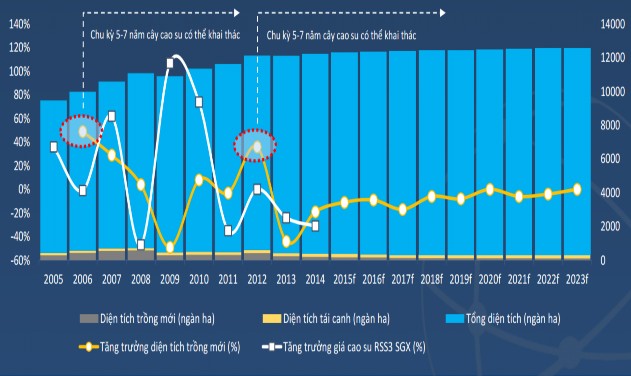
Chart 3.2: Relationship between rubber area growth and price growth
world rubber
(Source: www.blooberg.com)
Currently, to cope with the situation of falling rubber prices, the International Tripartite Rubber Council (ITRC), consisting of the world's three leading rubber producing countries, Thailand, Indonesia and Malaysia, has continuously announced a reduction in rubber export output. Specifically, Indonesia, Thailand and Malaysia will reduce exports by a total of 700,000 tons in 2016. To cope with the situation of oversupply pushing rubber prices to rock bottom, in February 2016, the three countries agreed to cut exports of 615,000 tons of natural rubber for 6 months from March to August, of which Indonesia agreed to cut 238,736 tons, Malaysia and Thailand committed to cut 52,259 tons and 324,005 tons respectively. Indonesia, Thailand and Malaysia supply 67% of the world's natural rubber. In addition to cutting exports, countries also agreed to increase domestic consumption of natural rubber through infrastructure construction projects to help reduce rubber inventories and improve prices soon.