
Introduce and highlight the traditional and historical cultural features of the tourist attraction.
Tour guides need to orient their thoughts and perceptions in a comprehensive and objective manner, avoiding misinterpretations of the meaning and value of the tourist attraction. Before arriving at the tourist attraction, tour guides need to introduce general information about the tourist attraction and can state the outstanding values of the tourist attraction.
Method of determining the observation position of the visiting object
- Location of implementation
At historical and cultural sites, tour guides can easily find a convenient viewing position for the group so that they can observe the visitors from many different angles and positions.
However, at some historical and cultural tourist sites, the location is near the road or densely populated areas, with many people passing by. Therefore, the tour guide needs to choose a suitable standing position to ensure the safety of life and property for the members of the tour group and not obstruct the common path.
- How to do it
At historical sites, tour guides can easily choose the ideal distance for the group to observe the visitors, which is the distance from the observer equal to twice the height of the visitor. However, for some visitors, the tour guide cannot choose the above distance but only chooses a relative distance. Because this choice also depends on the geographical location and height of the observed object.
Tour guide method
The tour guide will guide the group through the tour in a closed sequence from outside to inside the tourist attraction according to the following two basic contents.
- Review instructions
For historical and cultural sites, tour guides have very favorable conditions in finding good observation positions for the group to help visitors observe. In addition to guiding visitors to observe the entire image of the object of visit, tour guides also have the opportunity to guide visitors to observe each line and unique detail of the object of visit.
- Explanation
Tour guides can combine the use of one of the following methods of presentation:
as presented in the general method section. The content of the explanation needs to be detailed and specific to highlight the value of the attraction. The tour guide needs to explain in the following order of information.
The name of the tourist attraction or object of interest as well as the meaning of the tourist attraction.
+ Geographical location, landscape, scale of the attraction.
+ People who have contributed to the construction.
+ Architecture.
+ The value of the tourist attraction in terms of history and culture.
At each tourist attraction, the tour guide needs to provide information highlighting historical events associated with the attractions, including:
+ Origin of historical events.
+ The course of events.
+ Remaining relics and evidence of history.
+ Historical figures, backgrounds, careers associated with visitors and their influence on social life at the tourist destination.
+ Stories and anecdotes related to the subject of the tour.
The tour guide summarizes the content of the entire site and highlights the theme of the tour and information on restoration, conservation and embellishment of the monument at the last location in the tour program of that monument.
Moving Guide Method
Tour guides can combine two methods of movement to help visitors observe the object of interest best: moving from far to near, moving around the object of interest so that visitors have the opportunity to admire the beauty of the object of interest from many different angles.
At the natural tourist spot
Natural tourist attractions are places with vast, majestic natural beauty, wide and open spaces. Natural tourist attractions are very suitable for sightseeing, entertainment, sports or resort activities.
Method of determining the observation position of the visiting object
- Location of implementation
At natural tourist attractions, tour guides should choose a position with a general view.
The object of interest can be viewed from a high or distant position. Because natural objects are often large in area. If standing close, the visitor will have limited vision and cannot fully appreciate its beauty.
- Implementation distance
The viewing distance from the tourist group to the tourist attraction is often far or higher than the group's standing position. Because the tourist object is naturally large and spread out, the tour guide has little opportunity to choose the ideal distance. The tour guide should choose a distance so that the tourist can observe the entire tourist object.
Tour guide method
- Review instructions
Tour guides should use the method of instructing visitors to observe the object of interest without explaining. For natural tourist attractions, many places have beautiful natural scenery that attracts visitors. To improve the effectiveness of the tour guide process, tour guides should use the method of instructing visitors to stop without explaining about the object for a short period of 5 to 7 minutes so that visitors can feel the beauty of nature and enjoy the open space here. After that, the tour guide will explain about the object of interest.
- Explanation
Overview of the natural environment of the tourist destination.
Geographical location.
Terrain.
Weather, climate.
Flora and fauna and valuable resources of the site.
The natural resource value of a tourist destination includes natural landscapes and human landscapes serving the tourism business.
Cultural and historical values of residential areas where tourist attractions are located.
+ Customs
Regional festivals
Traditional craft villages.
Specialty dishes.
Art forms
Historical sites.
During the explanation, the tour guide can tell funny stories or personal experiences related to the trip to encourage the spirit or motivate guests to overcome the difficulties of the tour.
Moving Guide Method
Because the terrain at natural sites is much more complicated than at historical sites. Tour guides must guide the group on how to move at these sites to ensure the safety of the group members. Tour guides are always the first to guide guests through obstacles on the road. Tour guides need to move slowly to ensure that all members of the group can participate well in the tour and keep up with the guide. During the move, the tour guide can choose suitable locations for the group to stop and rest and to guide guests to consider the objects of the tour.
PART 2: PRACTICE GUIDE
1. Practice instruction sheet
PRACTICE INSTRUCTION SHEET
JOB | 1/B3/M D1 | |||
Step job | Content | Technical requirements | Tools and equipment | Note |
1 | Step 1. Inform the tour group accurately about the tour information to ensure the content, | Visiting times, reminders and correct viewing | Skin. - Speaker, microphone. - Map, compass. - Presentation. - Visitors. - Pictures, photos. - Tour program. | |
Maybe you are interested!
-
 Organizing and implementing the Lao Cai Community College tourism program - 2
 -
 Motorcycle Repair - Lao Cai Community College - 1
 -
 Text editing - Lao Cai Community College - 8
 -
 Maintenance and repair of internal combustion engines Rural Electromechanical Profession - Lao Cai Community College - 21
 -
 Problems Raised From The Current Situation Of Catholicism In The Mong Community In Lao Cai
- List of delegations. - Notebook. | ||||
2 | Step 2. Organize a tour guide | Gather the group of guests in a convenient location. Issue entrance tickets to each guest. - Guide to examine the object of visit (show the visitor the object of visit). - Specific explanation of the visitor. - Spend about 1/3 of the time for guests to visit and take photos on their own. - Answer visitors' questions. - Manage tour groups. | - Skin. - Speaker, microphone. - Map, compass. - Presentation. - Visitors. - Pictures, photos. - Tour program. - List of delegations. - Notebook. | |
3 | Thanks for the direction Tour guide (if any) | Guide the group to the bus. - Take roll call of guests carefully. - Notice of leaving the attraction. | Skin. - Speaker, microphone. - Map, compass. - Presentation. - Visitors. - Pictures, photos. - Tour program. |
- List of delegations. - Notebook. |
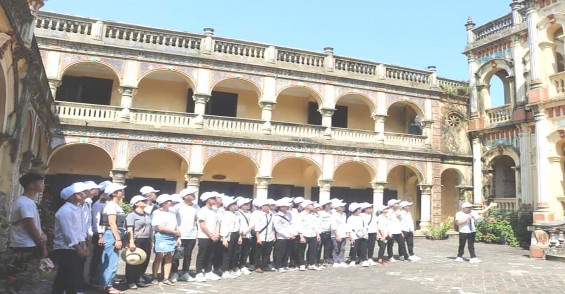
2. CRITERIA AND METHODS OF SKILLS ASSESSMENT
Evaluation criteria
How to evaluate | |
- Skill accuracy. | - Observe and compare with sample skills, check and compare actual skills with desired skills. standard capacity |
- Skills to perform work according to procedures. | - Monitor the operator's operations and compare them with the standards specified in the instruction manual and form. evaluation of the instructional process. |
- Hygiene, safety for people, equipment and tools. | - Monitor the operations of the operator and compare them with the standards specified in the instruction manual on: hygiene, safety for people and equipment tool. |
- Implementation time compared to standard time. | - Track the actual work execution time and compare it with the time specified in the instruction process. and process evaluation form. |
mouth
Figure 7: Organizing guidance activities at Hoang A Tuong mansion
Lesson 5. ORGANIZING OTHER ACTIVITIES AND SEEING OFF GUESTS
1. Knowledge
- Present the process of ending a tour program.
- Present service procedures at hotels, train stations, airports, and shops.
- Present the process of organizing events/activities.
- List the process of organizing group activities.
2. Skills
- Implement the process of organizing activities
- Carry out the process of seeing off guests in the tour program.
3. Attitude
- Respect customers, careful, accurate, flexible
- Love the job, proud of the job
I: RELATED KNOWLEDGE
In addition to sightseeing activities, tour guides can also organize a number of activities.
Other activities for the group of tourists to increase the attractiveness of the tour program such as shopping, propaganda, advertising. Tour guides need to pay special attention to the shopping activities of the guests. However, this is only one of the supplementary activities to satisfy part of the needs of the guests. Therefore, tour guides should not spend too much time, only consulting and supporting the guests.
The work needs to be done through the following steps:
Step 1. Find out relevant information
- Find out customer needs.
- Make a detailed plan to organize activities (determine topics, content, budget, human resources, equipment, time...).
Step 2. Prepare the conditions
- Prepare the location.
- Prepare human resources.
- Prepare content.
- Prepare means and equipment.
- Prepare for unexpected situations and backup plans.
moving
Step 3. Inform guests specifically about the time and content of the program.
- Organize guidance and transportation of guests (if necessary) to the activity location.
- Fully and effectively implement the contents of the activities according to plan.
- Flexible and reasonable handling of arising situations.
Step 4. Finish the activity.
Step 5. Prepare a report on the organization of other activities.
PART 2: PRACTICE GUIDE
1.Practice instruction sheet
PRACTICE INSTRUCTION SHEET
JOB | 1/B5/M D14 | |||
Step job | Content | Technical requirements | Tools and equipment | Note |
1 | Find out related information | Find out what your customers need. - Make a detailed plan to organize activities (determine topics, content, budget, human resources, equipment, time...). | Tour program. - Related documents. - Sample plans, or needs survey forms... - Implementation plan. - Documentation of suppliers/venues of activities. - Equipment and facilities for operations. - Report templates. | |
2 | Prepare the conditions | - Prepare the location | - Relevant documents | |
case | Fit - Prepare adequate human resources - Prepare the right content - Prepare adequate and qualified means and equipment. - Prepare for unexpected situations and backup plans. | mandarin. - Sample plans, or needs survey forms... - Implementation plan. - Documentation of suppliers/venues of activities. - Equipment and facilities for operations. - Report templates. | ||
3 | Notice to specific guests about time, program content | Organize guidance and transportation of guests (if needed) to the activity location. - Fully and effectively implement the contents of the activities according to plan. - Flexible and reasonable handling of arising situations. | Related documents mandarin. - Sample plans, or needs survey forms... - Implementation plan. - Documentation of suppliers/venues of activities. - Equipment and facilities for operations. - Report templates | |
4 | End of activity dynamic | Fully implemented job |