
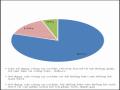
- Regarding timeliness: Looking at the chart, it shows that the timeliness of the coordination and information sharing mechanism within the CQTTGSNH in the 2 new stages is at an above-average level compared to work requirements: the percentage of opinions stating that the timeliness meets work requirements at the average level of the 2 stages (from 2009 to 2014 and the period from 2014 to the time of survey) is 61.4% and 45.1% respectively; at the above-average level of the 2 stages is: 25.7% and 37.8% respectively. Accordingly, the period from 2014 to the time of survey has improved compared to the previous period but is still at a low level.
- Regarding effectiveness: The change in effectiveness also developed similarly to the timeliness of the two stages: the percentage of opinions that effectiveness met work requirements at the average level of the two stages were 68.1% and 48.1% respectively; at the above average level of the two stages were: 23.2% and 37.0% respectively.
* Timeliness and effectiveness of the coordination and information sharing mechanism between the State Bank of Vietnam and the State Bank branches
Information between the State Bank of Vietnam and the State Bank Branch
From 2014 to 42.70% 42.70%
now
From 2009 to 65.70% 22.40%
2014
0% 50% 100%
Lack of timeliness/efficiency
Timeliness/effectiveness in meeting job requirements is weak.
Timeliness/effectiveness in meeting job requirements
average
Timeliness/effectiveness in meeting job requirements
above average
Timeliness/efficiency fully meets requirements
job
Chart 2.8: Evaluation of the effectiveness of coordination and sharing mechanismsChart 2.9: Assessment of the timeliness of coordination and sharing mechanisms Information between the State Bank of Vietnam and the State Bank Branch From 2014 to present 39.80% 42.20% From 2009 to 62.10% 25.8 2014 0% 50% Lack of timeliness/efficiency Timeliness/effectiveness in meeting job requirements Source: Survey results |
Maybe you are interested!
-
 Investigation of Qualifications of Import-Export Credit Officers and International Payments at Military Bank Branches in 2007
 -
 The State Bank Needs to Strengthen Its Management and Inspection Work for Credit Institutions
 -
 Current Status of Risk-Based Inspection and Supervision of the State Bank of Vietnam for Credit Institutions
 -
 Investment Situation in Non-Credit Services at Saigon Commercial Joint Stock Bank in the Period of 2015-2019
 -
 Vietnamese law on loan contracts in the field of banking credit - 28
- The survey results also show that the effectiveness and timeliness of the coordination and information sharing mechanism between the State Bank of Vietnam and the State Bank of Vietnam branches in provinces/cities have developed similarly to the coordination and information sharing mechanism within the State Bank of Vietnam. However, since 2014, the rate of evaluation of effectiveness/timeliness at the average level has only accounted for about 40% and the above average level accounts for about 42.7%. This shows that at this stage, the coordination and information sharing mechanism between the State Bank of Vietnam and the State Bank branches has shown signs of being better than the coordination and information sharing mechanism within the State Bank of Vietnam.
Thus, the establishment and completion of the structure and organization of the State Bank of Vietnam is an important step forward in the process of innovating the organization and operation of banking inspection and supervision towards closer integration with international practices and standards and in line with the development of the banking industry in the current period. Banking inspection and supervision activities have taken a new step forward according to the principle of concentration and more unity in directing and implementing tasks from the central to local levels because the inspection and supervision subjects have a great influence on the system and in the two key areas in Hanoi and Ho Chi Minh City, they are all under the direct management of units under the State Bank of Vietnam. The innovation in the structure and organization of the banking inspection and supervision system has created initial favorable conditions for implementing risk-based inspection and supervision in Vietnam. However, it is necessary to continue to improve the coordination and information sharing mechanism between units under the State Bank of Vietnam and the State Bank branches in provinces and cities (and this is also the reason for the third reform of the State Bank of Vietnam since its establishment).
2.2.1.3. Qualifications and capacity of inspection and supervision staff and civil servants
The force of inspection and supervision officers and civil servants is the top condition for implementing inspection and supervision on the basis of risk. During the research period, most of the inspection officers had university degrees or higher and good moral qualities, and were conscious of improving their knowledge to meet the tasks of inspection and supervision of banks in the new period. However, the capacity of the officers is still limited in some areas such as foreign languages, information technology, and understanding of banking products and services.
The survey results on the capacity of the inspection and supervision staff in 4 areas: (i) Professional training programs; (ii) Ability to use foreign languages; (iii) Ability to use information technology and (iv) Level of understanding of banking products and services, are as follows:
* Professional training programs
Chart 2.10: Short-term training programs in the most recent period
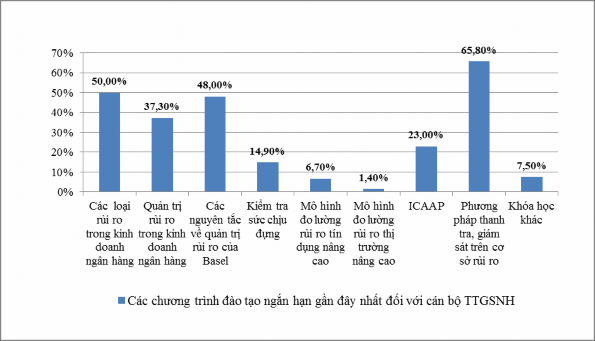
Source: Survey results According to the survey results, most of the inspectors and supervisors who are trained in specialized fields tend to be more micro-management than macro-management. The survey results show that more than 50% of the officers who are trained in short-term programs mainly focus on micro-programs: (i) inspection and supervision based on risk; (ii) types of risks in banking business and (iii) principles of risk management.
of Basel.
Meanwhile, macro and high mathematics programs account for a relatively modest training proportion: (i) stress testing (14.9%); (ii) advanced credit risk measurement models (6.7%) and (iii) advanced market risk measurement models (1.4%).
* About foreign language ability
English is still the most commonly used foreign language in the professional work of bank inspectors and supervisors with a usage rate of 100%. The remaining foreign languages all have usage rates of less than 10%. Of these, the highest is Chinese with a usage rate of 6.3%, followed by Japanese (4.3%), and Russian (4.2%). Korean and French have the lowest usage rates of 2.2% and 2.1%, respectively.
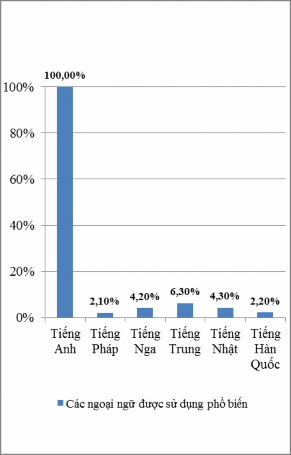
Chart 2.12: Assessment of foreign language proficiency of banking inspectors and supervisors Korean 100.0% Japanese 100.0% Chinese 33.3% 33.3% 33.3% Russian 50.0% 50.0% French 100.0% English 36.8% 34.5% 23.0% 5.7% 0% 20% 40% 60% 80% 100% Limited communication Proficient in communication but not yet used for professional work Able to use foreign languages at a fairly good level for professional work Use foreign languages fluently for professional work |
Source: Survey results
Regarding the ability to use foreign languages fluently, it can be seen that English is the language used at the highest level of proficiency, when inspectors can use English from communication to professional work. However, only 5.7% of the surveyed officers use English fluently for professional work (accounting for the lowest percentage). Meanwhile, 36.8% of the surveyed officers are limited in English communication and 34.5% of officers can communicate fluently in English but cannot use it for professional work. Next is Chinese, which has the second highest level of proficiency, and can also be used fluently for professional work. Russian has the third highest level of proficiency, but can only be applied to communication and cannot be used for professional work. Japanese, Korean, and French are all only used to a limited extent in communication.
* About the ability to use information technology
The survey results also show that most bank inspectors and supervisors only use basic information technology, and rarely use quantitative tools for inspection and supervision activities. One of the reasons is that the proportion of bank inspectors and supervisors participating in short-term training courses on the use of quantitative models is also very low, so the ability to use quantitative tools and software is limited.
At the same time, the limited use of information technology also affects the application of software to support the professional work of the staff of the CQTTGSNH. When up to 80% of the staff surveyed only used software at the level of word processing software. And only 20% of the staff surveyed used basic tools and the SG4 statistical reporting system, in which the majority of staff had worked before 2009.
* About the level of understanding of banking products and services
Chart 2.13: Assessment of the level of understanding of banking products and services
Products and services based on technology
digital art
36.10%
31.30%
Payment products and services
38.10%
45.20%
Lending products and services
25.30%
60.20%
Mobilization products and services
37.60%
50.60%
0%
20% 40% 60% 80% 100%
Lack of understanding of products and services
Low level of product and service knowledge Medium level of product and service knowledge
Source: Survey results According to the survey results, most of the surveyed officers have the highest level of understanding of lending products and services, followed by mobilization products and services. The third level of understanding is payment product and service groups. Meanwhile, for digital technology-based products and services, the level of understanding is the lowest because this is a new product and service group, requiring officers to have in-depth knowledge of
technology activities
The above situation shows that the capacity of the inspection and supervision staff is still inadequate, causing many difficulties for bank inspection and supervision in the process of performing inspection and supervision tasks based on risks.
2.2.1.4. Database resources and information technology systems supporting risk-based inspection and supervision activities
In each stage of development, the database source serving inspection and supervision work has changed in terms of quantity and quality of information. Initially, supervision information mainly came from exploiting reports of credit institutions, from inspection conclusions and from CIC, other information channels have also gradually received attention such as: exchanges with the State Securities Commission, with foreign management agencies, from independent audits. However, the level of exchange is still limited, low frequency. According to the Report on the implementation results of the Self-assessment Project of Banking Inspection according to the 25 basic principles of the Basel Committee by the auditing company Ernst & Young applied in Vietnam in 2011 and according to the Detailed Compliance Assessment Report of the Basel Core Principles for Effective Banking Supervision in Vietnam by the WB/IMF Vietnam Financial Sector Assessment Program in 2013, banking inspection and supervision mostly do not comply with principle number 1 - "Objectives, independence, authority, transparency and cooperation", accordingly, Vietnam does not have an official mechanism for sharing information and synthesizing risks in a number of organizations operating in all fields of banking, securities, insurance, investment funds...; there are no clear regulations on the rights of the State Bank of Vietnam in collecting information from companies belonging to the Financial Group when necessary. Up to now, information sharing has also been improved through the signing of Memorandums of Understanding (MOUs) between the State Bank and relevant ministries and branches, but the implementation has only been formal, and there has not been a truly effective coordination and information sharing mechanism.
The collection and processing of data information has gradually reduced manual methods thanks to the application of information technology. The State Bank has put into operation two modern information management systems, the State Bank's document and work management system (Edoc) and the new statistical reporting system SG4, which has significantly improved the capacity of technology systems in the Bank. The SG4 reporting system has brought a new look to the process of collecting and synthesizing data according to management indicators, especially banking supervision indicators, creating significant progress in data management, serving analysis and evaluation activities in inspection and supervision based on risks. Information security is still guaranteed by the Department of Technology.
information and there have been no significant incidents affecting the safety of the State Bank's operations. However, new information and data are mainly processed using office tools such as Word, Excel and lack supporting software for analysis and evaluation, with a low level of automation.
The survey results are as follows:
a) Information sources for inspection and supervision work
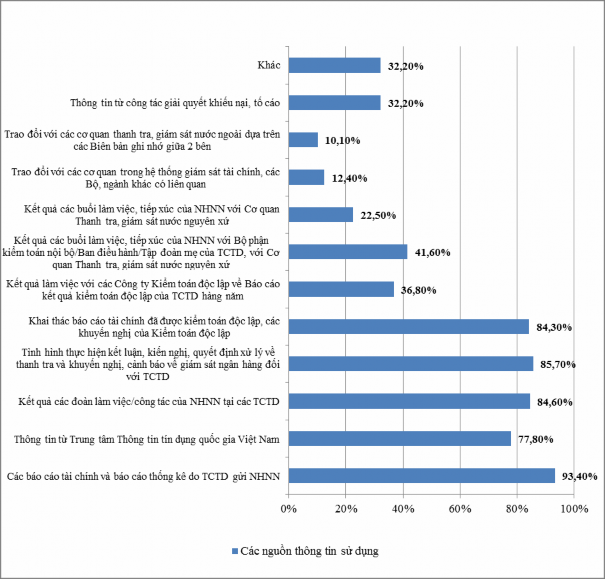
Chart 2.14: Information sources for inspection and supervision
Source: Survey results
Information for banking inspection and supervision primarily comes from remote monitoring through financial reports and statistical reports sent by credit institutions to the State Bank. Up to 93.4% of surveyed officials use this data source first.
Next, the priority data sources are: (i) The implementation status of conclusions, recommendations, decisions on handling inspections and recommendations, warnings on banking supervision for credit institutions; (ii) Results of working groups/missions of the State Bank at credit institutions; (iii) Exploitation of independently audited financial reports, recommendations of independent auditors; (iv) Information from the National Credit Information Center of Vietnam (over 75% of surveyed officers use these information sources).
Other sources of information such as working with foreign management agencies, or from other ministerial agencies, or from handling complaints and denunciations are still rarely used (less than 40% of surveyed officials use these sources of information).
b) Quality of data information and technology infrastructure, data reporting synthesis system
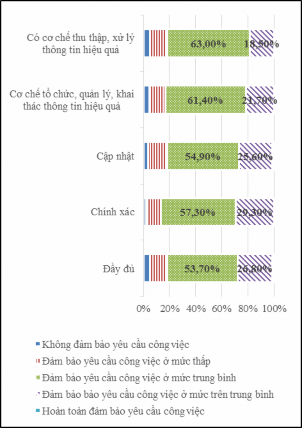
Chart 2.16: Evaluation of technology infrastructure, automatic reporting and data synthesis system
Source: Survey results |
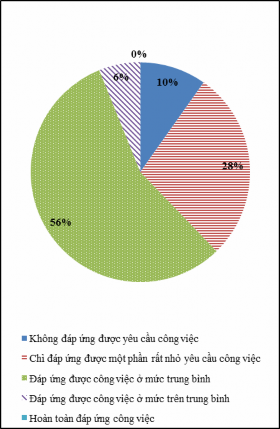
Assessing the quality of information and data serving the work of banking inspection and supervision, most opinions said that it only meets the job requirements at an average level.