
Chapter I Summary
In this chapter, the author used the theoretical basis of some domestic and foreign studies on the field of employee motivation. In addition, the author also used Kovach's ten-factor employee motivation model as the foundation for building a research model for this topic combined with theories that affect labor motivation to find out which factors affect employee motivation.
The group of theories related to labor motivation used by the author in this chapter includes: Maslow's Needs Theory, Herzberg's Two-Factor Theory, Stacy Adams' Equity Theory and Victor Vroom's Expectancy Theory. The combination of Kovach's Ten Factor Model and the above theories helps the author propose the research model in the next chapter.
In this chapter, the author has presented the concept of motivation and creating labor motivation. In addition, the author explains the meaning of factors affecting labor motivation including the group of personal factors and the group of organizational factors:
Maybe you are interested!
-

 Applying Local Marketing in Bac Ninh Tourism Development - 2
 -
 Developing lending to small and medium enterprises at Vietnam Joint Stock Commercial Bank for Industry and Trade - Bac Ninh Branch - 12
 -
 Developing cultural tourism from the potential of ethnic minorities in Ninh Thuan province, the case of the Raglai ethnic group in Bac Ai district - 17
 -
 Organizational Structure of Joint Stock Commercial Bank for Foreign Trade of Vietnam - Bac Ninh Branch
 -
 Current status and solutions for developing cultural tourism in Bac Ninh - 1
- Personal factors include: Age, Gender, Education level, Work experience
- The group of organizational factors includes: Corporate culture, Leadership style, Training and promotion, Salary and benefits, Working conditions, Nature of work and Relationship with colleagues.
In the next chapter, the author will present the research method of the topic.
CHAPTER II: RESEARCH DESIGN AND METHODS
2.1. Research design
2.1.1. Research process
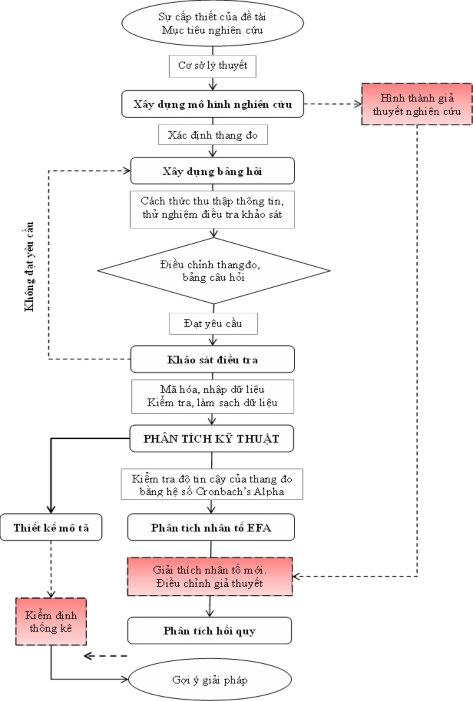
Figure 2.1. Research process diagram
Source: Nguyen Dinh Tho, 2011
Step 1: Build a research model based on previous theory to determine the scales of factors affecting labor motivation, form initial research hypotheses in accordance with the set research objectives and characteristics of employees in the organization.
Step 2: Select the observed variables for the scale, determine the sample for this study. The scale used in this study is a 5-level Likert scale for all observed variables and the sample selection method was used with a sample size of 200 samples as presented in the sampling section of this chapter.
Step 3: Choose the method of collecting information to be researched. The questionnaire is used to interview workers directly and indirectly. The content of the questions in the questionnaire is presented in the section on questionnaire construction and information collection methods of this chapter.
Step 4: After the questionnaire has been developed and the number of samples to be collected has been determined, the questionnaire needs to be tested in accordance with the actual situation of the organization to completely check the scale and questionnaire. If the questionnaire meets the research requirements, proceed to collect information, if it does not meet the requirements, the questionnaire needs to be rebuilt.
Step 5: After collecting information, the questionnaire is coded and the survey data is entered. From the stage of information entering into the questionnaire to the stage of survey data entry, the database is checked, data is cleaned and the collected data is processed to ensure the reliability of digital analysis observed in the questionnaire.
Step 6: Technical analysis consists of 02 parts: (a) descriptive statistics, (b) EFA factor analysis and regression. Before EFA factor analysis, the measurement scales are tested for reliability using Cronbach's Alpha coefficient to eliminate garbage variables and loose correlations in the EFA factor analysis model.
From there, re-test the initial hypothesis on assessing employee satisfaction with work, and conduct regression analysis.
Step 7: After technical analysis, the inferred data needs to be statistically tested to ensure the stability of the model to evaluate the factors affecting employee motivation. Finally, some solutions are suggested for Bac Ninh Trade and Tourism Joint Stock Company.
2.1.2. Building a research model
Based on the research model of 10 factors motivating employees by Kovach (1987), the author discussed with the company's Board of Directors about the factors affecting the labor motivation of officers and employees of Bac Ninh Trade and Tourism Joint Stock Company as follows:
- Add the factors "Corporate culture" and "Relationship with colleagues" to the research model
- Combine the factors “Interesting work”, “Job autonomy” and “Job stability” into a new factor group called “Nature of work”
- Combine the factors "Full recognition of work done", "Supervisor's attachment to employees", "Talent and delicate handling of discipline" and "Supervisor's help in solving personal problems" into a new group of factors called "Leadership style"
- The factor “High salary” is renamed “Salary and benefits”
- The factor “Promotion and career development” was renamed “Training and development”
- The factor “Good working conditions” remains the same
After discussion and agreement, the author proposes a research model of seven factors affecting employee motivation at Bac Ninh Trade and Tourism Joint Stock Company as follows:
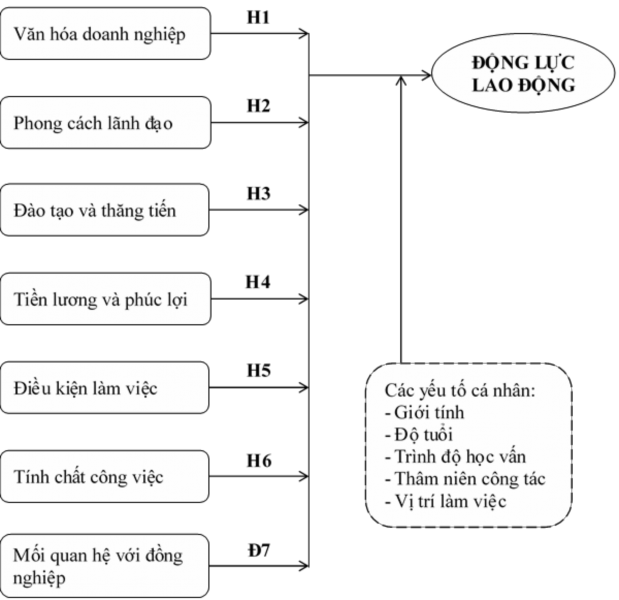
Figure 2.2. Research model
Source: Author's research
2.1.3. Research hypotheses
Corporate culture with built values of trust is not outside the goal of creating the best working environment, favorable and creating trust for employees so that they are willing to stick with and contribute to the success of the company. Corporate culture will determine the behavior of employees, as well as the efficiency of production and business activities of the enterprise and no one else.
It is the leaders of the organization who are responsible for building and maintaining the culture, mission, beliefs and core values of the business. According to Stephen Overell (2009), the five key factors of motivation include: Building an internal brand, communicating the values of the organization, demonstrating good leadership, an interesting working environment, challenging performance management and constant improvement. Tavassoli's research (2008) shows that: "Implementing communication and making the brand alive through human resources will result in employees having a higher sense of pride in the common goal and a higher level of motivation." (Quoted from Tran Thi Kim Dung and Nguyen Ngoc Lan Vy, 2011). Therefore, in this study, the author puts forward the research hypothesis:
Hypothesis H1: The factor "Corporate culture" has a positive influence on employee motivation.
Leadership style affects employee satisfaction. Employees will feel satisfied with a leader who is friendly, listens well and cares about their interests. Employees will feel that they are always respected and trusted as an important member of the company, and employees receive support from their superiors in solving difficulties. In addition, leaders who are tactful and tactful in criticizing employees are also a way to motivate them to improve themselves and work better. According to research by Janet Cheng Lian Chew (2004), employee motivation depends on leadership behavior, work relationships, company culture and structure, and work environment. The results from research by Towers Watson (2012) reinforce the view that direct managers have a strong influence on employees' commitment to their work, commitment to the company and willingness to contribute to the company's success. Therefore, in this study, the author puts forward the research hypothesis:
Hypothesis H2: The factor “Leadership style” has a positive influence on employee motivation.
Training and promotion : Training is the process of learning the skills needed to perform a specific job. Promotion is the move to a more important position or job in a company. Training in this topic is grouped together with promotion because training often aims to promote or improve the ability and performance of employees. Training has been highly appreciated by Schmidt (2007) for its importance in the company. His research results have shown that the need for training and promotion in the job has a clear impact on employee motivation. According to Tran Thi Kim Dung (2009), when equipped with the necessary professional skills, employees will be stimulated to perform better, achieve more achievements and want to be assigned more challenging tasks and have more promotions. According to Maslow's theory of needs, this factor is in the hierarchy of needs for respect and self-affirmation. According to Herzberg's two-factor theory, this factor belongs to the group of environmental factors that can cause dissatisfaction. Therefore, in this study, the author puts forward the following research hypothesis:
Hypothesis H3: The factor “Training and promotion” has a positive influence on employee motivation.
Salary and benefits are the remuneration that employees receive from their work in the organization. According to Maslow's hierarchy theory, the need for salary and benefits is equivalent to basic human needs. At the same level of work, employees will feel more stimulated when their income is higher. In addition, factors of fairness in income are also compared by employees and are factors that affect their work motivation according to studies by Kinichki et al. (2002), Tran Thi Kim
Dung (2005)… Therefore, in this study, the author puts forward the research hypothesis:
Hypothesis H4: The factor “Salary and benefits” has a positive effect on employee motivation.
Working conditions are the state of the workplace of the employee, including the following factors: safe environment, adequate tools for work, reasonable working hours, happy and well-organized workplace according to Kovach's research (1987). When employees are provided with good working conditions, they will evaluate their work well. On the contrary, poor working conditions will make employees dissatisfied with their work, leading to a loss of motivation to work in the long run. This has been verified through the research of Spector (1985), Tran Thi Kim Dung (2005) and Nguyen Trong Hieu (2012)... Therefore, in this study, the author puts forward the research hypothesis:
Hypothesis H5: The factor “Working conditions” has a positive influence on employee motivation.
The nature of the job is the content of the job that is suitable for the employee's capacity, inspiring the employee to develop his/her ability. Arranging suitable work will make the employee work more enthusiastically and effectively. In other words, the employee will feel interested and motivated to work if the assigned work is suitable for their ability. This has been verified through studies by John.D Pettit et al. (1997), research by T.Ramyah et al. (2001) in Malaysia, research by Kinicki et al. (2002), research by Luddy (2005), research by Tran Thi Kim Dung (2005), Nguyen Thu Thuy (2011), etc. all show that the nature of the job affects the employee's motivation to work. Therefore, in this study, the author puts forward the following research hypothesis: