
According to a report by the Hanoi Department of Tourism (2020), although hotels have reduced prices very low, even up to 70-80% with many incentives, suitable for many customer groups, the number of visitors to Hanoi is still not much.
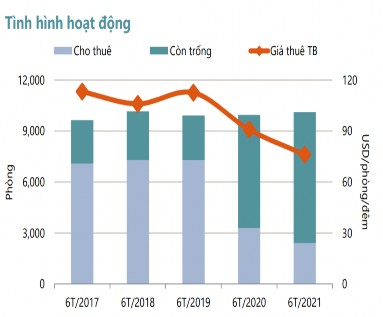
In 2017, the average occupancy rate of the entire market reached the highest level in the past 5 years (62.28%). By 2019, the room occupancy rate increased to 67.9%, of which the 5-star category had the best occupancy rate, reaching 80%, with contributions not only from tourists to Hanoi but also from workers to Hanoi. Next is the 4-star category, the 3-star category has |
stars in Hanoi Source: Savills Research and Consulting , Q2/2021 |
Maybe you are interested!
-
 The Relationship Between Competitiveness and Business Performance
 -
 Overview of Business Performance of Hanoi Bank for Agriculture and Rural Development
 -
 Improving the business performance of Saigon - Hanoi Commercial Joint Stock Bank after the merger - 12
 -
 The relationship between social responsibility, green marketing strategy, corporate reputation and business performance - Research on tourism and travel businesses in Ho Chi Minh City - 24
 -
 The relationship between social responsibility, green marketing strategy, corporate reputation and business performance: a study of tourism and travel businesses in Ho Chi Minh City - 20
By the second quarter of 2021, according to a report by Savills Vietnam, the average room rate in Hanoi reached 77 USD/room/night, up 1% quarter-on-quarter but down 9% year-on-year. 5-star hotels led with an average room revenue of 28 USD/room/night (about 650 VND/night) thanks to the main group of guests being business travelers and long-stay guests. However, due to the outbreak of COVID-19 since the end of April, the room occupancy rate in the second quarter dropped to 27%.
Figure 3.3. Room occupancy rate of 3 - 5 hotels
occupancy rate reached 49%.
However, by 2020, according to the report of Hanoi Department of Tourism, the negative impact of the COVID-19 epidemic, the 3-5 star luxury hotel segment such as Hilton, Hanoi Opera, Melia, Authentic Hanoi, Thang Loi, ... fell into a serious crisis, with some hotels having an occupancy rate of only 7%. According to statistics from Savills (2020), the operating capacity and nightly rental price of hotels in Hanoi also dropped to a record low. Notably, the room occupancy rate of 5-star hotels such as Lotte only reached 30%, Metropole 25%, Park Hyatt Hanoi 18%, ... even Daewoo Hotel only reached 7% room occupancy because the guests of these hotels are mainly international guests. By the end of 2020, the average occupancy rate of 3-5 star hotels was estimated at about 32%, down 35.9% compared to the same period in 2019, while the average rental price decreased by 29% year-on-year. The 5-star hotel segment still leads the market in average room revenue with 35 USD/room/night, the 4-star segment reached 15 USD/room/night while the 3-star segment only reached 9 USD/room/night.
By the end of Q2/2021, 2 4-star hotels and 8 3-star hotels, mainly in the central area, remained closed. The occupancy rate of 3-5 star hotels was 21%, down 23% quarter-on-quarter and 52% year-on-year, the average room rate decreased 14% quarter-on-quarter and 24% year-on-year, down to USD 85/room/night. The 5-star hotel segment had an occupancy rate of 25%. Long-term guests and business travelers continued to be the main source of guests for this segment.
According to CBRE Hotels Vietnam, the hotel market in the period of 2020 - 2021 is forecast to always be on the defensive, with the operating situation subject to constant change due to facing unpredictable fluctuations in the pandemic.
3.1.2. Business performance of 3-5 star hotels in Hanoi in the period 2016-2020
In the period 2016 - 2019, Vietnam in general and Hanoi in particular witnessed rapid growth in the tourism industry, tourism competitiveness increased by 12 ranks (from 75th to 63rd). But right after the record growth, the COVID - 19 pandemic broke out, causing Vietnam's tourism to fall into a serious crisis. Since March 2020, international tourist arrivals have been temporarily suspended. Domestic tourism has also been affected by the implementation of social distancing orders in April 2020, followed by outbreaks in July 2020 and December 2020. In 2020, the number of international visitors to Vietnam decreased by 80% compared to 2019, and domestic visitors also decreased by 50% despite the tourism industry's efforts to implement many large stimulus programs. Faced with fluctuations in the Vietnamese tourism market, the Hanoi hotel market is also directly affected (see table 3.1).
Table 3.1. Business performance of the 3-5 star hotel market in Hanoi in the period 2016-2019
STT
Target | Unit | 2016 | 2017 | 2018 | 2019 | 2020 | |
1 | Total tourist arrivals | Tr. views | 22.4 | 23.83 | 26.30 | 28.95 | 8.65 |
International guests | Tr. views | 3.81 | 4.95 | 5.7 | 7,025 | 1.11 | |
Domestic guests | Tr. views | 18.59 | 18.88 | 20.6 | 21.93 | 7.54 | |
2 | Average length of stay | Day | 2.35 | 2.88 | 2,995 | 3.39 | NA |
Length of stay for international guests | Day | 3.11 | 3.64 | 3.67 | 3.92 | NA | |
Length of stay for domestic guests | Day | 1.6 | 2.12 | 2.32 | 2.86 | NA | |
3 | Total revenue | Ratio | 68,503 | 70,958 | 77,480 | 103,807 | 26.62 |
4 | Average chamber capacity | % | 60.05 | 62.28 | 64.86 | 67.9 | 32.7 |
Source: NCS synthesis
NA: no data available
According to the statistics table on business performance of the 3-5 star hotel market in Hanoi, the indicators increased steadily over the years from 2016 - 2019 and decreased sharply in 2020.
In terms of total visitors, in 2017 Hanoi reached a record with about 4.95 million international visitors, up 23% year-on-year and accounting for 40% of visitors to Vietnam.
80% of tourists come to Hanoi for leisure tourism. By 2018, Hanoi welcomed 26.3 million visitors, of which 5.7 million were international visitors, an increase of 13.2% compared to 2017. The performance of the 4-star and 5-star hotel segment was very good in 2018 due to limited new supply while demand continued to grow strongly. In addition, according to the Hanoi Statistics Office (2018), it is estimated that out of every 10 foreign visitors to Vietnam, 4 come to Hanoi. Hanoi is an important transit point to famous tourist destinations in the North such as Sapa, Ha Long Bay, Trang An - Bai Dinh and from there to famous destinations in Vietnam such as Quang Binh, Hue, Da Nang, Nha Trang... Therefore, the number of visitors to Hanoi in 2019 continued to increase with impressive numbers. In 2019, the 3-5 star hotel market in Vietnam had a fairly good business year. A notable point of the 2019 market is that Korean guests are gradually replacing Chinese guests to become the largest source of guests in Vietnam. In addition, the proportion of domestic guests continues to increase, reaching 22.2% of the total number of guests.
However, by 2020, due to the great impact of the COVID-19 pandemic, the number of visitors to the capital decreased by about 70%, of which international visitors decreased by 84.2% and domestic visitors decreased by 65.62%. In 2020, foreign visitors to Hanoi were basically business visitors, diplomats, and foreign workers.
In 2021, according to statistics from the Hanoi Department of Tourism, in the first 7 months of 2021, the number of tourists to Hanoi reached 2.92 million, down 43.1% over the same period in 2020. Total revenue from domestic tourists is estimated at 8.17 trillion VND, down 63.6% over the same period last year.
In terms of total revenue, hotels in Hanoi in 2019 were marked with an impressive figure of VND 103,809 billion, an increase of 33.97%. However, by 2020, total revenue dropped to VND 26,620 billion (down 74.36% compared to 2019). This significant decrease came from the decrease in total revenue of 8 international hotels in Hanoi such as Sheraton Hanoi Hotel with revenue of VND 392,963 billion (2019) to VND 151,285 billion (2020); Pullman Hanoi Hotel: VND 201,387 billion (2019) to VND 93,411 billion (2020); Melia Hanoi: VND 479,302 billion (2019) to VND 136,375 billion (2020); Intercontinental Hanoi: 401,485 billion VND (2019) to 171,424 billion VND (2020)...
In 2020, Hanoi had more than 950 accommodation establishments temporarily suspending operations with about
16,000 workers are temporarily unemployed. Many hotels in the Old Quarter have temporarily closed due to lack of guests to reduce taxes and operating costs or put up for sale.
By Q2/2021, the average room revenue of hotels in the central area decreased by 71% quarter-on-quarter and 84% year-on-year. Meanwhile, the inner city area decreased by 59% quarter-on-quarter and 80% year-on-year. The western area saw room revenue decrease by 51% quarter-on-quarter and 72% year-on-year.
Although the COVID-19 pandemic will leave a lot of damage and have a profound impact on the market, the development prospects of the hotel industry in Vietnam in general and in Hanoi in particular will remain positive in the long term thanks to continued improvements in infrastructure, preferential visa policies and the State's orientation to promote tourism development to become a key economic sector. According to a representative of Savills, even with an occupancy rate of only 27%, the Hanoi hotel market is still considered to be resilient during the pandemic. There is much hope for the return of the tourism industry when the implementation of vaccination will help international tourism to open up.
3.2. Current status of customer relationship management process of 3 - 5 star hotels in Hanoi
3.2.1. Introduction to case study sample
With the scope of the thesis's survey objects at 3-5 star hotels in Hanoi, during the implementation process, the researcher realized that 3-star hotels are different from 4-star and 5-star hotels in terms of business characteristics, scale, customer base... so the researcher divided them into 2 groups for research: 3-star hotels and 4-star and 5-star hotels. For both groups, the researcher will base on the management form and geographical scope to select typical hotels.
Table 3.2. List of hotels selected for case study
Star rating
Management form | Scope | Hotel name | |
3 stars | Independence | Domestic | Hacinco |
Chain | A25 | ||
4.5 stars | Independence | Domestic | Candle |
By chain | Domestic | Muong Thanh | |
Foreign | JW Marriott Hanoi |
Source: NCS synthesis
NCS has selected 5 typical research hotels as follows:
Firstly , with a 3-star hotel under independent management, Hacinco Hotel was chosen for research because Hacinco is one of the domestic hotels with a 22-year history of development. Therefore, the amount of customer data of the hotel is quite large. When choosing Hacinco Hotel, NCS wanted to find out how the hotel's CRM was implemented to be able to manage and maintain the amount of customer data over the past long period.
Second , with a case study of a domestic 3-star hotel chain, the A25 hotel group was selected. Although the A25 hotel system includes both 2 and 3 stars, in the thesis research, the researcher will focus on exploiting the 3-star hotel chain. The A25 hotel system is concentrated in the central areas of major cities such as Hanoi, Ho Chi Minh City and Da Nang. In the Hanoi area alone, A25 hotels are concentrated in 6 inner-city districts with a chain of 34 hotels. It can be said that, up to now, the hotel chain
A25 is considered the hotel chain with the largest number of 3-star hotels in the country. Therefore, NCS wants to learn about the customer exploitation and maintenance system of this hotel chain.
Third , with the group of 4-star and 5-star hotels: Domestically, Candle Hotel is an independent 4-star hotel selected for a typical study. The hotel is located in the center of Ba Dinh district - where there are many of the largest administrative centers in the country. The customer market of Candle Hotel is politicians, business leaders, and non-governmental organizations. Since its construction, the hotel has changed management twice. The first time the hotel was managed by a Japanese hotel manager. After 2 years, the Urban Design and Development Consulting Joint Stock Company (CDO) - a Vietnamese manager, officially directly managed the Candle Hotel Hanoi. With a specific target customer market and a change in hotel management, NCS wants to find out whether there is a difference in the operation of the CRM system between the 2 domestic and foreign managers at Candle Hotel.
Fourth , with the chain management model, NCS has selected two large hotel groups: Muong Thanh Center Hotel Group (the largest private hotel chain in the country) and JW Marriott Hanoi Hotel (a hotel chain managed by the international Marriott Group). These are two large-scale hotel groups with a diverse number and characteristics of customers. In order to manage a diverse and rich customer base along with a system of hotels both domestically (Muong Thanh Hotel) and internationally (JW Marriott Hotel), hotel managers have had to pay attention and invest heavily in the CRM system. Therefore, NCS wants to learn about the process of establishing, developing and maintaining customer relationships of these two hotel chains.
3.2.2. Customer relationship management process of typical 3-5 star hotels in Hanoi
With the CRM process, the majority of managers of typical selected hotels participating in the in-depth interview believe that CRM is an effective solution to identify, attract, develop and maintain customers. Along with that, the managers believe that the CRM process is implemented through the coordination between departments and divisions in the hotel, in which the main focus is on the marketing department with customer care programs and policies implemented to retain and develop customers. However, the most important thing is that the CRM strategy and implementation plan will be built and controlled by senior managers in the hotel.
The organizational structure of 3-5 star hotels all operate based on the online-functional principle. In which, the senior management will perform the task of strategic planning, building business programs for the hotel, monitoring the implementation of orders of all departments according to assigned functions and tasks, directly organizing and managing all related issues within their authority such as financial management, human resource management, management
all business activities in the hotel. The departments and functional units in the hotel structure include: human resources, marketing, finance - accounting, engineering, reception, housekeeping, restaurant... Each department is divided into smaller specialized groups and is managed and controlled by department heads and shift leaders.
The CRM process of typical 3-5 star hotels in Hanoi is analyzed as follows:
3.2.2.1. CRM planning phase
Hanoi is considered a vibrant market with high population density, rapid economic, scientific and technological development. Tourists come to Hanoi from many different provinces and countries around the world, so the demand for accommodation services is extremely large. This creates conditions for the development of hotel business activities. However, opportunities always come with strong competition. Especially after the great impacts of the COVID-19 pandemic, the Vietnamese hotel industry in general and in Hanoi in particular have encountered many difficulties. As of June 2021, the supply of 3-5 star hotel market in Hanoi with 10,120 rooms from 17 5-star hotels, 17 4-star hotels and 32 3-star hotels, however, the occupancy rate only reached 27%. In addition, according to a representative of Savills Vietnam, in the last 6 months of 2021 to 2023, nearly 2,600 rooms are expected to be introduced to the Hanoi market from 14 projects. In the context of the impact of the pandemic, combined with the appearance of many new competitors, the 3-5 star hotel market in Hanoi has the potential for extremely strong competition.
Starting with the CRM planning phase, hotels build their business strategy and CRM strategy based on their mission and vision.
- Mission and vision of typical 3-5 star hotels in Hanoi
According to survey results, each 3-5 star hotel builds a business strategy with a specific mission and vision.
Table 3.3. Mission of typical 3-5 star hotels in Hanoi
Hotel name
Mission | |
Hacinco | Bring visitors a feeling of comfort, friendliness and relaxation roof like in your own home |
A25 | Bring customers a feeling of accommodation service experience familiar, close to home with flexible and economical costs. |
Candle | Bring you a feeling of relaxation, comfort and enjoy many new joys with happy moments. filled |
Muong Thanh | Providing hotel products and services associated with conservation preserve and develop Vietnamese values |
JW Marriott Hanoi | MICE (conferences, seminars, events and exhibitions) hotel with Professional and convenient conference space will bring you impressive and rich experiences. |
Source: Compiled from hotel website
Each hotel selected for case study has developed different missions but they all have in common the customer orientation (See table 3.3). Domestic 3-star hotels (Hacinco and A25), with the main target audience being domestic guests with average payment ability, the mission is determined to bring a feeling of closeness and friendliness to customers as if they were staying in their own home.
With the goal of preserving, expanding and spreading traditional beauty, cultural quintessence and Vietnamese pride to domestic and foreign tourists in order to preserve and build the cultural values of Vietnamese ethnic groups, Muong Thanh Hotel Group has built a mission towards creating diversity in providing products and services but must ensure that it is closely linked to the preservation and development of Vietnamese values. Unlike hotels under domestic management, JW Marriott Hanoi Hotel has oriented its main target customers to business travelers, so the mission of JW Marriott Hanoi is built with the desire to bring customers impressive and rich experiences with professional conference space.
According to Kaplan and Norton (1996), mission is the basis for determining the reason for the existence of the business, based on the mission to determine the vision as well as the strategy of the business. With 3-5 star hotels, due to the difference in defining the mission, the construction of the vision is also different:
Table 3.4. Vision of typical 3-5 star hotels in Hanoi
Hotel name
Vision | |
Hacinco | Together we build the 3-star Hacinco Hotel to international standards. trusted destination for domestic and foreign customers |
A25 | Focus efforts to develop and expand more branches in and abroad. |
Candle | Strive for international standards, in style and quality Japan. |
Muong Thanh | Muong Thanh constantly aspires and strives to reach its goals. become a national representative of the Vietnamese hotel industry. |
JW Marriott Hanoi | Become a prestigious and well-known 5-star hotel in the industry hotel business nationwide as well as in the Asian market |
Source: Compiled from hotel website
Domestic independent hotels such as Hacinco and Candle all have a vision of striving to achieve international standards because these hotels have a system of rooms that meet international standards, a system of modern amenities, and a thoughtful and professional service style. Meanwhile, the domestic hotel chain A25 wants to develop and expand its branches not only domestically but also internationally.
With the hotel group in the chain, Muong Thanh hotel group aspires to become a national representative of the hotel industry in Vietnam because the hotel group
Muong Thanh is currently a purely Vietnamese brand, owning the largest domestic hotel chain in Vietnam and in the future, the group will continue to develop and expand the scale of the chain of high-class hotels and resorts across the country. With a hotel chain managed by an international management system, a broader vision, JW Marriott Hanoi Hotel is determined not only to make a name for itself in the hotel business nationwide but also to target the Asian market.
According to the interview results, when determining the mission and vision for the business strategy, 3-5 star hotels relied on specific bases such as: The core operating purpose of the hotel, target customers, financial resources and market context such as: competitors, hotel advantages... With domestic hotels such as Hacinco, A25 and Candle, Muong Thanh hotel chain, the task of determining the mission and vision is carried out by the board of directors and then leaders at all levels will rely on the mission and vision to build the hotel's business strategy with plans and operational directions given to operate the hotel in the best way, with the ability to compete, attract customers as well as increase profits, helping the hotel to grow. With JW Marriott Hanoi Hotel, the determination of mission and vision is carried out through meetings, discussions and agreements between the board of directors of Bitexco Group and the executive board of Marriott International in Hanoi.
- Customer relationship strategy
According to the interview results, the hotel's customer relationship strategy will be built and selected based on the business strategy. Based on the business mission of the hotels, it is easy to see that the reasons for the hotels' operations are all customer-oriented and customer-centric.
Table 3.5. Target customers of typical 3-5 star hotels in Hanoi
Hotel name
Target audience | |
Hacinco | Mainly domestic guests, a small part are international guests, ability payment at average level |
A25 | Young people, business travelers, who want to stay long term without cost too much |
Candle | Target customers are Japanese customers. |
Muong Thanh | Serving the diverse needs of all domestic and international tourists |
JW Marriott Hanoi | Target customers are domestic and foreign business travelers, mainly mainly international guests |
Source: Interview results of typical 3-5 star hotel managers
Thus, typical 3-5 star hotels in Hanoi all target different customer market segments (see table 3.5).
For the domestic independent 3-star hotel Hacinco, the main target customers are domestic guests with average payment ability. This source of guests is