
3.1.2 Drug use review activities
All hospitals performed the procedure, however, not all hospitals performed all four steps above. Four hospitals performed only one stage of the procedure (8.33%), 12 hospitals performed two of the four stages of the procedure (25%), 17 hospitals performed three of the four stages of the procedure (34.42%), and 15 hospitals performed all four stages of the procedure (31.25%).
Table 3.3. Steps in reviewing drug use conducted in hospitals
XXSDT steps
Hospital Number | Ratio % | |
Step 1: Collect patient information | 41 | 85.4 |
Step 2: Evaluate medication use | 45 | 93.8 |
Step 3: CTD Proposal | 36 | 75.0 |
Step 4: Follow up after CTD | 17 | 35.4 |
Maybe you are interested!
-

 Binh Nguyen Loc and His Wandering Steps on the Sidewalks
 -
 Review of Research Status Related to the Topic
 -
 Steps to Solve Two-Variable Quadratic Problems Using Geometric Methods
 -
 Receive Information About Events and Activities Conducted by the Ministry of Culture, Sports and Tourism
 -
 Review of service quality of Vung Tau - Con Dao tour at ATZ Travel Company - 2
Comment
Drug use assessment (Step 2) was conducted in almost all hospitals (accounting for 93.75%) and post-CTD follow-up (Step 4) was limited (accounting for 35.42%).
a) Collect patient information
Prescriptions and medical records were the two most commonly used sources (91.7%) to collect information before analyzing drug use. Direct communication with doctors and nurses (77.1%) and direct communication with patients (43.8%) had lower rates.
b) Detecting drug use problems
From the information collected, pharmacists detected drug-related errors in the areas presented in Table 3.4.
Table 3.4. Areas assessed in medication use review
Areas assessed in XXSDT
Hospital Number | Ratio % | |
Dose | 44 | 91.7 |
Assign | 45 | 93.8 |
Contraindications | 41 | 85.4 |
Drug interactions
43 | 89.6 | |
Adverse drug reactions (ADR) | 36 | 75.0 |
Treatment compliance | 14 | 29.2 |
Other * | 3 | 6.3 |
Comment
The most frequently assessed issues were dose, indications, contraindications and drug interactions (≥ 90%), followed by ADR (75%). Treatment adherence was assessed in only 1/3 of hospitals.
c) Proposed pharmaceutical intervention
The proposed pharmaceutical interventions were processed in various ways: discussion with the patient's attending physician (79.2%), general discussion during clinical department meetings (47.9%), discussion within the Pharmacy Department (41.7%), and discussion within the Clinical Pharmacy Unit (43.8%). Only 2.1% of hospitals did not discuss the results with colleagues.
d) Staffing, frequency, patient selection, storage
The XXSDT process in hospitals is mainly carried out by 1 to 2 Pharmacy staff (accounting for 66.7%). The common frequency ranges from 0 to 5 medical records/week (accounting for about 60%).
Table 3.5. Frequency of conducting medication use reviews
Number of medical records/week
Hospital Number | Ratio % | |
From 0 to 1 medical record/week | 19 | 39.6 |
2 to 5 medical records/week | 11 | 22.9 |
6 to 10 medical records/week | 6 | 12.5 |
Over 10 medical records/week | 8 | 16.7 |
Regarding the priority of patient selection for analysis: 62.5% chose inpatients; 52.1% chose outpatients; 47.9% chose priority clinical cases such as serious illness, long-term hospitalization, and use of multiple medications. Only 35.42% of medical staff actively cooperated with pharmacists during the XXSDT process.
CTDs are stored in text form (64.6%); in computers (62.5%) while 12.5% of hospitals do not store them.
e) Effectiveness of drug use review
Table 3.6. Effectiveness of medication use review in Vietnamese hospitals
Effective range
Hospital Number | Ratio % | |
Across the system | 2 | 4.2 |
In most clinical cases | 6 | 12.5 |
In certain cases | 25 | 52.2 |
Not effective yet | 15 | 31.3 |
Comment
The effectiveness of XXSDT activities is assessed as limited, with 31.3% saying it is ineffective, and 52.2% saying it is only effective in certain cases.
f) Difficulty of drug use review
Table 3.7. Difficulties in reviewing drug use in Vietnamese hospitals
Hard
Hospital Number | Ratio % | |
The professional team is limited in quality and quantity. | 42 | 87.5 |
No standard procedure | 34 | 70.8 |
There is no coordination between pharmacists and other health workers. | 33 | 68.8 |
XXSDT time for a long clinical case | 20 | 41.7 |
If there is a standard process, it is complicated and difficult to apply. | 7 | 14.6 |
Other * | 7 | 14.6 |
Comment
The biggest difficulties are the limited professional qualifications of the pharmacist team (87.5%), the lack of a standard process to support the XXSDT activities (70.8%) and the lack of coordination between pharmacists and medical staff (67.8%).
3.1.3 Medication review support form
Of the 48 surveyed hospitals, only 16 hospitals had forms to support the XXSDT process (accounting for 33.33%) and the remaining 32 hospitals did not have forms to support the XXSDT implementation process (accounting for 66.67%).
The structure of XXSDT support forms is mostly based on the Drug Use Analysis Form of the Ministry of Health [2]. However, most hospitals are not really satisfied with those forms.
3.1.4 Opinions/Expectations about future drug use review methods
Of the 48 surveyed hospitals, 47 said that the XXSDT support form was necessary (accounting for 97.92%) and only 1 hospital said that the new form was less necessary (accounting for 2.08%). According to the survey results, if the new form was introduced, 40 hospitals would definitely test it (accounting for 83.33%), 5 hospitals would test it after consulting results from other hospitals (accounting for 10.42%) and 3 hospitals would only test it in a few cases (accounting for 6.25%).
3.2 Development and evaluation of the Vi – Med ® tool to support medication review
The survey results have shown that the XXSDT process in Vietnam still has many limitations. Therefore, building a tool to support this process is necessary.
3.2.1. Building the Vi – Med ® tool to support drug use review
The Vi – Med ® toolkit consists of 3 forms corresponding to 4 XXSDT steps, easily distinguished by the symbols M1 – M2 – M3 and the colors blue – red.
– green. (See Appendix 5)
The name Vi – Med ® is a combination of two acronyms: Vi in Vietnam and Med in Medication Review (the English name of XXSDT) with the desire that the toolkit can be widely applied in DLS activities nationwide.
The structure of Vi – Med ® consists of 3 distinct forms corresponding to 4 steps of a complete XXSDT process presented in Figure 3.1.
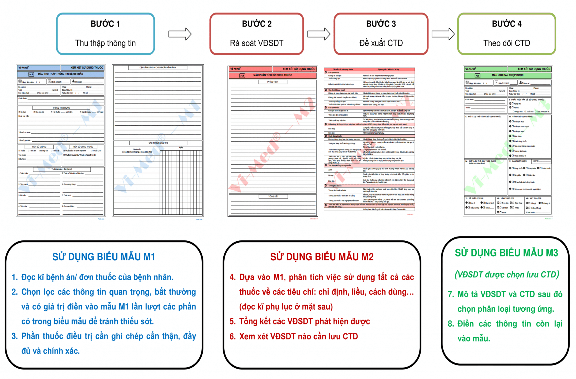
Figure 3.1. Process of using Vi – Med ® tool to review drug use
In terms of form, all 3 forms are quite similar due to their unified design but with different colors ( M1 – blue, M2 – red, M3 – green) and the numbers are printed on the background of the form so even when printed in black and white, they are still easy to distinguish. In terms of content, the main information sections in each form are suitable for the purpose of use of that form.
a) Form M1 – Patient information collection form
Form M1 is blue and has 2 sides. The main contents of the form include 4 parts: patient information, clinical examination results, paraclinical results - diagnostic imaging and treatment drugs. Because it is contained on 2 sides of 1 sheet of paper, only important, unusual and valuable information is recorded.
b) Form M2 – Drug Usage Analysis Form
Form M2 is red and has 2 sides.
The front of the form is a blank space for the pharmacist to analyze the use of all the patient's medications and then summarize the VĐSDT detected from the above analysis results.
The back of the form lists 8 main VDSDTs with simple definitions, specific descriptions or common examples for illustration. This is considered an appendix to support the analysis on the front, helping pharmacists review possible VDSDTs to avoid omissions, especially for complex medical records and prescriptions (patients with multiple diseases or using multiple drugs at the same time...)
c) Form M3 – Pharmaceutical intervention record form
The M3 form is green and has one side. Each M3 form is used to store only one CTD.
In the form, the VDSDT and CTD are specifically described in the two boxes on the left and the corresponding classification is selected in the two boxes on the right. The remaining information of a CTD is presented in a selection form: Who is the CTD proposed to? What is the form of CTD? and What are the results of the CTD?
3.2.2. Evaluation of the Vi – Med ® tool to support medication review
a) Reliability of the Vi – Med ® tool
The reliability of the Vi – Med ® tool was assessed by the consensus in classifying VDSDT and classifying CTD of the tool presented in Table 3.8.
Table 3.8. Levels of classification of drug use problems and pharmaceutical interventions
TT
Expert pharmacist pair | Classification of VDSDT | CTD Classification | |||
Cohen's Kappa (κ) | Ratio consensus (%) | Cohen's Kappa (κ) | Ratio consensus (%) | ||
1 | DS1 - DS2 | 0.71 | 76.7 | 0.78 | 83.3 |
2 | DS1 - DS3 | 0.67 | 73.3 | 0.87 | 90.0 |
3 | DS1 - DS4 | 0.71 | 76.7 | 0.82 | 86.7 |
4 | DS1 - DS5 | 0.80 | 83.3 | 0.87 | 90.0 |
5 | DS1 - DS6 | 0.67 | 73.3 | 0.78 | 83.3 |
6 | DS1 - DS7 | 0.78 | 83.3 | 0.91 | 96.7 |
7 | DS1 - DS8 | 0.91 | 93.3 | 0.96 | 96.7 |
8 | DS2 - DS3 | 0.88 | 90.0 | 0.91 | 93.3 |
9 | DS2 - DS4 | 0.75 | 80.0 | 0.77 | 83.3 |
10
DS2 - DS5 | 0.84 | 86.7 | 0.82 | 86.7 | |
11 | DS2 - DS6 | 0.79 | 83.3 | 0.82 | 86.7 |
12 | DS2 - DS7 | 0.75 | 80.0 | 0.78 | 83.3 |
13 | DS2 - DS8 | 0.71 | 76.7 | 0.82 | 86.7 |
14 | DS3 - DS8 | 0.67 | 73.3 | 0.91 | 93.3 |
15 | DS3 - DS4 | 0.63 | 70.0 | 0.86 | 90.0 |
16 | DS3 - DS5 | 0.72 | 76.7 | 0.91 | 93.3 |
17 | DS3 - DS6 | 0.92 | 93.3 | 0.82 | 86.7 |
18 | DS3 - DS7 | 0.66 | 73.3 | 0.86 | 90.0 |
19 | DS4 - DS5 | 0.84 | 86.7 | 0.86 | 90.0 |
20 | DS4 - DS6 | 0.71 | 76.7 | 0.77 | 83.3 |
21 | DS4 - DS7 | 0.75 | 80.0 | 0.81 | 86.7 |
22 | DS4 - DS8 | 0.79 | 83.3 | 0.86 | 90.0 |
23 | DS5 - DS8 | 0.80 | 83.3 | 0.91 | 93.3 |
24 | DS5 - DS6 | 0.80 | 83.3 | 0.82 | 86.7 |
25 | DS5 - DS7 | 0.67 | 73.3 | 0.86 | 90.0 |
26 | DS6 - DS7 | 0.66 | 73.3 | 0.78 | 83.3 |
27 | DS6 - DS8 | 0.75 | 80.0 | 0.82 | 86.7 |
28 | DS7 - DS8 | 0.78 | 83.3 | 0.95 | 96.7 |
Medium | 0.75 | 80.2 | 0.85 | 88.8 | |
Comment
Level of consensus when classifying the VĐSDT as “Good” (80.2% consensus and κ
= 0.75) and classified CTD as “Nearly Perfect” (88.8% agreement and κ = 0.85).
b) Satisfaction level with Vi – Med ® tool
Evaluation opinions about the Vi – Med ® tool are presented in Table 3.9.
Table 3.9. Evaluation results of Vi – Med ® tool
(unit: number of experts – %)
Likert scale *
Form | Content | Suitability | Usefulness | Ability to apply use | |||||
Clear | Unified | Enough space drum | Form M1 | Form M2 | Form M3 | ||||
Level 4 | 7 87.5% | 5 62.5% | 4 50% | 4 50% | 6 75% | 4 50% | 5 62.5% | 7 87.5% | 7 87.5% |
Level 3 | 1 12.5% | 3 37.5% | 4 50% | 4 50% | 2 25% | 4 50% | 3 37.5% | 1 12.5% | 1 12.5% |
( * Likert scale score for each indicator see Table 2.2)
Comment
Most of the experts were satisfied with the Vi – Med ® tool: 66.7% “ Very satisfied ” and 33.3% “ Satisfied ” in terms of form , 58.3% “ Very satisfied ” and 41.7% “ Satisfied ” in terms of content . Regarding the suitability of the Vi – Med ® tool for pharmaceutical practice conditions in Vietnam, 5 out of 8 experts rated it “ Very suitable ” and the remaining 3 pharmacists rated it “ Suitable ”. 7 out of 8 experts (87.5%) rated the Vi – Med ® tool “ Very useful ” and “ Definitely apply ” the Vi – Med ® tool in the future, the remaining expert rated the Vi – Med ® tool “ Useful ” and “ Possible to apply ” the tool in the future.