
1.1.5. Introduction to BIDV Bank in the Southeast region
According to the history of the BIDV system, the predecessors of BIDV branches in the Southeast region were 3 branches of Construction Bank (Dong Nai, Ba Ria-Vung Tau, and Song Be) established in 1976 under the decision of the Minister of Finance. After 43 years of continuous development, BIDV in the Southeast region currently has 15 branches and is always in the leading group of regions bringing high business efficiency, profit and the largest scale to the system. Notably, Binh Duong branch has been ranked as a "super branch" for 10 consecutive years from 2008 to present, along with 2 other branches: Hanoi and Ho Chi Minh City branches.
Currently, the network of the Vietnam Joint Stock Commercial Bank for Investment and Development is divided into 10 regions according to region and location. BIDV branches in the Southeast region are identified as Region 9, including 15 branches: Binh Duong, Nam Binh Duong, My Phuoc, Di An-Binh Duong, Thu Dau Mot (belonging to Binh Duong province) ; Ba Ria, Ba Ria-Vung Tau, Vung Tau-Con Dao, Phu My (belonging to Ba Ria-Vung Tau province) ; Dong Nai, Bien Hoa, Dong Nai, Nam Dong Nai (belonging to Dong Nai province) ; Binh Phuoc and Tay Ninh. This is also the industrial center, the key economic region of the South, as well as the whole country.
Like BIDV branches nationwide, BIDV in the Southeast region performs dependent accounting, following the management of the Head Office, which is BIDV Central, on financial revenue and expenditure, customer policies, product policies, general personnel policies, and senior personnel organization (Branch Board of Directors). In addition, BIDV branches in the Southeast region have a number of separate mechanisms according to the unit's characteristics in terms of products and business, are proactive in organizing business, distributing additional funds based on efficiency (incentive funds, motivational mechanisms, etc.), organizing and appointing qualified personnel from the middle level (deputy department heads) and below.
BIDV Southeast region has a large number of employees, as of December 2018.
3,150 employees, along with the advantage of being located in the industrial center of the country. In recent years, BIDV Southeast has had a high growth rate and good operating efficiency, shown through the business results data in Table 1.1 below:
Table 1.1. Business performance of BIDV in the Southeast region in the period 2016 - 2018
Unit: billion VND
Indicator name
2016 | 2017 | 2018 | 2017 vs. with 2016 | 2018 vs. with 2017 | |||
Level degree | Proportion (%) | Level degree | Proportion (%) | ||||
1. Total income net (TNR) | 2,111.84 | 2,437.50 | 3,156.36 | 325.66 | 15.4% | 718.86 | 29.5% |
- TNR from activities credit | 262.24 | 282.75 | 324.57 | 20.51 | 7.8% | 41.82 | 14.8% |
- TNR from activities fundraising | 900.16 | 1,540.50 | 2,028.05 | 640.34 | 71.1% | 487.55 | 31.6% |
- TNR from the condition internal transfer | 589.44 | 314.41 | 356.16 | - 275.04 | - 46.7% | 41.76 | 13.3% |
- TNR from activities finance | 76.00 | 132.47 | 277.99 | 56.47 | 74.3% | 145.52 | 109.8% |
- TNR from activities service | 204.00 | 138.19 | 136.90 | -65.81 | - 32.3% | -1.29 | -0.9% |
- Net income other | 80.00 | 29.19 | 32.70 | -50.82 | - 63.5% | 3.52 | 12.0% |
2. Cost | 531.84 | 534.11 | 565.03 | 2.27 | 0.4% | 30.93 | 5.8% |
- Management costs business | 335.84 | 348.47 | 384.67 | 12.63 | 3.8% | 36.21 | 10.4% |
- Other costs | 196.00 | 185.64 | 180.36 | -10.36 | -5.3% | -5.28 | -2.8% |
3. Income difference spend | 1,580.00 | 1,903.40 | 2,591.33 | 323.39 | 20.5% | 687.93 | 36.1% |
4. DPRR costs | 442.40 | 203.13 | 214.65 | - 239.28 | - 54.1% | 11.53 | 5.7% |
5. Pre-tax profit tax | 1,137.60 | 1,700.27 | 2,376.68 | 562.67 | 49.5% | 676.41 | 39.8% |
6. Tax payment | 307.20 | 459.10 | 613.53 | 151.90 | 49.4% | 154.43 | 33.6% |
7. Profit after tax | 830.40 | 1,241.18 | 1,763.15 | 410.77 | 49.5% | 521.98 | 42.1% |
Maybe you are interested!
-

 Summary of Soft Skills Classes Held at Bidv Bank in the Southeast Region
 -
 Introduction to Saigon Thuong Tin Commercial Joint Stock Bank (Sacombank)
 -
 Number and Composition of the Sample of Opinion Survey of High Schools in the Southeast Region
 -
 Improving the quality of lending to small and medium-sized enterprise customers at the Vietnam Development Investment Bank branch - bidv tu son - 7
 -
 Economic Development Goals of the Southeast Region for the 2006 – 2020 Period
Source: Consolidated report on business results of Region 9 (15 BIDV branches in Southeast)
1.2. Background of the problem
Banking is one of the important service industries in Vietnam. The government considers the monetary and banking system and the operations of credit institutions as the lifeblood of the economy, continuing to play a key role in the overall financial system of Vietnam.
According to the International Labor Organization (ILO), in the period 2016 - 2020, the banking industry in Vietnam will need to recruit an additional 1.6 million workers and it is expected that by 2020, the total number of workers in the industry will be about 300,000 people. However, according to the ILO report, about 26.6% of credit institutions are still lacking in labor and by the fourth quarter of 2018, more than 50% of credit institutions still need to recruit more.
Human resources in the banking industry are always in a state of crisis, although according to annual reports, bank employees' income is "sky-high", leading to a situation where "the outside wants to get in but the inside wants to get out". Many people dream of having the income of bank employees while the rate of bank employee turnover is alarmingly high.
According to the consolidated financial report of the fourth quarter of 2017 at nearly 20 banks, including both private and state-owned, three banks recorded a sharp decrease in the number of employees in 2017, including Vietnam Joint Stock Commercial Bank for Investment and Development (BIDV), National Citizen Bank (NCB) and Saigon - Hanoi Bank (SHB) (Source: Author's synthesis from financial reports).
At the parent bank BIDV in 2017, there was a decrease of 936 employees compared to the beginning of the year. Currently, the number of employees at BIDV is about more than 25,400 employees. The reason for the large fluctuations in human resources in 2017 at BIDV was due to instability in the internal personnel, many bank leaders were imprisoned, affecting the psychology of employees, leading to many employees quitting their jobs to find other places with more job security.
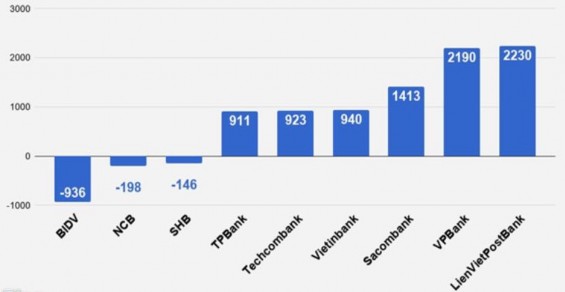
Figure 1.6. Number of employee changes at banks in 2017
Source: Zing news (2017)
1.3. Symptoms of the problem
At BIDV Southeast region, although it is one of the regions with "huge" employee income in the BIDV system (average income in 2018 was 29.2 million VND/month, higher than the system average of 27.5 million VND/month), it is also the place with the highest rate of resignation in the system. Specifically, in 2017, the resignation rate at BIDV Southeast region was 4.38%, while the average of the entire BIDV system was only 3.2%. In 2018, the rate and number of employees resigning at BIDV Southeast region decreased but were still higher than the average of the BIDV system.
Table 1.2. Number of employees leaving and new recruitment at BIDV Southeast Region in 2017-2018
Criteria
2017 | 2018 | Year 2018/2017 | |
Number of employees leaving | 223 | 181 | -42 |
Number of new hires | 90 | 128 | 38 |
Net increase or decrease in volume | -133 | -53 |
Source: BIDV's Personnel Organization Department compiled
Results from Table 1.2 show that in 2017 alone, the number of BIDV employees in the Southeast region decreased by 133 employees, the region with the largest decrease.
in the BIDV system. Although by the end of the third quarter of 2018, the number of employees leaving their jobs decreased compared to the same period last year, plus the number of new employees increased, it was still not enough to compensate for the decrease in employees due to resignation, not to mention the number of employees needed to recruit more for expansion and development needs.
1.4. Preliminary diagnosis of the cause and urgency of the problem
In order to find out the cause of the above phenomenon, the Personnel Organization Department of BIDV Bank Headquarters conducted statistics on the reasons for employees quitting their jobs in the Southeast region in 2017 and 2018. The statistical results are presented in Table 1.3 below:
Table 1.3. Summary of reasons for employee resignation at BIDV Southeast Region in 2017 & 2018
Reason
2017 | 2018 | |
% | % | |
Mission not completed | 3 | 2 |
Personal reasons | 15 | 17 |
Work-life balance is not possible. | 28 | 39 |
Human resource management policy | 31 | 14 |
No chance of advancement | 23 | 28 |
Total | 100 | 100 |
Source: BIDV's Personnel Organization Department compiled
The results of Table 1.3 show that the main reason for leaving work in 2017 was due to human resource management policies. However, the rate of leaving work in 2018 tended to increase due to the reason of not being able to balance work and life. In addition, the reason for leaving work due to lack of promotion opportunities also had a fairly high rate (accounting for 23% in 2017 and 28% in 2018).
Recruiting new employees or recruiting additional employees to compensate for the decrease in the number of employees is something that no business wants because it requires a lot of money, time, human resources, and material resources to train employees with enough qualities and skills for the job requirements. On the other hand, BIDV itself is also subject to the mechanism
Human resource organization for units with state-owned shares, so it is very limited in proactively recruiting more official employees due to the entanglement of the staffing mechanism or waiting for the time to enter the seasonal recruitment period of the system. Therefore, retaining employees and improving organizational commitment has become the most urgent problem today. Based on the situation that needs to be solved, the author chose the topic "Solutions to improve employee commitment at the Vietnam Joint Stock Commercial Bank for Investment and Development in the Southeast region" to find optimal solutions to help improve employee commitment at BIDV bank.
1.5. Research objectives
The general objective of the study is to find solutions to improve employee engagement at BIDV Bank in the Southeast region. To achieve this main objective, the specific objectives that need to be implemented are:
(1) Diagnose the symptoms of the problem, identify factors affecting employee engagement at BIDV Bank in the Southeast region;
(2) Analyze the current status of engagement to find out the reasons for the decrease in employee engagement at BIDV Bank in the Southeast region;
(3) Propose solutions to improve employee engagement at BIDV Bank in the Southeast region.
1.6. Research objects and scope
Research object: Employee engagement and factors affecting employee engagement at BIDV Bank in the Southeast region.
Research scope: BIDV Bank in the Southeast region (including 15 branches): the study selected 5 typical branches according to the provinces including: Binh Duong, Dong Nai, Binh Phuoc, Ba Ria-Vung Tau, Tay Ninh branches.
Survey subjects: Employees currently working at branches (Within the limits of the study) of BIDV Bank system in the Southeast region.
Proposed solution to be implemented by 2025.
1.7. Research methods
Data sources used
Secondary data: The study uses secondary data from BIDV Bank from 2016 to 2018 to analyze the current status of employee engagement at BIDV Bank in the Southeast region.
Primary data: Primary data collected from direct surveys of employees currently working at BIDV Bank system in the Southeast region from January 2019 to April 2019 was used to analyze the current situation, compare and contrast to find the cause of the problem, thereby providing a basis for proposing solutions.
Method of implementation
Qualitative research: The study used one-on-one and group interviews to determine factors affecting employee engagement at BIDV Bank in the Southeast region, thereby adjusting the scale to suit the banking business environment.
Quantitative research: Quantitative methods used in the study include testing the reliability of the scale (Cronbach's Alpha), exploratory factor analysis (EFA), descriptive statistics (mean value, standard deviation) to analyze the current status of employee engagement for BIDV bank in the Southeast region. The data collected after the survey will be processed using SPSS 25.0 software.
1.8. Practical significance of the topic
The research results have identified the components affecting employee engagement through an empirical survey at BIDV Bank in the Southeast region. The research has once again verified the components affecting employee engagement through an analysis of the current situation at BIDV Bank in the Southeast region. The results of the current situation analysis are the basis for proposing solutions to improve the engagement of bank employees at BIDV Bank in the Southeast region in particular and bank employees in the entire system in general.
1.9. Structure of the topic
The thesis has the following structure of 5 chapters: Chapter 1: Research overview
Chapter 2: Theoretical basis of engagement
Chapter 3: Current status of employee engagement at Vietnam Joint Stock Commercial Bank for Investment and Development in the Southeast region
Chapter 4: Proposing solutions to improve employee engagement at Vietnam Joint Stock Commercial Bank for Investment and Development in the Southeast region
Chapter 5: Conclusion