
648,067,008 USD (down -8.73%). In 2018, there were DL visitors to
4,186,432 arrivals, generating an income of 811,010,661 USD (up 8.21%). In 2019, there were 4,791,065 tourists visiting, generating an income of 934,710,409 USD (up 14.4%) and the number of days tourists stayed was 5 days. In 2020 alone, due to the Covid-19 pandemic, it has been affecting many aspects of socio-economic life in the country and in the locality, strongly affecting tourism activities in the province/city. From the first months of 2020 until now, the service and tourism industry has continued to decline sharply in both revenue and number of visitors compared to the previous year: in 2020, there were only 886,447 tourists visiting (a decrease of 3,904,618 people compared to 2019) and generated an income of 213,367,141 USD (a decrease of -81.5%) compared to 2019. Specifically, see table 4.1:
Table 4.1: International tourist arrivals and tourism income in Laos (2015-2020) and forecast 2025
Year
Number of visitors (turns) | Change (%) | Date of stay | Income (USD) | |
2015 | 4,684,429 | 13.0 | 4.8 | 725.365.681 |
2016 | 4,239,047 | - 10.0 | 4.8 | 724.191.957 |
2017 | 3,868,838 | - 8.73 | 5.2 | 648.067.008 |
2018 | 4,186,432 | 8.21 | 5.0 | 811.010.661 |
2019 | 4,791,065 | 14.4 | 5.0 | 934.710.409 |
2020 | 886,447 | - 81.5 | 5.0 | 213,367,141 |
Forecast | ||||
2025 | 5,823,202 | 20 | 9.0 | 1,210,169,259 |
Maybe you are interested!
-
 Identify Rating Levels and Rating Scales
zt2i3t4l5ee
zt2a3gstourism,quan lan,quang ninh,ecology,ecotourism,minh chau,van don,geography,geographical basis,tourism development,science
zt2a3ge
zc2o3n4t5e6n7ts
of the islanders. Therefore, this indicator will be divided into two sub-indicators:
a1. Natural tourism attractiveness a2. Cultural tourism attractiveness
b. Tourist capacity
The two island communes in Quan Lan have different capacities to receive tourists. Minh Chau Commune is home to many standard hotels and resorts, attracting high-income domestic and international tourists. Meanwhile, Quan Lan Commune has many motels mainly built and operated by local people, so the scale and quality are not high, and will be suitable for ordinary tourists such as students.
c. Time of exploitation of Quan Lan Island Commune:
Quan Lan tourism is seasonal due to weather and climate conditions and festivals only take place on certain days of the year, specifically in spring. In Quan Lan commune, the period from April to June and from September to November is considered the best time to visit Quan Lan because the cultural tourism activities are mainly associated with festivals taking place during this time.
Minh Chau island commune:
Tourism exploitation time is all year round, because this is a place with a number of tourist attractions with diverse ecosystems such as Bai Tu Long National Park Research Center, Tram forest, Turtle Laying Beach, so besides coming to the beach for tourism and vacation in the summer, Minh Chau will attract research groups to come for tourism combined with research at other times of the year.
d. Sustainability
The sustainability of ecotourism sites in Quan Lan and Minh Chau communes depends on the sensitivity of the ecosystems to climate changes.
landscape. In general, these tourist destinations have a fairly high level of sustainability, because they are natural ecosystems, planned and protected. However, if a large number of tourists gather at certain times, it can exceed the carrying capacity and affect the sustainability of the environment (polluted beaches, damaged trees, animals moving away from their habitats, etc.), then the sustainability of the above ecosystems (natural ecosystems, human ecosystems) will also be affected and become less sustainable.
e. Location and accessibility
Both island communes have ports to take tourists to visit from Van Don wharf:
- Quan Lan – Van Don traffic route:
Phuc Thinh – Viet Anh high-speed boat and Quang Minh high-speed boat, depart at 8am and 2pm from Van Don to Quan Lan, and at 7am and 1pm from Quan Lan to Van Don. There are also wooden boats departing at 7am and 1pm.
- Van Don - Minh Chau traffic route:
Chung Huong high-speed train, Minh Chau train, morning 7:30 and afternoon 13:30 from Van Don to Minh Chau, morning 6:30 and afternoon 13:00 from Minh Chau to Van Don.
f. Infrastructure
Despite receiving investment attention, the issue of infrastructure and technical facilities for tourism on Quan Lan Island is still an issue that needs to be resolved because it has a direct impact on the implementation of ecotourism activities. The minimum conditions for serving tourists such as accommodation, electricity, water, communication, especially medical services, and security work need to be given top priority. Ecotourism spots in Minh Chau commune are assessed to have better infrastructure and technical facilities for tourism because there are quite complete and synchronous conditions for serving tourists, meeting many needs of domestic and foreign tourists.
3.2.1.4. Determine assessment levels and assessment scales
Corresponding to the levels of each criterion, the index is the score of those levels in the order of 4, 3, 2, 1 decreasing according to the standard of each level: very attractive (4), attractive (3), average (2), less attractive (1).
3.2.1.5. Determining the coefficients of the criteria
For the assessment of DLST in the two communes of Quan Lan and Minh Chau islands, the students added evaluation coefficients to show the importance of the criteria and indicators as follows:
Coefficient 3 with criteria: Attractiveness, Exploitation time. These are the 2 most important criteria for attracting tourists to tourism in general and eco-tourism in particular, so they have the highest coefficient.
Coefficient 2 with criteria: Capacity, Infrastructure, Location and accessibility . Because the assessment area is an island commune of Van Don district, the above criteria are selected by the author with appropriate coefficients at the average level.
Coefficient 1 with criteria: Sustainability. Quan Lan has natural and human-made ecotourism sites, with high biodiversity and little impact from local human factors. Most of the ecotourism sites are still wild, so they are highly sustainable.
3.2.1.6. Results of DLST assessment on Quan Lan island
a. Assessment of the potential for natural tourism development
For Minh Chau commune:
+ Natural tourism attractiveness is determined to be very attractive (4 points) and the most important coefficient (coefficient 3), so the score of the Attractiveness criterion is 4 x 3 = 12.
+ Capacity is determined as average (2 points) and the coefficient is quite important (coefficient 2), then the score of Capacity criterion is 2 x 2 = 4.
+ Exploitation time is long (4 points), the most important coefficient (coefficient 3) so the score of the Exploitation time criterion is 4 x 3 = 12.
+ Sustainability is determined as sustainable (4 points), the important coefficient is the average coefficient (coefficient 1), so the score of the Sustainability criterion is 4 x 1 = 4 points
+ Location and accessibility are determined to be quite favorable (2 points), the coefficient is quite important (coefficient 2), the criterion score is 2 x 2 = 4 points.
+ Infrastructure is assessed as good (3 points), the coefficient is quite important (coefficient 2), then the score of the Infrastructure criterion is 3 x 2 = 6 points.
The total score for evaluating DLST in Minh Chau commune according to 6 evaluation criteria is determined as: 12 + 4 + 12 + 4 + 4 + 6 = 42 points
Similar assessment for Quan Lan commune, we have the following table:
Table 3.3: Assessment of the potential for natural ecotourism development in Quan Lan and Minh Chau communes
Attractiveness of self-tourismof course
Capacity
Mining time
Sustainability
Location and accessibility
Infrastructure
Result
Point
DarkMulti
Point
DarkMulti
Point
DarkMulti
Point
DarkMulti
Point
DarkMulti
Point
DarkMulti
CommuneMinh Chau
12
12
4
8
12
12
4
4
4
8
6
8
42/52
Quan CommuneLan
6
12
6
8
9
12
4
4
4
8
4
8
33/52
b. Assessment of the potential for humanistic tourism development
For Quan Lan commune:
+ The attractiveness of human tourism is determined to be very attractive (4 points) and the most important coefficient (coefficient 3), so the score of the Attractiveness criterion is 4 x 3 = 12.
+ Capacity is determined to be large (3 points) and the coefficient is quite important (coefficient 2), then the score of the Capacity criterion is 3 x 2 = 6.
+ Mining time is average (3 points), the most important coefficient (coefficient 3) so the score of the Mining time criterion is 3 x 3 = 9.
+ Sustainability is determined as sustainable (4 points), the important coefficient is the average coefficient (coefficient 1), so the score of the Sustainability criterion is 4 x 1 = 4 points.
+ Location and accessibility are determined to be quite favorable (2 points), the coefficient is quite important (coefficient 2), the criterion score is 2 x 2 = 4 points.
+ Infrastructure is rated as average (2 points), the coefficient is quite important (coefficient 2), then the score of the Infrastructure criterion is 2 x 2 = 4 points.
The total score for evaluating DLST in Quan Lan commune according to 6 evaluation criteria is determined as: 12 + 6 + 6 + 4 + 4 + 4 = 36 points.
Similar assessment with Minh Chau commune we have the following table:
Table 3.4: Assessment of the potential for developing humanistic eco-tourism in Quan Lan and Minh Chau communes
Attractiveness of human tourismliterature
Capacity
Mining time
Sustainability
Location and accessibility
Infrastructure
Result
Point
DarkMulti
Point
DarkMulti
Point
DarkMulti
Point
DarkMulti
Point
DarkMulti
Point
DarkMulti
Quan CommuneLan
12
12
6
8
9
12
4
4
4
8
4
8
39/52
Minh CommuneChau
6
12
4
8
12
12
4
4
4
8
6
8
36/52
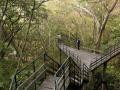
Basically, both Minh Chau and Quan Lan localities have quite favorable conditions for developing ecotourism. However, Quan Lan commune has more advantages to develop ecotourism in a humanistic direction, because this is an area with many famous historical relics such as Quan Lan Communal House, Quan Lan Pagoda, Temple worshiping the hero Tran Khanh Du, ... along with local festivals held annually such as the wind praying ceremony (March 15), Quan Lan festival (June 10-19); due to its location near the port and long exploitation time, the beaches in Quan Lan commune (especially Quan Lan beach) are no longer hygienic and clean to ensure the needs of tourists coming to relax and swim; this is also an area with many beautiful landscapes such as Got Beo wind pass, Ong Phong head, Voi Voi cave, but the ability to access these places is still very limited (dirt hill road, lots of gravel and rocks), especially during rainy and windy times; In addition, other natural resources such as mangrove forests and sea worms have not been really exploited for tourism purposes and ecotourism development. On the contrary, Minh Chau commune has more advantages in developing ecotourism in the direction of natural tourism, this is an area with diverse ecosystems such as at Rua De Beach, Bai Tu Long National Park Conservation Center...; Minh Chau beach is highly appreciated for its natural beauty and cleanliness, ranked in the top ten most beautiful beaches in Vietnam; Minh Chau commune is also home to Tram forest with a large area and a purity of up to 90%, suitable for building bridges through the forest (a very effective type of natural ecotourism currently applied by many countries) for tourists to sightsee, as well as for the purpose of studying and researching.
Figure 3.1: Thenmala Forest Bridge (India) Source: https://www.thenmalaecotourism.com/(August 21, 2019)
3.2.2. Using SWOT matrix to evaluate Quan Lan island tourism
General assessment of current tourism activities of Quan Lan island is shown through the following SWOT matrix:
Table 3.5: SWOT matrix evaluating tourism activities on Quan Lan island
Internal agent
Strengths- There is a lot of potential for tourism development, especially natural ecotourism and humanistic ecotourism.- The unskilled labor force is relatively abundant.- resource environmentunpolluted, still
Weaknesses- Poorly developed infrastructure, especially traffic routes to tourist destinations on the island.- The team of professional staff is still weak.- Tourism products in general
quite wild, originalintact
general and DLST in particularalone is monotonous.
External agents
Opportunity- Tourism is a key industry in the socio-economic development strategy of the province and Van Don economic zone.- Quan Lan was selected as a pilot area for eco-tourism development within the framework of the green growth project between Quang Ninh province and the Japanese organization JICA.- The flow of tourists and especially ecotourism in the world tends toincreasing
Challenge- Weather and climate change abnormally.- Competition in tourism products is increasingly fierce, especially with other localities in the province such as Ha Long, Mong Cai...- Awareness of tourists, especially domestic tourists, about ecotourism and nature conservation is not high.
Through summary analysis using SWOT matrix we see that:
To exploit strengths and take advantage of opportunities, it is necessary to:
- Diversify products and service types (build more tourism routes aimed at specific needs of tourists: experiential tourism immersed in nature, spiritual cultural tourism...)
- Effective exploitation of resources and differentiated products (natural resources and human resources)
div.maincontent .p { color: black; font-family:"Times New Roman", serif; font-style: normal; font-weight: normal; text-decoration: none; font-size: 14pt; margin:0pt; } div.maincontent p { color: black; font-family:"Times New Roman", serif; font-style: normal; font-weight: normal; text-decoration: none; font-size: 14pt; margin:0pt; } div.maincontent .s1 { color: black; font-family:"Times New Roman", serif; font-style: normal; font-weight: normal; text-decoration: none; font-size: 13pt; } div.maincontent .s2 { color: black; font-family:"Times New Roman", serif; font-style: normal; font-weight: normal; text-decoration: none; font-size: 13pt; } div.maincontent .s3 { color: #0D0D0D; font-family:"Times New Roman", serif; font-style: normal; font-weight: bold; text-decoration: none; font-size: 14pt; } div.maincontent .s4 { color: black; font-family:"Times New Roman", serif; font-style: italic; font-weight: normal; text-decoration: none; font-size: 14pt; } div.maincontent .s5 { color: black; font-family:"Times New Roman", serif; font-style: italic; font-weight: bold; text-decoration: none; font-size: 14pt; } div.maincontent .s6 { color: black; font-family:"Times New Roman", serif; font-style: italic; font-weight: normal; text-decoration: none; font-size: 14pt; vertical-align: -3pt; } div.maincontent .s7 { color: black; font-family:"Times New Roman", serif; font-style: italic; font-weight: normal; text-decoration: none; font-size: 14pt; vertical-align: -2pt; } div.maincontent .s8 { color: black; font-family:"Times New Roman", serif; font-style: italic; font-weight: normal; text-decoration: none; font-size: 14pt; vertical-align: -1pt; } div.maincontent .s9 { color: black; font-family:"Times New Roman", serif; font-style: normal; font-weight: normal; text-decoration: none; font-size: 14pt; } div.maincontent .s10 { color: black; font-family:"Times New Roman", serif; font-style: normal; font-weight: bold; text-decoration: none; font-size: 14pt; } div.maincontent .s11 { color: black; font-family:"Times New Roman", serif; font-style: normal; font-weight: normal; text-decoration: none; font-size: 14pt; } div.maincontent .s12 { color: black; font-family:Symbol, serif; font-style: normal; font-weight: normal; text-decoration: none; font-size: 14pt; } div.maincontent .s13 { color: black; font-family:Wingdings; font-style: normal; font-weight: normal; text-decoration: none; font-size: 14pt; } div.maincontent .s14 { color: black; font-family:"Times New Roman", serif; font-style: normal; font-weight: normal; text-decoration: none; font-size: 9pt; vertical-align: 5pt; } div.maincontent .s15 { color: black; font-family:"Times New Roman", serif; font-style: normal; font-weight: normal; text-decoration: none; font-size: 9pt; vertical-align: 5pt; } div.maincontent .s16 { color: black; font-family:Cambria, serif; font-style: italic; font-weight: normal; text-decoration: none; font-size: 14pt; } div.maincontent .s17 { color: #080808; font-family:"Times New Roman", serif; font-style: normal; font-weight: bold; text-decoration: none; font-size: 14pt; } div.maincontent .s18 { color: #080808; font-family:"Times New Roman", serif; font-style: normal; font-weight: normal; text-decoration: none; font-size: 14pt; } div.maincontent .s19 { color: black; font-family:"Times New Roman", serif; font-style: normal; font-weight: normal; text-decoration: none; font-size: 11pt; } div.maincontent .s20 { color: black; font-family:"Times New Roman", serif; font-style: normal; font-weight: normal; text-decoration: none; font-size: 10pt; } div.maincontent .s21 { color: black; font-family:"Times New Roman", serif; font-style: normal; font-weight: bold; text-decoration: none; font-size: 11pt; } div.maincontent .s22 { color: black; font-family:"Times New Roman", serif; font-style: normal; font-weight: normal; text-decoration: none; font-size: 11pt; } div.maincontent .s23 { color: black; font-family:"Times New Roman", serif; font-style: italic; font-weight: normal; text-decoration: none; font-size: 14pt; } div.maincontent .s24 { color: #212121; font-family:"Times New Roman", serif; font-style: normal; font-weight: normal; tex
Identify Rating Levels and Rating Scales
zt2i3t4l5ee
zt2a3gstourism,quan lan,quang ninh,ecology,ecotourism,minh chau,van don,geography,geographical basis,tourism development,science
zt2a3ge
zc2o3n4t5e6n7ts
of the islanders. Therefore, this indicator will be divided into two sub-indicators:
a1. Natural tourism attractiveness a2. Cultural tourism attractiveness
b. Tourist capacity
The two island communes in Quan Lan have different capacities to receive tourists. Minh Chau Commune is home to many standard hotels and resorts, attracting high-income domestic and international tourists. Meanwhile, Quan Lan Commune has many motels mainly built and operated by local people, so the scale and quality are not high, and will be suitable for ordinary tourists such as students.
c. Time of exploitation of Quan Lan Island Commune:
Quan Lan tourism is seasonal due to weather and climate conditions and festivals only take place on certain days of the year, specifically in spring. In Quan Lan commune, the period from April to June and from September to November is considered the best time to visit Quan Lan because the cultural tourism activities are mainly associated with festivals taking place during this time.
Minh Chau island commune:
Tourism exploitation time is all year round, because this is a place with a number of tourist attractions with diverse ecosystems such as Bai Tu Long National Park Research Center, Tram forest, Turtle Laying Beach, so besides coming to the beach for tourism and vacation in the summer, Minh Chau will attract research groups to come for tourism combined with research at other times of the year.
d. Sustainability
The sustainability of ecotourism sites in Quan Lan and Minh Chau communes depends on the sensitivity of the ecosystems to climate changes.
landscape. In general, these tourist destinations have a fairly high level of sustainability, because they are natural ecosystems, planned and protected. However, if a large number of tourists gather at certain times, it can exceed the carrying capacity and affect the sustainability of the environment (polluted beaches, damaged trees, animals moving away from their habitats, etc.), then the sustainability of the above ecosystems (natural ecosystems, human ecosystems) will also be affected and become less sustainable.
e. Location and accessibility
Both island communes have ports to take tourists to visit from Van Don wharf:
- Quan Lan – Van Don traffic route:
Phuc Thinh – Viet Anh high-speed boat and Quang Minh high-speed boat, depart at 8am and 2pm from Van Don to Quan Lan, and at 7am and 1pm from Quan Lan to Van Don. There are also wooden boats departing at 7am and 1pm.
- Van Don - Minh Chau traffic route:
Chung Huong high-speed train, Minh Chau train, morning 7:30 and afternoon 13:30 from Van Don to Minh Chau, morning 6:30 and afternoon 13:00 from Minh Chau to Van Don.
f. Infrastructure
Despite receiving investment attention, the issue of infrastructure and technical facilities for tourism on Quan Lan Island is still an issue that needs to be resolved because it has a direct impact on the implementation of ecotourism activities. The minimum conditions for serving tourists such as accommodation, electricity, water, communication, especially medical services, and security work need to be given top priority. Ecotourism spots in Minh Chau commune are assessed to have better infrastructure and technical facilities for tourism because there are quite complete and synchronous conditions for serving tourists, meeting many needs of domestic and foreign tourists.
3.2.1.4. Determine assessment levels and assessment scales
Corresponding to the levels of each criterion, the index is the score of those levels in the order of 4, 3, 2, 1 decreasing according to the standard of each level: very attractive (4), attractive (3), average (2), less attractive (1).
3.2.1.5. Determining the coefficients of the criteria
For the assessment of DLST in the two communes of Quan Lan and Minh Chau islands, the students added evaluation coefficients to show the importance of the criteria and indicators as follows:
Coefficient 3 with criteria: Attractiveness, Exploitation time. These are the 2 most important criteria for attracting tourists to tourism in general and eco-tourism in particular, so they have the highest coefficient.
Coefficient 2 with criteria: Capacity, Infrastructure, Location and accessibility . Because the assessment area is an island commune of Van Don district, the above criteria are selected by the author with appropriate coefficients at the average level.
Coefficient 1 with criteria: Sustainability. Quan Lan has natural and human-made ecotourism sites, with high biodiversity and little impact from local human factors. Most of the ecotourism sites are still wild, so they are highly sustainable.
3.2.1.6. Results of DLST assessment on Quan Lan island
a. Assessment of the potential for natural tourism development
For Minh Chau commune:
+ Natural tourism attractiveness is determined to be very attractive (4 points) and the most important coefficient (coefficient 3), so the score of the Attractiveness criterion is 4 x 3 = 12.
+ Capacity is determined as average (2 points) and the coefficient is quite important (coefficient 2), then the score of Capacity criterion is 2 x 2 = 4.
+ Exploitation time is long (4 points), the most important coefficient (coefficient 3) so the score of the Exploitation time criterion is 4 x 3 = 12.
+ Sustainability is determined as sustainable (4 points), the important coefficient is the average coefficient (coefficient 1), so the score of the Sustainability criterion is 4 x 1 = 4 points
+ Location and accessibility are determined to be quite favorable (2 points), the coefficient is quite important (coefficient 2), the criterion score is 2 x 2 = 4 points.
+ Infrastructure is assessed as good (3 points), the coefficient is quite important (coefficient 2), then the score of the Infrastructure criterion is 3 x 2 = 6 points.
The total score for evaluating DLST in Minh Chau commune according to 6 evaluation criteria is determined as: 12 + 4 + 12 + 4 + 4 + 6 = 42 points
Similar assessment for Quan Lan commune, we have the following table:
Table 3.3: Assessment of the potential for natural ecotourism development in Quan Lan and Minh Chau communes
Attractiveness of self-tourismof course
Capacity
Mining time
Sustainability
Location and accessibility
Infrastructure
Result
Point
DarkMulti
Point
DarkMulti
Point
DarkMulti
Point
DarkMulti
Point
DarkMulti
Point
DarkMulti
CommuneMinh Chau
12
12
4
8
12
12
4
4
4
8
6
8
42/52
Quan CommuneLan
6
12
6
8
9
12
4
4
4
8
4
8
33/52
b. Assessment of the potential for humanistic tourism development
For Quan Lan commune:
+ The attractiveness of human tourism is determined to be very attractive (4 points) and the most important coefficient (coefficient 3), so the score of the Attractiveness criterion is 4 x 3 = 12.
+ Capacity is determined to be large (3 points) and the coefficient is quite important (coefficient 2), then the score of the Capacity criterion is 3 x 2 = 6.
+ Mining time is average (3 points), the most important coefficient (coefficient 3) so the score of the Mining time criterion is 3 x 3 = 9.
+ Sustainability is determined as sustainable (4 points), the important coefficient is the average coefficient (coefficient 1), so the score of the Sustainability criterion is 4 x 1 = 4 points.
+ Location and accessibility are determined to be quite favorable (2 points), the coefficient is quite important (coefficient 2), the criterion score is 2 x 2 = 4 points.
+ Infrastructure is rated as average (2 points), the coefficient is quite important (coefficient 2), then the score of the Infrastructure criterion is 2 x 2 = 4 points.
The total score for evaluating DLST in Quan Lan commune according to 6 evaluation criteria is determined as: 12 + 6 + 6 + 4 + 4 + 4 = 36 points.
Similar assessment with Minh Chau commune we have the following table:
Table 3.4: Assessment of the potential for developing humanistic eco-tourism in Quan Lan and Minh Chau communes
Attractiveness of human tourismliterature
Capacity
Mining time
Sustainability
Location and accessibility
Infrastructure
Result
Point
DarkMulti
Point
DarkMulti
Point
DarkMulti
Point
DarkMulti
Point
DarkMulti
Point
DarkMulti
Quan CommuneLan
12
12
6
8
9
12
4
4
4
8
4
8
39/52
Minh CommuneChau
6
12
4
8
12
12
4
4
4
8
6
8
36/52
Basically, both Minh Chau and Quan Lan localities have quite favorable conditions for developing ecotourism. However, Quan Lan commune has more advantages to develop ecotourism in a humanistic direction, because this is an area with many famous historical relics such as Quan Lan Communal House, Quan Lan Pagoda, Temple worshiping the hero Tran Khanh Du, ... along with local festivals held annually such as the wind praying ceremony (March 15), Quan Lan festival (June 10-19); due to its location near the port and long exploitation time, the beaches in Quan Lan commune (especially Quan Lan beach) are no longer hygienic and clean to ensure the needs of tourists coming to relax and swim; this is also an area with many beautiful landscapes such as Got Beo wind pass, Ong Phong head, Voi Voi cave, but the ability to access these places is still very limited (dirt hill road, lots of gravel and rocks), especially during rainy and windy times; In addition, other natural resources such as mangrove forests and sea worms have not been really exploited for tourism purposes and ecotourism development. On the contrary, Minh Chau commune has more advantages in developing ecotourism in the direction of natural tourism, this is an area with diverse ecosystems such as at Rua De Beach, Bai Tu Long National Park Conservation Center...; Minh Chau beach is highly appreciated for its natural beauty and cleanliness, ranked in the top ten most beautiful beaches in Vietnam; Minh Chau commune is also home to Tram forest with a large area and a purity of up to 90%, suitable for building bridges through the forest (a very effective type of natural ecotourism currently applied by many countries) for tourists to sightsee, as well as for the purpose of studying and researching.
Figure 3.1: Thenmala Forest Bridge (India) Source: https://www.thenmalaecotourism.com/(August 21, 2019)
3.2.2. Using SWOT matrix to evaluate Quan Lan island tourism
General assessment of current tourism activities of Quan Lan island is shown through the following SWOT matrix:
Table 3.5: SWOT matrix evaluating tourism activities on Quan Lan island
Internal agent
Strengths- There is a lot of potential for tourism development, especially natural ecotourism and humanistic ecotourism.- The unskilled labor force is relatively abundant.- resource environmentunpolluted, still
Weaknesses- Poorly developed infrastructure, especially traffic routes to tourist destinations on the island.- The team of professional staff is still weak.- Tourism products in general
quite wild, originalintact
general and DLST in particularalone is monotonous.
External agents
Opportunity- Tourism is a key industry in the socio-economic development strategy of the province and Van Don economic zone.- Quan Lan was selected as a pilot area for eco-tourism development within the framework of the green growth project between Quang Ninh province and the Japanese organization JICA.- The flow of tourists and especially ecotourism in the world tends toincreasing
Challenge- Weather and climate change abnormally.- Competition in tourism products is increasingly fierce, especially with other localities in the province such as Ha Long, Mong Cai...- Awareness of tourists, especially domestic tourists, about ecotourism and nature conservation is not high.
Through summary analysis using SWOT matrix we see that:
To exploit strengths and take advantage of opportunities, it is necessary to:
- Diversify products and service types (build more tourism routes aimed at specific needs of tourists: experiential tourism immersed in nature, spiritual cultural tourism...)
- Effective exploitation of resources and differentiated products (natural resources and human resources)
div.maincontent .p { color: black; font-family:"Times New Roman", serif; font-style: normal; font-weight: normal; text-decoration: none; font-size: 14pt; margin:0pt; } div.maincontent p { color: black; font-family:"Times New Roman", serif; font-style: normal; font-weight: normal; text-decoration: none; font-size: 14pt; margin:0pt; } div.maincontent .s1 { color: black; font-family:"Times New Roman", serif; font-style: normal; font-weight: normal; text-decoration: none; font-size: 13pt; } div.maincontent .s2 { color: black; font-family:"Times New Roman", serif; font-style: normal; font-weight: normal; text-decoration: none; font-size: 13pt; } div.maincontent .s3 { color: #0D0D0D; font-family:"Times New Roman", serif; font-style: normal; font-weight: bold; text-decoration: none; font-size: 14pt; } div.maincontent .s4 { color: black; font-family:"Times New Roman", serif; font-style: italic; font-weight: normal; text-decoration: none; font-size: 14pt; } div.maincontent .s5 { color: black; font-family:"Times New Roman", serif; font-style: italic; font-weight: bold; text-decoration: none; font-size: 14pt; } div.maincontent .s6 { color: black; font-family:"Times New Roman", serif; font-style: italic; font-weight: normal; text-decoration: none; font-size: 14pt; vertical-align: -3pt; } div.maincontent .s7 { color: black; font-family:"Times New Roman", serif; font-style: italic; font-weight: normal; text-decoration: none; font-size: 14pt; vertical-align: -2pt; } div.maincontent .s8 { color: black; font-family:"Times New Roman", serif; font-style: italic; font-weight: normal; text-decoration: none; font-size: 14pt; vertical-align: -1pt; } div.maincontent .s9 { color: black; font-family:"Times New Roman", serif; font-style: normal; font-weight: normal; text-decoration: none; font-size: 14pt; } div.maincontent .s10 { color: black; font-family:"Times New Roman", serif; font-style: normal; font-weight: bold; text-decoration: none; font-size: 14pt; } div.maincontent .s11 { color: black; font-family:"Times New Roman", serif; font-style: normal; font-weight: normal; text-decoration: none; font-size: 14pt; } div.maincontent .s12 { color: black; font-family:Symbol, serif; font-style: normal; font-weight: normal; text-decoration: none; font-size: 14pt; } div.maincontent .s13 { color: black; font-family:Wingdings; font-style: normal; font-weight: normal; text-decoration: none; font-size: 14pt; } div.maincontent .s14 { color: black; font-family:"Times New Roman", serif; font-style: normal; font-weight: normal; text-decoration: none; font-size: 9pt; vertical-align: 5pt; } div.maincontent .s15 { color: black; font-family:"Times New Roman", serif; font-style: normal; font-weight: normal; text-decoration: none; font-size: 9pt; vertical-align: 5pt; } div.maincontent .s16 { color: black; font-family:Cambria, serif; font-style: italic; font-weight: normal; text-decoration: none; font-size: 14pt; } div.maincontent .s17 { color: #080808; font-family:"Times New Roman", serif; font-style: normal; font-weight: bold; text-decoration: none; font-size: 14pt; } div.maincontent .s18 { color: #080808; font-family:"Times New Roman", serif; font-style: normal; font-weight: normal; text-decoration: none; font-size: 14pt; } div.maincontent .s19 { color: black; font-family:"Times New Roman", serif; font-style: normal; font-weight: normal; text-decoration: none; font-size: 11pt; } div.maincontent .s20 { color: black; font-family:"Times New Roman", serif; font-style: normal; font-weight: normal; text-decoration: none; font-size: 10pt; } div.maincontent .s21 { color: black; font-family:"Times New Roman", serif; font-style: normal; font-weight: bold; text-decoration: none; font-size: 11pt; } div.maincontent .s22 { color: black; font-family:"Times New Roman", serif; font-style: normal; font-weight: normal; text-decoration: none; font-size: 11pt; } div.maincontent .s23 { color: black; font-family:"Times New Roman", serif; font-style: italic; font-weight: normal; text-decoration: none; font-size: 14pt; } div.maincontent .s24 { color: #212121; font-family:"Times New Roman", serif; font-style: normal; font-weight: normal; tex -
 Strategy for exploiting and developing the MICE tourist market at the International High-Quality Conference and Tourism Center - 16
 -
 Strategy for exploiting and developing the MICE tourist market at the International High-Quality Conference and Tourism Center - 1
 -
 Tourism promotion to attract international visitors to Hue - Da Nang - Quang Nam tourist cluster - 23
 -
 Maraj Rehman Sofi, Iqbal Ahmad Hakim And Mohd Rafiq (2014), “Service Quality Variables And Tourist Satisfaction At Destination Level – A Study Of J&k Tourism”, International Journal Of
Source: [ 47].
Table 4.1 shows that: By 2025, the number of tourists coming to Laos is estimated to reach 5,823,202, generating an average income of 1,210,169,259 USD (an increase of 20%) and the number of days tourists stay will be 9 days. By 2025, the Lao tourism industry strives to become a country with a developed tourism industry such as:
- Focus on building a system of unique and high-quality tourism products on the basis of promoting the value of unique tourism resources with outstanding strengths.
- Prioritize the development of cultural tourism as a foundation, develop ecological tourism, green tourism, humanistic tourism, spiritual tourism, resorts, entertainment, etc.
- Linking "regional product development" with regions and areas in the country and neighboring countries.
- Laos' important tourism markets are the Asia-Pacific region such as China, Japan, Korea and Australia; the European and American regions are France, UK, Germany and the US, etc.; the ASEAN region is Thailand, Vietnam, Malaysia, etc.
For the development of tourism in the South Central provinces of Lao PDR, it is inseparable from the general development of the tourism industry in the international and domestic context. Therefore, it is necessary to correctly recognize the development trends of the tourism industry in the region, the area and the world, which will create opportunities for orienting the development of the tourism industry in the South Central provinces of Lao PDR in a suitable manner in the integration period, towards sustainable tourism development.
4.1.2. Goals and directions for tourism economic development in the South Central provinces, Lao People's Democratic Republic to 2030
4.1.2.1. Goals for tourism economic development in the South Central provinces of the Lao People's Democratic Republic by 2030
- Effectively exploit and promote the potential of eco-tourism and cultural tourism.
Culture - History, strive to develop tourism into an important economic sector of the South Central provinces by 2025 - 2030 and become the tourism center of the South Central region.
- Focus on completing the "construction of infrastructure and technical facilities to ensure the sustainable development of ecological tourism and cultural - historical tourism in the South Central provinces" Ministry.
- Manage and improve the service quality of tourism service establishments (hotels, restaurants, etc.) to meet national and international standards.
- Improve and enhance the quality of existing tourism products, especially focusing on eco-tourism and spiritual tourism products; at the same time, build a number of new products with unique characteristics and high competitiveness.
- Steady growth in visitor numbers, strong increase in tourism revenue through high-class, high-spending visitor markets by focusing on investment and improving the quality of high-end tourism services. Forecast by 2025 the number of
The number of tourists to the South Central provinces is estimated to reach more than 10 million people, generating income of about 1,600 million kip.
- Annually organize regional tourism festivals to attract more and more domestic and international tourists to the South Central provinces.
- Develop a tourism program in combination with Vietnam and Thailand to organize a tourism route in the Central region of the three countries, following the East-West economic corridor.
4.1.2.2. Direction for continued development of tourism economy in the South Central provinces, Lao People's Democratic Republic until 2030
To accelerate the development speed and achieve high efficiency, contributing to the cause of national construction in general, and in particular, the construction and development of the South Central provinces is based on the potential strengths of tourism and the current status of tourism development of those provinces to determine the main directions for tourism development as follows:
Firstly, sustainable development of tourism actively accelerates the development of the productive forces of tourism in the South Central provinces towards a modern, integrated and highly competitive tourism industry: Tourism development policy in this direction is to contribute to the successful implementation of the country's industrialization and modernization, building a prosperous and strong society. Therefore, tourism needs to bring about changes in all areas of social life from political economy to national security and defense, culture, society, environmental protection, thereby promoting international economic integration activities. The South Central region has a strategic position in terms of political economy and national security and defense for the whole country. In addition, the South Central region concentrates many unique natural resources and valuable historical and cultural relics. The growth of a sustainable tourism industry contributes to socio-economic development, achieving the set goals, and preserving cultural values. Thus, tourism development needs to be placed in relation to other areas, especially national defense and security, in order to have measures to prevent unwanted negative impacts from tourism development on society and nature. In addition, tourism development in the South Central provinces needs to be planned in a way that not only maximizes the historical, religious, cultural, and scenic values of the region and preserves the environment, but also preserves and increasingly enhances the value of national culture, thereby helping the South Central provinces become national tourism centers.
Second, gradually perfecting production relations, combining sectors and economic sectors to liberate means of production and resources for the development of tourism in the South Central provinces: Tourism is a comprehensive economic sector with high inter-sectoral, inter-regional and socialization. Thus, when developing the tourism sector, it requires the support of other socio-economic sectors, including transportation, national security and defense, environment, insurance, health, etc. However, this relationship is two-way, the development of the tourism sector brings high socio-economic efficiency, which will create conditions for other economic sectors to develop. The mutual impact in the above relationship creates a requirement for the development of the tourism sector in the South Central region, which is to have a correct understanding of the role of linkages between sectors. On that basis, there is direction and close coordination with other sectors in the development process. If the interdisciplinary nature of tourism development can be promoted, it will mobilize economic sectors to participate in order to exploit all resources for the development of the South Central Coast tourism sector. Promoting the role of economic sectors will arouse all possibilities and effectively exploit all resources such as capital, knowledge, technology, labor, etc. domestically and internationally.
Therefore, the development of tourism is the task and responsibility of all levels, sectors, people's organizations and social organizations. In the process of planning and organizing the implementation of tourism development planning in the South Central provinces, it is necessary to promote the combined strength, ensure high unity and close coordination between all levels, sectors, social organizations and all people in the South Central region. To exploit the potential of economic sectors, mobilize all local resources, combine with the support of the Central Government and neighboring provinces to invest in tourism development in order to quickly turn tourism into an important economic sector at the beginning of the 21st century and a spearhead economic sector in the future.
Third, combining tourism in the South Central region with national tourism and international tourism: On the basis of the process of globalization and regionalization, the development of each State is always governed and bound by each other through international economic institutions both bilaterally and multilaterally. Like other economic sectors, tourism cannot avoid the above inevitable trend. The South Central provinces have many
Attractive tourist destinations with convenient exchange locations, diverse, rich and unique tourism resources for tourism development, in addition to promoting internal resources, tourism in the South Central provinces needs to take advantage of external resources in its development process. International economic integration and cooperation will help the tourism industry in the South Central provinces gradually penetrate into regional and international markets to attract investment capital, tourists, take advantage of support for human resource development, and strengthen tourism promotion in the South Central provinces. In order to meet the increasing demand for tourism, it is necessary to focus on investing in upgrading infrastructure, technical facilities, and diversifying tourism products to attract more and more domestic and foreign tourists to the South Central provinces. In the development process, it is necessary to have proactive business plans, based on forecasts of tourist traffic and their needs in the coming time.
Fourth, tourism development must be associated with ensuring national security and defense, preserving national cultural identity and the environment: Tourism development, on the one hand, has the effect of increasing economic growth, improving the cultural and spiritual life of the people, but on the other hand, it poses difficulties in maintaining national security and social order and safety. The South Central provinces are part of the economic, political and cultural center of the country. Therefore, in the strategic development orientation, solutions on tourism space planning, management organization, etc. It is necessary to thoroughly grasp, analyze and evaluate the market, orient tourism marketing work to ensure national security and social order and safety, strictly prohibit tourism activities that harm national security and the fine customs of local people. In particular, strictly handle all disturbances and acts of using the name of tourists to carry out political tasks to ensure political security and social order and safety. Developing tourism in the South Central provinces also needs to be associated with protecting a clean social environment. There needs to be strict management measures to prevent negative influences, harmful cultural flows, etc. from entering with tourists from many different regions and countries, which can harm the cultural and social environment of that locality.
4.2. MAIN SOLUTIONS TO DEVELOP TOURISM ECONOMY IN THE SOUTH CENTRAL PROVINCES OF THE LAOS PEOPLE'S DEMOCRATIC REPUBLIC BY 2030
4.2.1. Group of solutions to continue promoting the development of economic and tourism production forces in the South Central provinces, Lao People's Democratic Republic
4.2.1.1. Solutions for training tourism human resources in the South Central provinces, Lao People's Democratic Republic
Human resources are the decisive resource for the development of all sectors and fields. Tourism as a service economic sector, the human factor becomes even more important. To improve the quality of human resources serving tourism development, the South Central provinces need to implement the following solutions:
Firstly, strengthen propaganda and mobilization work to raise awareness among workers and society about the role, position and importance of the tourism industry in the socio-economic development of the region, thereby educating the awareness of learning to improve the professional qualifications of workers and all classes of people.
Second, strengthen the connection to develop a network of training facilities and foster human resources for tourism at the regional level. In particular, it is necessary to pay attention to investing in tourism training schools in key tourism centers such as: Vientiane Capital, Luang Prabang and Chan Pa Sac. Vientiane Capital has the advantage of a system of universities and colleges with experience in training human resources for the tourism industry (tour guides, tourism management, hotels, etc.) that can directly train for the locality or cooperate to support training. At the same time, it is necessary to form a tourism training department in vocational schools in the remaining localities.
Third, organize investigations, surveys, and correctly assess the current situation of cadres, civil servants, and laborers working in the tourism industry, on that basis, develop a strategy for training and fostering human resources, from state management officials, tourism activity managers to all laborers in the tourism industry of the South Central provinces from now until 2025 and 2030. The training strategy must be comprehensive, reasonable, and suitable to the requirements of tourism development, develop specific projects, plans, and projects; train and foster both ideology, thinking, qualities, ethics, state management level, professional skills, foreign language proficiency, and ability.
communication skills, and importantly, the level of understanding of world culture and history, culture and history of Laos and the South Central provinces. In addition, planning to train and retrain a number of workers who are working in the tourism industry with potential; must consider training and fostering talents for tourism in the South Central provinces, so that in the future, the South Central region will have tourism experts, continuing to explore, research, and exploit the priceless hidden values to develop tourism in the South Central provinces.
Fourth, training forms must be diversified, and training and human resource development for tourism must be socialized. Encourage the opening of non-public training facilities and facilities with legal foreign investment, diversify the types of schools, classes, and training centers, and human resource development for tourism in the whole region to form a training network at many levels. In addition, organize short-term, non-formal training courses to train the workforce working in the tourism industry according to a reasonable, professional, and practical occupational structure to meet the needs of the tourism industry in the coming time and can increase the scale of training to improve the quality of direct workers in the tourism industry, providing necessary skills for indirect workers and residents in the region participating in tourism business activities.
Fifth, the training and development of tourism human resources needs to encourage businesses, link training facilities to participate in on-site training programs, short-term training, and socialize vocational training to quickly provide human resources for tourism development. Closely link training facilities - hotels, tourism units - tourism vocational training centers to combine theoretical training with practice, to improve the quality of human resources for tourism. In addition, to improve the level of awareness, communication skills, civilized and friendly attitudes of local communities at tourism destinations. At the same time, it is necessary to equip knowledge of history and culture of each locality so that people can convey the unique features of their homeland to tourists.
4.2.1.2. Promoting the application of science and technology to serve the tourism economy in the South Central provinces of the Lao People's Democratic Republic
Researching the application of science and technology in tourism development is an extremely necessary requirement. To carry out this work, it is necessary to focus on the following basic contents:
Firstly, adequately allocate resources for applied research, strongly develop high technology to serve the field of state management of tourism, propose strategies for developing tourism products and markets in the region, increasingly diversifying in scale and quantity, improving the quality of tourism goods, creating the ability for tourism integration of the South Central provinces with regions across the country, each estimated to be on par with the region and the world.
Second, develop information technology applications in tourism activities. At the same time, organize training courses, guide, coach, and foster tourism businesses, make tourism business more and more effective, operate healthily, improve competitiveness, and meet market demand.
Third, raise awareness of environmental protection, save natural resources such as clean energy, clean water, etc. through the application of modern technology, and promote awareness among tourists. Thereby, limit pollution and waste.
Fourth, applying modern scientific and technological achievements to develop tourism in the region requires the participation of the whole society, especially the coordination of research institutes and universities to build application programs and develop technology in the tourism field. The application of modern science and technology to tourism activities in the South Central provinces can be in the following basic directions:
- Promote the application of information technology in tourism economic management by creating a management information system in the South Central region connected to domestic and international information centers.
- Applying the network connection of the entire hotel system in the region and international border gates to effectively count tourists.
- Apply online tourism business models (buying and selling hotel rooms, booking tours online...) to gradually shift to an e-commerce model in tourism when the conditions for technology infrastructure and legal corridors are adequate.
- Applying information and communication technology (internet, wifi, building a separate TV channel for tourism, advertising on famous TV channels...) in tourism promotion activities of the South Central region and the tourism industry.