
Coming to, experiencing life and daily activities in different cultures, therefore, the knowledge of the local people about the locality where they live is a very important factor in homestay tourism. When welcoming tourists to their family, the local people will be the tour guides for tourists, they must have an accurate understanding of the cultural characteristics of their own region to be able to introduce the beauty of their people in an attractive way. In addition, basic knowledge about life, awareness of environmental protection, healthy lifestyle... are also part of demonstrating civility and politeness in tourist localities. Therefore, tourism organizations and local authorities need to have training courses to support local people to have basic knowledge about tourism and culture accurately to avoid introducing incorrect or confusing history and culture of the region.
The statistical results of the observed variables in the Service Capacity scale also show that customers also pay a lot of attention to this group of variables, especially the variables "Meals and cooking materials ensure food safety and hygiene" and "The host provides safe and secure activities and services". Therefore, the security and safety of tourists is also an important factor that service providers must always pay attention to. It is necessary to have a minimum safety system and ensure effective and timely fire prevention and fighting in the locality. Ensuring security in crowded areas also needs to be paid attention to and taken seriously by the authorities. Along with the issue of cuisine, service providers need to pay special attention to food safety and hygiene, which is important not only for the health of tourists but also for themselves. Meals not only have regional characteristics, they also need to be safe and secure, because sometimes food is the factor that can attract tourists to return to that locality many times.
 Reliability
According to Table 4.20, Reliability has the second highest variable mean value (3.633) after the Empathy factor. It can be said that Reliability is also highly valued by tourists when experiencing homestay tourism. In particular, private space is paid attention to and the
Full fulfillment of promises from service providers helps increase Customer Satisfaction. This factor also received a high Beta value in the regression analysis results, showing that tourists pay a lot of attention to this factor with = 0.094.
Building customer trust is something that any service provider must strive to achieve. Homestay tourism is no exception. However, in reality, homestay tourism providers in Vietnam today hardly guarantee what they have promised, the photos, service packages offered or the introductions on magazines and posters mostly do not reflect the services provided. This can easily make tourists feel disappointed from the first moment. Therefore, service providers need to pay attention when advertising, promoting their image to be truthful and ensuring that they can fulfill what they have promised, this will promote the intention to return and word of mouth behavior of tourists.
 Response level
Although this factor does not receive much attention from tourists, it also affects tourist satisfaction with = 0.05.
Currently, Vietnamese homestays are spontaneous, so meeting the needs of tourists is impossible. Although the response is not of much concern to tourists, it will also contribute to affecting the satisfaction of tourists when participating in homestay tourism. Therefore, service providers need to ensure that they meet the minimum and reasonable needs of tourists when experiencing the service, especially the issue of food and ensuring food hygiene and safety. Delicious and typical dishes with strong regional identity will contribute to attracting tourists, and there is nothing better than when tourists can make those dishes themselves, they will contribute to bringing those dishes to everyone, thereby creating curiosity for those who have never set foot in that locality.
 In addition to the above implications, in order for homestay tourism to develop further and bring more income to local people, in my opinion,
The author's personal, local agencies, government and non-government tourism organizations should have a plan to systematically build a homestay tourism program to create uniformity in service quality as well as the general image of Vietnamese homestay, thereby not only attracting domestic tourists but also easily creating trust and interest from international tourists as a tourism image of the country introduced to the world. At the same time, service-providing households must also pay attention to their lifestyle and activities to become more and more civilized, accompanying local authorities to build a beautiful tourism image in the eyes of domestic and foreign tourists.
5.3. Significance of the study:
The research results show that the quality of homestay tourism services has a direct and positive impact on the satisfaction of domestic tourists, thereby determining their behavioral intentions in the future. It is important for a service provider to understand the expectations and needs of customers, what they want when using the service, but this is currently lacking in the homestay tourism sector in Vietnam. In fact, this result is very useful in understanding tourists, as well as evaluating the current service quality of homestays, the choice trends and word-of-mouth behavior of tourists in the future, which gives service providers suggestions to improve and enhance service quality, meet the needs and expectations of tourists in the future, attract more tourists to experience this type of tourism and domestic tourists will thereby have the opportunity to better understand their country.
5.4. Limitations of the study
Because the sampling method is convenient, the feelings and assessments received do not cover all ages and social classes, so the research results do not represent the thoughts and feelings of almost all tourists.
5.5. Further research directions
This topic only stops at a scientific research topic, it points out a good measurement tool, indicating the relationship between the quality of homestay tourism services - a multi-dimensional concept for the satisfaction and behavioral intentions of domestic tourists in Vietnam. Based on this research, local management agencies, tourism organizations, homestay tourism service providers in Vietnam or subsequent researchers can continue to interview foreign tourists who have experienced Vietnamese homestays, thereby being able to give more specific and accurate assessments, thereby giving directions for developing their services as well as identifying the target tourists.
In addition, future studies can repeat or adjust the model based on the results of qualitative research to discover new factors that better match current and future tourist expectations. Furthermore, the sample size of future studies can be increased.
In addition, this study only considers the impact of service quality on tourists' satisfaction and behavioral intentions. There may be many other factors of homestay that can affect tourists' satisfaction and future intentions that have not been mentioned in the article, such as factors of local cultural characteristics, landscape, transportation, etc. Therefore, further studies are needed to explore other factors, improve the model by considering related structures, suitable for the Vietnamese market.
REFERENCES
Vietnamese References
1. Ha Nam Khanh Giao and Le Thai Son (2013), "Factors affecting tourist satisfaction to Hoi An Ancient Town" , Journal of Technical Economics, Vol. 6, pp. 9-20.
2. Hoang Trong and Chu Nguyen Mong Ngoc, 2008. SPSS research data analysis - Volume 1, Ho Chi Minh City, Hong Duc Publishing House.
3. Hoang Trong and Chu Nguyen Mong Ngoc, 2008. SPSS research data analysis - Volume 2, Ho Chi Minh City, Hong Duc Publishing House.
4. Le Huu Trang (2007), Research on customer satisfaction with hotel services of An Giang Tourism Joint Stock Company , Master's thesis, Ho Chi Minh City University of Economics.
5. Nguyen Dinh Tho, 2011, Scientific research methods in business, Ho Chi Minh City, Labor - Social Publishing House.
6. General Department of Tourism , Ministry of Culture, Sports and Tourism (Online) http://www.vietnamtourism.gov.vn/ .
English References
1. Cronin, JJ and Taylor, S. A (1994), “SERVPERF versus SERVQUAL: Reconciling Performance-Based and Perceptions-Minus-Expectations Measurements o Service Quality” Journal of Marketing , 58(1), 125- 131.
2. Ching-Fu Chen, Fu-Shian Chen (2010) Experience quality, perceived value, behavioral satisfaction and intentions for heritage tourists. Tourism Management 31 (2010) 29–35.
3. Javier Sa´ nchez, Luı´ s Callarisa, Rosa M. Rodrı´guez, Miguel A. Moliner (2004) Perceived value of the purchase of a tourism product. Tourism Management 27 (2006): 394–409
4. Maraj Rehman Sofi, Iqbal Ahmad Hakim and Mohd Rafiq (2014), “Service Quality Variables and Tourist Satisfaction at Destination Level – A Study of J&K Tourism”, International Journal of Applied Research and Studies (iJARS). (2014), 3(2), pp. 1 – 9.
5. Mohd Noor Ismawi Ismail*, Mohd Hafiz Hanafiah, Norliza Aminuddin and Norazah Mustafa (2015) Community-Based Homestay Service Quality, Visitor Satisfaction, and Behavioral Intention. Procedia - Social and Behavioral Sciences 222 ( 2016 ): 398 – 405
6. Mukhles AlAbabneh (2013), “Service Quality and its Impact on Tourist Satisfaction”, Interdisciplinary Journal of Contemporary Research in Business,12, pp. 164 – 177
7. Nguyen Quang VINH (2013) Destination Culture and Its Influence on Tourist Motivation and Tourist Satisfaction of Homestay Visit. Journal of the Faculty of Economics and Administrative Sciences Y.2013, Volume 3, Issue 2, pp.199-222
8. Oliver (2010), “Satisfaction: A Behavioral Perspective on the Consumer”, Irwin/McGraw-Hill, New York, NY.
9. Parasuraman, A., Zeithaml, VA and Berry, LL (1985), "A conceptual model of service quality and its implications for future research", Journal of Marketing, Vol. 49, Falls, pp. 1, 41-50.
10. Parasuraman, A., Zeithaml, VA and Berry, LL (1988), "SERVQUAL: a multi-item scale for measuring consumer perceptions of the service quality", Journal of Retailing, Vol. 64, No. 1, pp. 12-40.
11. Parasuraman, A., Zeithaml, VA and Berry, LL (1991), "Refinement and reassessment of the SERVQUAL scale", Journal of Retailing, Vol. 67, pp. 420-450.
12. Paul Williams (2000) Dimensions of Customer Value and the Tourism Experience: An Exploratory Study. ANZMAC 2000 Visionary Marketing for the 21st Century: Facing the Challenge: 1415-1421
13. Salamiah A. Jamal , Nor'Ain Othman & Nik Maheran Nik Muhammad (2014) The Moderating Influence of Psychographics in Homestay Tourism in Malaysia. Journal of Travel & Tourism Marketing, 28:1, 48-61
14. Salamiah A. Jamal, Nor'Ain Othman and Nik Maheran Nik Muhammad (2011) Tourist perceived value in a community-based homestay visit: An investigation into the functional and experiential aspects of value. Journal of Vacation Marketing 2011.
15. Salamiah A. Jamal & Nor'Ain Othman (2009) CONSUMER PERCEIVED VALUE: A MULTIPLE ITEM SCALE IN COMMUNITY-BASED HOMESTAY TOURISM.
Online: https://www.researchgate.net/publication/236944587
16. Suansri P (2003) Community-based Tourism: Principles and Meaning [Electronic version], Community based tourism handbook. Available at: http://www.rest.or.th/training/handbook.shtml(accessed 27 May 2008 ).
17. Sweeney J and Soutar GN (2001) Consumer perceived value: the development of a multiple item scale. Journal of Retailing 77: 203–220.
18. Vietnam National Administration of Tourism (2015), Annual the report of tourism.
19. WTTC., (2015).World: The 2015 Travel and Tourism Economic Research,
(Online) http:// www.wttc.org .
20. Wu CH-J and Liang RD (2009) Effect of experiential value on customer satisfaction with service encounters in luxury-hotel restaurants. International Journal of Hospitality Management 28: 586–593
21. Žabkar, V., Brenčič, M.M., & Dmitrović, T. (2010). Modeling perceived quality, visitor satisfaction and behavioral intentions at the destination level. Tourism Management, 31(4), 537-546
APPENDIX
APPENDIX 01: DISCUSSION OF THE RESEARCH DETERMINATION
Appendix 1.1: Expert discussion outline:
Dear Sir/Madam, I am Nguyen Ngoc Diem Phuong, a graduate student of Business Administration, University of Economics, Ho Chi Minh City. I am currently researching the topic "Research on the relationship between service quality, satisfaction and behavioral intentions of tourists towards the community-based tourism type "Homestay" in Vietnam". I look forward to receiving your help with your feelings and assessments of the current type of Homestay tourism service in Vietnam. This discussion is for reference purposes and is a valuable source of information for scientific research.
Question 1: Please give your opinion on which of the following quality factors affect tourists' satisfaction when experiencing homestay services at tourist destinations in Vietnam.
1. Reliability:
- Tourists still have private space when staying at the host's house.
- The host is committed to protecting the privacy of guests' data and personal information. |
- The landlord always fully performs the services promised initially. |
- Provide the promised travel packages in the best and fastest way |
Maybe you are interested!
-

 Number of Domestic Tourists in Vietnam from 2000 - 2007
 -
 Factors affecting the decision to choose domestic tour programs of tourists researched at Lua Viet Tourism Company Limited - 15
 -
 Bidding of domestic contractors in international construction bidding - 15
 -
 Social work services for men in reducing domestic violence from the practice of Quang Ninh province - 26
 -
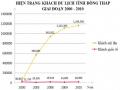 Number of International and Domestic Tourists in the Period 2001 – 2010
Opinion:....................................................................................................................
2. Response:
- Services are provided promptly
- The host is ready to help guests when needed. |
- Always put the needs of visitors first |
- Support tourists with meals, especially local specialties |
- The owner is polite, kind and has a civilized lifestyle. |
Opinion:....................................................................................................................