
- The teacher organizes students to discuss in pairs with the following requirements: One student gives the division problem, one student finds the result and identifies the components in the problem, then switches tasks.
When carrying out the above activities, teachers have enriched students' vocabulary of foreign languages. At the same time, students understand the meaning of the terms and know how to apply them when doing exercises.
Example 3 : Forming mathematical symbols, terms and semantics of NNTH for students when teaching the lesson "Reduce by a number" (Math 3, page 37)
Maybe you are interested!
-
 Some measures to help students in the first grades of primary school use mathematical language effectively - 14
 -
 Deviant Behavior of PCT Group in High School Students (%, N=448)
 -
 Training creative thinking for high school students through solving some Algebra - Analysis exercises in many ways - 6
 -
 Directing the Implementation of Experiential Activities for Elementary School Students
 -
 Organizing Professional Training for Managers and Teachers to Organize Experiential Activities and Career Guidance for High School Students
Step 1: Introduce mathematical symbols and terms
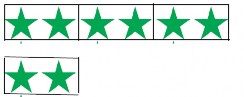
- Teacher presents the situation: I have 6 stars, I divide them equally into three boxes. How many stars are there in each box?
- Students observe the picture and answer the questions.
+ How many stars are there in the top row? (6 stars)
+ 6 stars are divided into how many parts? (3 parts)
+ How many stars are there in a part? (2 stars)
+ How many stars are there in the row below? (2 stars)
+ How many times more stars are there in the top row than in the bottom row? (3 times more)
The number of stars in the upper row is 3 times the number of stars in the lower row, or we say the number of stars in the upper row is reduced by 3 times to get the number of stars in the lower row.
+ To find the number of stars in the bottom row, what calculation is done? (Division)
+ Take how many divided by how many? (take 6 divided by 3)
+ How many stars are there in the bottom row? (2)
+ How do we find the number of stars in the bottom row? (6 divided by 3 equals 2) The teacher asks the students to repeat: To find the number of stars in the bottom row, we divide 6 by 3. Step 2 : Receive the semantics of the NNTH
To reduce a number of times is to make less in quantity or degree.
+ How do we reduce a number many times? (divide the number by the number of times). Teacher: To reduce a number many times, we divide the number by the number of times.
Step 3: Use mathematical symbols and terms
The teacher organizes students to work in pairs to practice. The teacher and a student present a sample situation: If we want to lose 10 kg by 5 times, what should we do? Then the student will answer 10 : 5. Then the teacher and the student change tasks. After the students finish working in pairs, the teacher organizes the students to report the results.
Measure 2. Organize for students to acquire the syntax of the target language.
a) Purpose of the measure
Measures to help students:
- Understand and write mathematical symbols correctly; know how to connect mathematical symbols correctly.
- Reduce syntax errors when solving mathematical problems.
- Understand mathematical content through effective use of NNTH, contributing to the development of abstract thinking.
b) Content and implementation of measures
In teaching Mathematics, if we only understand the semantics of symbols and terms in the NNTH, the ability to solve mathematical problems will be limited. Because both the semantic and syntactic aspects of the NNTH show the relationship between content and form in mathematics. If we only focus on the semantic aspect, students will not learn how to use the formal tools of mathematics, the ability to think abstractly will be limited; if we focus on the syntactic aspect, students' mathematical knowledge will only be formal, students will not be able to apply it in practice [27, p. 96]. Therefore, the measure to address the problem of forming the syntax of the NNTH aims to help students use the NNTH correctly in solving problems.
To help students learn the syntax of foreign languages, teachers can follow these steps:
Step 1: Form mathematical symbols
In learning, students mainly work with symbols when solving mathematical problems. In NNTH, a symbol is sometimes expressed by a word or phrase. If students apply the rules and writing methods as in NNTN, they will not grasp how to write symbols.
mathematical symbols. To form mathematical symbols, teachers introduce detailed writing methods to students. Teachers can prepare a side board with correct and incorrect writing methods for students to recognize, helping to deepen the image of the newly formed symbols.
After students have mastered how to write mathematical symbols, teachers let students practice writing on small boards and in notebooks. Teachers organize students to solve mathematical problems using newly formed symbols and learned symbols. This helps students see the connection between newly formed symbols and learned symbols, and know how to use symbols in learning.
Step 2: Link the mathematical symbols
Individual mathematical symbols are linked according to certain rules of the NNTH, however, the rules on how to link these are not stated in words but must be understood by students through writing examples. In this step, teachers need to help students know how to link mathematical symbols according to the correct syntax of the NNTH.
For example, in the first grades of primary school, students are introduced to the four arithmetic operations (addition, subtraction, multiplication, division) of natural numbers. Right from the first lessons when forming students' ways to write addition operations (grade 1), teachers introduce in detail and carefully the position, order of numbers, calculation signs, and equal signs in the operation. When learning how to write operations, students recognize that the calculation sign is always between two numbers, and the equal sign is placed before the result of the operation. Teachers provide correct and incorrect ways of writing for students to recognize and correct. Through that, students realize that the way of writing operations is the connection of mathematical symbols and complies with the syntax rules of NNTH. Especially when guiding students to place calculations in vertical columns, teachers pay attention to the way of writing and ask students to practice and present the way of placing calculations.
Step 3: Practice using NNTH syntax
In addition to linking mathematical symbols according to the correct syntax of the NNTH, teachers need to help students know how to link mathematical symbols to be informed about meaningful mathematics. When practicing using the syntax of the NNTH, it should be associated with specific mathematical situations so that students can use it flexibly and write the correct syntax of the NNTH. While practicing, teachers can organize students to work in groups to complete the study sheet.
The purpose of this exercise is to help students understand and master how to write in NNTH and use it flexibly to solve math problems.
c) Notes when implementing measures
- Teachers need to pay attention to each individual student, promptly correct and correct students who write wrong mathematical symbols and syntax of the textbook.
- In practice, teachers need to effectively utilize students' learning tools such as small boards and scratch paper for students to practice writing. Through that, teachers can grasp the situation of students' comprehension of writing NNTH.
- Learning through mistakes helps students discover incorrect writing, know how to correct it for their friends and themselves, helps deepen knowledge, contributes to language and communication development. Therefore, teachers need to let students know how to write correctly, how to write incorrectly and ask students to correct it.
- When teaching students how to write units of length and mass, it is important to remind them not to capitalize, not to write higher, and not to put a period right after the unit symbol (except for punctuation marks).
d) Illustrative example
Example 1: Organize students to learn and use the symbol "<" when teaching the lesson "Smaller than".
Sign <” (Math 1, page 17).
Step 1 : Forming the way to write the symbol <
- The teacher lets students observe the sign < then asks students to find the sign < in the math learning tools.
- The teacher introduces how to write the less than sign (<) carefully and in detail to the students.
- Organize students to practice writing the symbol <.
Step 2: Link the mathematical symbols
The teacher introduces the correct syntax of NNTH: The symbol < is always between two numbers.
The teacher introduces how to connect mathematical symbols to get meaningful mathematical information: (small number) (< sign) (large number). For example, 1 is less than 2, write 1 < 2.
Step 3: Practice using NNTH syntax
- The teacher organizes for students to use the math learning tools. The teacher makes statements and students select and arrange them to ensure correct syntax and math content. For example, if the teacher states "one is less than two", students must arrange them correctly (1 < 2). Then the teacher organizes for students to discuss in pairs, one student speaks orally and one student writes symbols, then switches tasks.
Example 2: Organize students to understand and use the symbol "cm" when teaching the lesson "centimeter. Measuring length" (Math 1, page 119).
Step 1: Forming the way to write the symbol "cm"
- The teacher introduces how to write the centimeter unit. First grade students encounter many difficulties and confusion when learning the unit of length "centimeter". Therefore, the teacher needs to guide students on how to abbreviate centimeter, which consists of the letters "c" and "m" written together as "cm". Although it is written as "cm", when reading it, it must be read as "centimeter".
- Teachers organize for students to recognize the correct and incorrect ways to write symbols so that students can remember and deepen their understanding of writing.
Step 2: Link the mathematical symbols
- The teacher clearly introduces to students how to write length measurements in centimeters, which is written according to the structure: (number) (cm). However, the teacher does not give students this structure but forms the way of writing through examples. For example, if you want to express the length of a piece of chalk as five centimeters, write 5cm.
- Teachers note students on correct and incorrect writing. For example, write 5cm, not cm5 or c5m.
Step 3: Practice using NNTH syntax
- The teacher organizes for students to practice writing on the board and in their notebooks. The teacher observes and checks the students' writing. The teacher can read for the students to write on the board. For example, the teacher reads "four centimeters", the students practice writing "4cm".
- Teachers organize students to complete exercises in the textbook.
Example 3: Organize students to comprehend and use the symbols of multiplication when teaching the lesson "Multiplication" (Math 2, page 92).
Step 1: Forming a way to write mathematical symbols
- Teacher introduces how to write the multiplication sign (×).
- The teacher asks students to observe the multiplication sign and give comments (consisting of two slashes, similar to the letter x in the alphabet), thereby helping students remember the symbol and not confuse it with other math signs.
Step 2: Link the mathematical symbols
- Students already know how to write the correct syntax of the multiplication and subtraction operations. Furthermore, multiplication is formed through the addition of equal terms. Therefore, the teacher organizes for students to form the correct syntax for multiplication. The teacher asks students to state how to write specific multiplication operations. For example, the teacher asks students to state how to write and write the calculation 2 × 5 = 10.
- Teachers organize for students to identify the correct and incorrect ways to write the syntax of NNTH for multiplication.
Step 3: Practice using NNTH syntax
- The teacher organizes students to work in groups of 3 in the following form: 1 student forms an addition problem, 1 student writes an addition problem, 1 student writes a multiplication problem, then switches tasks. For example, 1 student says "three plus three equals six", 1 student writes the addition problem 3 + 3 = 6, 1 student writes the multiplication problem 3 × 2 = 6.
- The teacher organizes for students to connect with reality to form multiplication operations. The teacher organizes for students to work in pairs with the task of 1 student stating the statement, 1 student writing the calculation.
- Teachers organize students to complete exercises in the textbook.
2.3.2. Group of measures 2: Training students to use NNTH
Once students have formed their knowledge of mathematical concepts, it is necessary to organize students to practice and use mathematical concepts. The process of using mathematical concepts will help students understand deeply, grasp firmly and transfer the acquired knowledge into their own knowledge. At the same time, through the use of mathematical concepts, students will master mathematical knowledge, contributing to the development of thinking.
Measure 1: Practice for students to use NNTH in teaching concepts
a) Purpose of the measure
Measures to:
- Practice for students to use correct NNTH in teaching concepts.
- Help students understand and grasp mathematical concepts through effective use of NNTH in learning Math; Use NNTH flexibly in reasoning, solving problems, and overcoming language difficulties.
b) Content and implementation of measures
Mathematical concepts are abstract for primary school students. Therefore, to be suitable for perception, physical and language development, Math textbooks for the first grades of primary school should form for students the concept of natural numbers, initial concepts in Geometry, Quantity and measurement of quantity in a descriptive way through visual images. However, in order for students to understand deeply and grasp the concepts, the issue of mathematical concepts in teaching needs to be concerned. The content of the measure refers to practicing the effective use of mathematical concepts for students through the use of mathematical concepts to receive concepts or activities with newly formed mathematical concepts, how to link symbols and terms in the process of consolidating concepts.
To train students to effectively use NNTH in teaching concepts, teachers should follow these steps:
Step 1: Use NNTH to receive mathematical concepts
Mathematical concepts in elementary math classes are mainly formed through visual images, drawings, and models. Teachers let students observe visual images and pose a system of questions to guide students in forming new knowledge. Teachers can maximize students' existing life experiences and experiences to create learning activities that help students construct knowledge. Through teaching and learning methods, teachers create conditions for students to use visual aids in the process of forming concepts. Students use existing mathematical knowledge with visual aids as tools to construct, explore, and acquire new knowledge.
For example, natural numbers are used a lot in daily life to convey information, so they are very familiar to students' lives. In teaching
To form the concept of natural numbers, teachers create an environment for students to explore and construct knowledge for themselves. When forming natural numbers within 10, teachers organize activities on learning materials, observe visual images, then use spoken language to express the perceived content and from there teachers guide students to form the concept of numbers.
In teaching the formation of Geometry concepts or concepts of Quantity and measurement of quantity, teachers create an environment for students to practice using NNTH in the process of acquiring new concepts. Teachers can organize for students to practice and manipulate on real objects and create conditions for students to use NNTH when forming concepts related to units of measurement of quantity.
Step 2: Use NNTH to practice applying the concept
Students not only use NNTH to receive concepts but also use NNTH in practice applying concepts. To help students understand deeply and grasp concepts, teachers need to flexibly apply teaching methods and forms to create opportunities for students to practice using NNTH. Teachers can design study sheets to both use mathematical concepts in problem solving and practice using NNTH. Moreover, concepts in Mathematics in the first grades of primary school are mainly introduced to students through visual images and specific examples, so when applying concepts, teachers need to gradually increase the level of abstraction to contribute to developing students' thinking. In addition, teachers can prepare a system of questions to help students consolidate and synthesize newly formed knowledge, thereby practicing students using NNTH in expressing problems in spoken language.
Step 3: Organize students to link concepts
Organizing the association of concepts will contribute to forming new NNTH capital for students. Thereby, students will not only see the connection between concepts but also see the connection between terms and symbols in NNTH. Therefore, with first grade students, teachers can use visualization to help students recognize the connection of concepts in mathematics. With second and third grade students, gradually increase the level of visualization or can use a system of questions to help achieve effective teaching and practicing NNTH.