
GOD OF THE SKY
(Vietnamese people)
At that time, there was no universe, no living things, and no human beings. Heaven and earth were just a dark and cold chaos. At that time, there suddenly appeared a god whose body was so huge that it was impossible to count. With each step, the god took, as if now, from one province to another or from one mountain peak to another.
The god had been in that hazy chaos for who knows how long, when suddenly he stood up, used his head to hold up the sky, and dug up dirt and rocks to build a huge, tall pillar to support the sky. The higher the pillar was built, the higher the sky, like a large curtain, was raised. The god plowed alone, and the taller the stone pillar became, pushing the sky up.
Maybe you are interested!
-
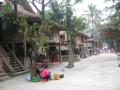
 Some Pictures of the Transformation of Traditional Culture of Thai People in Mai Chau
 -
 Housing changes of the Black Thai people in Binh Son commune since the renovation until now - Vu Thi Dieu - 3
 -
 Current Status of Exploiting Tran Temple Festival, Thai Binh to Serve Tourism Development.
 -
 Political quality education for students of National Defense and Security Education Center - Thai Nguyen University - 2
 -
 Impact of tourism on the cultural and social life of Thai people in Mai Chau - Hoa Binh and development solutions Case study of 4 villages: Lac village, Pom Coong village, Van village, Nhot village - 1
From then on, heaven and earth were divided into two. The earth was flat like a square tray, the sky above was like an upside down bowl, the border between heaven and earth was called the horizon.
When the sky had risen to its desired height and had dried up, the god, for some reason, broke the stone pillar. He threw rocks and soil everywhere. Each stone that flew out then became a mountain or an island. The soil scattered everywhere became hills and plateaus. That is why now the ground is not flat in some places, high in others, low in others. The place where the god dug up the rocks and soil to build the pillar is now the ocean.
That pillar is no longer there. Later, people in the lower world still considered Thach Mon mountain as it is now in Son Tay as the relic of that pillar. People called it the Pillar of Heaven (Kinh Thien Tru), some people also called it Khong Lo mountain (the road to heaven) or Khong Lo mountain.
It is not clear why that god later died or lived, or became the Jade Emperor. Folklore does not mention it. But it is certain that
Not long ago, there was a god named Ngoc Hoang or God who governed all things in heaven and on earth.
After the God Tru Troi separated heaven and earth, a number of other gods were assigned to either go to heaven or go to earth to continue the work of building the world. There were gods who made things, gods who dug rivers, gods who drained seas, gods who crushed sand and gravel, gods who planted trees...
That is why our people still have a song that is still in circulation today:
“First he counts the sand, Second he bails the ocean, Third he tells what,
Four men dug rivers, five men planted trees, and six men built hills.
Seven pillars of heaven…”
That song is just to compare the talents of the gods but also tells us a part of the work of creating heaven and earth.
Excerpt from “ Anthology of Vietnamese Folklore, Volume 1: Myths and Legends ”, Nguyen Thi Hue, Tran Thi An (ST)(2000), pp. 22-24.
GODS, GODDESSES
(Vietnamese people)
Once upon a time, there were two gods, male and female, with extremely large bodies. The male god was called Tu Tuong or Khong Lo, the female god was called Nu Oa.
The Four Symbols wanted to marry Nuwa. The goddess forced the male god to compete with her, promising that within three days each of them would build a mountain so high that they could stand on it and see the entire earth. If the male god's mountain was higher, the goddess would agree to be their husband.
The male god in the North, the female god in the South, both sides competed to build mountains. The Four Symbols had a pair of great baskets that could hold thousands of hills of earth. One day, the god was carrying a load when the baskets' rope broke, causing the earth to fall down and form a large hill.
After the deadline, the two gods climbed each other's mountains to see which one was higher. Standing on the male god's mountain, they could see out to the East Sea and as far as neighboring countries. Standing on the female god's mountain, they could see all four directions of the horizon. The male god lost, so the female god knocked down the Four Symbols' mountain and started a new one.
The mountain of the goddess today is said to still have traces of Nam Gioi mountain in Ha Tinh.
The male god tried to build many other mountains to please the goddess. As a result, many mountains arose from North to South. There are large footprints left on the islands and mountains of the North and Central regions, which later people considered to be the footprints of the male god Giant.
Faced with the male god's passionate pursuit, the goddess finally agreed to marry.
Speaking of male and female gods, there is a folk saying:
…the Lady Nu Oa is worth three acres of rice fields.
and …the Fourteen Poles of the Four Symbols represent the great bodies of the two gods.
Excerpt from “ Anthology of Vietnamese Folklore, Volume 1: Myths and Legends ”, Nguyen Thi Hue, Tran Thi An (ST) (2000), pp. 57-58.
Lady Oa
(Vietnamese people)
Nuwa is a giant goddess. She has existed since the beginning of the world. It is rumored that she is the goddess who built the high mountains and dense forests when the world was first created. She had extraordinary strength, so the mountain-building tasks that Heaven assigned her to do were completed in a very short time. At that time, there was a male god named Tu Tuong, who was also a giant god, who admired her and wanted to marry Nuwa. But Nuwa, because she somewhat underestimated Tu Tuong's talent, gave him a condition: he had to compete with her. If Tu Tuong won, then the two would become husband and wife. That is, within three days, each person had to build a very high mountain, from the top of which they could see the entire land and sea.
Believing in his talent, Tu Tuong happily accepted. The two gods moved to two separate places: he in the North, she in the South. They competed to work very hard and urgently. Tu Tuong was even more diligent, he worked all night without rest. His two poles were each filled with mounds of earth. The boat was so heavy that the pole broke, and the earth was scattered, creating nine large mounds of earth.
After three days of building the mountain, the two gods climbed each other's mountain to see which mountain was higher. Standing on the mountain of Tu Tuong, they could see the entire East Sea and neighboring countries. But when they reached the mountain of the goddess, they could see all four horizons. So Tu Tuong lost. Nu Oa then knocked down Tu Tuong's mountain and told them to build another one. The rocks and soil from the mountain of the male god were scattered, so the northern part of our country is now higher than the southern part. Tu Tuong was still not discouraged, and continued to build many other mountains to satisfy his girlfriend. He built many mountains from north to south. Today, people still call the large footprints left on rocks in the Northern and Central regions the footprints of the Giant God. As for Nu Oa's mountain,
still stands tall in the Southern region today. That is Ba Den Mountain, the only mountain in this region.
Speaking of Nuwa, seeing Tu Tuong's sincerity, he was moved and set a date for Tu Tuong to bring someone to hold the wedding ceremony. Hearing this, Tu Tuong quickly chose a group of people to bring gifts to ask for her hand in marriage. The group lined up in a long line heading towards Nuwa's house. But because of the long queue, when they were about to arrive, it was already dark and they had to cross another river. Everyone discussed building a bridge across the river. Tu Tuong suggested the most convenient way, which was to use his genitals to build a bridge so that his family could cross first, and then he would step across later. The bridge was very large and sturdy, and everyone felt secure and steady. But unfortunately, halfway through, someone thought he was walking on the ground and put out a matchstick on the bridge. Tu Tuong was startled, causing half of the people who were walking halfway to fall into the water.
On this side, Nuwa saw the groom's family coming and pulled up her clothes. Thanks to that, the sky was as bright as day. Seeing the groom's family struggling in the river, Nuwa reached down into the water and pulled them out. It was cold at that time, everyone was shivering, Nuwa felt sorry for them and let them sit on her lap to warm them up, so everyone felt comfortable.
The wedding was still held, but Nuwa was also somewhat annoyed because the Four Symbols were not thoughtful enough to make the ceremony less solemn.
Excerpt from “ Anthology of Vietnamese Folklore, Volume 1: Myths and Legends ”, Nguyen Thi Hue, Tran Thi An (ST)(2000), pp. 62-63.
Granny
(Vietnamese people)
In the beginning of the world, when heaven and earth were still in chaos, gods often appeared. Both male and female gods. These gods often went together in pairs such as Mr. Tu Tuong - Mrs. Nu Oa, Mr. Duc - Mrs. Cai, Mr. Dung - Mrs. Da... In the Tien Du region, there was Mr. Loc Coc - Mrs. To Co.
Mr. and Mrs. Loc Coc and To Co both had huge bodies, their heads touching the sky, their shoulders touching the clouds, their feet sinking into rocks and the ground. With each step they took, they moved from one mountain peak to another. They left behind in the fields, on the hillsides, and in the village alleys giant footprints measuring ten spans. Their footprints were everywhere.
Mr. and Mrs. Loc Coc and To Co sometimes walked as a couple, one following the other. Sometimes you could see him alone. Sometimes you could see her alone. The two giants had a very natural and honest temperament, sometimes happy, sometimes sad like playful children. When they were angry, their eyes flashed, their voices boomed like drums, their sneezes created a storm, their heavy breathing created a hurricane... When they were happy, they created wind and rain to water the plants and trees.
Mr. and Mrs. Loc Coc and To Co were both so big that they both had extraordinary strength. They often competed with each other to do great things like digging rivers, building mountains, filling seas...
A forgotten basket becomes a mound. A night of digging makes a hill. A footprint becomes a stream. A day of digging makes a river. Thanks to our ancestors pushing water into the sea and draining swamps, fields and land appeared, becoming places for people to live and work.
When people are crowded, Mr. Loc Co still comes back to make storms, thunder, lightning, and wind, Mrs. To Co still comes back to send herds of deer, antelope, and birds for people to hunt...
Looking at the scenery of mountains, rivers, fields, grass, trees, flowers and leaves in four successive seasons, Mrs. To Co was very satisfied. Her work was temporarily finished, and she was pregnant, so Mrs. To Co lay down by the Duong River to rest. Here, Mrs. To Co gave birth to a sac. From that sac hatched twelve beautiful daughters. The girls took their mother's place and went to all four directions to teach people different trades, each becoming the grandmother of a region.
Taking off her clothes, Mrs. To Co still lay naked under the windy and sunny sky, forever displaying her youthful beauty in the shape of Nguyet Hang mountain, now in Tien Du - Bac Ninh.
Excerpt from “ Anthology of Vietnamese Folklore, Volume 1: Myths and Legends ”, Nguyen Thi Hue, Tran Thi An (ST)(2000), pp. 63-64