
The pot has small holes to create ventilation and prevent the plant from getting waterlogged. The growing medium for Dendrobium can be coconut fiber that has been treated to prevent mold, the best is still a growing medium made of charcoal, which both creates ventilation and is less likely to rot, so it will not affect the growth of the orchid.
When the substrate in the pot is wet, it will rot and settle to the bottom of the pot, creating a layer of waterlogged humus that causes the roots of the plant to rot. Due to survival instinct, at this time the orchid will grow some seedlings on the top of the pseudobulbs (also known as keiki seedlings) to maintain the breed. When this phenomenon occurs, we must immediately change the pot and new substrate for the orchid [20].
The method of propagating young plants growing on the top of the stem (cutting) is very simple. We can separate the young plant from the mother plant by making a cut at the junction without cutting another section of the mother plant. However, the important thing is when is the best time to cut the young plant? Usually when we see the young plant growing strongly, having 5-7 leaves and many good roots 4-5cm long, we can separate it from the pseudobulb to plant a new one. If we leave the young plant on the mother plant for a long time, it will weaken the mother plant, affecting its ability to flower in the new season.
In addition, Dendrobium is a pseudobulb with a stem, so it can be propagated by cutting each section of the stem with eyes, thereby growing them into new seedlings.
- Use a sharp knife to cut the stem without leaves and roots into 3 - 4 segments.
- Spray the tree stumps with a fungicide to prevent fungal infection and then place them on a layer of coconut fiber. Then spread sand on a tray about 4-5 centimeters high and place the coconut fiber and the tree stumps on top of the sand. Place the tray in a shady place and water thoroughly, spraying water every few days.
- About 6 weeks later, for survival reasons, the young shoots begin to crack from the nodes, then grow roots and penetrate the coconut fiber layer to find water.
- After 8-10 weeks, these young shoots will have leaves and roots about 4-5cm long.
- Cut the stem into short pieces to easily plant in pots, use a sharp knife to cut, do not crush the stem. Spray with antifungal medicine and plant in pots.
Figure 4.13: Steps to propagate Dendrobium by cuttings
4.5. Evaluation of the production and business process of wild orchids in Sa Pa
Through the survey data of 20 households growing all 6 species of orchids, we have a summary table of the growth status of the cultivated orchid species (Table 4.6).
Table 4.6: Summary of growth status of cultivated orchid species
( The percentages in the table are calculated using formula 2.1)
Species
Total (ham, pot) | Growth status | ||||||
Good | Medium | Bad | |||||
Tran Mong Xuan | 2,580 | 2,382 | 92.32% | 164 | 6.36% | 34 | 1.32% |
Red Phoenix Sword | 2,227 | 2.123 | 95.33% | 81 | 3.64% | 23 | 1.03% |
Earn income | 2,072 | 1,947 | 93.97% | 100 | 4.83% | 25 | 1.21% |
Jade Sword | 1,983 | 1,861 | 93.85% | 105 | 5.30% | 17 | 0.86% |
Chicken fat narcissus | 2,057 | 1,935 | 94.07% | 103 | 5.01% | 19 | 0.92% |
White Narcissus | 1,862 | 1,729 | 92.86% | 117 | 6.28% | 16 | 0.86% |
Maybe you are interested!
-
 Identify Rating Levels and Rating Scales
zt2i3t4l5ee
zt2a3gstourism,quan lan,quang ninh,ecology,ecotourism,minh chau,van don,geography,geographical basis,tourism development,science
zt2a3ge
zc2o3n4t5e6n7ts
of the islanders. Therefore, this indicator will be divided into two sub-indicators:
a1. Natural tourism attractiveness a2. Cultural tourism attractiveness
b. Tourist capacity
The two island communes in Quan Lan have different capacities to receive tourists. Minh Chau Commune is home to many standard hotels and resorts, attracting high-income domestic and international tourists. Meanwhile, Quan Lan Commune has many motels mainly built and operated by local people, so the scale and quality are not high, and will be suitable for ordinary tourists such as students.
c. Time of exploitation of Quan Lan Island Commune:
Quan Lan tourism is seasonal due to weather and climate conditions and festivals only take place on certain days of the year, specifically in spring. In Quan Lan commune, the period from April to June and from September to November is considered the best time to visit Quan Lan because the cultural tourism activities are mainly associated with festivals taking place during this time.
Minh Chau island commune:
Tourism exploitation time is all year round, because this is a place with a number of tourist attractions with diverse ecosystems such as Bai Tu Long National Park Research Center, Tram forest, Turtle Laying Beach, so besides coming to the beach for tourism and vacation in the summer, Minh Chau will attract research groups to come for tourism combined with research at other times of the year.
d. Sustainability
The sustainability of ecotourism sites in Quan Lan and Minh Chau communes depends on the sensitivity of the ecosystems to climate changes.
landscape. In general, these tourist destinations have a fairly high level of sustainability, because they are natural ecosystems, planned and protected. However, if a large number of tourists gather at certain times, it can exceed the carrying capacity and affect the sustainability of the environment (polluted beaches, damaged trees, animals moving away from their habitats, etc.), then the sustainability of the above ecosystems (natural ecosystems, human ecosystems) will also be affected and become less sustainable.
e. Location and accessibility
Both island communes have ports to take tourists to visit from Van Don wharf:
- Quan Lan – Van Don traffic route:
Phuc Thinh – Viet Anh high-speed boat and Quang Minh high-speed boat, depart at 8am and 2pm from Van Don to Quan Lan, and at 7am and 1pm from Quan Lan to Van Don. There are also wooden boats departing at 7am and 1pm.
- Van Don - Minh Chau traffic route:
Chung Huong high-speed train, Minh Chau train, morning 7:30 and afternoon 13:30 from Van Don to Minh Chau, morning 6:30 and afternoon 13:00 from Minh Chau to Van Don.
f. Infrastructure
Despite receiving investment attention, the issue of infrastructure and technical facilities for tourism on Quan Lan Island is still an issue that needs to be resolved because it has a direct impact on the implementation of ecotourism activities. The minimum conditions for serving tourists such as accommodation, electricity, water, communication, especially medical services, and security work need to be given top priority. Ecotourism spots in Minh Chau commune are assessed to have better infrastructure and technical facilities for tourism because there are quite complete and synchronous conditions for serving tourists, meeting many needs of domestic and foreign tourists.
3.2.1.4. Determine assessment levels and assessment scales
Corresponding to the levels of each criterion, the index is the score of those levels in the order of 4, 3, 2, 1 decreasing according to the standard of each level: very attractive (4), attractive (3), average (2), less attractive (1).
3.2.1.5. Determining the coefficients of the criteria
For the assessment of DLST in the two communes of Quan Lan and Minh Chau islands, the students added evaluation coefficients to show the importance of the criteria and indicators as follows:
Coefficient 3 with criteria: Attractiveness, Exploitation time. These are the 2 most important criteria for attracting tourists to tourism in general and eco-tourism in particular, so they have the highest coefficient.
Coefficient 2 with criteria: Capacity, Infrastructure, Location and accessibility . Because the assessment area is an island commune of Van Don district, the above criteria are selected by the author with appropriate coefficients at the average level.
Coefficient 1 with criteria: Sustainability. Quan Lan has natural and human-made ecotourism sites, with high biodiversity and little impact from local human factors. Most of the ecotourism sites are still wild, so they are highly sustainable.
3.2.1.6. Results of DLST assessment on Quan Lan island
a. Assessment of the potential for natural tourism development
For Minh Chau commune:
+ Natural tourism attractiveness is determined to be very attractive (4 points) and the most important coefficient (coefficient 3), so the score of the Attractiveness criterion is 4 x 3 = 12.
+ Capacity is determined as average (2 points) and the coefficient is quite important (coefficient 2), then the score of Capacity criterion is 2 x 2 = 4.
+ Exploitation time is long (4 points), the most important coefficient (coefficient 3) so the score of the Exploitation time criterion is 4 x 3 = 12.
+ Sustainability is determined as sustainable (4 points), the important coefficient is the average coefficient (coefficient 1), so the score of the Sustainability criterion is 4 x 1 = 4 points
+ Location and accessibility are determined to be quite favorable (2 points), the coefficient is quite important (coefficient 2), the criterion score is 2 x 2 = 4 points.
+ Infrastructure is assessed as good (3 points), the coefficient is quite important (coefficient 2), then the score of the Infrastructure criterion is 3 x 2 = 6 points.
The total score for evaluating DLST in Minh Chau commune according to 6 evaluation criteria is determined as: 12 + 4 + 12 + 4 + 4 + 6 = 42 points
Similar assessment for Quan Lan commune, we have the following table:
Table 3.3: Assessment of the potential for natural ecotourism development in Quan Lan and Minh Chau communes
Attractiveness of self-tourismof course
Capacity
Mining time
Sustainability
Location and accessibility
Infrastructure
Result
Point
DarkMulti
Point
DarkMulti
Point
DarkMulti
Point
DarkMulti
Point
DarkMulti
Point
DarkMulti
CommuneMinh Chau
12
12
4
8
12
12
4
4
4
8
6
8
42/52
Quan CommuneLan
6
12
6
8
9
12
4
4
4
8
4
8
33/52
b. Assessment of the potential for humanistic tourism development
For Quan Lan commune:
+ The attractiveness of human tourism is determined to be very attractive (4 points) and the most important coefficient (coefficient 3), so the score of the Attractiveness criterion is 4 x 3 = 12.
+ Capacity is determined to be large (3 points) and the coefficient is quite important (coefficient 2), then the score of the Capacity criterion is 3 x 2 = 6.
+ Mining time is average (3 points), the most important coefficient (coefficient 3) so the score of the Mining time criterion is 3 x 3 = 9.
+ Sustainability is determined as sustainable (4 points), the important coefficient is the average coefficient (coefficient 1), so the score of the Sustainability criterion is 4 x 1 = 4 points.
+ Location and accessibility are determined to be quite favorable (2 points), the coefficient is quite important (coefficient 2), the criterion score is 2 x 2 = 4 points.
+ Infrastructure is rated as average (2 points), the coefficient is quite important (coefficient 2), then the score of the Infrastructure criterion is 2 x 2 = 4 points.
The total score for evaluating DLST in Quan Lan commune according to 6 evaluation criteria is determined as: 12 + 6 + 6 + 4 + 4 + 4 = 36 points.
Similar assessment with Minh Chau commune we have the following table:
Table 3.4: Assessment of the potential for developing humanistic eco-tourism in Quan Lan and Minh Chau communes
Attractiveness of human tourismliterature
Capacity
Mining time
Sustainability
Location and accessibility
Infrastructure
Result
Point
DarkMulti
Point
DarkMulti
Point
DarkMulti
Point
DarkMulti
Point
DarkMulti
Point
DarkMulti
Quan CommuneLan
12
12
6
8
9
12
4
4
4
8
4
8
39/52
Minh CommuneChau
6
12
4
8
12
12
4
4
4
8
6
8
36/52
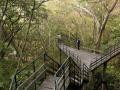
Basically, both Minh Chau and Quan Lan localities have quite favorable conditions for developing ecotourism. However, Quan Lan commune has more advantages to develop ecotourism in a humanistic direction, because this is an area with many famous historical relics such as Quan Lan Communal House, Quan Lan Pagoda, Temple worshiping the hero Tran Khanh Du, ... along with local festivals held annually such as the wind praying ceremony (March 15), Quan Lan festival (June 10-19); due to its location near the port and long exploitation time, the beaches in Quan Lan commune (especially Quan Lan beach) are no longer hygienic and clean to ensure the needs of tourists coming to relax and swim; this is also an area with many beautiful landscapes such as Got Beo wind pass, Ong Phong head, Voi Voi cave, but the ability to access these places is still very limited (dirt hill road, lots of gravel and rocks), especially during rainy and windy times; In addition, other natural resources such as mangrove forests and sea worms have not been really exploited for tourism purposes and ecotourism development. On the contrary, Minh Chau commune has more advantages in developing ecotourism in the direction of natural tourism, this is an area with diverse ecosystems such as at Rua De Beach, Bai Tu Long National Park Conservation Center...; Minh Chau beach is highly appreciated for its natural beauty and cleanliness, ranked in the top ten most beautiful beaches in Vietnam; Minh Chau commune is also home to Tram forest with a large area and a purity of up to 90%, suitable for building bridges through the forest (a very effective type of natural ecotourism currently applied by many countries) for tourists to sightsee, as well as for the purpose of studying and researching.
Figure 3.1: Thenmala Forest Bridge (India) Source: https://www.thenmalaecotourism.com/(August 21, 2019)
3.2.2. Using SWOT matrix to evaluate Quan Lan island tourism
General assessment of current tourism activities of Quan Lan island is shown through the following SWOT matrix:
Table 3.5: SWOT matrix evaluating tourism activities on Quan Lan island
Internal agent
Strengths- There is a lot of potential for tourism development, especially natural ecotourism and humanistic ecotourism.- The unskilled labor force is relatively abundant.- resource environmentunpolluted, still
Weaknesses- Poorly developed infrastructure, especially traffic routes to tourist destinations on the island.- The team of professional staff is still weak.- Tourism products in general
quite wild, originalintact
general and DLST in particularalone is monotonous.
External agents
Opportunity- Tourism is a key industry in the socio-economic development strategy of the province and Van Don economic zone.- Quan Lan was selected as a pilot area for eco-tourism development within the framework of the green growth project between Quang Ninh province and the Japanese organization JICA.- The flow of tourists and especially ecotourism in the world tends toincreasing
Challenge- Weather and climate change abnormally.- Competition in tourism products is increasingly fierce, especially with other localities in the province such as Ha Long, Mong Cai...- Awareness of tourists, especially domestic tourists, about ecotourism and nature conservation is not high.
Through summary analysis using SWOT matrix we see that:
To exploit strengths and take advantage of opportunities, it is necessary to:
- Diversify products and service types (build more tourism routes aimed at specific needs of tourists: experiential tourism immersed in nature, spiritual cultural tourism...)
- Effective exploitation of resources and differentiated products (natural resources and human resources)
div.maincontent .p { color: black; font-family:"Times New Roman", serif; font-style: normal; font-weight: normal; text-decoration: none; font-size: 14pt; margin:0pt; } div.maincontent p { color: black; font-family:"Times New Roman", serif; font-style: normal; font-weight: normal; text-decoration: none; font-size: 14pt; margin:0pt; } div.maincontent .s1 { color: black; font-family:"Times New Roman", serif; font-style: normal; font-weight: normal; text-decoration: none; font-size: 13pt; } div.maincontent .s2 { color: black; font-family:"Times New Roman", serif; font-style: normal; font-weight: normal; text-decoration: none; font-size: 13pt; } div.maincontent .s3 { color: #0D0D0D; font-family:"Times New Roman", serif; font-style: normal; font-weight: bold; text-decoration: none; font-size: 14pt; } div.maincontent .s4 { color: black; font-family:"Times New Roman", serif; font-style: italic; font-weight: normal; text-decoration: none; font-size: 14pt; } div.maincontent .s5 { color: black; font-family:"Times New Roman", serif; font-style: italic; font-weight: bold; text-decoration: none; font-size: 14pt; } div.maincontent .s6 { color: black; font-family:"Times New Roman", serif; font-style: italic; font-weight: normal; text-decoration: none; font-size: 14pt; vertical-align: -3pt; } div.maincontent .s7 { color: black; font-family:"Times New Roman", serif; font-style: italic; font-weight: normal; text-decoration: none; font-size: 14pt; vertical-align: -2pt; } div.maincontent .s8 { color: black; font-family:"Times New Roman", serif; font-style: italic; font-weight: normal; text-decoration: none; font-size: 14pt; vertical-align: -1pt; } div.maincontent .s9 { color: black; font-family:"Times New Roman", serif; font-style: normal; font-weight: normal; text-decoration: none; font-size: 14pt; } div.maincontent .s10 { color: black; font-family:"Times New Roman", serif; font-style: normal; font-weight: bold; text-decoration: none; font-size: 14pt; } div.maincontent .s11 { color: black; font-family:"Times New Roman", serif; font-style: normal; font-weight: normal; text-decoration: none; font-size: 14pt; } div.maincontent .s12 { color: black; font-family:Symbol, serif; font-style: normal; font-weight: normal; text-decoration: none; font-size: 14pt; } div.maincontent .s13 { color: black; font-family:Wingdings; font-style: normal; font-weight: normal; text-decoration: none; font-size: 14pt; } div.maincontent .s14 { color: black; font-family:"Times New Roman", serif; font-style: normal; font-weight: normal; text-decoration: none; font-size: 9pt; vertical-align: 5pt; } div.maincontent .s15 { color: black; font-family:"Times New Roman", serif; font-style: normal; font-weight: normal; text-decoration: none; font-size: 9pt; vertical-align: 5pt; } div.maincontent .s16 { color: black; font-family:Cambria, serif; font-style: italic; font-weight: normal; text-decoration: none; font-size: 14pt; } div.maincontent .s17 { color: #080808; font-family:"Times New Roman", serif; font-style: normal; font-weight: bold; text-decoration: none; font-size: 14pt; } div.maincontent .s18 { color: #080808; font-family:"Times New Roman", serif; font-style: normal; font-weight: normal; text-decoration: none; font-size: 14pt; } div.maincontent .s19 { color: black; font-family:"Times New Roman", serif; font-style: normal; font-weight: normal; text-decoration: none; font-size: 11pt; } div.maincontent .s20 { color: black; font-family:"Times New Roman", serif; font-style: normal; font-weight: normal; text-decoration: none; font-size: 10pt; } div.maincontent .s21 { color: black; font-family:"Times New Roman", serif; font-style: normal; font-weight: bold; text-decoration: none; font-size: 11pt; } div.maincontent .s22 { color: black; font-family:"Times New Roman", serif; font-style: normal; font-weight: normal; text-decoration: none; font-size: 11pt; } div.maincontent .s23 { color: black; font-family:"Times New Roman", serif; font-style: italic; font-weight: normal; text-decoration: none; font-size: 14pt; } div.maincontent .s24 { color: #212121; font-family:"Times New Roman", serif; font-style: normal; font-weight: normal; tex
Identify Rating Levels and Rating Scales
zt2i3t4l5ee
zt2a3gstourism,quan lan,quang ninh,ecology,ecotourism,minh chau,van don,geography,geographical basis,tourism development,science
zt2a3ge
zc2o3n4t5e6n7ts
of the islanders. Therefore, this indicator will be divided into two sub-indicators:
a1. Natural tourism attractiveness a2. Cultural tourism attractiveness
b. Tourist capacity
The two island communes in Quan Lan have different capacities to receive tourists. Minh Chau Commune is home to many standard hotels and resorts, attracting high-income domestic and international tourists. Meanwhile, Quan Lan Commune has many motels mainly built and operated by local people, so the scale and quality are not high, and will be suitable for ordinary tourists such as students.
c. Time of exploitation of Quan Lan Island Commune:
Quan Lan tourism is seasonal due to weather and climate conditions and festivals only take place on certain days of the year, specifically in spring. In Quan Lan commune, the period from April to June and from September to November is considered the best time to visit Quan Lan because the cultural tourism activities are mainly associated with festivals taking place during this time.
Minh Chau island commune:
Tourism exploitation time is all year round, because this is a place with a number of tourist attractions with diverse ecosystems such as Bai Tu Long National Park Research Center, Tram forest, Turtle Laying Beach, so besides coming to the beach for tourism and vacation in the summer, Minh Chau will attract research groups to come for tourism combined with research at other times of the year.
d. Sustainability
The sustainability of ecotourism sites in Quan Lan and Minh Chau communes depends on the sensitivity of the ecosystems to climate changes.
landscape. In general, these tourist destinations have a fairly high level of sustainability, because they are natural ecosystems, planned and protected. However, if a large number of tourists gather at certain times, it can exceed the carrying capacity and affect the sustainability of the environment (polluted beaches, damaged trees, animals moving away from their habitats, etc.), then the sustainability of the above ecosystems (natural ecosystems, human ecosystems) will also be affected and become less sustainable.
e. Location and accessibility
Both island communes have ports to take tourists to visit from Van Don wharf:
- Quan Lan – Van Don traffic route:
Phuc Thinh – Viet Anh high-speed boat and Quang Minh high-speed boat, depart at 8am and 2pm from Van Don to Quan Lan, and at 7am and 1pm from Quan Lan to Van Don. There are also wooden boats departing at 7am and 1pm.
- Van Don - Minh Chau traffic route:
Chung Huong high-speed train, Minh Chau train, morning 7:30 and afternoon 13:30 from Van Don to Minh Chau, morning 6:30 and afternoon 13:00 from Minh Chau to Van Don.
f. Infrastructure
Despite receiving investment attention, the issue of infrastructure and technical facilities for tourism on Quan Lan Island is still an issue that needs to be resolved because it has a direct impact on the implementation of ecotourism activities. The minimum conditions for serving tourists such as accommodation, electricity, water, communication, especially medical services, and security work need to be given top priority. Ecotourism spots in Minh Chau commune are assessed to have better infrastructure and technical facilities for tourism because there are quite complete and synchronous conditions for serving tourists, meeting many needs of domestic and foreign tourists.
3.2.1.4. Determine assessment levels and assessment scales
Corresponding to the levels of each criterion, the index is the score of those levels in the order of 4, 3, 2, 1 decreasing according to the standard of each level: very attractive (4), attractive (3), average (2), less attractive (1).
3.2.1.5. Determining the coefficients of the criteria
For the assessment of DLST in the two communes of Quan Lan and Minh Chau islands, the students added evaluation coefficients to show the importance of the criteria and indicators as follows:
Coefficient 3 with criteria: Attractiveness, Exploitation time. These are the 2 most important criteria for attracting tourists to tourism in general and eco-tourism in particular, so they have the highest coefficient.
Coefficient 2 with criteria: Capacity, Infrastructure, Location and accessibility . Because the assessment area is an island commune of Van Don district, the above criteria are selected by the author with appropriate coefficients at the average level.
Coefficient 1 with criteria: Sustainability. Quan Lan has natural and human-made ecotourism sites, with high biodiversity and little impact from local human factors. Most of the ecotourism sites are still wild, so they are highly sustainable.
3.2.1.6. Results of DLST assessment on Quan Lan island
a. Assessment of the potential for natural tourism development
For Minh Chau commune:
+ Natural tourism attractiveness is determined to be very attractive (4 points) and the most important coefficient (coefficient 3), so the score of the Attractiveness criterion is 4 x 3 = 12.
+ Capacity is determined as average (2 points) and the coefficient is quite important (coefficient 2), then the score of Capacity criterion is 2 x 2 = 4.
+ Exploitation time is long (4 points), the most important coefficient (coefficient 3) so the score of the Exploitation time criterion is 4 x 3 = 12.
+ Sustainability is determined as sustainable (4 points), the important coefficient is the average coefficient (coefficient 1), so the score of the Sustainability criterion is 4 x 1 = 4 points
+ Location and accessibility are determined to be quite favorable (2 points), the coefficient is quite important (coefficient 2), the criterion score is 2 x 2 = 4 points.
+ Infrastructure is assessed as good (3 points), the coefficient is quite important (coefficient 2), then the score of the Infrastructure criterion is 3 x 2 = 6 points.
The total score for evaluating DLST in Minh Chau commune according to 6 evaluation criteria is determined as: 12 + 4 + 12 + 4 + 4 + 6 = 42 points
Similar assessment for Quan Lan commune, we have the following table:
Table 3.3: Assessment of the potential for natural ecotourism development in Quan Lan and Minh Chau communes
Attractiveness of self-tourismof course
Capacity
Mining time
Sustainability
Location and accessibility
Infrastructure
Result
Point
DarkMulti
Point
DarkMulti
Point
DarkMulti
Point
DarkMulti
Point
DarkMulti
Point
DarkMulti
CommuneMinh Chau
12
12
4
8
12
12
4
4
4
8
6
8
42/52
Quan CommuneLan
6
12
6
8
9
12
4
4
4
8
4
8
33/52
b. Assessment of the potential for humanistic tourism development
For Quan Lan commune:
+ The attractiveness of human tourism is determined to be very attractive (4 points) and the most important coefficient (coefficient 3), so the score of the Attractiveness criterion is 4 x 3 = 12.
+ Capacity is determined to be large (3 points) and the coefficient is quite important (coefficient 2), then the score of the Capacity criterion is 3 x 2 = 6.
+ Mining time is average (3 points), the most important coefficient (coefficient 3) so the score of the Mining time criterion is 3 x 3 = 9.
+ Sustainability is determined as sustainable (4 points), the important coefficient is the average coefficient (coefficient 1), so the score of the Sustainability criterion is 4 x 1 = 4 points.
+ Location and accessibility are determined to be quite favorable (2 points), the coefficient is quite important (coefficient 2), the criterion score is 2 x 2 = 4 points.
+ Infrastructure is rated as average (2 points), the coefficient is quite important (coefficient 2), then the score of the Infrastructure criterion is 2 x 2 = 4 points.
The total score for evaluating DLST in Quan Lan commune according to 6 evaluation criteria is determined as: 12 + 6 + 6 + 4 + 4 + 4 = 36 points.
Similar assessment with Minh Chau commune we have the following table:
Table 3.4: Assessment of the potential for developing humanistic eco-tourism in Quan Lan and Minh Chau communes
Attractiveness of human tourismliterature
Capacity
Mining time
Sustainability
Location and accessibility
Infrastructure
Result
Point
DarkMulti
Point
DarkMulti
Point
DarkMulti
Point
DarkMulti
Point
DarkMulti
Point
DarkMulti
Quan CommuneLan
12
12
6
8
9
12
4
4
4
8
4
8
39/52
Minh CommuneChau
6
12
4
8
12
12
4
4
4
8
6
8
36/52
Basically, both Minh Chau and Quan Lan localities have quite favorable conditions for developing ecotourism. However, Quan Lan commune has more advantages to develop ecotourism in a humanistic direction, because this is an area with many famous historical relics such as Quan Lan Communal House, Quan Lan Pagoda, Temple worshiping the hero Tran Khanh Du, ... along with local festivals held annually such as the wind praying ceremony (March 15), Quan Lan festival (June 10-19); due to its location near the port and long exploitation time, the beaches in Quan Lan commune (especially Quan Lan beach) are no longer hygienic and clean to ensure the needs of tourists coming to relax and swim; this is also an area with many beautiful landscapes such as Got Beo wind pass, Ong Phong head, Voi Voi cave, but the ability to access these places is still very limited (dirt hill road, lots of gravel and rocks), especially during rainy and windy times; In addition, other natural resources such as mangrove forests and sea worms have not been really exploited for tourism purposes and ecotourism development. On the contrary, Minh Chau commune has more advantages in developing ecotourism in the direction of natural tourism, this is an area with diverse ecosystems such as at Rua De Beach, Bai Tu Long National Park Conservation Center...; Minh Chau beach is highly appreciated for its natural beauty and cleanliness, ranked in the top ten most beautiful beaches in Vietnam; Minh Chau commune is also home to Tram forest with a large area and a purity of up to 90%, suitable for building bridges through the forest (a very effective type of natural ecotourism currently applied by many countries) for tourists to sightsee, as well as for the purpose of studying and researching.
Figure 3.1: Thenmala Forest Bridge (India) Source: https://www.thenmalaecotourism.com/(August 21, 2019)
3.2.2. Using SWOT matrix to evaluate Quan Lan island tourism
General assessment of current tourism activities of Quan Lan island is shown through the following SWOT matrix:
Table 3.5: SWOT matrix evaluating tourism activities on Quan Lan island
Internal agent
Strengths- There is a lot of potential for tourism development, especially natural ecotourism and humanistic ecotourism.- The unskilled labor force is relatively abundant.- resource environmentunpolluted, still
Weaknesses- Poorly developed infrastructure, especially traffic routes to tourist destinations on the island.- The team of professional staff is still weak.- Tourism products in general
quite wild, originalintact
general and DLST in particularalone is monotonous.
External agents
Opportunity- Tourism is a key industry in the socio-economic development strategy of the province and Van Don economic zone.- Quan Lan was selected as a pilot area for eco-tourism development within the framework of the green growth project between Quang Ninh province and the Japanese organization JICA.- The flow of tourists and especially ecotourism in the world tends toincreasing
Challenge- Weather and climate change abnormally.- Competition in tourism products is increasingly fierce, especially with other localities in the province such as Ha Long, Mong Cai...- Awareness of tourists, especially domestic tourists, about ecotourism and nature conservation is not high.
Through summary analysis using SWOT matrix we see that:
To exploit strengths and take advantage of opportunities, it is necessary to:
- Diversify products and service types (build more tourism routes aimed at specific needs of tourists: experiential tourism immersed in nature, spiritual cultural tourism...)
- Effective exploitation of resources and differentiated products (natural resources and human resources)
div.maincontent .p { color: black; font-family:"Times New Roman", serif; font-style: normal; font-weight: normal; text-decoration: none; font-size: 14pt; margin:0pt; } div.maincontent p { color: black; font-family:"Times New Roman", serif; font-style: normal; font-weight: normal; text-decoration: none; font-size: 14pt; margin:0pt; } div.maincontent .s1 { color: black; font-family:"Times New Roman", serif; font-style: normal; font-weight: normal; text-decoration: none; font-size: 13pt; } div.maincontent .s2 { color: black; font-family:"Times New Roman", serif; font-style: normal; font-weight: normal; text-decoration: none; font-size: 13pt; } div.maincontent .s3 { color: #0D0D0D; font-family:"Times New Roman", serif; font-style: normal; font-weight: bold; text-decoration: none; font-size: 14pt; } div.maincontent .s4 { color: black; font-family:"Times New Roman", serif; font-style: italic; font-weight: normal; text-decoration: none; font-size: 14pt; } div.maincontent .s5 { color: black; font-family:"Times New Roman", serif; font-style: italic; font-weight: bold; text-decoration: none; font-size: 14pt; } div.maincontent .s6 { color: black; font-family:"Times New Roman", serif; font-style: italic; font-weight: normal; text-decoration: none; font-size: 14pt; vertical-align: -3pt; } div.maincontent .s7 { color: black; font-family:"Times New Roman", serif; font-style: italic; font-weight: normal; text-decoration: none; font-size: 14pt; vertical-align: -2pt; } div.maincontent .s8 { color: black; font-family:"Times New Roman", serif; font-style: italic; font-weight: normal; text-decoration: none; font-size: 14pt; vertical-align: -1pt; } div.maincontent .s9 { color: black; font-family:"Times New Roman", serif; font-style: normal; font-weight: normal; text-decoration: none; font-size: 14pt; } div.maincontent .s10 { color: black; font-family:"Times New Roman", serif; font-style: normal; font-weight: bold; text-decoration: none; font-size: 14pt; } div.maincontent .s11 { color: black; font-family:"Times New Roman", serif; font-style: normal; font-weight: normal; text-decoration: none; font-size: 14pt; } div.maincontent .s12 { color: black; font-family:Symbol, serif; font-style: normal; font-weight: normal; text-decoration: none; font-size: 14pt; } div.maincontent .s13 { color: black; font-family:Wingdings; font-style: normal; font-weight: normal; text-decoration: none; font-size: 14pt; } div.maincontent .s14 { color: black; font-family:"Times New Roman", serif; font-style: normal; font-weight: normal; text-decoration: none; font-size: 9pt; vertical-align: 5pt; } div.maincontent .s15 { color: black; font-family:"Times New Roman", serif; font-style: normal; font-weight: normal; text-decoration: none; font-size: 9pt; vertical-align: 5pt; } div.maincontent .s16 { color: black; font-family:Cambria, serif; font-style: italic; font-weight: normal; text-decoration: none; font-size: 14pt; } div.maincontent .s17 { color: #080808; font-family:"Times New Roman", serif; font-style: normal; font-weight: bold; text-decoration: none; font-size: 14pt; } div.maincontent .s18 { color: #080808; font-family:"Times New Roman", serif; font-style: normal; font-weight: normal; text-decoration: none; font-size: 14pt; } div.maincontent .s19 { color: black; font-family:"Times New Roman", serif; font-style: normal; font-weight: normal; text-decoration: none; font-size: 11pt; } div.maincontent .s20 { color: black; font-family:"Times New Roman", serif; font-style: normal; font-weight: normal; text-decoration: none; font-size: 10pt; } div.maincontent .s21 { color: black; font-family:"Times New Roman", serif; font-style: normal; font-weight: bold; text-decoration: none; font-size: 11pt; } div.maincontent .s22 { color: black; font-family:"Times New Roman", serif; font-style: normal; font-weight: normal; text-decoration: none; font-size: 11pt; } div.maincontent .s23 { color: black; font-family:"Times New Roman", serif; font-style: italic; font-weight: normal; text-decoration: none; font-size: 14pt; } div.maincontent .s24 { color: #212121; font-family:"Times New Roman", serif; font-style: normal; font-weight: normal; tex -
 Evaluation of Research Situation and Issues Raised for the Thesis
 -
 Evaluation of Online Marketing Activities of Philip Entertainment Media and Entertainment Company Limited - 1
 -
 Management Status of Tcm Results Evaluation Through NCBH Form Table 2.9: Current Status of Evaluation of Professional Team Performance Results Through Form
 -
 Evaluation of the effectiveness of selective tibial nerve resection in the treatment of lower limb muscle spasticity sequelae - 19
Through Table 4.6, we can see that the percentage of plants with good growth in each species is over 90%, the highest being the Sword Hong Hoang at 95.33%. Plants with average growth at 7% have species that only reach approximately 4%. The percentage of plants with poor growth in each species is the highest at 1.32% ( Tran Mong Xuan ) and the lowest at 0.86% ( Sword Thanh Ngoc, Thuy Tien Trang ). Thus, it can be seen that the process of caring for wild orchids in households has initially had good results that need to be recognized.
To check whether the growth of species grown in households and in nature is the same, we can check according to Pearson's standard (Calculated according to formula 2.2). The calculation results are shown in Table 4.7:
Table 4.7: Test table for uniformity of growth according to Pearson standard
2
look up the table with k = (2-1)(3-1) = 2
05
Species
2 properties n | 2 look up table 05 | Conclude | |
Tran Mong Xuan | 5.30 | 5.99 | Grown in two pure places together |
Red Phoenix Sword | 11.13 | 5.99 | Growing in two different places each other |
Earn income | 12.60 | 5.99 | Growing in two different places |
Jade Sword | 5.15 | 5.99 | Grown in two pure places together |
Chicken fat narcissus | 5.50 | 5.99 | Grown in two pure places together |
White Narcissus | 16.89 | 5.99 | Growing in two different places each other |
According to the results in Table 4.7, the growth quality of Tran Mong Xuan, Kiem Thanh Ngoc, and Thuy Tien Mo Ga species in the wild and in farming households are similar; while the growth quality of Kiem Thu, Kiem Hong Hoang, and Thuy Tien Trang species has differences between farming conditions and in the wild.
However, Sa Pa is still the center of diversity of wild orchids in Vietnam. The natural conditions in Sa Pa still ensure the growth and development of most wild orchids, including the Cymbidium and Dendrobium genera.
In the process of growing orchids, households in Sa Pa have learned to follow nature to achieve certain results. They have applied basic knowledge about the habits and ecological requirements of these species in nature to have appropriate impacts on their growth process to achieve the highest efficiency. For example: Cymbidium needs a cold period at night of about 10 - 15.5 0 C to form flowers, otherwise it will not flower, Dendrobium
The plant needs a dormant period of about 1 month after the growth period before continuing to flower. If we water and fertilize during this period, the plant may not flower anymore. Knowing this characteristic, growers will be more proactive in the care process.
In addition to nurturing and caring for wild orchids to grow and develop well, the ability to propagate these orchids only stops at taking advantage of the ability to sprout and branch of these orchids to separate and create new orchids as a source of seeds for the business process. However, this method can only create a limited number of seedlings and can only be carried out on a small scale. To expand production, in addition to investing in orchid care and nurturing techniques, it is also necessary to increase the rate of propagation by other forms of propagation.
Currently, Sa Pa has about 300 establishments participating in the cultivation of wild orchids. These businesses, mainly individual households, rely on their experience and land conditions to collect wild orchid species for cultivation and nurturing. Therefore, the scale and quality of these establishments are also very different, some families only take advantage of small gardens around their houses, but there are also households that have invested hundreds of square meters of land to grow orchids for business. Depending on
Each family's conditions allow them to care for orchids in different quantities. According to the survey results of 20 orchid growing households in Sa Pa, the number of orchid species grown is 35, focusing on 9 genera ( shown in Table 4.8). However, there are households that only focus on growing 10 - 15 species of orchid genera with beautiful flowers that are popular: Dendrobium , Cymbidium , Aerides lour , Coelogyne Lindl . , Paphiopedilum Pfilzer , etc. And there are also families that grow up to 25 - 30 species of many different orchid genera, including species that are endemic to the region or even endemic to Vietnam: Biermannia , Cleisostoma filiforme , Eria , etc. However, species of the genera Dendrobium , Cymbidium , Cymbidium and Paphiopedilum are still grown in large quantities by households to meet the needs of orchid growers.
According to the summary results in Table 4.8: the genus Dendrobium is cultivated with the largest quantity of 10 species, followed by the genus Cymbidium with 9 species, and the genus Cymbidium with 5 species. In which, each species is cultivated by households in large quantities.
Table 4.8: Orchid species grown in Sa Pa
TT
Scientific name | Common name | Number of species | |
1 | Aerides Lour | Orchid Fragrance | 2 |
2 | Beermannia | Blue orchid | 2 |
3 | Cleisostoma Blume. | Closed Mouth Orchid | 2 |
4 | Coelogyne Lindl. | Thanh dam orchid | 2 |
5 | Cymbidium Sw. | Orchid Sword | 9 |
6 | Dendrobium Sw. | Dendrobium orchid | 10 |
7 | Hygrochilus Pfitzer. | Cymbidium Orchid | 1 |
8 | Paphiopedilum Pfitzer. | Cymbidium | 5 |
9 | Phaius Lour | Brown Crane Orchid | 2 |
In addition to orchid growers, Hoang Lien National Park has also collected a garden of original orchid varieties including 172 species. The garden has also invested in building a tissue culture room and tested invitro propagation with several orchid species: Cymbidium, Paphiopedilum and Dendrobium; up to now, the first orchid seedlings of these species have been brought to the nursery and are in the process of being cared for and monitored.
According to the results of the investigation of orchid growers, there are also people who come to buy orchids and then sell them in other provinces, even transporting them to Hanoi. For these people, they often buy in relatively large quantities but the price is not high, only 20,000 - 30,000 VND for a beautiful orchid pot and they only buy some popular species: Dendrobium, Dendrobium, Paphiopedilum, and Cymbidium. With this method, orchid growers do not have to bear the cost of transportation and Sa Pa orchids reach many orchid lovers and are known to many new markets.
Orchid farms in Sa Pa also supply orchids to the ornamental flower market in Lao Cai city. The amount of orchids sold here is usually more stable, but the prices are only average. Usually, each beautiful orchid pot that is about to bloom costs only 30,000-40,000 VND, and each cut orchid branch is only sold for about
5,000 - 7,000 VND. However, with this sales method, orchid growers have to pay for transportation fees, sales locations, etc. However, if calculated on 1m2 of land, the income of orchid growers is still much higher than that of rice growers or other crops. The reason is because:
- Orchids can be grown in any soil condition, but growing other plants requires suitable soil to be effective.
- On 1m2 of land, you can place many orchid pots: can be used as a hanging rack or can be combined
The combination of raising terrestrial orchids below and hanging orchids above. This is a feature that can create high efficiency that no other industry has. Table 4.9 is the result of the control
Investigate the income of some orchid growing households in Sa Pa
Table 4.9: Table of results of income structure of households
Business household
Area volume (m 2 ) | Total revenue import (VND/year) | Orchid | Other sources | |||
VND | % | VND | % | |||
Tran Huu Duong | 200 | 70,000,000 | 70,000,000 | 100 | 0 | 0.00 |
Tran Van Cuong | 420 | 90,000,000 | 90,000,000 | 100 | 0 | 0.00 |
Le Duc Huu | 380 | 86,000,000 | 86,000,000 | 100 | 0 | 0.00 |
Average | 82,000,000 | 82,000,000 | 100 | 0 | 0.00 | |
Nguyen Van Dang | 200 | 45,000,000 | 37,000,000 | 82.22 | 8,000,000 | 17.78 |
Le Van Khoi | 120 | 27,000,000 | 21,000,000 | 77.78 | 6,000,000 | 22.22 |
Nguyen Ngoc Tien | 160 | 43,000,000 | 36,000,000 | 83.72 | 7,000,000 | 16.28 |
Tran Van Khi | 140 | 30,000,000 | 26,500,000 | 88.33 | 3,500,000 | 11.67 |
Do Duc Hieu | 180 | 45,000,000 | 42,500,000 | 94.44 | 2,500,000 | 5.56 |
Do Van Bach | 150 | 30,000,000 | 23,300,000 | 77.67 | 6,700,000 | 22.33 |
Nguyen Xuan Lam | 230 | 64,000,000 | 56,000,000 | 87.50 | 8,000,000 | 12.50 |
Nguyen Thi Lanh | 100 | 38,000,000 | 32,600,000 | 85.79 | 5,400,000 | 14.21 |
Bui Van Manh | 90 | 26,000,000 | 22,400,000 | 86.15 | 3,600,000 | 13.85 |
Tran Dinh Sam | 200 | 46,000,000 | 36,000,000 | 78.26 | 10,000,000 | 21.74 |
Nguyen Van Dung | 170 | 35,000,000 | 27,500,000 | 78.57 | 7,500,000 | 21.43 |
Do Thi Chau | 200 | 53,000,000 | 41,000,000 | 77.36 | 12,000,000 | 22.64 |
Nguyen Huu Khai | 250 | 68,000,000 | 55,000,000 | 80.88 | 13,000,000 | 19.12 |
Nguyen Van Nghia | 180 | 40,000,000 | 36,000,000 | 90.00 | 4,000,000 | 10.00 |
Average | 42,142,857 | 35,200,000 | 83.48 | 6,942,857 | 16.52 | |
Duong Van Thai | 130 | 32,000,000 | 22,000,000 | 68.75 | 10,000,000 | 31.25 |
Dinh Van Thu | 80 | 23,000,000 | 13,400,000 | 58.26 | 9,600,000 | 41.74 |
Do Xuan Ba | 200 | 50,000,000 | 34,000,000 | 68.00 | 16,000,000 | 32.00 |
Average | 35,000,000 | 23,133,333 | 65.00 | 11,866,667 | 35.00 | |
Through Table 4.9, we can divide the surveyed households into 3 groups according to the income ratio of the households as follows:
- Group 1 : income source is entirely based on orchid business. This group of households consists of 3 families, they focus all of their family's economy and labor on orchid business without participating in other production activities. All three households have invested in area and technology to be able to maintain such a large quantity of orchids with good quality. With the average income of each household
82,000,000 VND/year is also a very large source of income, especially with the general economic difficulties of the area.
- Second group : Income from orchids accounts for more than 75% of the total family income in the year. This group consists of 14 households, besides income from orchids, they also participate in other activities: farming, providing additional tourism services, etc. Like group 1, these households also have a lot of investment in area and techniques to grow orchids. However, the production scale of these households is smaller than that of group 1, but it still brings them a fairly large income.
- The third group : income from orchids accounts for less than 75% of the total income of the family in the year. Group 3, in addition to orchid business, also participates in other production activities and these activities are also a significant source of income for them. Although there is also investment in orchid business, the scale of cultivation is still small compared to the two groups of households above. Therefore, their income from orchids only accounts for about 65% of the total income of the family.
In the process of production and business, understanding the needs of the market is decisive to the success of the business process. Business people must bring to customers the products they like with the best quality. Therefore, orchid growers focus on some beautiful orchid species that are popular with many people: Tran mong xuan, Kiem thu, Kiem hong hoang, Hoang thao hoa vang, Hoang thao kim diep, Hoang thao kieu,