
STARTUP SKILLS
"If you don't build your dream, someone else will hire you to build it."
You build their dreams."
(Tony Gaskins)
Maybe you are interested!
-

 Percentage of Investigation Articles Using Role-Playing Skills (%)
 -
 Skills for Working with Text Channels and Combining Image Channels
 -
 Results in Increased Knowledge and Skills in Self-Monitoring Blood Pressure
 -
 Soft skills education for students of Savannakhet Pedagogical College, Lao PDR - 2
 -
 Practical Research Results on Event Organization Skills of Tourism Students
PART 1. WHAT'S GOOD ABOUT STARTUP?
Metaphorical story:
Suppose, there is a very large lake. On the lake surface there are many dry coconuts floating down from upstream. If you spend 1 day collecting them, you can collect an average of about 50 coconuts and sell them for 10 thousand each.
However, there are yellow croakers swimming in the pond, only those with sharp eyes can detect them. If you are willing to buy a net with an investment capital of 200 thousand VND and start fishing, you can catch 1 fish in 1 day of work and sell it for 3 million VND. However, you may not catch any fish if your fishing skills are not good.
In particular, beneath the deep mud at the bottom of the pond are raw gold nuggets. Only those with knowledge and experience can predict its existence under the special terrain of this pond. If you want to find it, you have to spend 30 million VND to buy a metal detector. If you spend a whole day searching, you can find a raw gold nugget and sell it for 200 million.
If you only had 1 day to work, what would you choose? Some people would choose coconut scooping because it is easy and “surefire”. Some people would choose fishing, because they have fishing skills, and it is not too risky. Some people would choose gold panning, because they have specialized knowledge, capital, and want high profits.
However, there is another person who does not do any work, but can reap all the harvest. That person chooses to find and hire three other workers, then equips the workers he has just hired with the necessary machinery, and requires them to work according to instructions. The workers are paid by the day, and the other hirer becomes the employer. To do all three of the above, the employer must have a vision, must have a large capital, must spend more time finding personnel, must be persistent, and must have management skills. However, if
If the work is successful, the owner will gain huge profits. If the work fails, all losses will be borne by the owner.
And there is one person, they can choose not to directly hire others, nor directly manage the work, they are the ones with capital, they just need to lend money to different owners with agreements on profit sharing. They are called investors. To do this kind of work, they not only need money, but also have the skills to evaluate projects, and bear a certain level of risk.
1. Four groups of workers in society:
The above story also shows four groups of workers in society that you and any worker need to choose to join after graduating:
- First, employees, who work for others and are paid. If the business makes a loss, they do not lose money; but if the business makes a lot of profit, they hardly get any of the profit (unless the boss is generous and gives some small bonuses to motivate them). They may have a stable job but can also be fired at any time. Their stability depends on the decision of the boss.
- Second, those who are self-employed and start their own businesses from small - medium - large scale.
+ Coconut pickers represent freelance workers, hunters, gatherers, and those who harvest natural products... The job does not require initial investment, nor does it require qualifications, and the profit is almost certain, but income is difficult to break through or will be unstable when the products are exhausted.
+ Fishermen represent shopkeepers, small traders, those who run their own businesses with products they produce, also including experts, artists, highly skilled workers who are sought after by companies and have the right to choose their own place of work or work for many places. In fact, they work for themselves, or it is not wrong to say that they work for many employers. To be able to work privately, they need certain professional skills, or need a high degree or reputation, or need to equip themselves with working tools, need to invest some initial capital. The opportunity for income is quite good but also has some potential risks.
+ Gold diggers represent people who open their own companies and factories to exploit a valuable but still hidden market. These are the entrepreneurs that society often mentions. This job requires a higher level of market vision, skills, and capital. They themselves are still the main workers of the company, the others they hire are just assistants. Profits can be high but often come slowly and are very risky.
- Third, the group of real owners. They are not the ones who directly work but are the ones who specialize in building systems to work for them (including human resources systems, equipment systems or distribution systems) to achieve the goals they want. Building the initial system takes a lot of time, effort and money. The owner must also have a long-term vision and very high management skills. Profits come very slowly, the success rate is not high; but once a system that can operate "automatically" is established, the owner will be free while still regularly earning huge profits.
- Fourth, the group of investors. They use money or valuable assets to put into profit-making mechanisms and make them increase. The profit-making mechanism they choose can be from the simplest form such as putting it in the bank to earn interest or lending, or a bit more complicated such as investing in gold - real estate - stocks or investing in start-up companies.

The Cashflow Quadrant by Robert Kiyosaki, talks about 4 groups of workers
The usual path is as follows:
- New graduates often enter the Employee group. Most will remain in this group until retirement.
- Meanwhile, some workers, after a period of working, have accumulated a lot of experience, knowledge, skills, some capital, and feel more mature. Those accumulations combined with the desire for financial independence will lead to the path of starting a business to build a career of their own. The common age of workers who quit their jobs to join the Private sector is usually around 30 - 35 years old, but it can be at any age.
- A small percentage of successful entrepreneurs start their companies and grow them into a system, a business “empire”. If this is successful, they will join the Owner group.
- When their financial resources are abundant, they start to join the money game, make money generate money and become real Investors.
However, in addition to the usual path mentioned above, with the trend of financial education becoming more and more popular today, there are also many cases where people from the Private group who have accumulated a certain amount of money will move to the Investor group; or some members of the Employee group also participate in small-scale investment projects.
In addition, with the business encouragement policy of the management agency, establishing a company is very easy today; with the flourishing career training courses, starting a business has taken place at an increasingly young age. Nowadays, starting a business has become a trend and attracted many young workers to step into the path of building their own career.
2. Benefits and risks of starting a business:
Starting a business is starting to build your career. If successful:
- Starting a business creates a breakthrough in income. Further, a successful startup will move towards building a system to "automate" the money-making machine. From there, achieve financial freedom, satisfy your own needs, and enjoy life the way you want.
- Successful startups also help realize ideas and turn dreams into reality. It helps entrepreneurs feel like they are
a successful person, valuable, proud of family, clan, society, and himself.
- “Starting a business, if not becoming famous, usually becomes a person”, because the process of building a company requires a lot of skills and qualities. People often become more mature after ups and downs, successes and failures, advantages and disadvantages, happiness and stress. Thinking becomes more realistic, less dreamy, more specialized, organizational capacity develops. At the same time, relationships also expand, people are more aware, calm and mature in the face of changes and storms.
- A successful start-up also contributes to society, creating positive changes for the region, the people, and the country. Starting a business will create tens to thousands of jobs, supporting tens to thousands of families.
However, starting a business is not a bed of roses. It can help you become successful and rich, but the price to pay is not small.
- First, most startups fail. According to analysis by many startup statistics organizations, the failure rate of startups in the world in general ranges from 75 - 90%. According to the General Statistics Office of Vietnam, among the bankrupt enterprises in the first 3 years, nearly 95% have capital under 10 billion VND (ie small and medium enterprises, weak capital). According to some business magazines in Vietnam, the bankruptcy rate of first-time startups can be up to 95%. Where the highest profit is often accompanied by the highest risk. Therefore, starting a business is stepping into a risky area.
- Second, to start a successful business, you need enormous mental and physical endurance. “All theories are gray, only the tree of life is forever green” (Goethe). Successful startup stories are often praised and embellished in the media. However, behind those successes is a process of constant effort, stressful days, sleepless nights, deadlocked meetings, days of running out of capital and the company standing on the brink of bankruptcy, having to constantly solve difficulties, facing problems continuously. Therefore, be mentally prepared when rolling up your sleeves and starting a business.

Entrepreneur, or Start-up, is what entrepreneurs are called. They often work late into the night, solving problems continuously.
Tom Corley is the author of "Rich Habits". He spent 5 years observing and recording the daily habits of 233 rich people, from which he summarized the 4 most popular paths to wealth:
1. Save and prioritize investing (rather than spending) that money. Investing helps to increase your wealth.
2. Get promoted in big companies by dedicating all your time and energy to work to climb to senior management positions with extremely high salaries.
3. They are among the top experts in their field, with high degrees. Therefore, they receive large salaries for their work.
4. Pursue your passion and start a business, from there become a famous actor, or a famous author, or a successful entrepreneur... They love their work and that work also helps them make a lot of money. 28% of the rich people in Corley's research belong to this group. Once successful, their assets grow dramatically in a shorter period of time than any other group. He believes that this is the fastest way to get rich, but also the most difficult. Typical examples of this group are the richest billionaires in the world, such as Elon Musk, Jeff Bezos, Bill Gates or Mark Zuckerberg. One person in this group once told him: "In the worst times, you feel like you're walking into hell, full of barriers, failures, mistakes, rejections and
"Money trouble". The prices they have to pay before reaching the glorious position of an entrepreneur are often:
* Long work hours: People in Corley's study worked more than 10 hours a day to achieve their dreams. Weekends and vacations were virtually non-existent. This took a huge toll on family and friendship relationships.
* Life is stressful: Until their dreams come true, they often face financial difficulties, especially when starting their own business without family support. In the beginning, earning a steady income is almost impossible. Some people in Corley's study even had to sell their homes.
* High risk: Entrepreneurs are also risky. They are often willing to bet everything they have, from their houses, cars to savings, even though there is no guarantee of success. In fact, most people in this group told Corley that they failed many times before they succeeded. And each failure almost resulted in bankruptcy.
* Discouragement: Because entrepreneurs often have extremely ambitious, sometimes seemingly impossible goals, they are often told to stop by others, especially their parents and family members. They also often hear the word "no" from those around them. Some told Corley that they have considered giving up many times.
Therefore, the entrepreneurial path is not for everyone. Although everyone has the right to dream and everyone desires to get rich, only those with the right qualities and abilities can reach the pinnacle of glory when choosing to pursue this path.
PART 2. WHO IS SUITABLE FOR STARTUP?
If you start a business in the direction of a professional - talent (such as a book author, famous actor/singer/musician, speaker, industry expert), the most important condition is to have a top professional skill. This skill can come from talent, or be formed by knowing how to practice hard to reach the peak of the profession. At the same time, they must know how to build their own brand, thereby having their own appeal and being sought after by the market without having to work or be too dependent on a certain company. At the same time, they also need soft skills to work professionally.

Necessary skills & qualities when starting a business as a Talent (expert, talented person)
If starting a business (such as opening a private company, or a business owner building a system, or an investor), the entrepreneur often needs the following factors:
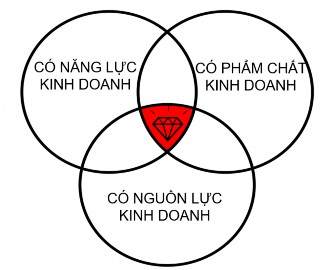
- One is business capacity.
- Second is business quality.
- Third is business resources. Specifically as follows: