
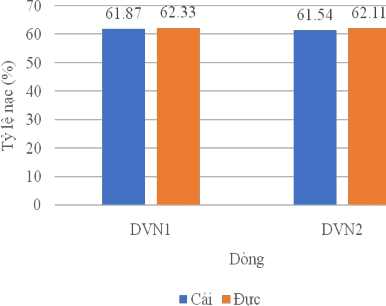
Figure 3.7. Lean meat ratio of two pig lines DVN1 and DVN2 according to characteristics
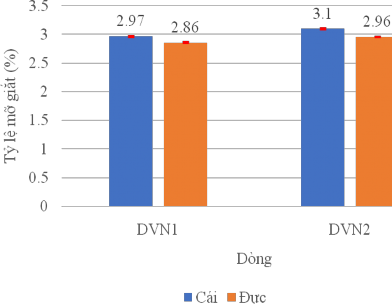
Figure 3.8. Fat ratio of two pig lines DVN1 and DVN2 according to characteristics
3.1.2. Reproductive performance of DVN1 and DVN2 sows
3.1.2.1. Influence of factors on reproductive performance of DVN1 and DVN2 sows
The results of the assessment of the influence of factors on the reproductive performance of DVN1 and DVN2 sows are presented in Table 3.9.
Table 3.9. The influence of factors on the reproductive capacity of DVN1 and DVN2 sows
Target
Current | Generation | Litter | |
Age at first mating (days) | <0.0001 | <0.0001 | - |
Age at first calving (days) | <0.0001 | <0.0001 | - |
Litter interval (days) | 0.653 | <0.0001 | <0.0001 |
Number of litters/sow/year | 0.881 | <0.0001 | <0.0001 |
Number of weaned piglets/sow/year (pigs) | 0.068 | <0.0001 | <0.0001 |
Number of newborns/litter (children) | 0.072 | 0.032 | 0.063 |
Number of live births/litter (infants) | 0.013 | 0.315 | 0.028 |
Number of children to raise/litter (children) | 0.009 | 0.182 | 0.141 |
Live birth rate (%) | 0.188 | 0.0007 | 0.497 |
Birth weight/child (kg) | 0.316 | <0.0001 | 0.018 |
Birth weight/lunch (kg) | 0.0009 | 0.011 | 0.004 |
Number of days to weaning (days) | 0.425 | 0.0057 | 0.070 |
Number of weaned piglets/litter (pigs) | 0.013 | 0.039 | <0.0001 |
Survival rate to weaning (%) | 0.439 | 0.540 | <0.0001 |
Weaning weight/pig (kg) | 0.375 | <0.0001 | 0.086 |
Weaning weight/litter (kg) | 0.021 | 0.0001 | <0.0001 |
Maybe you are interested!
-

 Factors Affecting Business Performance of Meiko Trading and Construction Company Limited
 -
 Djiko Soetrisno And Mahyuddin MD (1994), “Effect Of Graizing Systems On Reproductive Performance And The Net Return Of Milk Yielded By Shiwal – Friesian (Fs) Cows”, Proceeding Of The 7Th
 -
 Accounting determines business performance at Thanh Son Company Limited and factors affecting the effectiveness of this accounting work - 21
 -
 Factors Affecting the Improvement of Enterprise Performance
 -
 Factors affecting the business performance of Viet Thai Joint Venture Bank - 14
Note: - not tested
Pig lineage significantly affected the indicators of age at first mating, age at first farrowing, birth weight/litter (P<0.001), number of piglets to raise (P<0.01), number of live piglets/litter, number of weaned piglets/litter (P<0.05). Generation significantly affected the indicators of age at first mating, age at first farrowing, litter interval, number of litters/sow/year, number of weaned piglets/sow/year, live birth rate, birth weight/pig, weaning weight/pig, weaning weight/litter (P<0.001), number of piglets, birth weight/litter and number of weaned piglets (P<0.05). Parity significantly affected the indicators of age at first mating, age at first farrowing, litter interval, number of litters/sow/year, number of weaned piglets, survival to weaning rate, weaning weight/litter (P<0.001), number of live piglets, birth weight/pig (P<0.05).
The results of evaluating the influence of factors on the reproductive performance of DVN1 and DVN2 sows are similar to the results published by Trinh Hong Son et al. (2019a); Trinh Hong Son et al. (2019b) when studying the influence of some factors on the reproductive performance indicators of LVN1 and LVN2 sows and the Landrace and Yorkshire nucleus sow herd. The results published by Trinh Hong Son et al. (2019a); Trinh Hong Son et al. (2019b) showed that the pig line and breed factors did not affect all the reproductive performance indicators of Landrace and Yorkshire sows (P>0.05), while the litter factor significantly affected most of the reproductive performance indicators of Landrace and Yorkshire sows (P<0.001), except for the live birth rate (P>0.05). The published results of Nguyen Van Thang and Vu Dinh Ton (2010) showed that the litter factor has a significant effect (P<0.001) on the indicators of reproductive performance of sows, the boar has a significant effect on the birth weight/pig, the weaning weight/pig, the farm affects the weaning weight/litter (P<0.05) and the weaning weight/pig (P<0.001), and the season affects the weaning weight/pig (P<0.001). The published results of Nguyen Van Thang and Dang Vu Binh (2006) also showed that: year, litter has a significant effect on all indicators of reproductive performance of sows, the farm affects the number of piglets to raise, the birth weight/litter, the weaning weight/pig and the season affects the weaning weight/pig. The published results of Šprysl et al. (2012) showed that litter size had a very clear effect on the number of piglets born (P<0.0001), year and season had no effect on the reproductive performance of sows (P>0.05). The results published by Duziński et al. (2014) also showed that season had an effect on birth weight/pig (P<0.05) and weaning weight/pig (P<0.01). Thus, the results of the assessment of the influence of factors on the reproductive performance of DVN1 and DVN2 sows in this study are consistent with the published research results of domestic and foreign authors.
3.1.2.2. Reproductive performance of DVN1 and DVN2 sows
Reproductive performance indicators of DVN1 and DVN2 sows are presented in Table 3.10.
Table 3.10. Reproductive performance of DVN1 and DVN2 sows
Target
n | DVN1 | DVN2 | SEM | |
Age at first mating (days) | 150 | 218.85 b | 229.43a | 0.69 |
Age at first calving (days) | 150 | 333.57 b | 343.89a | 0.70 |
Litter interval (days) | 300 | 158.37 | 157.95 | 0.66 |
Number of litters/sow/year | 300 | 2.32 | 2.32 | 0.01 |
Number of weaned piglets/sow/year (pigs) | 300 | 22.82 | 22.22 | 0.23 |
Number of newborns/litter (children) | 450 | 11.23 | 10.95 | 0.11 |
Number of live births/litter (infants) | 450 | 10.76a | 10.42b | 0.10 |
Number of children to raise/litter (children) | 450 | 10.34a | 10.03b | 0.08 |
Live birth rate (%) | 450 | 96.41 | 95.80 | 0.33 |
Birth weight/child (kg) | 450 | 1.54 | 1.53 | 0.01 |
Birth weight/lunch (kg) | 450 | 16.64a | 15.95b | 0.15 |
Number of days to weaning (days) | 450 | 22.48 | 22.54 | 0.06 |
Number of weaned piglets/litter (pigs) | 450 | 9.70a | 9.44b | 0.07 |
Survival rate to weaning (%) | 450 | 94.29 | 94.70 | 0.37 |
Weaning weight/pig (kg) | 450 | 6.87 | 6.89 | 0.01 |
Weaning weight/litter (kg) | 450 | 66.67a | 65.02 b | 0.51 |
Note: In the same index, LSM values with different letters are statistically different.
Reproductive performance of DVN1 and DVN2 sows raised at Thuy Phuong Pig Research Center reached an average level with the number of live piglets/litter, number of piglets to feed/litter, birth weight/litter, number of piglets to wean and weaning weight/litter of DVN1 sows reaching the values of 10.76 piglets, 10.34 piglets, 16.64 kg, 9.7 piglets and 66.67 kg, respectively (Table 3.10). The number of live piglets/litter, number of piglets to feed/litter, birth weight/litter, number of piglets to wean and weaning weight/litter of DVN2 sows reached the values of 10.42 piglets, 10.03 piglets, 15.95 kg, 9.44 piglets and 65.02 kg, respectively (Table 3.10). DVN1 and DVN2 sows are created from Canadian Duroc pigs of the specialized "male line" group, so their reproductive performance indicators are at an average level.
Table 3.10 shows that DVN1 sows have an earlier age at first mating (218.85 days) and age at first litter (333.57 days) than DVN2 sows (229.43 days and 343.89 days). The number of live piglets/litter, the number of piglets to raise/litter, the birth weight/litter, the number of weaned piglets and the weaned weight/litter of DVN1 sows (10.76 piglets, 10.34 piglets, 16.64 kg, 9.7 piglets and 66.67 kg) are higher than those of DVN2 sows (10.42 piglets, 10.03 piglets, 15.95 kg,
9.44 pigs and 65.02 kg). The difference in these indicators between the two sow lines DVN1 and DVN2 is statistically significant (P<0.01). Thus, using DVN1 sows can improve the number of live piglets, the number of piglets to raise, the number of piglets weaned, the birth weight/litter and the weaning weight/litter compared to DVN2 sows.
The reproductive performance indicators of DVN1 and DVN2 sows in this study were all higher than the standards according to Decision No. 675/QD-BNN-CN of the Ministry of Agriculture and Rural Development (2014) for the original Duroc pig breed.
The results of this study on the reproductive performance of DVN1 and DVN2 sows tend to be higher than the results published by Doan Phuong Thuy et al. (2015) when studying the reproductive performance and selection orientation for Duroc pigs raised at Dabaco Nuclear Pig Breeding Company Limited. The results published by Doan Phuong Thuy et al. (2015) showed that the reproductive performance indicators of Duroc pigs were low with the number of newborn pigs/litter reaching 10.30, the number of live newborn pigs/litter reaching 9.33, the birth weight/litter reaching 14.20 kg and the weaning weight/litter reaching 68.79 kg. The results of the study by Doan Phuong Thuy et al. (2015) on Landrace and Yorkshire sows also showed that the age of first calving of Landrace and Yorkshire sows reached values of 357.55 and 358.17 days, respectively; The litter intervals were 147.83 and 145.35 days, respectively; the number of newborns per litter was 11.47 and 11.91, respectively; the number of live newborns per litter was 10.48 and 10.85, respectively; the number of rearing pigs per litter was 10.49 and 10.48, respectively; and the number of weaned pigs per litter was 10.35 and 10.31, respectively.
The results published by Alam et al. (2021) when studying the reproductive capacity of Duroc pigs raised in Korea showed that the age at first calving was 370.86 days, the number of newborns was 9.28 and the number of live newborns was 8.28. The results published by Imaeda et al. (2018) when studying the reproductive performance of Duroc pigs in Japan showed that the number of piglets born in Duroc pigs was low, ranging from 6.8 to 8.3; the number of live pigs was also low, ranging from 5.6 to 7.1, and the survival rate to weaning was from 81 to 94.2%. The results published by Li et al. (2018) when studying Duroc pigs raised in China showed that the age of first estrus was from 221.14 to 228.93 days, the age of first mating was 247.90 days, the age of first litter was 362.90 days, the number of weaned piglets was 247.90 days, the number of weaned piglets was 247.90 days, the age of first mating ...
Milk/sow/year reached 19.17 piglets, the number of live piglets in a sow's production cycle reached 24.83 piglets and the birth weight/litter in a sow's production cycle reached 40.47 kg. Hagan and Etim (2019) when studying the effects of breed, season and litter on the reproductive capacity of Large White (LW) and Duroc x Large White (DLW) pigs raised in hot and humid conditions of Ghana showed that the average number of piglets born and the number of piglets weaned reached 13.2 piglets and 10.2 piglets. DLW crossbred sows had a higher number of piglets born (14.2 piglets) (P = 0.03) than LW sows (12.5 piglets), but the number of piglets weaned of LW sows (10.8 piglets) was higher (P = 0.01) than DLW sows (9.7 piglets). The results published by Thapa (2018) when studying the reproductive capacity of Duroc sows raised in Bhutan showed that the age at first farrowing was 389 days, the number of piglets/litter was 7.34, the birth weight/litter was 8.87 kg, the weaning age was 48.76 days, the number of piglets weaned/litter was 6.77, the weaning weight/pig was 8.17 kg and the litter interval was 196.68 days.
Thus, the reproductive performance indicators of DVN1 and DVN2 sows in this study tend to be higher than the published results of domestic and foreign authors.
Number of newborns/litter, number of live newborns/litter, number of weaned pigs/litter, newborn weight/litter, weaned weight/litter of two sow lines DVN1, DVN2 are illustrated in Figures 3.9, 3.10, 3.11.
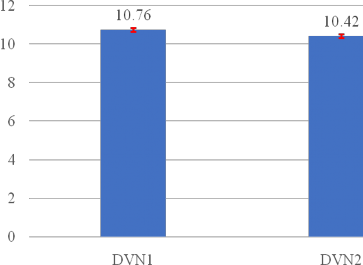
Figure 3.9. Number of live piglets/litter of two sow lines DVN1 and DVN2
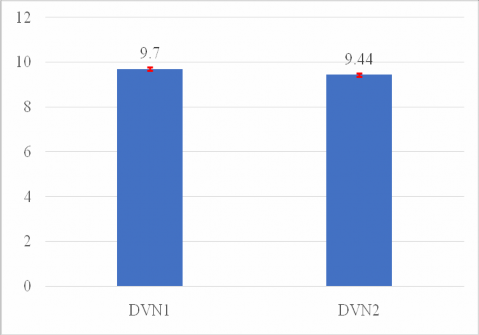
Figure 3.10. Number of weaned piglets/litter of two sow lines DVN1 and DVN2
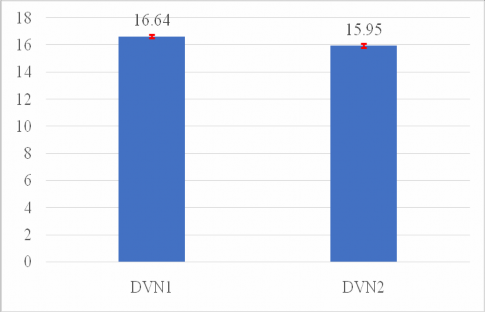
Figure 3.11. Birth weight/litter of two sow lines DVN1 and DVN2
3.1.2.3. Reproductive performance of DVN1 and DVN2 sows over 3 generations
Reproductive performance of DVN1 and DVN2 sows over three generations is presented in tables 3.11, 3.12 and 3.13.
Table 3.11. Reproductive performance of DVN1 and DVN2 sows over 3 generations
Target
n | Generation 1 | Generation 2 | Generation 3 | SEM | |
Age at first mating (days) | 100 | 221.71b | 230.20a | 220.51b | 0.85 |
Age at first calving (days) | 100 | 336.46 b | 345.00 a | 334.72 c | 0.86 |
Litter interval (days) | 200 | 161.53a | 159.33a | 153.62 b | 0.81 |
Number of litters/sow/year | 200 | 2.28b | 2.30b | 2.39a | 0.01 |
Number of weaned piglets/sow/year (pigs) | 200 | 21.62b | 22.39b | 23.54a | 0.28 |
Number of newborns/litter (children) | 300 | 10.83b | 11,12 ab | 11.32a | 0.13 |
Number of live births/litter (infants) | 300 | 10.45 | 10.61 | 10.70 | 0.12 |
Number of children to raise/litter (children) | 300 | 10.04 | 10.23 | 10.30 | 0.10 |
Live birth rate (%) | 300 | 97.07 | 96.32 | 94.93 | 0.40 |
Birth weight/child (kg) | 300 | 1.51b | 1.55a | 1.55a | 0.01 |
Birth weight/lunch (kg) | 300 | 15.85b | 16.49a | 16.54a | 0.18 |
Number of days to weaning (days) | 300 | 22.39b | 22.46 ab | 22.68a | 0.07 |
Number of weaned piglets/litter (pigs) | 300 | 9.40b | 9.59 ab | 9.72a | 0.09 |
Survival rate to weaning (%) | 300 | 94.21 | 94.39 | 94.89 | 0.45 |
Weaning weight/pig (kg) | 300 | 6.79b | 6.92a | 6.94a | 0.02 |
Weaning weight/litter (kg) | 300 | 63.79b | 66.36a | 67.38a | 0.62 |
Note: In the same index, LSM values with different letters are statistically different.
Number of litters/sow/year, number of weaned piglets/sow/year, number of newborn piglets, birth weight/pig, number of weaned piglets, weaned weight/pig and weaned weight/litter of DVN1 and DVN2 sows were lowest in generation 1 (2.28; 21.62 piglets; 10.83 piglets, 1.51 kg; 15.85 kg; 9.40 piglets; 6.79 kg and 63.79 kg) and highest in generation 3 (2.39; 23.54
children; 11.32 children; 1.55 kg; 16.54 kg; 9.72 children; 6.94 kg and 67.38 kg). The difference in these indicators between generations is statistically significant (P<0.01).