
4.2.2.2. The effectiveness of 25% concentration of extract from bark and leaves of White Eucalyptus tree on fungi
The results of the study on the effectiveness of 25% extract from the bark and leaves of White Eucalyptus on fungi are summarized in Table 4.7 and Figure 4.7.
Table 4.7. Evaluation of the effectiveness of 25% concentration of Eucalyptus bark and leaf extract against fungi
Target
Evaluation score of preservative effectiveness according to criteria | ||||||||||
Control | Color change | Soft item | Loss | |||||||
BM dc | BM tt (cm 2 ) | Total weight (%) | Point | mm tt (cm 2 ) | T mm (%) | Point | Average height (cm 2 ) | T hh (%) | Point | |
TB | 75.1 | 1.88 | 69.74 | 1 | 0 | 100 | 1 | 0 | 100 | 1 |
Total score | 3 | |||||||||
Maybe you are interested!
-
 Effect of Initial Glyphosate Concentration on Processability of Electrochemical Fenton Process
 -
 Survey Results of the Effect of Agent Concentration on Reaction Yield at 5 G/Batch Scale
 -
 Test Results of Optimal Mode Effect on Mechanical Properties
 -
 Djiko Soetrisno And Mahyuddin MD (1994), “Effect Of Graizing Systems On Reproductive Performance And The Net Return Of Milk Yielded By Shiwal – Friesian (Fs) Cows”, Proceeding Of The 7Th
 -
 Comparison of the effects of two methods of complete intravenous anesthesia with Propofol with and without target concentration control - 2
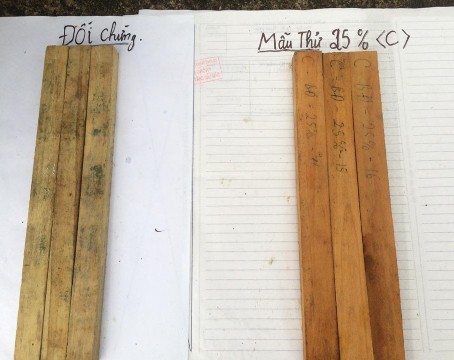
Figure 4.7. Image comparing the effectiveness against fungi of wood samples soaked with 25% concentration of preparation and control samples
The analysis results showed that the control bars not soaked in the extract from the bark and leaves of white eucalyptus were completely damaged, while the samples soaked in the extract from the bark and leaves of white eucalyptus at a concentration of 25% had reduced fungal penetration. The average fungal area was 1.88cm 2 . So at a concentration of 25%, the extract was effective in limiting fungal penetration. The evaluation score of the product's effectiveness against fungi was 3 points compared to the standard of good effectiveness.
4.2.2.3. The effectiveness of 35% concentration of extract from bark and leaves of White Eucalyptus tree on fungi
The results of the study on the effectiveness of 35% extract from the bark and leaves of White Eucalyptus on fungi are summarized in Table 4.8 and Figure 4.8.
Table 4.8. Evaluation of the effectiveness of 35% concentration of Eucalyptus bark and leaf extract against fungi
Target
Evaluation score of preservative effectiveness according to criteria | ||||||||||
Address | Color change | Soft item | Loss | |||||||
BM dc | BM tt (cm 2 ) | Total weight (%) | Point | mm tt (cm 2 ) | T mm (%) | Point | Average height (cm 2 ) | T hh (%) | Point | |
TB | 75.1 | 1.51 | 76.58 | 1 | 0 | 100 | 1 | 0 | 100 | 1 |
Total point | 3 | |||||||||
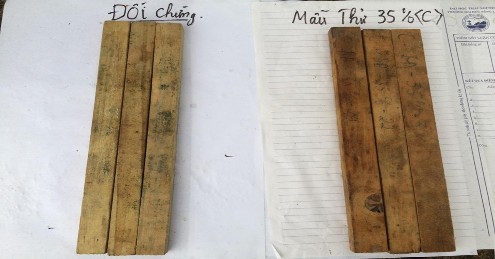
Figure 4.8. Image comparing the effectiveness against fungi of wood samples soaked in 35% concentration of preparation and control samples
The analysis results showed that the control sample not soaked in the extract from the bark and leaves of the white eucalyptus tree was completely damaged. For the sample soaked in the extract from the bark and leaves of the white eucalyptus tree at a concentration of 35%, the fungal penetration was reduced. The average fungal area was 1.51cm 2 . So at a concentration of 35%, the extract had the effect of limiting the penetration of the fungus. The evaluation score of the effectiveness of the preparation against the fungus was 3 points compared to the standard of achieving good effectiveness.
To see the difference in concentration of the preparation soaked in alcohol to the antifungal effect, summarized in table 4.9
Table 4.9. Efficacy of extracts from bark and leaves of White Eucalyptus at different concentrations against fungi
Concentration (%)
Separation method | Mass of absorbed drug (Kg/m 3 ) | Drug efficacy according to the criteria | |||||||
T bm | Point | T mm | Point | T hh | Point | Conclude | |||
15 | Soak alcohol | 2,778 | 68.28 | 1 | 100 | 1 | 100 | 1 | Good |
25 | Soak in alcohol | 4,325 | 69.74 | 1 | 100 | 1 | 100 | 1 | Good |
35 | Soak in alcohol | 5,435 | 76.08 | 1 | 100 | 1 | 100 | 1 | Good |
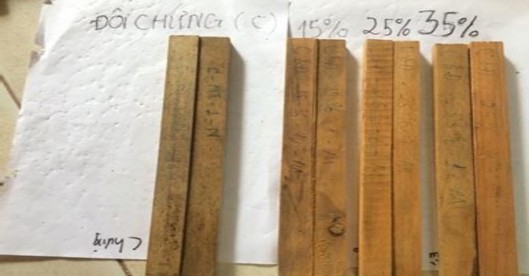
Figure 4.9. Image comparing the effectiveness against fungi of wood samples soaked with the preparation at different concentrations and control samples
ANOVA analysis results: frequency statistic F = 0.850 with Sig value (or probability p-value) = 0.605 greater than 0.05 indicates that concentration does not affect the effectiveness of the preparation against fungi.
Table 4.10. Efficacy of extracts from bark and leaves of White Eucalyptus at different concentrations against fungi
Concentration (%)
Separation method | Color change | |
15 | Soak in alcohol | 68.28 |
Soak in hot water | 66.24 | |
25 | Soak in alcohol | 69.74 |
Soak in hot water | 92.33 | |
35 | Soak in alcohol | 76.08 |
Soak in hot water | 93.60 |
92.33 93.60
66.24
69.74 76.08
68.28
Figure 4.10. Graph showing the effect of each concentration on discoloration of fungi.
From the above analysis results, it can be seen that the ability of fungi to penetrate into pine wood samples soaked in extracts from the bark and leaves of white eucalyptus decreases with increasing concentration of the extract. When soaking pine wood in the extract with
The higher the concentration, the better the antifungal effect. For wood samples soaked in preservative solution, the wood itself has created an environment that is completely different from wood samples not soaked in preservative solution. It ignores the favorable conditions for the germination of fungal spores, moreover, the preservative solution also destroys fungal spores, the active ingredients of the preservative solution penetrate into the wood and react with the main components of the fungal spores, causing the fungal spores to not germinate. The combined result of the above effects of the preservative on fungi is to deform them in shape, change, and sometimes destroy them right on the surface of the impregnated wood. However, at different concentrations, the ability to inhibit the growth of fungi will be different. This explains the experimental results when testing the ability of fungi to penetrate pine wood at different concentrations and extraction methods, in the method of extracting with alcohol, the wood samples were invaded by fungi in some wood samples even at a concentration of 35%. This method of extracting the solution has the effect of limiting the penetration of fungi but has not completely limited the penetration of fungi. After 1 month of monitoring, some wood samples still have fungi. Extracting the solution with hot water at a concentration of 35% also has fungal penetration but it is not significant.
Therefore, we can conclude that the preservative solution with a concentration of 35% is effective in preserving pine wood in preventing the penetration of destructive fungi. When using pine wood in production and construction, the choice of preservative solution concentration will be based on the purpose of use. When preserving pine wood, it must be preserved in a soaking solution with a concentration of 35% for the best effect.
4.3. Termite effect of the product from the bark and leaves of White Eucalyptus on Pine wood
4.3.1. Effect of hot water extract of bark and leaves of Eucalyptus on termites
After testing on 60 samples to see the difference in the concentration of the preparation affecting the termite resistance effect on wood, the wood samples were soaked with the preparation at concentrations of 15%, 25%, 35% and then removed.
The wood samples were dried and then placed in an environment with strong termite activity for 1 month. The results are summarized in Table 4.11 and Figure 4.11.
Table 4.11. Effect of extracts from bark and leaves of white Eucalyptus on termites
Concentration (%)
Separation method | Mass of absorbed drug (Kg/m 3 ) | Drug efficacy according to the criteria | |||||||
TV | Point | TVs | Point | TV | Point | Conclude | |||
15% | Soak in water hot | 2,248 | 100 | 1 | 100 | 1 | 100 | 1 | Good |
25% | Soak hot water | 3,581 | 100 | 1 | 100 | 1 | 100 | 1 | Good |
35% | Soak hot water | 4,981 | 100 | 1 | 100 | 1 | 100 | 1 | Good |
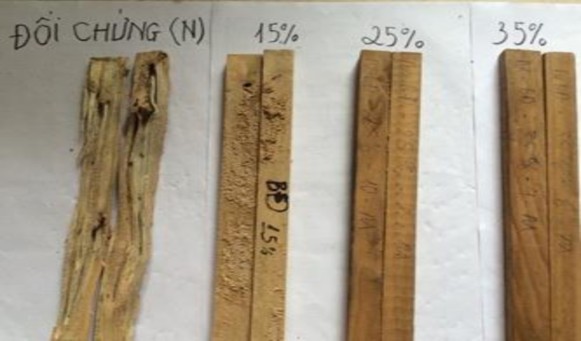
Figure 4.11. Image comparing the effectiveness against termites of wood samples soaked with the preparation at different concentrations and control samples
From the results summarized in the table and through figure 4.11, it can be seen that the ability of termites to penetrate each concentration is negligible. The ability of termites to penetrate the Pine wood sample soaked with preservative from the bark
and the leaves of white eucalyptus decreased with the increasing concentration of the preservative and the amount of medicine absorbed for the control sample when not soaked with the extract was completely invaded and damaged by termites. The sample soaked with the extract at a concentration of 15% had the phenomenon of each attack but only stopped when it met the surface of the wood. At a concentration of 15%, the termites only covered the surface of the wood and no termite invasion occurred. Meanwhile, the samples soaked with the extract at concentrations of 25%, 35% remained intact and no termite attack occurred. From these results, it can be concluded that when soaking pine wood with the extract at concentrations of 15%, 25%, 35%, it is capable of preventing termite invasion.
4.3.2. The effect of alcohol extract from the bark and leaves of White Eucalyptus on termites
Through testing on 60 samples to see the difference in the concentration of the preparation affecting the termite resistance effect on wood, the wood samples were soaked with the preparation at concentrations of 15%, 25%, 35%, then taken out to dry and then placed in an environment with strong termite activity for 1 month. The results are summarized in Table 4.12 and Figure 4.12.
Table 4.12. Effect of bark and leaf extracts of white Eucalyptus on termites
Concentration (%)
Separation method | Mass of absorbed drug (Kg/m 3 ) | Drug efficacy according to the criteria | |||||||
TV | Point | TVs | Point | TV | Point | Conclude | |||
15% | Soak in alcohol | 2,189 | 100 | 1 | 100 | 1 | 100 | 1 | Good |
25% | Soak in alcohol | 3,847 | 100 | 1 | 100 | 1 | 100 | 1 | Good |
35% | Soak alcohol | 6,228 | 100 | 1 | 100 | 1 | 100 | 1 | Good |
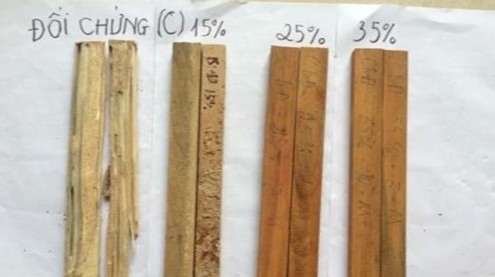
Figure 4.12. Image comparing the effectiveness against termites of wood samples soaked with the preparation at different concentrations and control samples
From the results summarized in the table and through figure 4.12, it can be seen that the ability of termites to penetrate each concentration is different. The ability of termites to penetrate the pine wood sample soaked with preservative from bark and leaves
The white eucalyptus tree decreased with the increasing concentration of the preservative and the amount of the drug absorbed. The sample soaked with the extract at a concentration of 15% showed the phenomenon of each attack but only stopped when it met the surface of the wood. At a concentration of 15%, the termites only covered the surface of the wood and no termite invasion occurred. For the control sample when not soaked with the extract, the termites invaded and completely damaged it. As for the samples soaked with the extract at concentrations of 25%, 35% remained intact and there was no phenomenon of termite attack. From these results, it can be concluded that when soaking pine wood with the extract at concentrations of 15%, 25%, 35%, it is capable of preventing termite invasion.
Through two experiments of soaking pine wood with hot water and alcohol at different concentrations, it can be seen that in general, pine wood is quite soft, slightly porous, light and is a favorite material of termites. When termites approach it, they eat it very quickly. Termites are insects that are very sensitive to chemicals. With toxic chemicals, they will build a tunnel to overcome them or when they detect food (wood), they will attack, but when they detect chemicals, they will leave on their own. But the solution from eucalyptus bark and leaves at different concentrations