
CHAPTER 5
ASSESSMENT IMPLEMENTATION
AND USING PERFORMANCE EVALUATION RESULTS
Chapter Objectives
The content of Chapter 5 focuses on the implementation of assessment and use of performance assessment results of organizations/enterprises. This content is presented through two parts: Implementation of assessment and use of performance assessment results. Part 5.1 discusses the main contents of implementing performance assessment, including communication, training on performance assessment, conducting performance assessment and feedback on performance assessment. At the same time, this content also studies and identifies common mistakes in performance assessment of organizations/enterprises. The use of performance assessment results in human resource management activities of organizations/enterprises such as in human resource treatment, in training and development of human resources, in human resource arrangement and use... is presented in part 5.2.
Through this chapter, readers will grasp the basic knowledge about the contents of implementing performance appraisal in organizations/enterprises, including communication activities for performance appraisal; training for performance appraisal and conducting performance appraisal. Readers will also be equipped and trained in the skills of developing and implementing a communication plan for performance appraisal, a training plan for performance appraisal; skills of conducting interviews for performance appraisal, etc.
Introductory situation
MISTAKES IN PERFORMANCE EVALUATION AT MINH DUC GROUP
Mr. Hung is the Human Resources Director of Minh Duc Group - specializing in providing comprehensive software solutions to businesses. With more than 15 years of experience working in the field of human resources of large companies and corporations in the same field, he is considered a key personnel of Minh Duc and is planned for a higher position in the group. Mr. Hung's work process is also highly appreciated by the Board of Directors. With his experience, he has built a performance evaluation system for employees in the company to clarify their contributions to the overall performance of the group. The evaluation system is built with 3 methods including: work diary, 360-degree evaluation and rating scale for each department and division in the group. This evaluation method has been well applied in the development process of the group. In addition, Mr. Hung is also wholeheartedly supported by employees because he is always fair in the evaluation process.
A year ago, the HR department recruited a new head of recruitment - Mr. An. The HR staff noticed that although Mr. An's work results were not good and did not meet the planned results, Mr. Hung rated him as excellent in both of the past two evaluations. Part of the reason that the HR staff noticed was that Mr. An had a personality that was "compatible" with Mr. Hung. This evaluation result did not receive consensus from the staff because they felt it was unfair, which resulted in a significant decrease in the work results of the HR staff and a lack of efficiency in their work. Even some employees who had good performance in previous periods became irresponsible with their work. The previous 360-degree evaluation system received negative feedback.
Despite the very honest feedback from employees, some employees are still reluctant to provide honest and accurate information when asked for evaluation and no longer hope that this evaluation system will be a tool to accurately assess employees' contributions to the business.
Question: Please analyze the advantages and disadvantages of performance evaluation at Minh Duc Group. In your opinion, what mistakes did Mr. Hung make when conducting performance evaluation?
5.1. Implementing performance appraisal
The activity of implementing performance appraisal in an organization/enterprise includes the following basic tasks: communicating performance appraisal; training on performance appraisal; conducting performance appraisal and providing feedback on performance appraisal.
5.1.1. Performance appraisal communication
Performance appraisal has many different roles, one of the most important of which is to measure the level of work completion of employees and guide them to perform according to the requirements of the organization/enterprise. Communication activities of performance appraisal will help performance appraisal achieve this role.
- Purpose of performance appraisal communication
The main purpose of communication in performance appraisal is to help employees in the organization/enterprise clearly understand the functions, tasks and contents of the appraisal program (Mai Thanh Lan & Nguyen Thi Minh Nhan, 2016), specifically:
+ When conducting assessments, organizations/enterprises need to identify clear messages related to the rights and obligations of employees when they participate in performance assessment programs.
and in different ways to convey those messages to each employee. Through communication activities in performance appraisal, employees will clearly understand the benefits that the performance appraisal program brings to them and have a positive view of the performance appraisal work of the organization/enterprise. From there, the subjects participating in the performance appraisal process will cooperate with the organization/enterprise.
+ With the messages that the evaluation media in the performance evaluation conveys to the workforce, it will help them grasp and understand better the content of the performance evaluation program, the expectations and job requirements of the organization/enterprise so that they can perform tasks according to the requirements of the organization/enterprise.
- Content of performance appraisal communication
Organizations/enterprises need to develop an evaluation communication plan to ensure that information related to the organization/enterprise's performance evaluation system is fully, quickly and widely communicated to all subjects involved in the performance evaluation process. The content of a good evaluation communication program must ensure that the recipients of the information can answer the following basic questions:
+ What is performance appraisal?
+ How consistent is the performance appraisal system with the organization/enterprise's operating strategy?
+ What are the benefits of a performance appraisal system?
+ How is the performance appraisal system implemented?
+ What are the responsibilities of the communicated subject in the performance appraisal system?
+ …
- Time and method of communication to evaluate work performance
During the process of evaluating work performance at an organization/enterprise, communication activities are continuously implemented. After the organization/enterprise builds a performance evaluation system, it is necessary to communicate about the performance evaluation system.
At the beginning of the period, managers assign and agree with department heads and individual employees on evaluation criteria and scope of work performance evaluation.
Before conducting a performance appraisal, employees need to be informed about issues related to the content and scope of the appraisal; the areas that need to be appraised and how they will be appraised; and the importance of the performance appraisal results not only for the employee, for each department, but also for the entire organization/enterprise.
After completing the performance evaluation, the results of the performance evaluation are also announced and communicated to individuals/departments along with related decisions.
For example, at company Y, the direct manager will assign tasks/jobs via software, email, in writing or in person. The content of the assigned tasks/jobs includes: name of the task/job; goals and targets to be achieved (according to quantitative and qualitative criteria) to evaluate the results of the goal implementation; completion deadline; weight of each task/job (according to 4 levels based on two factors: the level of importance and the level of urgency of each task/job). Employees will update all tasks/jobs on the software (with tasks/jobs according to the job description, tasks/jobs assigned according to the plan, tasks/jobs assigned by the direct manager via email, writing or in person).
TT
Quest Name | Weight | Time of execution | Target results to be achieved | Description of results | |
1. | - About the workload - About the quality of work - About other requests | - About the workload - About the quality of work - About other requests | |||
2. | |||||
3. | |||||
4. | |||||
5. |
Maybe you are interested!
-

 State management of youth work in Čư M'gar district, Dak Lak province - 15
 -
 State management of youth work in Čư M'gar district, Dak Lak province - 18
 -
 State management of youth work in Čư M'gar district, Dak Lak province - 1
 -
 Car body electrical practice - 8
zt2i3t4l5ee
zt2a3gs
zt2a3ge
zc2o3n4t5e6n7ts
If the voltage is out of specification, replace the wire or connector.
If the voltage is within specification, install the front fog light relay and follow step 5.
Step 5 Check the front fog light switch
- Remove the D4 connector of the fog light switch
- Use a multimeter to measure the resistance of the front fog light switch.
Measurement location
Condition
Standard
D4-3 (BFG) -D4-4 (LFG)
Light switchFront Fog OFF
>10kΩ
D4-3 (BFG) -D4-4 (LFG)
Front fog light switchON
<1 Ω
- Standard resistor
D4 connector is located on the combination switch assembly.
If the resistance is out of specification, replace the combination switch (the fog light switch is located in the combination switch).
If the resistance is within specification, follow step 6.
Step 6 Check wiring and connectors (front fog light relay-light selector switch)
- Disconnect connector D4 of the combination switch assembly
- Use a voltmeter to measure the voltage value of jack D4 on the wire side.
Measurement location
Control modecontrol
Standard
D4-3 (BFG) - (-) AQ
TAIL
11 to 14 V
D4 connector for the wiring of the combination switch assembly
If the voltage does not meet the standard, replace the wire or connector.
If the voltage is within standard, there may have been an error in the previous measurements.
Step 7 Check the front fog lights
- Remove the front fog light electrical connector.
- Supply battery voltage to the fog lamp terminals
Jack 8, B9 of front fog lamp on the electrical side
blind first.
Power supply location
Terms and Conditions
Battery positive terminal - Terminal 2Battery negative terminal - Terminal 1
Fog lightsbefore morning
- If the light does not come on, replace the bulb.
If the light is on, re-plug the jack and continue to step 8.
Step 8 Check wiring and connectors (relay and front fog lights)
- Disconnect the B8 and B9 connectors of the front fog lights.
- Use a voltmeter to measure voltage at the following locations:
Measurement location
Switch location
Terms and Conditions
B8-2 - (-) AQ
Electric lock ON TAIL size switchFog switch ON
11 to 14 V
B9-2 - (-) AQ
Electric lock ONTAIL size switch Fog switch ON
11 to 14 V
B8 and B9 connectors on the front fog lamp wiring side
Voltage is not up to standard, repair or replace the jack. If up to standard, there may have been an error in the measurement process.
2.2.4. Procedure for removing, installing and adjusting fog lights 1. Procedure for removing
- Remove the front inner ear pads
Use a screwdriver to remove the 3 screws and remove the front part of the front inner ear liner
-Remove the fog light assembly
+ Disconnect the connector.
+ Use a screwdriver to remove 3 screws to remove the fog light cover
2. Installation sequence
-Rotate the fog lamp bulb in the direction indicated by the arrow as shown in the figure and remove the fog lamp from the fog lamp assembly.
-Rotate the fog light bulb in the direction indicated by the arrow as shown in the figure and install the light into the fog light assembly.
- Use a screwdriver to install the fog light cover
-Install the electrical connector
Attention: Be careful not to damage the plastic thread on the lamp assembly.
- Install the front inner ear pads
Use a screwdriver to install the front inner bumper with 3 screws.
3. Prepare the vehicle to adjust the fog light convergence. Prepare the vehicle:
- Make sure there is no damage or deformation to the vehicle body around the fog lights.
- Add fuel to the fuel tank
- Add oil to standard level.
- Add engine coolant to standard level.
- Inflate the tire to standard pressure.
- Place spare tire, tools and jack in original design position
- Do not leave any load in the luggage compartment.
- Let a person weighing about 75 kg sit in the driver's seat.
4. Prepare to check the fog light convergence
a/ Prepare the vehicle status as follows:
- Place the car in a dark enough place to see the lines. The lines are the dividing line, below which the light from the fog lights can be seen but above which it cannot.
- Place the car perpendicular to the wall.
- Keep a distance of 7.62 m between the center of the fog lamp and the wall.
- Park the car on level ground.
- Press the car down a few times to stabilize the suspension.
Note: A distance of approximately 7.62 m is required between the vehicle (fog lamp center) and the wall to adjust the convergence correctly. If the distance of 7.62 m cannot be achieved, set the correct distance of 3 m to check and adjust the fog lamp convergence. (Since the target area varies with the distance, please follow the instructions as shown in the figure.)
b/ Prepare a piece of thick white paper about 2 m high and 4 m wide to use as a screen.
c/ Draw a vertical line through the center of the screen (line V).
d/ Set the screen as shown in the picture. Note:
- Keep the screen perpendicular to the ground.
- Align the V line on the screen with the center of the vehicle.
e/Draw the reference lines (H, V LH and V RH lines) on the screen as shown in the figure.HINT:
Mark the center of the fog lamp on the screen. If the center mark cannot be seen on the fog lamp, use the center of the fog lamp or the manufacturer's name mark on the fog lamp as the center mark.
H line (fog light height):
Draw a line across the screen so that it passes through the center mark. Line H should be at the same height as the center mark of the fog light bulb.
Line V LH, V RH (center mark position of left fog lamp LH and right fog lamp RH):
Draw two lines so that they intersect line H at the center marks.
5. Check the fog light convergence
a/ Cover the fog lamp or remove the connector of the other side fog lamp to prevent light from the unchecked fog lamp from affecting the fog lamp convergence test.
b/ Start the engine.
c/ Turn on the fog lights and make sure that the dividing line is outside the standard area as shown in the drawing.
6. Adjust the fog light convergence
Use a screwdriver to adjust the fog light to the standard area by turning the toe adjustment screw.
Note: If the screw is adjusted too far, loosen it and then tighten it again, so that the last rotation of the light adjustment screw is clockwise.
3. Self-study questions
1. Describe the operating principle of the lighting system with automatic headlight function
2. Describe the operating principle of the lighting system with the function of rotating headlights when turning
3. Draw diagram and connect lighting system on Hyundai Porter car
4. Draw diagram and connect lighting system on Honda Accord 1992
5. Draw the lighting circuit on a 1993 Toyota Lexus
LESSON 3 MAINTENANCE AND REPAIR OF SIGNAL SYSTEM
I. IMPLEMENTATION GOAL
After completing this lesson, students will be able to:
- Distinguish between types of signals on cars
- Correctly describe common symptoms and suspected areas causing damage.
- Connecting signal circuits ensures technical requirements
- Disassemble, install, check, maintain and repair the signal system to ensure technical requirements.
- Ensure safety in work and industrial hygiene
II. LESSON CONTENT
1. General description
The signal system equipped on cars aims to create signals to notify other vehicles participating in traffic about the vehicle's operating status such as: stopping, parking, braking, reversing, turning...
Signals are used either by light such as headlamps, brake lights, turn signals….. or by sound such as horns, reverse music….
Just like the lighting system. A signal system circuit usually consists of: battery, fuse, wire, relay, electrical load and control switch. Only some switches of the signal system are on the combination switch. The switches of other signals are usually located in different locations such as in the gearbox or brake pedal……
2. Maintenance and repair
2.1. Turn signals and hazard lights
The installation location of the turn signal is shown in Figure 3.1. The turn signal control switch is located in the combination switch under the steering wheel. Turning this switch to the right or left will make the turn signal turn right or left.
The hazard light switch is used when the vehicle has a problem while participating in traffic. When the hazard light switch is turned on, all the turn signals on the vehicle will light up at a certain frequency. The hazard light switch is usually placed separately from the turn signal switch (some old cars integrate the hazard and turn signal switches on the same combination switch cluster).
Figure 3.1 Turn signal switch Figure 3.2 Hazard switch
The part that generates the flashing frequency for the lights is called a turn signal relay. The turn signal relay usually has 3 terminals: B (positive power supply); E (negative power supply); L (providing the turn signal switch to distribute to the
lamp)
2.1.1. Circuit diagram
To generate the frequency for the turn signal, a turn signal relay is used in the turn signal circuit. The current from the turn signal relay will be sent to the turn signal switch assembly to distribute the current to the turn signal lights for the driver's purpose.
Figure 3.3. Schematic diagram of a turn signal circuit without a hazard switch
1. Battery; 2. Electric lock; 3. Turn signal relay; 4. Turn signal switch; 5. Turn signal lamp; 6. Turn signal lamp; 7. Hazard switch
Figure 3.4 Schematic diagram of turn signal circuit with hazard switch
1. Battery; 2. Combination switch cluster; 3. Turn signal;
4. Turn signal light; 5. Turn signal relay
Today's cars no longer use three-pin turn signal relays (B, L, E) but use eight-pin turn signal relays (figure 3.5) (pin number 8 is used for hazard lights).
For this type, the current supplying the turn signal lights is supplied directly from the turn signal relay to the lights.
div.maincontent .p { color: black; font-family:"Times New Roman", serif; font-style: normal; font-weight: normal; text-decoration: none; font-size: 14pt; margin:0pt; } div.maincontent p { color: black; font-family:"Times New Roman", serif; font-style: normal; font-weight: normal; text-decoration: none; font-size: 14pt; margin:0pt; } div.maincontent .s1 { color: black; font-family:"Times New Roman", serif; font-style: normal; font-weight: normal; text-decoration: none; font-size: 13pt; } div.maincontent .s2 { color: black; font-family:"Times New Roman", serif; font-style: italic; font-weight: normal; text-decoration: none; font-size: 14pt; } div.maincontent .s3 { color: black; font-family:"Times New Roman", serif; font-style: normal; font-weight: normal; text-decoration: none; font-size: 14pt; } div.maincontent .s4 { color: black; font-family:"Times New Roman", serif; font-style: normal; font-weight: normal; text-decoration: none; font-size: 13pt; } div.maincontent .s5 { color: black; font-family:"Times New Roman", serif; font-style: normal; font-weight: normal; text-decoration: none; font-size: 13pt; vertical-align: 1pt; } div.maincontent .s6 { color: black; font-family:"Times New Roman", serif; font-style: normal; font-weight: normal; text-decoration: none; font-size: 11pt; } div.maincontent .s7 { color: black; font-family:"Times New Roman", serif; font-style: normal; font-weight: normal; text-decoration: none; font-size: 14pt; vertical-align: -9pt; } div.maincontent .s8 { color: black; font-family:"Times New Roman", serif; font-style: normal; font-weight: normal; text-decoration: none; font-size: 11pt; } div.maincontent .s9 { color: #008000; font-family:"Times New Roman", serif; font-style: normal; font-weight: normal; text-decoration: none; font-size: 14pt; } div.maincontent .s10 { color: black; font-family:"Times New Roman", serif; font-style: italic; font-weight: normal; te
Car body electrical practice - 8
zt2i3t4l5ee
zt2a3gs
zt2a3ge
zc2o3n4t5e6n7ts
If the voltage is out of specification, replace the wire or connector.
If the voltage is within specification, install the front fog light relay and follow step 5.
Step 5 Check the front fog light switch
- Remove the D4 connector of the fog light switch
- Use a multimeter to measure the resistance of the front fog light switch.
Measurement location
Condition
Standard
D4-3 (BFG) -D4-4 (LFG)
Light switchFront Fog OFF
>10kΩ
D4-3 (BFG) -D4-4 (LFG)
Front fog light switchON
<1 Ω
- Standard resistor
D4 connector is located on the combination switch assembly.
If the resistance is out of specification, replace the combination switch (the fog light switch is located in the combination switch).
If the resistance is within specification, follow step 6.
Step 6 Check wiring and connectors (front fog light relay-light selector switch)
- Disconnect connector D4 of the combination switch assembly
- Use a voltmeter to measure the voltage value of jack D4 on the wire side.
Measurement location
Control modecontrol
Standard
D4-3 (BFG) - (-) AQ
TAIL
11 to 14 V
D4 connector for the wiring of the combination switch assembly
If the voltage does not meet the standard, replace the wire or connector.
If the voltage is within standard, there may have been an error in the previous measurements.
Step 7 Check the front fog lights
- Remove the front fog light electrical connector.
- Supply battery voltage to the fog lamp terminals
Jack 8, B9 of front fog lamp on the electrical side
blind first.
Power supply location
Terms and Conditions
Battery positive terminal - Terminal 2Battery negative terminal - Terminal 1
Fog lightsbefore morning
- If the light does not come on, replace the bulb.
If the light is on, re-plug the jack and continue to step 8.
Step 8 Check wiring and connectors (relay and front fog lights)
- Disconnect the B8 and B9 connectors of the front fog lights.
- Use a voltmeter to measure voltage at the following locations:
Measurement location
Switch location
Terms and Conditions
B8-2 - (-) AQ
Electric lock ON TAIL size switchFog switch ON
11 to 14 V
B9-2 - (-) AQ
Electric lock ONTAIL size switch Fog switch ON
11 to 14 V
B8 and B9 connectors on the front fog lamp wiring side
Voltage is not up to standard, repair or replace the jack. If up to standard, there may have been an error in the measurement process.
2.2.4. Procedure for removing, installing and adjusting fog lights 1. Procedure for removing
- Remove the front inner ear pads
Use a screwdriver to remove the 3 screws and remove the front part of the front inner ear liner
-Remove the fog light assembly
+ Disconnect the connector.
+ Use a screwdriver to remove 3 screws to remove the fog light cover
2. Installation sequence
-Rotate the fog lamp bulb in the direction indicated by the arrow as shown in the figure and remove the fog lamp from the fog lamp assembly.
-Rotate the fog light bulb in the direction indicated by the arrow as shown in the figure and install the light into the fog light assembly.
- Use a screwdriver to install the fog light cover
-Install the electrical connector
Attention: Be careful not to damage the plastic thread on the lamp assembly.
- Install the front inner ear pads
Use a screwdriver to install the front inner bumper with 3 screws.
3. Prepare the vehicle to adjust the fog light convergence. Prepare the vehicle:
- Make sure there is no damage or deformation to the vehicle body around the fog lights.
- Add fuel to the fuel tank
- Add oil to standard level.
- Add engine coolant to standard level.
- Inflate the tire to standard pressure.
- Place spare tire, tools and jack in original design position
- Do not leave any load in the luggage compartment.
- Let a person weighing about 75 kg sit in the driver's seat.
4. Prepare to check the fog light convergence
a/ Prepare the vehicle status as follows:
- Place the car in a dark enough place to see the lines. The lines are the dividing line, below which the light from the fog lights can be seen but above which it cannot.
- Place the car perpendicular to the wall.
- Keep a distance of 7.62 m between the center of the fog lamp and the wall.
- Park the car on level ground.
- Press the car down a few times to stabilize the suspension.
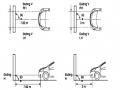
Note: A distance of approximately 7.62 m is required between the vehicle (fog lamp center) and the wall to adjust the convergence correctly. If the distance of 7.62 m cannot be achieved, set the correct distance of 3 m to check and adjust the fog lamp convergence. (Since the target area varies with the distance, please follow the instructions as shown in the figure.)
b/ Prepare a piece of thick white paper about 2 m high and 4 m wide to use as a screen.
c/ Draw a vertical line through the center of the screen (line V).
d/ Set the screen as shown in the picture. Note:
- Keep the screen perpendicular to the ground.
- Align the V line on the screen with the center of the vehicle.
e/Draw the reference lines (H, V LH and V RH lines) on the screen as shown in the figure.HINT:
Mark the center of the fog lamp on the screen. If the center mark cannot be seen on the fog lamp, use the center of the fog lamp or the manufacturer's name mark on the fog lamp as the center mark.
H line (fog light height):
Draw a line across the screen so that it passes through the center mark. Line H should be at the same height as the center mark of the fog light bulb.
Line V LH, V RH (center mark position of left fog lamp LH and right fog lamp RH):
Draw two lines so that they intersect line H at the center marks.
5. Check the fog light convergence
a/ Cover the fog lamp or remove the connector of the other side fog lamp to prevent light from the unchecked fog lamp from affecting the fog lamp convergence test.
b/ Start the engine.
c/ Turn on the fog lights and make sure that the dividing line is outside the standard area as shown in the drawing.
6. Adjust the fog light convergence
Use a screwdriver to adjust the fog light to the standard area by turning the toe adjustment screw.
Note: If the screw is adjusted too far, loosen it and then tighten it again, so that the last rotation of the light adjustment screw is clockwise.
3. Self-study questions
1. Describe the operating principle of the lighting system with automatic headlight function
2. Describe the operating principle of the lighting system with the function of rotating headlights when turning
3. Draw diagram and connect lighting system on Hyundai Porter car
4. Draw diagram and connect lighting system on Honda Accord 1992
5. Draw the lighting circuit on a 1993 Toyota Lexus
LESSON 3 MAINTENANCE AND REPAIR OF SIGNAL SYSTEM
I. IMPLEMENTATION GOAL
After completing this lesson, students will be able to:
- Distinguish between types of signals on cars
- Correctly describe common symptoms and suspected areas causing damage.
- Connecting signal circuits ensures technical requirements
- Disassemble, install, check, maintain and repair the signal system to ensure technical requirements.
- Ensure safety in work and industrial hygiene
II. LESSON CONTENT
1. General description
The signal system equipped on cars aims to create signals to notify other vehicles participating in traffic about the vehicle's operating status such as: stopping, parking, braking, reversing, turning...
Signals are used either by light such as headlamps, brake lights, turn signals….. or by sound such as horns, reverse music….
Just like the lighting system. A signal system circuit usually consists of: battery, fuse, wire, relay, electrical load and control switch. Only some switches of the signal system are on the combination switch. The switches of other signals are usually located in different locations such as in the gearbox or brake pedal……
2. Maintenance and repair
2.1. Turn signals and hazard lights
The installation location of the turn signal is shown in Figure 3.1. The turn signal control switch is located in the combination switch under the steering wheel. Turning this switch to the right or left will make the turn signal turn right or left.
The hazard light switch is used when the vehicle has a problem while participating in traffic. When the hazard light switch is turned on, all the turn signals on the vehicle will light up at a certain frequency. The hazard light switch is usually placed separately from the turn signal switch (some old cars integrate the hazard and turn signal switches on the same combination switch cluster).
Figure 3.1 Turn signal switch Figure 3.2 Hazard switch
The part that generates the flashing frequency for the lights is called a turn signal relay. The turn signal relay usually has 3 terminals: B (positive power supply); E (negative power supply); L (providing the turn signal switch to distribute to the
lamp)
2.1.1. Circuit diagram
To generate the frequency for the turn signal, a turn signal relay is used in the turn signal circuit. The current from the turn signal relay will be sent to the turn signal switch assembly to distribute the current to the turn signal lights for the driver's purpose.
Figure 3.3. Schematic diagram of a turn signal circuit without a hazard switch
1. Battery; 2. Electric lock; 3. Turn signal relay; 4. Turn signal switch; 5. Turn signal lamp; 6. Turn signal lamp; 7. Hazard switch
Figure 3.4 Schematic diagram of turn signal circuit with hazard switch
1. Battery; 2. Combination switch cluster; 3. Turn signal;
4. Turn signal light; 5. Turn signal relay
Today's cars no longer use three-pin turn signal relays (B, L, E) but use eight-pin turn signal relays (figure 3.5) (pin number 8 is used for hazard lights).
For this type, the current supplying the turn signal lights is supplied directly from the turn signal relay to the lights.
div.maincontent .p { color: black; font-family:"Times New Roman", serif; font-style: normal; font-weight: normal; text-decoration: none; font-size: 14pt; margin:0pt; } div.maincontent p { color: black; font-family:"Times New Roman", serif; font-style: normal; font-weight: normal; text-decoration: none; font-size: 14pt; margin:0pt; } div.maincontent .s1 { color: black; font-family:"Times New Roman", serif; font-style: normal; font-weight: normal; text-decoration: none; font-size: 13pt; } div.maincontent .s2 { color: black; font-family:"Times New Roman", serif; font-style: italic; font-weight: normal; text-decoration: none; font-size: 14pt; } div.maincontent .s3 { color: black; font-family:"Times New Roman", serif; font-style: normal; font-weight: normal; text-decoration: none; font-size: 14pt; } div.maincontent .s4 { color: black; font-family:"Times New Roman", serif; font-style: normal; font-weight: normal; text-decoration: none; font-size: 13pt; } div.maincontent .s5 { color: black; font-family:"Times New Roman", serif; font-style: normal; font-weight: normal; text-decoration: none; font-size: 13pt; vertical-align: 1pt; } div.maincontent .s6 { color: black; font-family:"Times New Roman", serif; font-style: normal; font-weight: normal; text-decoration: none; font-size: 11pt; } div.maincontent .s7 { color: black; font-family:"Times New Roman", serif; font-style: normal; font-weight: normal; text-decoration: none; font-size: 14pt; vertical-align: -9pt; } div.maincontent .s8 { color: black; font-family:"Times New Roman", serif; font-style: normal; font-weight: normal; text-decoration: none; font-size: 11pt; } div.maincontent .s9 { color: #008000; font-family:"Times New Roman", serif; font-style: normal; font-weight: normal; text-decoration: none; font-size: 14pt; } div.maincontent .s10 { color: black; font-family:"Times New Roman", serif; font-style: italic; font-weight: normal; te -
 Research Model of Factors Impacting Work Motivation of Tour Guide Team in Binh Dinh Province
Box 5.1. Sample form for handing over and receiving monthly task results
1. General information
Full name: Department:
Job position:
Evaluation period:
Day
Day
Direct manager
The person who received the mission
2. Details of tasks and work to be completed during the month:
When an organization/enterprise makes changes, adjusts, or updates its performance evaluation system, it is also necessary to conduct performance evaluation communication. The evaluation communication system in an organization/enterprise often includes: internal newsletters, forums, mail groups, meetings, seminars, communication in performance evaluation interviews, etc.
17
The example below (box 5.2) is a performance appraisal communication product of a company when the company communicated some changes in its performance appraisal policy through a written notice.
Box 5.2. Example of performance appraisal communication via written notice
AMENDMENTS AND SUPPLEMENTS TO THE EVALUATION REGULATIONS
(Attached to Decision No.….)
TT | Content | Old rules | New rules | Reason |
1 | Article 4: Method | 3 methods: text, system | 1 method: software | - Promote technology application |
assign tasks and evaluate | email system, software | of the company | information technology to manage the whole | |
performance price | assign work | delivery and evaluation process | ||
mission | results of task performance | |||
direct manager's duties/jobs | ||||
reception and staff | ||||
- Manage and save all records | ||||
assign, receive, and perform work | ||||
and performance evaluation | ||||
duties/jobs of each | ||||
direct management and staff | ||||
worker |
17
2
Article 6: Adjusting criteria for evaluating performance of tasks/jobs that are difficult to evaluate according to quantitative indicators | Evaluated by 5 criteria: (i) workload; (ii) quality of work; (iii) skills and professional knowledge demonstrated when performing work; (iv) initiative and creativity in work; (v) communication skills, interaction and coordination with colleagues and departments | Evaluated by 2 criteria: (i) volume (products and completion time); (ii) quality of finished products | Focus on evaluating the true nature of the results of the task, which is the quantity and quality of the product. The factors of creativity, communication, coordination, skills, knowledge, and direct management will comment, discuss, and give feedback to staff to improve work efficiency. | |
3 | Article 7: Strengthening | Do not have | Direct management often | Strengthen guidance, |
two-way interaction | regularly (weekly, monthly, | mentoring, capacity development | ||
between direct management | quarterly), timely (when staff | staff | ||
and staff | completed worker | through exchange, interaction two | ||
pill | duty or risk | direction between direct management and | ||
incomplete) reflection | staff | |||
feedback and exchange with staff | ||||
employees on results | ||||
perform tasks, those | ||||
attitude, behavior need to be regulated | ||||
adjust, the abilities (skills) | ||||
skill, expertise, profession | ||||
service) need to be supplemented, completed | ||||
improve efficiency | ||||
perform tasks | ||||
other work |