
varies with the temperature and pressure of the material medium. The speed of sound at standard temperature and pressure is measured as 333m/s.
- In reality, sound is created from many different sources. In space, sound waves travel freely in all directions. In a narrow space or with obstacles, sound waves will be reflected and will intersect with other waves, creating wave interference. When two sound waves interfere, it will produce noise phenomena, causing phenomena such as loss of sound, intermittent sound, noise, and echo [29].
b) Unit of measurement of sound intensity:
- The range of physical units of sound varies considerably from 1
Maybe you are interested!
-
 Status of Hearing Loss and Some Related Factors in Armored Corps in 2017
 -
 Effectiveness of Preventing Hearing Loss with Mg-B6 in Armored Corps Cadets in 2017-2018
 -
 Current status of hearing loss, some related factors and preventive effectiveness of Mg-B6 supplementation in armored troops in 2017-2018 - 1
 -
 Some characteristics and risk factors of hearing loss in children from 2 to 5 years old in inner-city kindergartens in Hanoi - 1
 -
 Degree of Hearing Loss by Ear in Study Groups Before and After Intervention
– 10 10 Bel. To avoid having to calculate with very large numbers, physicist Alexander Graham Bell (1847-1922) used a logarithmic scale to convert extremely large numbers into small ones, giving the unit Bel.
- In reality, people often encounter smaller numbers, so the unit of 1/10 Bel is deciBel (dB).
- In practice, sound pressure meters usually measure in dB on the A scale (dBA). The A scale is designed to emphasize the frequencies to which the human ear is most sensitive, and to minimize the impact of very low or very high frequency sounds.
1.1.2.3. Definition of hearing loss
Hearing loss: When a person's hearing threshold is above 20 dB in one or both ears. Hearing loss can be mild, moderate, severe and deaf, causing difficulty in communication, especially in noisy environments [112]. If there is an anatomical or functional abnormality from the sound receptor in the ear to the auditory center in the cerebral cortex, hearing loss occurs.
1.1.2.4. Definition of noise-induced hearing loss
Noise-induced hearing loss, also known as occupational deafness, is a disease caused by noise from the working environment that is too high in intensity for the ear to tolerate, acting as a micro-acoustic trauma for a long time, causing irreversible damage to the Corti organ of the inner ear [2],[7],[116].
1.1.3. Pathogenesis
1.1.3.1. At the auditory organ
Noise-induced hearing loss is a disorder of the inner ear that causes increased hearing threshold, difficulty understanding speech, and anatomical and physiological changes.
a) Temporary increase in hearing threshold: Exposure to loud noise for several seconds or hours can cause temporary sensorineural hearing loss that is fully reversible within 24 hours. The extent of temporary increase in hearing threshold can be inferred from acoustic parameters: frequency spectrum intensity, time pattern.
- Loud sounds cause a greater increase in the threshold of hearing. Monotones and narrow-band noise cause the greatest increase in the threshold of hearing at the center frequency. In the case of sounds with a wide frequency spectrum, the frequencies that humans hear best are those that are most sensitive to a temporary increase in the threshold of hearing.
- The effect of time is complex: over the same period of time, intermittent noise causes less temporary increase in hearing threshold than continuous noise.
b) Permanent increase in hearing threshold: When exposed to repeated noise, the initial stage only causes a temporary increase in hearing threshold, but later it will lead to a state of irreversible increase in hearing threshold, called permanent increase in hearing threshold due to noise. Experts agree on this condition.
Permanent hearing loss will not progress further after the person has stopped exposure to the damaging noise.
- When exposed to broad-spectrum noise, initial changes usually occur at high frequencies (3000 – 6000 Hz, especially 4000 Hz). After about 10 years, high-frequency hearing loss tends to reach a plateau and continues to spread slowly to lower frequencies.
- Noise levels < 85 dB do not harm hearing, but levels ≥ 85 dB cause hearing loss quite quickly for high frequency sounds and cause a slower loss for low frequency sounds.
Since the main function of the middle ear is to equalize the impedance of the outer and inner ear, this system is a low-pass filter with a cutoff of around 1200 Hz, so it tends to attenuate high frequencies above 4000 Hz. This is also why the perception of high-frequency sounds tends to be much worse than the perception of lower-frequency sounds.
Another explanation for the 4000Hz audiogram defect in noise-induced deafness is that the external ear has an external auditory canal, with one end sealed off by the tympanic membrane. The acoustic resonance characteristics of the external auditory canal can be described by the equation:
With:
f = 𝑣
4𝑙
f = resonant frequency v = resonant velocity
l = length of the external auditory canal
The length of the external auditory canal is about 25 mm, so according to the equation, the average resonance is about 3200 Hz. Therefore, the resonance characteristics of the external auditory canal help determine the sound energy transmitted to the cochlea [50]. For example, industrial noise is often broad-spectrum; however, when it is transmitted through the ear canal
In addition, the sound energy in the mid-frequency range will resonate or be amplified, creating a cross-band noise centered at 3200 Hz. Therefore, it is common to see a "4 kHz notch" on the audiogram of a patient with DNN, which is about half an octave above the frequency of the noise [50]. Henderson and Hamernick (1995) also cited studies that found that the basilar membrane vibrations of the cochlea showed a maximum displacement of half an octave from the stimulus frequency. The study found that the frequency at which noise-induced SGTL occurs depends on the anatomy of the patient's external ear. Since not everyone's external ear is 25 mm long, noise-induced SGTL may vary. That is why a change in hearing loss sometimes between 3 and 6 kHz is observed.
It is important to know that early noise-induced SGTL may affect only very small frequency bands, so large frequency changes during audiometry may not be suitable for detecting subjects with early SGTL. Therefore, when testing for early detection, it is important to use narrow frequency changes in the high range and small dB changes. It has been found that even when workers had normal hearing when averaging all the frequencies tested, they had early changes in noise-induced SGTL in the form of a defect in audiometry at 4000 Hz. In the study by Gaurav in 2015 [39], small changes in sound intensity were found at 500 Hz, 1000 Hz, 2000 Hz and 4000 Hz in steel mill workers.
1.1.3.2. Physical damage in noise-induced hearing loss
Noise-induced hearing loss involves the hair cells in the organ of Corti. The outer hair cells are more susceptible to damage, and the degree of damage increases with the intensity and duration of exposure [10],[101].
It is difficult to determine the correlation between the transient increase in hearing threshold and the extent of anatomical damage [32],[46]. Perhaps the hairs of the hair cells
In addition to becoming less rigid and less responsive to stimulation, this condition can be reversible. With sufficient intensity and duration of exposure to cause a permanent increase in hearing threshold, more severe damage manifests as hairs that fuse together, degenerate, and lose hairs. Primary damage to the hairs occurs at the base of the stereocilia's attachment to the surface of the hair cell. When stereocilia are lost, the hair cells die and are replaced by scar tissue [26].
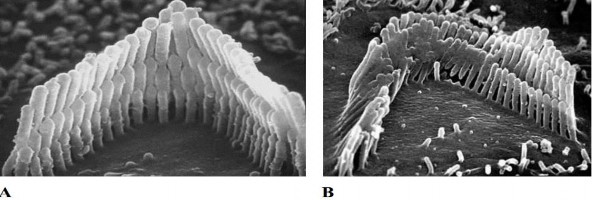
Figure 1.2. A: Normal outer hair cells. B: Damaged outer hair cells [32]
As exposure to noise increases, inner hair cells and supporting cells are damaged, and if hair cell loss is severe, there is secondary degeneration of the auditory nerve and auditory nuclei in the brainstem.
When exposed to high-frequency noise, hair cell damage is usually localized in the high-frequency region of the cochlea. When exposed to low-frequency noise, hair cell damage is not only localized in the low-frequency region but also extends to the high-frequency regions of the cochlea.
1.1.3.3. Effects of noise on the whole body
- Effects on the central nervous system: After exposure to noise, initial signs often appear: tinnitus, dizziness, headache, fatigue, memory loss, decreased concentration, poor and shallow sleep, easily leading to nervous breakdown [43],[52],[77].
- Effects on the cardiovascular and respiratory systems: Maximum blood pressure increases, breathing rate increases [42].
- On the digestive system: Often inhibited saliva secretion, reduced appetite, high energy consumption [42].
- Effects on the whole body: Increased metabolism, changes in blood amylase levels, blood sedimentation rate, and muscle tone all increase [42].
- Impact of noise on the vestibular system: There are signs of vestibular system excitement, affecting body balance [43],[58],[94].
1.1.3.4. Symptoms of noise-induced hearing loss
Noise-induced hearing loss develops slowly, with no definite time pattern. In general, the clinical course is divided into four stages:
a) Initial stage: This is the adaptation stage, which usually occurs several weeks to several months after exposure to noise.
- The patient feels tinnitus, feels pressure in both ears as if there are earplugs. There is a feeling of hearing loss at the end of the working day, the patient pays little attention to it.
- Whole body fatigue, headache, insomnia.
- Hearing loss was very limited at 4000Hz frequency to 30 - 40 dB in both ears. When removed from the noisy area, hearing recovered completely. The 4000Hz frequency recovered more slowly.
b) Latent stage: This stage lasts for years, up to 5-7 years. The patient does not know because the subjective and systemic symptoms completely pass, only feeling a little difficulty when listening to music because only hearing is impaired at high frequencies, but speaking loudly in a noisy place is clearer.
- The audiogram has a distinct V-shaped notch, the peak can reach 50-60dB at 4000Hz and can spread to 3000-6000Hz.
- At this time, pure tone audiometry is a good and early way to detect people with the disease.
c) Near-complete latent stage:
- Patients with tinnitus, hearing loss, and inability to hear whispers.
- Audiometry of the V-shaped defect has extended to the living frequencies (500Hz and 1000Hz), there can be a loss of 70dB at 4000Hz, a loss of ≥ 30dB at 2000Hz, and high frequencies of 8000Hz are also affected.
d) Obvious stage:
- At this stage, loud voices are difficult to hear.
- Patients with frequent tinnitus have difficulty communicating.
- Audiometry of the V-shaped defect has been extended to all low frequencies: 250Hz, 500Hz, 1000Hz and hearing loss of 35dB - 40dB.
- The hearing field narrows, not only does the hearing threshold increase but the pain threshold also decreases.
1.1.3.5. Characteristics of noise-induced hearing loss
- Noise-induced hearing loss is bilateral symmetrical sensorineural deafness. It can be completely or incompletely symmetrical.
- The hearing curve has a V-shaped notch at 4000Hz. This notch increases with exposure time.
- Noise-induced hearing loss is deafness due to cochlear damage, a manifestation of conductive deafness due to inner ear damage.
- Irreversible noise-induced hearing loss, due to acoustic microtrauma with physical damage concentrated in the nervous tissue, cannot be recovered. Hair cells are destroyed, nerve cells degenerate.
- Noise-induced hearing loss does not progress on its own. When exposure stops, noise-induced hearing loss also stops progressing.
1.1.3.6. Definitive diagnosis
Based on the following factors:
a) Exposure factors
Soldiers operate in environments with high noise levels at harmful levels, according to TCVN 3985:1999, from 85dB or higher for 8 working hours/day. If
For every 5dB increase in noise level, the daily exposure time to noise is reduced by half and the maximum level does not exceed 115dB. The remaining working time during the day is only exposed to noise levels below 80dB [1],[15].
b) Clinical
- As described in section 1.1.3.4.
- No damage to the external auditory canal, tympanic membrane, middle ear, mastoid bone, no vestibular damage.
c) Paraclinical
- Complete pure-tone audiometry. This is the decisive factor in diagnosing noise-induced hearing loss.
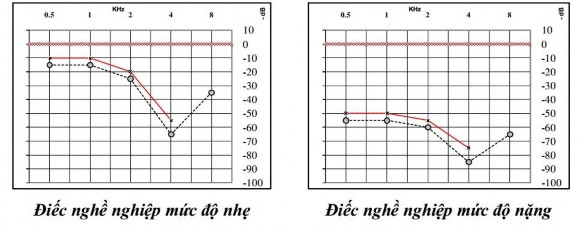
Figure 1.3. Progression of noise-induced hearing loss
- On the audiogram, there is a symmetrical, receptive deafness in both ears (complete or incomplete), hearing loss at 4000Hz, depending on the severity, there is damage to the basilar concha or the entire concha.
- Normal tympanometry.
1.1.3.7. Differential diagnosis
a) Acoustic trauma: exposure to very loud sounds, short exposure to noise, even just once, can cause deafness.