
1.2.4.3. Dong Ho folk painting village
“Hey girl with the green belt, if you want to come back to Mai village with me, then come back
Mai Village has a calendar and rules.
There is a cool pond to bathe in and a profession of making paintings"
(Folk song)
Mai Village is Dong Ho village - the hometown of the famous Dong Ho painting genre, located next to the Duong River in Thuan Thanh district, Bac Ninh province.
Because it was born from a land with a cultural foundation and traditional handicrafts, Dong Ho soon emerged as a bright spot in the material culture and proud spiritual culture of the Kinh Bac region. While painting genres such as Hang Trong paintings, Sinh village paintings, and Kim Hoan paintings were modernized and lost to the present, Dong Ho paintings are still maintained and stand firm, attracting the attention of tourists, especially international visitors. Today, Dong Ho can be considered the most famous folk painting production center in Vietnam.
The unique feature of Dong Ho paintings is that they must be painted on Do paper, made from Do tree bark, covered with a layer of powder made from scallop shells. The colors used for painting are completely taken from natural materials such as: blue from indigo leaves, red from red pebbles, black from bamboo leaf charcoal, yellow from Sophora japonica flowers, white from scallop shells... Initially, the paintings were mostly religious in nature, gradually expanding to decorate houses, reflecting daily life as well as reflecting the dreams and aspirations of the people. The type of paintings with the largest quantity and most popular today are those reflecting the aspirations and dreams of the working people for a prosperous and happy life such as Hung Dua, Danh Ghen, Danh Vat, Choi Swing, Tha Dieu... Due to contact with many other folk paintings, especially Hang Trong paintings, Dong Ho paintings have appeared with new themes such as Tu Binh paintings, story paintings... [17, 113].
Dong Ho woodcut paintings are not only attractive in their ideological content but also satisfy the aesthetic needs of viewers. Although the aesthetic needs of society
has changed, the content of the paintings, although not completely correct in the context of modern society, is still attractive. Today, Dong Ho paintings still exist but are no longer as prosperous as before. In the past, most families in the village made paintings, but now there are only three households: Mr. Nguyen Dang Che, Mr. Nguyen Huu Sam and Mr. Tran Nhat Tan. However, if given proper attention and investment, Dong Ho folk painting village can certainly become one of the attractive tourist destinations for visitors to Bac Ninh.
1.2.5. Quan Ho cuisine
In Vietnam, each region and each locality has its own rustic dishes that are imbued with regional identity. Bac Ninh is a typical countryside of the Northern countryside, so the traditional dishes here all have the rich flavor of the land of the sea far from the forest.
1.2.5.1. Phu The Cake
Phu The cake is a specialty of Dinh Bang countryside (Bac Ninh). This is a characteristic of Kinh Bac culinary culture. Those who have not eaten it are attracted by its name, but those who have enjoyed it once cannot forget its unique flavor.
The cake was formerly called “xu xue” cake, later changed to “phu the” meaning husband and wife, because the cake usually comes in pairs and is one of the indispensable gifts in the weddings of Kinh Bac people. The cake is square, large, flat, wrapped in dong leaves, tied with fresh red string, as a symbol of the couple's loyalty. The cake is made from yellow sticky rice flour, not from yellow starch like other cakes. When making the cake, you have to knead the dough with gardenia juice to get the natural color, no food coloring is added. People also grate green papaya, soak it in alum, then cut it into small pieces and knead it with the dough to make the cake more crispy. The filling is made from stir-fried mung beans with sugar, shredded coconut and lotus seed jam. When eating the cake, we will feel the stickiness of sticky rice, the crispiness of papaya, the richness of green beans, the fat of coconut meat, the richness of lotus seeds, the sweetness of sugar..., all blend together to create the cake's very own flavor. [32].
The round cake filling is inside a square coconut leaf mold, like the square and round symbol of the yin and yang philosophy. People spread the dough thinly on the mold, put the filling at one end and then cover the remaining dough on top of the filling, as if to show the embrace and protection of husband and wife love. The philosophy of the five elements is also subtly expressed through the five colors of the cake: white of tapioca flour and coconut pulp, yellow of gardenia and bean filling, black of sesame seeds, green of leaves, red of strings..., all symbolizing the harmony of heaven and earth and human beings.
Nowadays, the economy has developed, the standard of living has increased, but Phu The cake is still a favorite cake of many people. According to Mrs. Nguyen Thi Lua, a famous cake maker in Dinh Bang village, there was a Korean man who, after being invited to eat Phu The cake, bought a suitcase of cakes as a gift to his homeland, even though the airfare was one and a half times more expensive than the price of the cake [33]. That proves that Phu The cake is very attractive to tourists, attractive not only because of its taste but also because of the meaning of this cake. If exploited, this will be an indispensable gift from the countryside for those who have the opportunity to pass through Bac Ninh.
1.2.5.2. Banh te of Cho village
Banh te is a specialty of the people of Cho village (Yen Phong, Bac Ninh). However, few people know about and enjoy this dish because Banh te is currently only made to serve the need for breakfast on the spot.
No one knows exactly when Banh Te Cho appeared, but it is known that on holidays and weddings, every family in the village displays this special dish on the altar.
Banh te lang Cho is made from fragrant, long-grained, not chalky, and less sticky rice. The rice is washed and then ground into flour. The finer the flour is ground, the stickier the cake will be. The flour is kept in a basin, the clear water is drained out a couple of times a day, then cold water is added and stirred well, and kept in a cool, airy place. The flour must not give off a sour smell. Before making the cake, all the remaining clear water in the flour basin must be drained, the flour must be put in a pot, put on the stove over low heat and stirred constantly until the flour is thick, in a state of half-raw, half-cooked, then the cake is wrapped.
The filling of banh te is made from minced lean meat with wood ear mushrooms, onions, and stir-fried pepper.
cooked. Banh te is wrapped in fresh dong leaves, boiled until soft and tied with banana strings or small strips of string. Put the cake in a pot of boiling water and boil for about 15 minutes. When you peel the cake off and see that the dough does not stick to the leaves, the cake is cooked. [30]
Banh te lang Cho is best eaten hot. People here often make the cakes during holidays, Tet or parties. In the past, after each party, the host would give the guests some cakes to take home to the elderly or children to show their gratitude.
1.2.5.3. Nem Bui
In addition to the types of cakes that make you want to enjoy just by hearing the name, Bui Xa village, Ninh Xa commune, Thuan Thanh district is also famous at home and abroad for its Nem Bui, comparable to Nem Phung, Nem Ve... Nem village Bui was once chosen to be presented to the king, during the French colonial period, the French also loved this dish, but during the subsidy period, the profession of making Nem village Bui was lost because at that time, the whole village only raised hybrid pigs for economic purposes, so it was impossible to make Nem Bui because the meat was fibrous and smelly.
The ingredients to make Nem Bui must be black pigs, with a broken back in the shape of a saddle, a short snout, and fed with rice bran and duckweed, or banana leaves. The whole pig can only be butchered with two loins and the nape fat to make Nem. The process requires using julienned meat, then adding garlic, chili, vinegar, and ground rice bran, squeezing it tightly and wrapping it in banana leaves. After 3 days, the Nem will ripen on its own, then it can be eaten. Open the banana leaves, the square Nem is tightly pressed, has a light pink color, the aroma of rice bran, the fatty, rich, sour taste of meat. Nem Bui does not need to be dipped in sauce because the Nem is already seasoned to taste.
Mr. Nguyen Van Thanh, one of the long-time nem makers in Bui village, said that 6 years ago, 3 Western men, nearly 90 years old, came back to the village to eat the nem that they had eaten a few times when they were soldiers for the French. At that time, the nem making profession had died out and was not available; therefore, they sent money back to order people in Bui village to raise pigs to make nem. During the Canh Dan New Year 2010, Mr. Thanh's family exported 40kg of Bui nem to France. Not only the Western gourmets, but now the parties of the wealthy families in the area also come to the village to order Bui nem in large numbers. [34]
Nem lang Bui has become a hometown gift for many people at home and abroad.
favorite. In the cold season, Nem Bui is "exported" to many countries as gifts such as: Japan, Russia, America...
1.3. Summary of Chapter 1
The entire content of chapter 1 is the theoretical basis and overview of cultural tourism resources in Bac Ninh. In the general theoretical basis, the author has introduced the concepts of culture, tourism and cultural tourism as well as ways to classify humanistic tourism resources. That is the basis for classifying and studying in depth about typical cultural tourism resources that have exploitation value for tourism in Bac Ninh. That is also the orientation to review and evaluate the current status of cultural tourism development in Bac Ninh, on that basis, propose some solutions to further develop this type of tourism in Bac Ninh province.
It can be said that along with the development of Vietnam tourism, Bac Ninh tourism is increasingly developing. Currently, cultural tourism is the main tourism product of the province. However, the exploitation is not yet commensurate with the available potential of the region.
CHAPTER 2:
CURRENT STATUS OF EXPLOITATION OF CULTURAL TOURISM IN BAC NINH
2.1. Current status of tourism exploitation at historical and cultural relics in Bac Ninh
Considered the land of communal houses, temples, pagodas and festivals, Bac Ninh province has over
1,259 historical and cultural relics, of which 191 are ranked at the national level and 237 are ranked at the provincial level. These relics have been and are important elements that make up the cultural identity of Bac Ninh - Kinh Bac in particular and Vietnam in general, because they contain historical, cultural, and architectural values typical of the nation through the stages of development.
With the attention of authorities at all levels, managers and scientists, many relics in the province have preserved their traditional values, and the campus and landscape have been renovated, contributing to building an advanced Vietnamese culture imbued with national identity, while opening up great prospects for developing the tourism industry in Bac Ninh.
However, due to the large number of historical and cultural relics and their wide distribution in 8 districts, towns and cities in the province, many relics were built thousands of years ago and are now seriously degraded. In addition, the awareness of people in some localities about heritage protection in general is still limited, in some relics there is still the phenomenon of land encroachment, the restoration and embellishment of relics lack of funds... which has significantly affected the management, restoration and conservation of relics. On the other hand, the promotion of the value of relics through tourism activities currently lacks effective solutions, there is no synchronous coordination between management, conservation and organization of tourism activities. At the relics, there are still limitations in expanding cooperation and connecting with travel companies to build attractive tourism products, there is no professional tour guide force, souvenir products are still poor, there is a lack of wharves, parking lots, toilets..., information about the relics to tourists is not much, and the number of workers participating in local tourism activities is very small. Therefore, it can be seen that although there is a lot of potential, the relic sites
Cultural history in Bac Ninh still lacks initiative and the ability to welcome guests.
2.1.1. Exploitation at Temple relics
2.1.1.1. Dau Pagoda
Dau Pagoda, has long been considered a peak in the Buddhist triangle of Vietnam (Yen Tu - Dau Pagoda - Bo Da Pagoda); is one of 38 particularly important national relics. The pagoda is located in the center of the most typical and rich historical and cultural relic area of Kinh Bac homeland. This place includes Luy Lau ancient citadel, Sy Nhiep temple and tomb, pagoda and tower system, temple vestiges, mansions, roads, wharves, markets... The attraction of traditional culture is the reason for tourists to come to Dau Pagoda. According to statistics of the Department of Culture and Information of Thuan Thanh district, in recent years the number of tourists coming to Dau Pagoda and especially the number of international tourists has increased, mainly concentrated on the occasion of Lunar New Year and the New Year festival.
Table 1. Total number of tourists to Dau Pagoda in 2010
Unit: Number of people
Months of the year
Total number of tourists | Including: International tourist area | |
January | 3,753 | 208 |
February | 28,725 | 225 |
March | 9,450 | 250 |
April | 1,158 | 152 |
May | 2,200 | 122 |
June | 958 | 50 |
July | 930 | 30 |
August | 985 | 65 |
September | 830 | 68 |
October | 993 | 103 |
November | 1258 | 57 |
December | 1335 | 52 |
Maybe you are interested!
-
 Xa Ma Procession Festival in Hoang Chau Commune, Cat Hai District - current exploitation status and development solutions to serve local tourism - 11
 -
 Current Status of Street Food Exploitation in Tourism Business in Nha Trang (Khanh Hoa)
 -
 Xa Ma Procession Festival in Hoang Chau Commune, Cat Hai District - current exploitation status and development solutions to serve local tourism - 13
 -
 Identify Rating Levels and Rating Scales
zt2i3t4l5ee
zt2a3gstourism,quan lan,quang ninh,ecology,ecotourism,minh chau,van don,geography,geographical basis,tourism development,science
zt2a3ge
zc2o3n4t5e6n7ts
of the islanders. Therefore, this indicator will be divided into two sub-indicators:
a1. Natural tourism attractiveness a2. Cultural tourism attractiveness
b. Tourist capacity
The two island communes in Quan Lan have different capacities to receive tourists. Minh Chau Commune is home to many standard hotels and resorts, attracting high-income domestic and international tourists. Meanwhile, Quan Lan Commune has many motels mainly built and operated by local people, so the scale and quality are not high, and will be suitable for ordinary tourists such as students.
c. Time of exploitation of Quan Lan Island Commune:
Quan Lan tourism is seasonal due to weather and climate conditions and festivals only take place on certain days of the year, specifically in spring. In Quan Lan commune, the period from April to June and from September to November is considered the best time to visit Quan Lan because the cultural tourism activities are mainly associated with festivals taking place during this time.
Minh Chau island commune:
Tourism exploitation time is all year round, because this is a place with a number of tourist attractions with diverse ecosystems such as Bai Tu Long National Park Research Center, Tram forest, Turtle Laying Beach, so besides coming to the beach for tourism and vacation in the summer, Minh Chau will attract research groups to come for tourism combined with research at other times of the year.
d. Sustainability
The sustainability of ecotourism sites in Quan Lan and Minh Chau communes depends on the sensitivity of the ecosystems to climate changes.
landscape. In general, these tourist destinations have a fairly high level of sustainability, because they are natural ecosystems, planned and protected. However, if a large number of tourists gather at certain times, it can exceed the carrying capacity and affect the sustainability of the environment (polluted beaches, damaged trees, animals moving away from their habitats, etc.), then the sustainability of the above ecosystems (natural ecosystems, human ecosystems) will also be affected and become less sustainable.
e. Location and accessibility
Both island communes have ports to take tourists to visit from Van Don wharf:
- Quan Lan – Van Don traffic route:
Phuc Thinh – Viet Anh high-speed boat and Quang Minh high-speed boat, depart at 8am and 2pm from Van Don to Quan Lan, and at 7am and 1pm from Quan Lan to Van Don. There are also wooden boats departing at 7am and 1pm.
- Van Don - Minh Chau traffic route:
Chung Huong high-speed train, Minh Chau train, morning 7:30 and afternoon 13:30 from Van Don to Minh Chau, morning 6:30 and afternoon 13:00 from Minh Chau to Van Don.
f. Infrastructure
Despite receiving investment attention, the issue of infrastructure and technical facilities for tourism on Quan Lan Island is still an issue that needs to be resolved because it has a direct impact on the implementation of ecotourism activities. The minimum conditions for serving tourists such as accommodation, electricity, water, communication, especially medical services, and security work need to be given top priority. Ecotourism spots in Minh Chau commune are assessed to have better infrastructure and technical facilities for tourism because there are quite complete and synchronous conditions for serving tourists, meeting many needs of domestic and foreign tourists.
3.2.1.4. Determine assessment levels and assessment scales
Corresponding to the levels of each criterion, the index is the score of those levels in the order of 4, 3, 2, 1 decreasing according to the standard of each level: very attractive (4), attractive (3), average (2), less attractive (1).
3.2.1.5. Determining the coefficients of the criteria
For the assessment of DLST in the two communes of Quan Lan and Minh Chau islands, the students added evaluation coefficients to show the importance of the criteria and indicators as follows:
Coefficient 3 with criteria: Attractiveness, Exploitation time. These are the 2 most important criteria for attracting tourists to tourism in general and eco-tourism in particular, so they have the highest coefficient.
Coefficient 2 with criteria: Capacity, Infrastructure, Location and accessibility . Because the assessment area is an island commune of Van Don district, the above criteria are selected by the author with appropriate coefficients at the average level.
Coefficient 1 with criteria: Sustainability. Quan Lan has natural and human-made ecotourism sites, with high biodiversity and little impact from local human factors. Most of the ecotourism sites are still wild, so they are highly sustainable.
3.2.1.6. Results of DLST assessment on Quan Lan island
a. Assessment of the potential for natural tourism development
For Minh Chau commune:
+ Natural tourism attractiveness is determined to be very attractive (4 points) and the most important coefficient (coefficient 3), so the score of the Attractiveness criterion is 4 x 3 = 12.
+ Capacity is determined as average (2 points) and the coefficient is quite important (coefficient 2), then the score of Capacity criterion is 2 x 2 = 4.
+ Exploitation time is long (4 points), the most important coefficient (coefficient 3) so the score of the Exploitation time criterion is 4 x 3 = 12.
+ Sustainability is determined as sustainable (4 points), the important coefficient is the average coefficient (coefficient 1), so the score of the Sustainability criterion is 4 x 1 = 4 points
+ Location and accessibility are determined to be quite favorable (2 points), the coefficient is quite important (coefficient 2), the criterion score is 2 x 2 = 4 points.
+ Infrastructure is assessed as good (3 points), the coefficient is quite important (coefficient 2), then the score of the Infrastructure criterion is 3 x 2 = 6 points.
The total score for evaluating DLST in Minh Chau commune according to 6 evaluation criteria is determined as: 12 + 4 + 12 + 4 + 4 + 6 = 42 points
Similar assessment for Quan Lan commune, we have the following table:
Table 3.3: Assessment of the potential for natural ecotourism development in Quan Lan and Minh Chau communes
Attractiveness of self-tourismof course
Capacity
Mining time
Sustainability
Location and accessibility
Infrastructure
Result
Point
DarkMulti
Point
DarkMulti
Point
DarkMulti
Point
DarkMulti
Point
DarkMulti
Point
DarkMulti
CommuneMinh Chau
12
12
4
8
12
12
4
4
4
8
6
8
42/52
Quan CommuneLan
6
12
6
8
9
12
4
4
4
8
4
8
33/52
b. Assessment of the potential for humanistic tourism development
For Quan Lan commune:
+ The attractiveness of human tourism is determined to be very attractive (4 points) and the most important coefficient (coefficient 3), so the score of the Attractiveness criterion is 4 x 3 = 12.
+ Capacity is determined to be large (3 points) and the coefficient is quite important (coefficient 2), then the score of the Capacity criterion is 3 x 2 = 6.
+ Mining time is average (3 points), the most important coefficient (coefficient 3) so the score of the Mining time criterion is 3 x 3 = 9.
+ Sustainability is determined as sustainable (4 points), the important coefficient is the average coefficient (coefficient 1), so the score of the Sustainability criterion is 4 x 1 = 4 points.
+ Location and accessibility are determined to be quite favorable (2 points), the coefficient is quite important (coefficient 2), the criterion score is 2 x 2 = 4 points.
+ Infrastructure is rated as average (2 points), the coefficient is quite important (coefficient 2), then the score of the Infrastructure criterion is 2 x 2 = 4 points.
The total score for evaluating DLST in Quan Lan commune according to 6 evaluation criteria is determined as: 12 + 6 + 6 + 4 + 4 + 4 = 36 points.
Similar assessment with Minh Chau commune we have the following table:
Table 3.4: Assessment of the potential for developing humanistic eco-tourism in Quan Lan and Minh Chau communes
Attractiveness of human tourismliterature
Capacity
Mining time
Sustainability
Location and accessibility
Infrastructure
Result
Point
DarkMulti
Point
DarkMulti
Point
DarkMulti
Point
DarkMulti
Point
DarkMulti
Point
DarkMulti
Quan CommuneLan
12
12
6
8
9
12
4
4
4
8
4
8
39/52
Minh CommuneChau
6
12
4
8
12
12
4
4
4
8
6
8
36/52
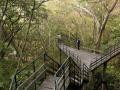
Basically, both Minh Chau and Quan Lan localities have quite favorable conditions for developing ecotourism. However, Quan Lan commune has more advantages to develop ecotourism in a humanistic direction, because this is an area with many famous historical relics such as Quan Lan Communal House, Quan Lan Pagoda, Temple worshiping the hero Tran Khanh Du, ... along with local festivals held annually such as the wind praying ceremony (March 15), Quan Lan festival (June 10-19); due to its location near the port and long exploitation time, the beaches in Quan Lan commune (especially Quan Lan beach) are no longer hygienic and clean to ensure the needs of tourists coming to relax and swim; this is also an area with many beautiful landscapes such as Got Beo wind pass, Ong Phong head, Voi Voi cave, but the ability to access these places is still very limited (dirt hill road, lots of gravel and rocks), especially during rainy and windy times; In addition, other natural resources such as mangrove forests and sea worms have not been really exploited for tourism purposes and ecotourism development. On the contrary, Minh Chau commune has more advantages in developing ecotourism in the direction of natural tourism, this is an area with diverse ecosystems such as at Rua De Beach, Bai Tu Long National Park Conservation Center...; Minh Chau beach is highly appreciated for its natural beauty and cleanliness, ranked in the top ten most beautiful beaches in Vietnam; Minh Chau commune is also home to Tram forest with a large area and a purity of up to 90%, suitable for building bridges through the forest (a very effective type of natural ecotourism currently applied by many countries) for tourists to sightsee, as well as for the purpose of studying and researching.
Figure 3.1: Thenmala Forest Bridge (India) Source: https://www.thenmalaecotourism.com/(August 21, 2019)
3.2.2. Using SWOT matrix to evaluate Quan Lan island tourism
General assessment of current tourism activities of Quan Lan island is shown through the following SWOT matrix:
Table 3.5: SWOT matrix evaluating tourism activities on Quan Lan island
Internal agent
Strengths- There is a lot of potential for tourism development, especially natural ecotourism and humanistic ecotourism.- The unskilled labor force is relatively abundant.- resource environmentunpolluted, still
Weaknesses- Poorly developed infrastructure, especially traffic routes to tourist destinations on the island.- The team of professional staff is still weak.- Tourism products in general
quite wild, originalintact
general and DLST in particularalone is monotonous.
External agents
Opportunity- Tourism is a key industry in the socio-economic development strategy of the province and Van Don economic zone.- Quan Lan was selected as a pilot area for eco-tourism development within the framework of the green growth project between Quang Ninh province and the Japanese organization JICA.- The flow of tourists and especially ecotourism in the world tends toincreasing
Challenge- Weather and climate change abnormally.- Competition in tourism products is increasingly fierce, especially with other localities in the province such as Ha Long, Mong Cai...- Awareness of tourists, especially domestic tourists, about ecotourism and nature conservation is not high.
Through summary analysis using SWOT matrix we see that:
To exploit strengths and take advantage of opportunities, it is necessary to:
- Diversify products and service types (build more tourism routes aimed at specific needs of tourists: experiential tourism immersed in nature, spiritual cultural tourism...)
- Effective exploitation of resources and differentiated products (natural resources and human resources)
div.maincontent .p { color: black; font-family:"Times New Roman", serif; font-style: normal; font-weight: normal; text-decoration: none; font-size: 14pt; margin:0pt; } div.maincontent p { color: black; font-family:"Times New Roman", serif; font-style: normal; font-weight: normal; text-decoration: none; font-size: 14pt; margin:0pt; } div.maincontent .s1 { color: black; font-family:"Times New Roman", serif; font-style: normal; font-weight: normal; text-decoration: none; font-size: 13pt; } div.maincontent .s2 { color: black; font-family:"Times New Roman", serif; font-style: normal; font-weight: normal; text-decoration: none; font-size: 13pt; } div.maincontent .s3 { color: #0D0D0D; font-family:"Times New Roman", serif; font-style: normal; font-weight: bold; text-decoration: none; font-size: 14pt; } div.maincontent .s4 { color: black; font-family:"Times New Roman", serif; font-style: italic; font-weight: normal; text-decoration: none; font-size: 14pt; } div.maincontent .s5 { color: black; font-family:"Times New Roman", serif; font-style: italic; font-weight: bold; text-decoration: none; font-size: 14pt; } div.maincontent .s6 { color: black; font-family:"Times New Roman", serif; font-style: italic; font-weight: normal; text-decoration: none; font-size: 14pt; vertical-align: -3pt; } div.maincontent .s7 { color: black; font-family:"Times New Roman", serif; font-style: italic; font-weight: normal; text-decoration: none; font-size: 14pt; vertical-align: -2pt; } div.maincontent .s8 { color: black; font-family:"Times New Roman", serif; font-style: italic; font-weight: normal; text-decoration: none; font-size: 14pt; vertical-align: -1pt; } div.maincontent .s9 { color: black; font-family:"Times New Roman", serif; font-style: normal; font-weight: normal; text-decoration: none; font-size: 14pt; } div.maincontent .s10 { color: black; font-family:"Times New Roman", serif; font-style: normal; font-weight: bold; text-decoration: none; font-size: 14pt; } div.maincontent .s11 { color: black; font-family:"Times New Roman", serif; font-style: normal; font-weight: normal; text-decoration: none; font-size: 14pt; } div.maincontent .s12 { color: black; font-family:Symbol, serif; font-style: normal; font-weight: normal; text-decoration: none; font-size: 14pt; } div.maincontent .s13 { color: black; font-family:Wingdings; font-style: normal; font-weight: normal; text-decoration: none; font-size: 14pt; } div.maincontent .s14 { color: black; font-family:"Times New Roman", serif; font-style: normal; font-weight: normal; text-decoration: none; font-size: 9pt; vertical-align: 5pt; } div.maincontent .s15 { color: black; font-family:"Times New Roman", serif; font-style: normal; font-weight: normal; text-decoration: none; font-size: 9pt; vertical-align: 5pt; } div.maincontent .s16 { color: black; font-family:Cambria, serif; font-style: italic; font-weight: normal; text-decoration: none; font-size: 14pt; } div.maincontent .s17 { color: #080808; font-family:"Times New Roman", serif; font-style: normal; font-weight: bold; text-decoration: none; font-size: 14pt; } div.maincontent .s18 { color: #080808; font-family:"Times New Roman", serif; font-style: normal; font-weight: normal; text-decoration: none; font-size: 14pt; } div.maincontent .s19 { color: black; font-family:"Times New Roman", serif; font-style: normal; font-weight: normal; text-decoration: none; font-size: 11pt; } div.maincontent .s20 { color: black; font-family:"Times New Roman", serif; font-style: normal; font-weight: normal; text-decoration: none; font-size: 10pt; } div.maincontent .s21 { color: black; font-family:"Times New Roman", serif; font-style: normal; font-weight: bold; text-decoration: none; font-size: 11pt; } div.maincontent .s22 { color: black; font-family:"Times New Roman", serif; font-style: normal; font-weight: normal; text-decoration: none; font-size: 11pt; } div.maincontent .s23 { color: black; font-family:"Times New Roman", serif; font-style: italic; font-weight: normal; text-decoration: none; font-size: 14pt; } div.maincontent .s24 { color: #212121; font-family:"Times New Roman", serif; font-style: normal; font-weight: normal; tex
Identify Rating Levels and Rating Scales
zt2i3t4l5ee
zt2a3gstourism,quan lan,quang ninh,ecology,ecotourism,minh chau,van don,geography,geographical basis,tourism development,science
zt2a3ge
zc2o3n4t5e6n7ts
of the islanders. Therefore, this indicator will be divided into two sub-indicators:
a1. Natural tourism attractiveness a2. Cultural tourism attractiveness
b. Tourist capacity
The two island communes in Quan Lan have different capacities to receive tourists. Minh Chau Commune is home to many standard hotels and resorts, attracting high-income domestic and international tourists. Meanwhile, Quan Lan Commune has many motels mainly built and operated by local people, so the scale and quality are not high, and will be suitable for ordinary tourists such as students.
c. Time of exploitation of Quan Lan Island Commune:
Quan Lan tourism is seasonal due to weather and climate conditions and festivals only take place on certain days of the year, specifically in spring. In Quan Lan commune, the period from April to June and from September to November is considered the best time to visit Quan Lan because the cultural tourism activities are mainly associated with festivals taking place during this time.
Minh Chau island commune:
Tourism exploitation time is all year round, because this is a place with a number of tourist attractions with diverse ecosystems such as Bai Tu Long National Park Research Center, Tram forest, Turtle Laying Beach, so besides coming to the beach for tourism and vacation in the summer, Minh Chau will attract research groups to come for tourism combined with research at other times of the year.
d. Sustainability
The sustainability of ecotourism sites in Quan Lan and Minh Chau communes depends on the sensitivity of the ecosystems to climate changes.
landscape. In general, these tourist destinations have a fairly high level of sustainability, because they are natural ecosystems, planned and protected. However, if a large number of tourists gather at certain times, it can exceed the carrying capacity and affect the sustainability of the environment (polluted beaches, damaged trees, animals moving away from their habitats, etc.), then the sustainability of the above ecosystems (natural ecosystems, human ecosystems) will also be affected and become less sustainable.
e. Location and accessibility
Both island communes have ports to take tourists to visit from Van Don wharf:
- Quan Lan – Van Don traffic route:
Phuc Thinh – Viet Anh high-speed boat and Quang Minh high-speed boat, depart at 8am and 2pm from Van Don to Quan Lan, and at 7am and 1pm from Quan Lan to Van Don. There are also wooden boats departing at 7am and 1pm.
- Van Don - Minh Chau traffic route:
Chung Huong high-speed train, Minh Chau train, morning 7:30 and afternoon 13:30 from Van Don to Minh Chau, morning 6:30 and afternoon 13:00 from Minh Chau to Van Don.
f. Infrastructure
Despite receiving investment attention, the issue of infrastructure and technical facilities for tourism on Quan Lan Island is still an issue that needs to be resolved because it has a direct impact on the implementation of ecotourism activities. The minimum conditions for serving tourists such as accommodation, electricity, water, communication, especially medical services, and security work need to be given top priority. Ecotourism spots in Minh Chau commune are assessed to have better infrastructure and technical facilities for tourism because there are quite complete and synchronous conditions for serving tourists, meeting many needs of domestic and foreign tourists.
3.2.1.4. Determine assessment levels and assessment scales
Corresponding to the levels of each criterion, the index is the score of those levels in the order of 4, 3, 2, 1 decreasing according to the standard of each level: very attractive (4), attractive (3), average (2), less attractive (1).
3.2.1.5. Determining the coefficients of the criteria
For the assessment of DLST in the two communes of Quan Lan and Minh Chau islands, the students added evaluation coefficients to show the importance of the criteria and indicators as follows:
Coefficient 3 with criteria: Attractiveness, Exploitation time. These are the 2 most important criteria for attracting tourists to tourism in general and eco-tourism in particular, so they have the highest coefficient.
Coefficient 2 with criteria: Capacity, Infrastructure, Location and accessibility . Because the assessment area is an island commune of Van Don district, the above criteria are selected by the author with appropriate coefficients at the average level.
Coefficient 1 with criteria: Sustainability. Quan Lan has natural and human-made ecotourism sites, with high biodiversity and little impact from local human factors. Most of the ecotourism sites are still wild, so they are highly sustainable.
3.2.1.6. Results of DLST assessment on Quan Lan island
a. Assessment of the potential for natural tourism development
For Minh Chau commune:
+ Natural tourism attractiveness is determined to be very attractive (4 points) and the most important coefficient (coefficient 3), so the score of the Attractiveness criterion is 4 x 3 = 12.
+ Capacity is determined as average (2 points) and the coefficient is quite important (coefficient 2), then the score of Capacity criterion is 2 x 2 = 4.
+ Exploitation time is long (4 points), the most important coefficient (coefficient 3) so the score of the Exploitation time criterion is 4 x 3 = 12.
+ Sustainability is determined as sustainable (4 points), the important coefficient is the average coefficient (coefficient 1), so the score of the Sustainability criterion is 4 x 1 = 4 points
+ Location and accessibility are determined to be quite favorable (2 points), the coefficient is quite important (coefficient 2), the criterion score is 2 x 2 = 4 points.
+ Infrastructure is assessed as good (3 points), the coefficient is quite important (coefficient 2), then the score of the Infrastructure criterion is 3 x 2 = 6 points.
The total score for evaluating DLST in Minh Chau commune according to 6 evaluation criteria is determined as: 12 + 4 + 12 + 4 + 4 + 6 = 42 points
Similar assessment for Quan Lan commune, we have the following table:
Table 3.3: Assessment of the potential for natural ecotourism development in Quan Lan and Minh Chau communes
Attractiveness of self-tourismof course
Capacity
Mining time
Sustainability
Location and accessibility
Infrastructure
Result
Point
DarkMulti
Point
DarkMulti
Point
DarkMulti
Point
DarkMulti
Point
DarkMulti
Point
DarkMulti
CommuneMinh Chau
12
12
4
8
12
12
4
4
4
8
6
8
42/52
Quan CommuneLan
6
12
6
8
9
12
4
4
4
8
4
8
33/52
b. Assessment of the potential for humanistic tourism development
For Quan Lan commune:
+ The attractiveness of human tourism is determined to be very attractive (4 points) and the most important coefficient (coefficient 3), so the score of the Attractiveness criterion is 4 x 3 = 12.
+ Capacity is determined to be large (3 points) and the coefficient is quite important (coefficient 2), then the score of the Capacity criterion is 3 x 2 = 6.
+ Mining time is average (3 points), the most important coefficient (coefficient 3) so the score of the Mining time criterion is 3 x 3 = 9.
+ Sustainability is determined as sustainable (4 points), the important coefficient is the average coefficient (coefficient 1), so the score of the Sustainability criterion is 4 x 1 = 4 points.
+ Location and accessibility are determined to be quite favorable (2 points), the coefficient is quite important (coefficient 2), the criterion score is 2 x 2 = 4 points.
+ Infrastructure is rated as average (2 points), the coefficient is quite important (coefficient 2), then the score of the Infrastructure criterion is 2 x 2 = 4 points.
The total score for evaluating DLST in Quan Lan commune according to 6 evaluation criteria is determined as: 12 + 6 + 6 + 4 + 4 + 4 = 36 points.
Similar assessment with Minh Chau commune we have the following table:
Table 3.4: Assessment of the potential for developing humanistic eco-tourism in Quan Lan and Minh Chau communes
Attractiveness of human tourismliterature
Capacity
Mining time
Sustainability
Location and accessibility
Infrastructure
Result
Point
DarkMulti
Point
DarkMulti
Point
DarkMulti
Point
DarkMulti
Point
DarkMulti
Point
DarkMulti
Quan CommuneLan
12
12
6
8
9
12
4
4
4
8
4
8
39/52
Minh CommuneChau
6
12
4
8
12
12
4
4
4
8
6
8
36/52
Basically, both Minh Chau and Quan Lan localities have quite favorable conditions for developing ecotourism. However, Quan Lan commune has more advantages to develop ecotourism in a humanistic direction, because this is an area with many famous historical relics such as Quan Lan Communal House, Quan Lan Pagoda, Temple worshiping the hero Tran Khanh Du, ... along with local festivals held annually such as the wind praying ceremony (March 15), Quan Lan festival (June 10-19); due to its location near the port and long exploitation time, the beaches in Quan Lan commune (especially Quan Lan beach) are no longer hygienic and clean to ensure the needs of tourists coming to relax and swim; this is also an area with many beautiful landscapes such as Got Beo wind pass, Ong Phong head, Voi Voi cave, but the ability to access these places is still very limited (dirt hill road, lots of gravel and rocks), especially during rainy and windy times; In addition, other natural resources such as mangrove forests and sea worms have not been really exploited for tourism purposes and ecotourism development. On the contrary, Minh Chau commune has more advantages in developing ecotourism in the direction of natural tourism, this is an area with diverse ecosystems such as at Rua De Beach, Bai Tu Long National Park Conservation Center...; Minh Chau beach is highly appreciated for its natural beauty and cleanliness, ranked in the top ten most beautiful beaches in Vietnam; Minh Chau commune is also home to Tram forest with a large area and a purity of up to 90%, suitable for building bridges through the forest (a very effective type of natural ecotourism currently applied by many countries) for tourists to sightsee, as well as for the purpose of studying and researching.
Figure 3.1: Thenmala Forest Bridge (India) Source: https://www.thenmalaecotourism.com/(August 21, 2019)
3.2.2. Using SWOT matrix to evaluate Quan Lan island tourism
General assessment of current tourism activities of Quan Lan island is shown through the following SWOT matrix:
Table 3.5: SWOT matrix evaluating tourism activities on Quan Lan island
Internal agent
Strengths- There is a lot of potential for tourism development, especially natural ecotourism and humanistic ecotourism.- The unskilled labor force is relatively abundant.- resource environmentunpolluted, still
Weaknesses- Poorly developed infrastructure, especially traffic routes to tourist destinations on the island.- The team of professional staff is still weak.- Tourism products in general
quite wild, originalintact
general and DLST in particularalone is monotonous.
External agents
Opportunity- Tourism is a key industry in the socio-economic development strategy of the province and Van Don economic zone.- Quan Lan was selected as a pilot area for eco-tourism development within the framework of the green growth project between Quang Ninh province and the Japanese organization JICA.- The flow of tourists and especially ecotourism in the world tends toincreasing
Challenge- Weather and climate change abnormally.- Competition in tourism products is increasingly fierce, especially with other localities in the province such as Ha Long, Mong Cai...- Awareness of tourists, especially domestic tourists, about ecotourism and nature conservation is not high.
Through summary analysis using SWOT matrix we see that:
To exploit strengths and take advantage of opportunities, it is necessary to:
- Diversify products and service types (build more tourism routes aimed at specific needs of tourists: experiential tourism immersed in nature, spiritual cultural tourism...)
- Effective exploitation of resources and differentiated products (natural resources and human resources)
div.maincontent .p { color: black; font-family:"Times New Roman", serif; font-style: normal; font-weight: normal; text-decoration: none; font-size: 14pt; margin:0pt; } div.maincontent p { color: black; font-family:"Times New Roman", serif; font-style: normal; font-weight: normal; text-decoration: none; font-size: 14pt; margin:0pt; } div.maincontent .s1 { color: black; font-family:"Times New Roman", serif; font-style: normal; font-weight: normal; text-decoration: none; font-size: 13pt; } div.maincontent .s2 { color: black; font-family:"Times New Roman", serif; font-style: normal; font-weight: normal; text-decoration: none; font-size: 13pt; } div.maincontent .s3 { color: #0D0D0D; font-family:"Times New Roman", serif; font-style: normal; font-weight: bold; text-decoration: none; font-size: 14pt; } div.maincontent .s4 { color: black; font-family:"Times New Roman", serif; font-style: italic; font-weight: normal; text-decoration: none; font-size: 14pt; } div.maincontent .s5 { color: black; font-family:"Times New Roman", serif; font-style: italic; font-weight: bold; text-decoration: none; font-size: 14pt; } div.maincontent .s6 { color: black; font-family:"Times New Roman", serif; font-style: italic; font-weight: normal; text-decoration: none; font-size: 14pt; vertical-align: -3pt; } div.maincontent .s7 { color: black; font-family:"Times New Roman", serif; font-style: italic; font-weight: normal; text-decoration: none; font-size: 14pt; vertical-align: -2pt; } div.maincontent .s8 { color: black; font-family:"Times New Roman", serif; font-style: italic; font-weight: normal; text-decoration: none; font-size: 14pt; vertical-align: -1pt; } div.maincontent .s9 { color: black; font-family:"Times New Roman", serif; font-style: normal; font-weight: normal; text-decoration: none; font-size: 14pt; } div.maincontent .s10 { color: black; font-family:"Times New Roman", serif; font-style: normal; font-weight: bold; text-decoration: none; font-size: 14pt; } div.maincontent .s11 { color: black; font-family:"Times New Roman", serif; font-style: normal; font-weight: normal; text-decoration: none; font-size: 14pt; } div.maincontent .s12 { color: black; font-family:Symbol, serif; font-style: normal; font-weight: normal; text-decoration: none; font-size: 14pt; } div.maincontent .s13 { color: black; font-family:Wingdings; font-style: normal; font-weight: normal; text-decoration: none; font-size: 14pt; } div.maincontent .s14 { color: black; font-family:"Times New Roman", serif; font-style: normal; font-weight: normal; text-decoration: none; font-size: 9pt; vertical-align: 5pt; } div.maincontent .s15 { color: black; font-family:"Times New Roman", serif; font-style: normal; font-weight: normal; text-decoration: none; font-size: 9pt; vertical-align: 5pt; } div.maincontent .s16 { color: black; font-family:Cambria, serif; font-style: italic; font-weight: normal; text-decoration: none; font-size: 14pt; } div.maincontent .s17 { color: #080808; font-family:"Times New Roman", serif; font-style: normal; font-weight: bold; text-decoration: none; font-size: 14pt; } div.maincontent .s18 { color: #080808; font-family:"Times New Roman", serif; font-style: normal; font-weight: normal; text-decoration: none; font-size: 14pt; } div.maincontent .s19 { color: black; font-family:"Times New Roman", serif; font-style: normal; font-weight: normal; text-decoration: none; font-size: 11pt; } div.maincontent .s20 { color: black; font-family:"Times New Roman", serif; font-style: normal; font-weight: normal; text-decoration: none; font-size: 10pt; } div.maincontent .s21 { color: black; font-family:"Times New Roman", serif; font-style: normal; font-weight: bold; text-decoration: none; font-size: 11pt; } div.maincontent .s22 { color: black; font-family:"Times New Roman", serif; font-style: normal; font-weight: normal; text-decoration: none; font-size: 11pt; } div.maincontent .s23 { color: black; font-family:"Times New Roman", serif; font-style: italic; font-weight: normal; text-decoration: none; font-size: 14pt; } div.maincontent .s24 { color: #212121; font-family:"Times New Roman", serif; font-style: normal; font-weight: normal; tex -
 Analysis of Current Status of Tourism Activities in Phong Dien District

Table 2. Total number of tourists to Dau Pagoda in the first quarter of 2011
Unit: Number of people
Category
January | February | March | |
Total tourists | 4,325 | 29,850 | 9,525 |
Including: international tourists | 193 | 213 | 258 |
¬
(Source: Dau Pagoda Relic Management Board)
With the above figures, the results are still not really proportional.
with the existing potential of Dau Pagoda in particular and Thuan Thanh District in general. Through the table of total number of tourists to Dau Pagoda in 2010, we can easily see that the number of tourists to Dau Pagoda is highest in the first 3 months of the year and during the Dau Pagoda festival. According to Mr. Nguyen Van Te - Chairman of the Fatherland Front of Thanh Khuong Commune, head of the festival organizing committee, it is estimated that there are about
40,000 visitors come to the festival every year. The Dau Pagoda relic management board said that at the beginning of the year, especially in the first month (lunar calendar), the number of visitors to Dau Pagoda is very large, on average about 30 passenger cars (40 seats) per day, not to mention individual visitors. In other months of the year, the number of visitors to Dau Pagoda is very low, even some days there are no visitors. Tourists to Dau Pagoda are mostly domestic visitors (accounting for 90%) for spiritual and sightseeing purposes, international visitors are very few, mainly individual visitors concentrated in some countries such as: France, Germany, America...
Also according to the table of total number of visitors to Dau Pagoda in 2010 and the first 3 months of 2011, we see that the total number of visitors to Dau Pagoda in the first quarter of 2011 increased compared to the same period in 2010. The reason is that the demand for spiritual tourism of the people is increasing, the pagoda is recognized as the place where the first Zen sect originated in Vietnam, so it attracts more and more tourists, moreover, the quality of tourism activities at Dau Pagoda also has a change with significant investment. However, the number of visitors has not increased much (increased by 1,499 visitors) and mainly domestic visitors, international visitors tend to decrease, the time visitors stay at the pagoda is short. However, if visitors want to stay longer, they cannot because the additional services are too few, easily causing boredom. Number of visitors staying