
There are conditions, but the law does not set conditions for registering a travel agency business, but sets conditions for operating a travel agency business. Specifically, a travel agency must have an agency contract with a travel business enterprise. The conditions are set to ensure the publicity of travel agency activities regarding program prices and commissions in order to limit unfair competition. With such regulations, travel agencies are not allowed to sell travel programs at a higher price than the principal's price, are not allowed to copy travel programs, and are not allowed to carry out travel programs themselves. The regulations on business conditions of the 2017 Tourism Law have partly met the requirements of practice, creating a favorable legal basis for the development of travel business, attracting domestic and foreign tourism enterprises to participate in investment cooperation [19]. Since then, travel activities in Vietnam have grown increasingly stronger. However, in addition, there are still many shortcomings in the process of applying and implementing conditions for tourism business.
2.2.2. Conditions for tourist accommodation business
Accommodation is one of the main needs of tourists during their trip, which is when tourists stay for a certain period of time at tourist accommodation establishments for the purpose of sightseeing, learning about cultural values, entertainment, relaxation, etc.
Tourist accommodation business is a business activity based on providing accommodation, food and beverage services and additional services for tourists to meet their accommodation and entertainment needs at tourist destinations for the purpose of making a profit. Previously, accommodation business was only a service business activity to ensure overnight accommodation for paying guests, but for the demands to satisfy the higher needs of tourists, tourist accommodation businesses gradually organized additional food and beverage services to meet all the needs of guests. In addition to the two essential services of accommodation and food, tourist accommodation businesses also add services such as entertainment, sports, healthcare, beauty care, laundry, party organization, vehicle rental, etc.
Accommodation business is a special industry, affecting many common interests of the community as well as many other tourism businesses. To ensure freedom of business, as well as harmonize other rights and interests in business
Maybe you are interested!
-
 Identify Rating Levels and Rating Scales
zt2i3t4l5ee
zt2a3gstourism,quan lan,quang ninh,ecology,ecotourism,minh chau,van don,geography,geographical basis,tourism development,science
zt2a3ge
zc2o3n4t5e6n7ts
of the islanders. Therefore, this indicator will be divided into two sub-indicators:
a1. Natural tourism attractiveness a2. Cultural tourism attractiveness
b. Tourist capacity
The two island communes in Quan Lan have different capacities to receive tourists. Minh Chau Commune is home to many standard hotels and resorts, attracting high-income domestic and international tourists. Meanwhile, Quan Lan Commune has many motels mainly built and operated by local people, so the scale and quality are not high, and will be suitable for ordinary tourists such as students.
c. Time of exploitation of Quan Lan Island Commune:
Quan Lan tourism is seasonal due to weather and climate conditions and festivals only take place on certain days of the year, specifically in spring. In Quan Lan commune, the period from April to June and from September to November is considered the best time to visit Quan Lan because the cultural tourism activities are mainly associated with festivals taking place during this time.
Minh Chau island commune:
Tourism exploitation time is all year round, because this is a place with a number of tourist attractions with diverse ecosystems such as Bai Tu Long National Park Research Center, Tram forest, Turtle Laying Beach, so besides coming to the beach for tourism and vacation in the summer, Minh Chau will attract research groups to come for tourism combined with research at other times of the year.
d. Sustainability
The sustainability of ecotourism sites in Quan Lan and Minh Chau communes depends on the sensitivity of the ecosystems to climate changes.
landscape. In general, these tourist destinations have a fairly high level of sustainability, because they are natural ecosystems, planned and protected. However, if a large number of tourists gather at certain times, it can exceed the carrying capacity and affect the sustainability of the environment (polluted beaches, damaged trees, animals moving away from their habitats, etc.), then the sustainability of the above ecosystems (natural ecosystems, human ecosystems) will also be affected and become less sustainable.
e. Location and accessibility
Both island communes have ports to take tourists to visit from Van Don wharf:
- Quan Lan – Van Don traffic route:
Phuc Thinh – Viet Anh high-speed boat and Quang Minh high-speed boat, depart at 8am and 2pm from Van Don to Quan Lan, and at 7am and 1pm from Quan Lan to Van Don. There are also wooden boats departing at 7am and 1pm.
- Van Don - Minh Chau traffic route:
Chung Huong high-speed train, Minh Chau train, morning 7:30 and afternoon 13:30 from Van Don to Minh Chau, morning 6:30 and afternoon 13:00 from Minh Chau to Van Don.
f. Infrastructure
Despite receiving investment attention, the issue of infrastructure and technical facilities for tourism on Quan Lan Island is still an issue that needs to be resolved because it has a direct impact on the implementation of ecotourism activities. The minimum conditions for serving tourists such as accommodation, electricity, water, communication, especially medical services, and security work need to be given top priority. Ecotourism spots in Minh Chau commune are assessed to have better infrastructure and technical facilities for tourism because there are quite complete and synchronous conditions for serving tourists, meeting many needs of domestic and foreign tourists.
3.2.1.4. Determine assessment levels and assessment scales
Corresponding to the levels of each criterion, the index is the score of those levels in the order of 4, 3, 2, 1 decreasing according to the standard of each level: very attractive (4), attractive (3), average (2), less attractive (1).
3.2.1.5. Determining the coefficients of the criteria
For the assessment of DLST in the two communes of Quan Lan and Minh Chau islands, the students added evaluation coefficients to show the importance of the criteria and indicators as follows:
Coefficient 3 with criteria: Attractiveness, Exploitation time. These are the 2 most important criteria for attracting tourists to tourism in general and eco-tourism in particular, so they have the highest coefficient.
Coefficient 2 with criteria: Capacity, Infrastructure, Location and accessibility . Because the assessment area is an island commune of Van Don district, the above criteria are selected by the author with appropriate coefficients at the average level.
Coefficient 1 with criteria: Sustainability. Quan Lan has natural and human-made ecotourism sites, with high biodiversity and little impact from local human factors. Most of the ecotourism sites are still wild, so they are highly sustainable.
3.2.1.6. Results of DLST assessment on Quan Lan island
a. Assessment of the potential for natural tourism development
For Minh Chau commune:
+ Natural tourism attractiveness is determined to be very attractive (4 points) and the most important coefficient (coefficient 3), so the score of the Attractiveness criterion is 4 x 3 = 12.
+ Capacity is determined as average (2 points) and the coefficient is quite important (coefficient 2), then the score of Capacity criterion is 2 x 2 = 4.
+ Exploitation time is long (4 points), the most important coefficient (coefficient 3) so the score of the Exploitation time criterion is 4 x 3 = 12.
+ Sustainability is determined as sustainable (4 points), the important coefficient is the average coefficient (coefficient 1), so the score of the Sustainability criterion is 4 x 1 = 4 points
+ Location and accessibility are determined to be quite favorable (2 points), the coefficient is quite important (coefficient 2), the criterion score is 2 x 2 = 4 points.
+ Infrastructure is assessed as good (3 points), the coefficient is quite important (coefficient 2), then the score of the Infrastructure criterion is 3 x 2 = 6 points.
The total score for evaluating DLST in Minh Chau commune according to 6 evaluation criteria is determined as: 12 + 4 + 12 + 4 + 4 + 6 = 42 points
Similar assessment for Quan Lan commune, we have the following table:
Table 3.3: Assessment of the potential for natural ecotourism development in Quan Lan and Minh Chau communes
Attractiveness of self-tourismof course
Capacity
Mining time
Sustainability
Location and accessibility
Infrastructure
Result
Point
DarkMulti
Point
DarkMulti
Point
DarkMulti
Point
DarkMulti
Point
DarkMulti
Point
DarkMulti
CommuneMinh Chau
12
12
4
8
12
12
4
4
4
8
6
8
42/52
Quan CommuneLan
6
12
6
8
9
12
4
4
4
8
4
8
33/52
b. Assessment of the potential for humanistic tourism development
For Quan Lan commune:
+ The attractiveness of human tourism is determined to be very attractive (4 points) and the most important coefficient (coefficient 3), so the score of the Attractiveness criterion is 4 x 3 = 12.
+ Capacity is determined to be large (3 points) and the coefficient is quite important (coefficient 2), then the score of the Capacity criterion is 3 x 2 = 6.
+ Mining time is average (3 points), the most important coefficient (coefficient 3) so the score of the Mining time criterion is 3 x 3 = 9.
+ Sustainability is determined as sustainable (4 points), the important coefficient is the average coefficient (coefficient 1), so the score of the Sustainability criterion is 4 x 1 = 4 points.
+ Location and accessibility are determined to be quite favorable (2 points), the coefficient is quite important (coefficient 2), the criterion score is 2 x 2 = 4 points.
+ Infrastructure is rated as average (2 points), the coefficient is quite important (coefficient 2), then the score of the Infrastructure criterion is 2 x 2 = 4 points.
The total score for evaluating DLST in Quan Lan commune according to 6 evaluation criteria is determined as: 12 + 6 + 6 + 4 + 4 + 4 = 36 points.
Similar assessment with Minh Chau commune we have the following table:
Table 3.4: Assessment of the potential for developing humanistic eco-tourism in Quan Lan and Minh Chau communes
Attractiveness of human tourismliterature
Capacity
Mining time
Sustainability
Location and accessibility
Infrastructure
Result
Point
DarkMulti
Point
DarkMulti
Point
DarkMulti
Point
DarkMulti
Point
DarkMulti
Point
DarkMulti
Quan CommuneLan
12
12
6
8
9
12
4
4
4
8
4
8
39/52
Minh CommuneChau
6
12
4
8
12
12
4
4
4
8
6
8
36/52
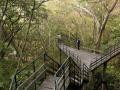
Basically, both Minh Chau and Quan Lan localities have quite favorable conditions for developing ecotourism. However, Quan Lan commune has more advantages to develop ecotourism in a humanistic direction, because this is an area with many famous historical relics such as Quan Lan Communal House, Quan Lan Pagoda, Temple worshiping the hero Tran Khanh Du, ... along with local festivals held annually such as the wind praying ceremony (March 15), Quan Lan festival (June 10-19); due to its location near the port and long exploitation time, the beaches in Quan Lan commune (especially Quan Lan beach) are no longer hygienic and clean to ensure the needs of tourists coming to relax and swim; this is also an area with many beautiful landscapes such as Got Beo wind pass, Ong Phong head, Voi Voi cave, but the ability to access these places is still very limited (dirt hill road, lots of gravel and rocks), especially during rainy and windy times; In addition, other natural resources such as mangrove forests and sea worms have not been really exploited for tourism purposes and ecotourism development. On the contrary, Minh Chau commune has more advantages in developing ecotourism in the direction of natural tourism, this is an area with diverse ecosystems such as at Rua De Beach, Bai Tu Long National Park Conservation Center...; Minh Chau beach is highly appreciated for its natural beauty and cleanliness, ranked in the top ten most beautiful beaches in Vietnam; Minh Chau commune is also home to Tram forest with a large area and a purity of up to 90%, suitable for building bridges through the forest (a very effective type of natural ecotourism currently applied by many countries) for tourists to sightsee, as well as for the purpose of studying and researching.
Figure 3.1: Thenmala Forest Bridge (India) Source: https://www.thenmalaecotourism.com/(August 21, 2019)
3.2.2. Using SWOT matrix to evaluate Quan Lan island tourism
General assessment of current tourism activities of Quan Lan island is shown through the following SWOT matrix:
Table 3.5: SWOT matrix evaluating tourism activities on Quan Lan island
Internal agent
Strengths- There is a lot of potential for tourism development, especially natural ecotourism and humanistic ecotourism.- The unskilled labor force is relatively abundant.- resource environmentunpolluted, still
Weaknesses- Poorly developed infrastructure, especially traffic routes to tourist destinations on the island.- The team of professional staff is still weak.- Tourism products in general
quite wild, originalintact
general and DLST in particularalone is monotonous.
External agents
Opportunity- Tourism is a key industry in the socio-economic development strategy of the province and Van Don economic zone.- Quan Lan was selected as a pilot area for eco-tourism development within the framework of the green growth project between Quang Ninh province and the Japanese organization JICA.- The flow of tourists and especially ecotourism in the world tends toincreasing
Challenge- Weather and climate change abnormally.- Competition in tourism products is increasingly fierce, especially with other localities in the province such as Ha Long, Mong Cai...- Awareness of tourists, especially domestic tourists, about ecotourism and nature conservation is not high.
Through summary analysis using SWOT matrix we see that:
To exploit strengths and take advantage of opportunities, it is necessary to:
- Diversify products and service types (build more tourism routes aimed at specific needs of tourists: experiential tourism immersed in nature, spiritual cultural tourism...)
- Effective exploitation of resources and differentiated products (natural resources and human resources)
div.maincontent .p { color: black; font-family:"Times New Roman", serif; font-style: normal; font-weight: normal; text-decoration: none; font-size: 14pt; margin:0pt; } div.maincontent p { color: black; font-family:"Times New Roman", serif; font-style: normal; font-weight: normal; text-decoration: none; font-size: 14pt; margin:0pt; } div.maincontent .s1 { color: black; font-family:"Times New Roman", serif; font-style: normal; font-weight: normal; text-decoration: none; font-size: 13pt; } div.maincontent .s2 { color: black; font-family:"Times New Roman", serif; font-style: normal; font-weight: normal; text-decoration: none; font-size: 13pt; } div.maincontent .s3 { color: #0D0D0D; font-family:"Times New Roman", serif; font-style: normal; font-weight: bold; text-decoration: none; font-size: 14pt; } div.maincontent .s4 { color: black; font-family:"Times New Roman", serif; font-style: italic; font-weight: normal; text-decoration: none; font-size: 14pt; } div.maincontent .s5 { color: black; font-family:"Times New Roman", serif; font-style: italic; font-weight: bold; text-decoration: none; font-size: 14pt; } div.maincontent .s6 { color: black; font-family:"Times New Roman", serif; font-style: italic; font-weight: normal; text-decoration: none; font-size: 14pt; vertical-align: -3pt; } div.maincontent .s7 { color: black; font-family:"Times New Roman", serif; font-style: italic; font-weight: normal; text-decoration: none; font-size: 14pt; vertical-align: -2pt; } div.maincontent .s8 { color: black; font-family:"Times New Roman", serif; font-style: italic; font-weight: normal; text-decoration: none; font-size: 14pt; vertical-align: -1pt; } div.maincontent .s9 { color: black; font-family:"Times New Roman", serif; font-style: normal; font-weight: normal; text-decoration: none; font-size: 14pt; } div.maincontent .s10 { color: black; font-family:"Times New Roman", serif; font-style: normal; font-weight: bold; text-decoration: none; font-size: 14pt; } div.maincontent .s11 { color: black; font-family:"Times New Roman", serif; font-style: normal; font-weight: normal; text-decoration: none; font-size: 14pt; } div.maincontent .s12 { color: black; font-family:Symbol, serif; font-style: normal; font-weight: normal; text-decoration: none; font-size: 14pt; } div.maincontent .s13 { color: black; font-family:Wingdings; font-style: normal; font-weight: normal; text-decoration: none; font-size: 14pt; } div.maincontent .s14 { color: black; font-family:"Times New Roman", serif; font-style: normal; font-weight: normal; text-decoration: none; font-size: 9pt; vertical-align: 5pt; } div.maincontent .s15 { color: black; font-family:"Times New Roman", serif; font-style: normal; font-weight: normal; text-decoration: none; font-size: 9pt; vertical-align: 5pt; } div.maincontent .s16 { color: black; font-family:Cambria, serif; font-style: italic; font-weight: normal; text-decoration: none; font-size: 14pt; } div.maincontent .s17 { color: #080808; font-family:"Times New Roman", serif; font-style: normal; font-weight: bold; text-decoration: none; font-size: 14pt; } div.maincontent .s18 { color: #080808; font-family:"Times New Roman", serif; font-style: normal; font-weight: normal; text-decoration: none; font-size: 14pt; } div.maincontent .s19 { color: black; font-family:"Times New Roman", serif; font-style: normal; font-weight: normal; text-decoration: none; font-size: 11pt; } div.maincontent .s20 { color: black; font-family:"Times New Roman", serif; font-style: normal; font-weight: normal; text-decoration: none; font-size: 10pt; } div.maincontent .s21 { color: black; font-family:"Times New Roman", serif; font-style: normal; font-weight: bold; text-decoration: none; font-size: 11pt; } div.maincontent .s22 { color: black; font-family:"Times New Roman", serif; font-style: normal; font-weight: normal; text-decoration: none; font-size: 11pt; } div.maincontent .s23 { color: black; font-family:"Times New Roman", serif; font-style: italic; font-weight: normal; text-decoration: none; font-size: 14pt; } div.maincontent .s24 { color: #212121; font-family:"Times New Roman", serif; font-style: normal; font-weight: normal; tex
Identify Rating Levels and Rating Scales
zt2i3t4l5ee
zt2a3gstourism,quan lan,quang ninh,ecology,ecotourism,minh chau,van don,geography,geographical basis,tourism development,science
zt2a3ge
zc2o3n4t5e6n7ts
of the islanders. Therefore, this indicator will be divided into two sub-indicators:
a1. Natural tourism attractiveness a2. Cultural tourism attractiveness
b. Tourist capacity
The two island communes in Quan Lan have different capacities to receive tourists. Minh Chau Commune is home to many standard hotels and resorts, attracting high-income domestic and international tourists. Meanwhile, Quan Lan Commune has many motels mainly built and operated by local people, so the scale and quality are not high, and will be suitable for ordinary tourists such as students.
c. Time of exploitation of Quan Lan Island Commune:
Quan Lan tourism is seasonal due to weather and climate conditions and festivals only take place on certain days of the year, specifically in spring. In Quan Lan commune, the period from April to June and from September to November is considered the best time to visit Quan Lan because the cultural tourism activities are mainly associated with festivals taking place during this time.
Minh Chau island commune:
Tourism exploitation time is all year round, because this is a place with a number of tourist attractions with diverse ecosystems such as Bai Tu Long National Park Research Center, Tram forest, Turtle Laying Beach, so besides coming to the beach for tourism and vacation in the summer, Minh Chau will attract research groups to come for tourism combined with research at other times of the year.
d. Sustainability
The sustainability of ecotourism sites in Quan Lan and Minh Chau communes depends on the sensitivity of the ecosystems to climate changes.
landscape. In general, these tourist destinations have a fairly high level of sustainability, because they are natural ecosystems, planned and protected. However, if a large number of tourists gather at certain times, it can exceed the carrying capacity and affect the sustainability of the environment (polluted beaches, damaged trees, animals moving away from their habitats, etc.), then the sustainability of the above ecosystems (natural ecosystems, human ecosystems) will also be affected and become less sustainable.
e. Location and accessibility
Both island communes have ports to take tourists to visit from Van Don wharf:
- Quan Lan – Van Don traffic route:
Phuc Thinh – Viet Anh high-speed boat and Quang Minh high-speed boat, depart at 8am and 2pm from Van Don to Quan Lan, and at 7am and 1pm from Quan Lan to Van Don. There are also wooden boats departing at 7am and 1pm.
- Van Don - Minh Chau traffic route:
Chung Huong high-speed train, Minh Chau train, morning 7:30 and afternoon 13:30 from Van Don to Minh Chau, morning 6:30 and afternoon 13:00 from Minh Chau to Van Don.
f. Infrastructure
Despite receiving investment attention, the issue of infrastructure and technical facilities for tourism on Quan Lan Island is still an issue that needs to be resolved because it has a direct impact on the implementation of ecotourism activities. The minimum conditions for serving tourists such as accommodation, electricity, water, communication, especially medical services, and security work need to be given top priority. Ecotourism spots in Minh Chau commune are assessed to have better infrastructure and technical facilities for tourism because there are quite complete and synchronous conditions for serving tourists, meeting many needs of domestic and foreign tourists.
3.2.1.4. Determine assessment levels and assessment scales
Corresponding to the levels of each criterion, the index is the score of those levels in the order of 4, 3, 2, 1 decreasing according to the standard of each level: very attractive (4), attractive (3), average (2), less attractive (1).
3.2.1.5. Determining the coefficients of the criteria
For the assessment of DLST in the two communes of Quan Lan and Minh Chau islands, the students added evaluation coefficients to show the importance of the criteria and indicators as follows:
Coefficient 3 with criteria: Attractiveness, Exploitation time. These are the 2 most important criteria for attracting tourists to tourism in general and eco-tourism in particular, so they have the highest coefficient.
Coefficient 2 with criteria: Capacity, Infrastructure, Location and accessibility . Because the assessment area is an island commune of Van Don district, the above criteria are selected by the author with appropriate coefficients at the average level.
Coefficient 1 with criteria: Sustainability. Quan Lan has natural and human-made ecotourism sites, with high biodiversity and little impact from local human factors. Most of the ecotourism sites are still wild, so they are highly sustainable.
3.2.1.6. Results of DLST assessment on Quan Lan island
a. Assessment of the potential for natural tourism development
For Minh Chau commune:
+ Natural tourism attractiveness is determined to be very attractive (4 points) and the most important coefficient (coefficient 3), so the score of the Attractiveness criterion is 4 x 3 = 12.
+ Capacity is determined as average (2 points) and the coefficient is quite important (coefficient 2), then the score of Capacity criterion is 2 x 2 = 4.
+ Exploitation time is long (4 points), the most important coefficient (coefficient 3) so the score of the Exploitation time criterion is 4 x 3 = 12.
+ Sustainability is determined as sustainable (4 points), the important coefficient is the average coefficient (coefficient 1), so the score of the Sustainability criterion is 4 x 1 = 4 points
+ Location and accessibility are determined to be quite favorable (2 points), the coefficient is quite important (coefficient 2), the criterion score is 2 x 2 = 4 points.
+ Infrastructure is assessed as good (3 points), the coefficient is quite important (coefficient 2), then the score of the Infrastructure criterion is 3 x 2 = 6 points.
The total score for evaluating DLST in Minh Chau commune according to 6 evaluation criteria is determined as: 12 + 4 + 12 + 4 + 4 + 6 = 42 points
Similar assessment for Quan Lan commune, we have the following table:
Table 3.3: Assessment of the potential for natural ecotourism development in Quan Lan and Minh Chau communes
Attractiveness of self-tourismof course
Capacity
Mining time
Sustainability
Location and accessibility
Infrastructure
Result
Point
DarkMulti
Point
DarkMulti
Point
DarkMulti
Point
DarkMulti
Point
DarkMulti
Point
DarkMulti
CommuneMinh Chau
12
12
4
8
12
12
4
4
4
8
6
8
42/52
Quan CommuneLan
6
12
6
8
9
12
4
4
4
8
4
8
33/52
b. Assessment of the potential for humanistic tourism development
For Quan Lan commune:
+ The attractiveness of human tourism is determined to be very attractive (4 points) and the most important coefficient (coefficient 3), so the score of the Attractiveness criterion is 4 x 3 = 12.
+ Capacity is determined to be large (3 points) and the coefficient is quite important (coefficient 2), then the score of the Capacity criterion is 3 x 2 = 6.
+ Mining time is average (3 points), the most important coefficient (coefficient 3) so the score of the Mining time criterion is 3 x 3 = 9.
+ Sustainability is determined as sustainable (4 points), the important coefficient is the average coefficient (coefficient 1), so the score of the Sustainability criterion is 4 x 1 = 4 points.
+ Location and accessibility are determined to be quite favorable (2 points), the coefficient is quite important (coefficient 2), the criterion score is 2 x 2 = 4 points.
+ Infrastructure is rated as average (2 points), the coefficient is quite important (coefficient 2), then the score of the Infrastructure criterion is 2 x 2 = 4 points.
The total score for evaluating DLST in Quan Lan commune according to 6 evaluation criteria is determined as: 12 + 6 + 6 + 4 + 4 + 4 = 36 points.
Similar assessment with Minh Chau commune we have the following table:
Table 3.4: Assessment of the potential for developing humanistic eco-tourism in Quan Lan and Minh Chau communes
Attractiveness of human tourismliterature
Capacity
Mining time
Sustainability
Location and accessibility
Infrastructure
Result
Point
DarkMulti
Point
DarkMulti
Point
DarkMulti
Point
DarkMulti
Point
DarkMulti
Point
DarkMulti
Quan CommuneLan
12
12
6
8
9
12
4
4
4
8
4
8
39/52
Minh CommuneChau
6
12
4
8
12
12
4
4
4
8
6
8
36/52
Basically, both Minh Chau and Quan Lan localities have quite favorable conditions for developing ecotourism. However, Quan Lan commune has more advantages to develop ecotourism in a humanistic direction, because this is an area with many famous historical relics such as Quan Lan Communal House, Quan Lan Pagoda, Temple worshiping the hero Tran Khanh Du, ... along with local festivals held annually such as the wind praying ceremony (March 15), Quan Lan festival (June 10-19); due to its location near the port and long exploitation time, the beaches in Quan Lan commune (especially Quan Lan beach) are no longer hygienic and clean to ensure the needs of tourists coming to relax and swim; this is also an area with many beautiful landscapes such as Got Beo wind pass, Ong Phong head, Voi Voi cave, but the ability to access these places is still very limited (dirt hill road, lots of gravel and rocks), especially during rainy and windy times; In addition, other natural resources such as mangrove forests and sea worms have not been really exploited for tourism purposes and ecotourism development. On the contrary, Minh Chau commune has more advantages in developing ecotourism in the direction of natural tourism, this is an area with diverse ecosystems such as at Rua De Beach, Bai Tu Long National Park Conservation Center...; Minh Chau beach is highly appreciated for its natural beauty and cleanliness, ranked in the top ten most beautiful beaches in Vietnam; Minh Chau commune is also home to Tram forest with a large area and a purity of up to 90%, suitable for building bridges through the forest (a very effective type of natural ecotourism currently applied by many countries) for tourists to sightsee, as well as for the purpose of studying and researching.
Figure 3.1: Thenmala Forest Bridge (India) Source: https://www.thenmalaecotourism.com/(August 21, 2019)
3.2.2. Using SWOT matrix to evaluate Quan Lan island tourism
General assessment of current tourism activities of Quan Lan island is shown through the following SWOT matrix:
Table 3.5: SWOT matrix evaluating tourism activities on Quan Lan island
Internal agent
Strengths- There is a lot of potential for tourism development, especially natural ecotourism and humanistic ecotourism.- The unskilled labor force is relatively abundant.- resource environmentunpolluted, still
Weaknesses- Poorly developed infrastructure, especially traffic routes to tourist destinations on the island.- The team of professional staff is still weak.- Tourism products in general
quite wild, originalintact
general and DLST in particularalone is monotonous.
External agents
Opportunity- Tourism is a key industry in the socio-economic development strategy of the province and Van Don economic zone.- Quan Lan was selected as a pilot area for eco-tourism development within the framework of the green growth project between Quang Ninh province and the Japanese organization JICA.- The flow of tourists and especially ecotourism in the world tends toincreasing
Challenge- Weather and climate change abnormally.- Competition in tourism products is increasingly fierce, especially with other localities in the province such as Ha Long, Mong Cai...- Awareness of tourists, especially domestic tourists, about ecotourism and nature conservation is not high.
Through summary analysis using SWOT matrix we see that:
To exploit strengths and take advantage of opportunities, it is necessary to:
- Diversify products and service types (build more tourism routes aimed at specific needs of tourists: experiential tourism immersed in nature, spiritual cultural tourism...)
- Effective exploitation of resources and differentiated products (natural resources and human resources)
div.maincontent .p { color: black; font-family:"Times New Roman", serif; font-style: normal; font-weight: normal; text-decoration: none; font-size: 14pt; margin:0pt; } div.maincontent p { color: black; font-family:"Times New Roman", serif; font-style: normal; font-weight: normal; text-decoration: none; font-size: 14pt; margin:0pt; } div.maincontent .s1 { color: black; font-family:"Times New Roman", serif; font-style: normal; font-weight: normal; text-decoration: none; font-size: 13pt; } div.maincontent .s2 { color: black; font-family:"Times New Roman", serif; font-style: normal; font-weight: normal; text-decoration: none; font-size: 13pt; } div.maincontent .s3 { color: #0D0D0D; font-family:"Times New Roman", serif; font-style: normal; font-weight: bold; text-decoration: none; font-size: 14pt; } div.maincontent .s4 { color: black; font-family:"Times New Roman", serif; font-style: italic; font-weight: normal; text-decoration: none; font-size: 14pt; } div.maincontent .s5 { color: black; font-family:"Times New Roman", serif; font-style: italic; font-weight: bold; text-decoration: none; font-size: 14pt; } div.maincontent .s6 { color: black; font-family:"Times New Roman", serif; font-style: italic; font-weight: normal; text-decoration: none; font-size: 14pt; vertical-align: -3pt; } div.maincontent .s7 { color: black; font-family:"Times New Roman", serif; font-style: italic; font-weight: normal; text-decoration: none; font-size: 14pt; vertical-align: -2pt; } div.maincontent .s8 { color: black; font-family:"Times New Roman", serif; font-style: italic; font-weight: normal; text-decoration: none; font-size: 14pt; vertical-align: -1pt; } div.maincontent .s9 { color: black; font-family:"Times New Roman", serif; font-style: normal; font-weight: normal; text-decoration: none; font-size: 14pt; } div.maincontent .s10 { color: black; font-family:"Times New Roman", serif; font-style: normal; font-weight: bold; text-decoration: none; font-size: 14pt; } div.maincontent .s11 { color: black; font-family:"Times New Roman", serif; font-style: normal; font-weight: normal; text-decoration: none; font-size: 14pt; } div.maincontent .s12 { color: black; font-family:Symbol, serif; font-style: normal; font-weight: normal; text-decoration: none; font-size: 14pt; } div.maincontent .s13 { color: black; font-family:Wingdings; font-style: normal; font-weight: normal; text-decoration: none; font-size: 14pt; } div.maincontent .s14 { color: black; font-family:"Times New Roman", serif; font-style: normal; font-weight: normal; text-decoration: none; font-size: 9pt; vertical-align: 5pt; } div.maincontent .s15 { color: black; font-family:"Times New Roman", serif; font-style: normal; font-weight: normal; text-decoration: none; font-size: 9pt; vertical-align: 5pt; } div.maincontent .s16 { color: black; font-family:Cambria, serif; font-style: italic; font-weight: normal; text-decoration: none; font-size: 14pt; } div.maincontent .s17 { color: #080808; font-family:"Times New Roman", serif; font-style: normal; font-weight: bold; text-decoration: none; font-size: 14pt; } div.maincontent .s18 { color: #080808; font-family:"Times New Roman", serif; font-style: normal; font-weight: normal; text-decoration: none; font-size: 14pt; } div.maincontent .s19 { color: black; font-family:"Times New Roman", serif; font-style: normal; font-weight: normal; text-decoration: none; font-size: 11pt; } div.maincontent .s20 { color: black; font-family:"Times New Roman", serif; font-style: normal; font-weight: normal; text-decoration: none; font-size: 10pt; } div.maincontent .s21 { color: black; font-family:"Times New Roman", serif; font-style: normal; font-weight: bold; text-decoration: none; font-size: 11pt; } div.maincontent .s22 { color: black; font-family:"Times New Roman", serif; font-style: normal; font-weight: normal; text-decoration: none; font-size: 11pt; } div.maincontent .s23 { color: black; font-family:"Times New Roman", serif; font-style: italic; font-weight: normal; text-decoration: none; font-size: 14pt; } div.maincontent .s24 { color: #212121; font-family:"Times New Roman", serif; font-style: normal; font-weight: normal; tex -
 Handling Violations of Law on Tourist Accommodation Business.
 -
 Business culture at Soc Son Temple Tourist Area - Relic - 1
 -
 Tourist Routes Are Routes Connecting Tourist Areas, Tourist Attractions, Tourist Service Providers, Associated With Road and Rail Traffic Routes
 -
 Some recommendations to improve the business strategy of Tay Ho Tourism Service Company - 9
Economy, security, social order, environment, natural resources... registration of tourism accommodation business must ensure the necessary conditions prescribed by law.
Types of tourist accommodation establishments stipulated in Article 48 of the 2017 Law on Tourism include hotels, tourist villas, tourist apartments, tourist accommodation ships, tourist motels, houses with rooms for tourists to rent, tourist campsites, and other tourist establishments [27]. Thus, there are many types of tourist accommodation for customers to choose from. Which type of tourist accommodation customers choose depends entirely on their personal preferences and economic conditions.
The Investment Law 2014, effective from July 1, 2015, continues to be a conditional business and investment sector, meaning that the freedom to conduct tourism accommodation business is limited. For business conditions requiring a license, business entities must carry out procedures to apply for a business license and must be approved by a competent state agency in the form of a business license or a certificate of eligibility to conduct business.
According to Article 49 of the 2017 Law on Tourism, conditions for doing business in tourist accommodation services include:
“ - Registered business in accordance with the law
- Meet the conditions of security, order, fire prevention and fighting safety, environmental protection, food safety according to the provisions of law.
- Meet the minimum requirements for technical facilities and services for tourists.”
Accordingly:
- Conditions on subjects: Business subjects under the 2017 Tourism Law have been expanded to organizations and individuals who, if they meet the conditions specified in Article 49 of this Law, can conduct tourism accommodation business. However, the problem is that the 2017 Tourism Law does not define or stipulate what an organization is. That also creates many inconsistent understandings of these subjects. If understood in the broadest sense, business subjects are organizations and individuals who conduct business activities. Including organizations and individuals who have completed registration procedures or applied for business licenses and other organizations and individuals who conduct business activities for the purpose of making a profit. If understood
In the sense of positive law, business entities are organizations and individuals that carry out professional business activities, operate under a certain legal form and have completed procedures and been granted a business registration certificate or investment certificate according to the provisions of law.
Thus, it can be understood that an organization that wants to do tourism accommodation business can register as an enterprise or cooperative and choose one of the following four forms: Private enterprise, Limited liability company, Joint stock company or Partnership. If an individual does tourism accommodation business, he or she can register as a sole proprietorship. For business households, according to Article 66 of Decree 78/2015, it is stipulated that: “A business household owned by an individual or a group of individuals who are Vietnamese citizens aged 18 years or older with full civil act capacity or a household, can only register to do business at one location, employ less than ten workers, and be personally responsible for all of its assets for business activities”. For tourism accommodation business, which is one of the conditional business lines, individuals must register so that the state can compile statistics, manage and supervise to ensure business conditions. The place of registration can be the place of permanent or temporary residence registration or the place of business.
According to Article 18 of the Enterprise Law 2015, organizations and individuals who are not allowed to establish, manage, buy shares, or contribute capital to enterprises are of course not eligible to participate in tourism accommodation business activities in the form of enterprises. However, the law has different provisions for business households. Individuals who are in most cases prohibited from establishing, managing, or contributing capital to enterprises are not prohibited from registering as business owners. These subjects can still register to operate tourism accommodation businesses.
In addition to the conditions on the subject, traders in the tourism accommodation business must also ensure other specific conditions, such as:
- Conditions on security and order: According to Clause 22, Article 3 of Decree 96/2016/ND-CP dated July 1, 2016 "Accommodation service business, including: Accommodation establishments according to the provisions of the Law on Tourism and other forms of accommodation rental services (hourly and overnight stays) operating on land or on watercraft
Tourist accommodation must have conditions on security, order and scope of management"[ 6 ]. Organizations and individuals operating in sectors and professions with conditions on security and order, if meeting the conditions specified in Decree 96/2016 and complying with other relevant provisions of law, are allowed to operate and be granted a Certificate of eligibility for security and order. Tourist accommodation establishments must actively and proactively coordinate with local authorities and police on coordination regulations to ensure security and order in tourism business. Strengthen close coordination with local mass organizations to promptly prevent disturbances caused by subjects to tourists during their stay at the accommodation establishment. Educate and promote strongly among service staff as well as tourists about the good implementation of the Road Traffic Law. Organize well the work of on-duty and security to protect security and order in tourist accommodation establishments and be ready to coordinate in handling related incidents.
- Fire safety conditions: Ensure fire prevention and fighting in accommodation establishments. Strictly comply with fire prevention and fighting regulations. Develop fire fighting plans at accommodation establishments. Fully equip fire prevention and fighting equipment according to regulations. For accommodation establishments that are not equipped with fire prevention and fighting water systems, fire extinguishers must be arranged in reasonable and visible areas. Regularly check the quality of fire extinguishers and replace expired ones. Organize training for managers and employees on how to use fire prevention and fighting equipment at accommodation establishments. Check the electrical system at accommodation establishments, electrical safety equipment in guest rooms, offices, rechargeable lighting systems in corridors and emergency exits. Arrange electrical outlets, switches, and circuit breakers reasonably. Strictly implement Government regulations on prohibiting the production, transportation, trading, and use of explosives. For accommodation establishments with catering services when using gas stoves, the gas cylinders must be placed in a suitable location, with a solid fence separating them, away from crowded areas. A contract must be signed with a legal supplier and a plan must be made to regularly check safety equipment to avoid gas leaks, and proper procedures must be followed during use.
- Food safety conditions: To ensure food hygiene and safety, in addition to strictly implementing food safety regulations, accommodation establishments must absolutely not allow food poisoning to occur. Accommodation establishments must develop a plan to prevent poisoning in order to promptly and effectively handle incidents that occur at the accommodation establishment.
- Minimum conditions on technical facilities and services for accommodation establishments are stipulated in Decree 168/2017/ND-CP. Specifically as follows:
For the hotel type in Article 22, Decree 168/2017/ND-CP stipulates: “There is an electricity system, a clean water supply and drainage system; there is at least 10 bedrooms, a reception desk, a shared restroom, and a parking space for guests for resort hotels and roadside hotels; there is a kitchen, dining room, and food service for resort hotels, floating hotels, and roadside hotels; there are beds, mattresses, blankets, pillows, towels, bath towels, and mattress covers, blanket covers, pillow covers, towels, bath towels, and mattress covers are changed when there are new guests; there are staff on duty 24 hours a day; managers and staff are trained in tourism services”.
For the type of tourist villas in Article 23, Decree 168/2017/ND-CP stipulates: “There is an electricity system, a clean water supply and drainage system; there are beds, mattresses, blankets, pillows, towels, bath towels; change mattress covers, blanket covers, pillow covers, towels, bath towels when there are new guests; there are staff on duty 24 hours a day; there is a reception area, bedroom, kitchen, bathroom, and toilet”.
For tourist apartments, Article 24 of Decree 168/2017/ND-CP stipulates: “There is an electricity system, a clean water supply and drainage system; there are beds, mattresses, blankets, pillows, towels, and bath towels; there are beds, mattresses, blankets, pillows, towels, and bath towels; change mattress covers, blanket covers, pillow covers, towels, and bath towels when there are new guests; the apartment manager is trained in tourism services”.
For tourist accommodation ships, Article 25, Decree 168/2017/ND-CP stipulates: “The ship must be in good condition, with valid inspection; have life jackets, life buoys, means of communication, first aid medicine cabinets; have electricity, clean water; have equipment to collect waste and wastewater to ensure environmental hygiene; have a guest reception area, bedroom (cabin), bathroom, toilet, kitchen, dining room and
Food service; beds, mattresses, blankets, pillows, towels, bath towels; mattress covers, blankets, pillow covers, towels, bath towels are changed when new guests arrive; managers and service staff are trained in tourism services and river rescue skills.”
For tourist accommodation in Article 26, Decree 168/2017/ND-CP stipulates: “There is electricity, clean water and drainage system; there is a reception area and bedroom; there is a shared bathroom and toilet in case the bedroom does not have a private bathroom and toilet; there is a bed, mattress, blanket, pillow, face towel, bath towel, change the mattress cover, blanket cover, pillow cover, face towel, bath towel when there are new guests; there is staff on duty 24 hours a day; the manager and staff are trained in tourism services”.
For houses with rooms for tourists to rent, Article 27 of Decree 168/2017/ND-CP stipulates: “there must be lighting, clean water, a common living area, a guest accommodation area, a kitchen, a bathroom, a toilet, a bed, a mattress or mat, a blanket, a pillow, a mosquito net, a face towel, a bath towel; change the mattress or mat covers; change the blanket, pillow covers, face towel, bath towel covers when there are new guests; the owner of the house with rooms for tourists to rent must be trained in tourism services”.
For tourist camping sites in Article 28, Decree 168/2017/ND-CP stipulates: "there is an area to receive guests, an area to set up tents, camps, parking, bathrooms, and public toilets; there is clean water; there are tools and equipment to set up tents, there is a first aid kit; there are security guards on duty when there are guests; there are staff on duty 24 hours a day"
It can be seen that, for the conditions for registering a tourist accommodation business, the state agency must be responsible for checking and assessing to issue a business license, a business certificate, for the conditions for doing business without a license, the state only records but is not responsible for the business conditions declared by the trader. However, in reality, checking and monitoring the process of creating business conditions without a license is much more difficult and less effective than with a license [38]. However, the author finds that the overly detailed and detailed regulations on the minimum conditions for technical facilities and services for types of accommodation establishments stipulated in Decree 168/2017/ND-CP are not really reasonable, creating many difficulties for business organizations and individuals as well as difficulties in checking and managing for state agencies.
Ranking of tourist accommodation establishments
After more than 10 years, the 1999 Tourism Ordinance has expired, replaced by the 2005 Tourism Law and now the 2017 Tourism Law, each type of accommodation business will be applied a separate standard. Thus, the basis for classifying tourist accommodation establishments is based on the type, scale of the accommodation establishment and business purpose, including hotels; tourist villas; tourist apartments; tourist camping sites; tourist motels; houses with rooms for tourists to rent. The standards for classifying tourist accommodation establishments are issued by the State management agency of tourism at the central level for uniform application throughout the country.
Article 50 of the 2017 Law on Tourism stipulates the registration of tourist accommodation establishment rankings : “Organizations and individuals doing business in tourist accommodation services may voluntarily register for tourist accommodation establishment rankings with competent state agencies;
Hotels, tourist villas, tourist apartments, and tourist cruise ships are ranked according to national standards for ranking tourist accommodation establishments. Tourist accommodation establishments are classified into 01 star, 02 stars, 03 stars, 04 stars, and 05 stars.
The authority to appraise and recognize the rank of tourist accommodation establishments is stipulated as follows: The General Department of Tourism appraises and recognizes 4-star and 5-star tourist accommodation establishments; provincial tourism authorities appraise and recognize 1-star, 2-star and 3-star tourist accommodation establishments.”
Thus, according to the 2017 Tourism Law, registration for classification of accommodation types is not mandatory for organizations and individuals. According to Decision No. 217/QD-TCDL dated May 15, 2009 of the General Director of the General Department of Tourism on National Standards for classification of accommodation establishments:
- Hotel classification applies TCVN 4391:2009
- Tourist accommodation standards apply TCVN 7799:2009
- The standard for accommodation with rooms for tourists to rent applies TCVN 7800:2009. The 2017 Tourism Law stipulates that registration for ranking of tourist accommodation establishments is voluntary instead of mandatory as stipulated in the 2005 Tourism Law. Registration for ranking comes from the need to affirm the brand and service quality to attract tourists. Tourists, based on the advertised information to choose accommodation establishments that have been ranked by competent authorities, will be more assured about the quality of service. But it seems to be "open" but in reality the regulations are accompanied by conditions.
The condition is that “accommodation establishments are only allowed to use the word star or star image for their accommodation establishments after being recognized as tourist accommodation establishments by a competent state agency” . Thus, in essence, the business is still ranked, because the business has no way to attach stars for customers to identify [18].
Rights and obligations of organizations and individuals doing business in tourist accommodation services
The rights of organizations and individuals doing business in tourist accommodation are stipulated in Clause 1, Article 53, Law on Tourism 2017, including: "Refuse to receive tourists who violate the law, violate the regulations of the tourist accommodation establishment or when the tourist accommodation establishment is no longer able to meet the requirements of tourists; cancel the service provision contract for tourists who violate the law, violate the regulations of the tourist accommodation establishment" . Thus, the tourist accommodation establishment has the right to issue regulations. The issuance of a system of regulations is important in the management and operation of the accommodation establishment; however, in order to develop and issue a legal document, suitable to reality, ensuring applicability and science. The regulations of the tourist accommodation establishment must ensure:
- Legality: In accordance with the provisions of law, not contrary to the Constitution and laws.
- Practicality: Suitable for management and operation requirements, suitable for the operations of tourist accommodation establishments in each specific field.
- Effectiveness: Rules and regulations create an internal legal corridor for tourist accommodation establishments, actively contributing to the management and operation as well as the entire operation of the accommodation establishment; when applied, they must be respected and thoroughly implemented by everyone.
The obligations of organizations and individuals doing business in tourist accommodation are stipulated in Clause 2, Article 53, Law on Tourism 2017, including: “Ensure to maintain the conditions for doing business in tourist accommodation services; publicly post the prices of goods and services, and the internal regulations of the tourist accommodation establishment; compensate tourists for damages according to the provisions of civil law; notify in writing the specialized tourism agency at the provincial level where the tourist accommodation establishment is located when there is a change in the name of the establishment, scale, address, or legal representative; only use the word “star” or the image of a star to advertise the class of the tourist accommodation establishment after the competent state agency recognizes the class of the tourist accommodation establishment; implement the reporting, statistical, and accounting regimes according to the provisions of law”.