
cabernet sauvignon, grenache, merlot, and pinot noir. Popular white grape varieties include colombard, chardonnay, chenin blanc, and sauvignon blanc.
The natural factors that produce wine depend on the specific region. Known in the wine industry as terroir, these factors include the climate of the region (temperature, rainfall, sunlight), the location of the vineyard (elevation and slope), and the soil (texture, composition, permeability). Generally, a vine produces its best fruit in a temperate climate with plenty of sunshine and cool, frost-free nights, and the soil is well-drained. Grapes do best on sandy, chalky, or rocky soils.
Grapes are grown in vineyards, and are trained on a system of wire stakes, called trellises , to allow for even distribution of sunlight. The first harvest of grapes occurs after three years of planting, with full commercial harvest occurring after five years. Grape vines can be productive from 20 to over 100 years old. The grape growth cycle begins in early spring when new shoots appear on the branches. These shoots develop and flower, which then produce small clusters of green grapes. The grapes begin to ripen in mid-summer and are ready for harvest starting in mid-autumn, depending on location, grape variety, weather, and the type of wine being produced. In late autumn the vines drop their leaves and lie dormant until the following spring.
The character of a wine is strongly influenced by the way the grapes are grown. In fact, the work of growing grapes is very complicated, such as bending the plants, trellising the vines, harvesting, and pruning. The process of bending the plants and trellising the vines helps the grower to control the sunlight evenly to make the grapes ripen evenly.
Maybe you are interested!
-

 Beverage and Bar Knowledge - Vung Tau Tourism College - 6
 -
 Experiences Learned for Sustainable Tourism Development in Ba Ria - Vung Tau
 -
 Orientation and Solutions for Tourism Development in Ba Ria - Vung Tau to 2020
 -
 Cronbach's Alpha Reliability Coefficient of Components of the Scale of Factors Affecting Investment Capital Attraction for Tourism in Ba Ria Vung Tau Province
 -
 Review of service quality of Vung Tau - Con Dao tour at ATZ Travel Company - 2
Harvesting grapes before they are ripe can result in grapes that are not very sweet and can affect the fermentation process. Overripe grapes contain high sugar levels and will produce wines with high alcohol content. When the vines are dormant, growers prune dead, dry branches. Pruning allows growers to control the size and shape of the vines, as well as the number of buds that will develop in the following year. Too many buds on a vine can deprive the vine of nutrients, reducing the quality of the following harvests.
Grapevines have many natural enemies: insects, fungi, bacteria, viruses, and animals such as deer and birds that eat the young shoots, buds, and ripe fruit. Some soil-borne pests, such as the Phylloxera aphid , destroy the roots of European grapes. Grapevines native to North and South America have natural defenses against these pests, but often
produce grapes with undesirable flavors. To avoid this, American vineyards use vines grown from two different parts: the roots are American vines that are resistant to insects, and the above-ground part is European grapes. The process of joining two different parts of a plant is called grafting.
Eight million hectares (20 million acres; 0.4 ha) of vineyards worldwide produce 60 million tons of grapes each year. About 26 billion liters (7 billion gallons; 3.78 l) of wine are produced from the harvest. The largest wine-producing countries in the world are Italy (24%), France (21%), and Spain (10%). The United States is the fifth largest producer in the world, accounting for about 6% of the world's wine production. California produces 90% of all U.S. wine, with New York City, Washington, Oregon, and 41 other states producing the rest.
White wine grape varieties:
Riesling: a grape variety that grows in Germany's Elsass region and in Austria, and produces high quality wines. Depending on the time the grapes are left to ripen on the vine, it produces excellent wines. A good bottle of Riesling can be stored for up to 10 years.
Chardonnay: grows in France. Since it is not very demanding, it can be grown everywhere. The taste can be light and lively to aromatic and mellow.
Gewürztraminer: has a fruity, tropical aroma, grown in Germany in the Elsass, Baden, Burgenland regions.
Grüner Veltiner: Austria's most famous grape variety. This produces fruity, vibrant wines.
Pinot blanc, Pinot bianco, Weissburgunder: Grape varieties grown in the Baden region, in Austria, the Alsace region, and Italy. The Friaul region produces very high quality wines.
Pinot grigio, Grauburgunder, Ruländer: grown in Italy and Alsace for making dry wines, in Baden the Ruländer grape is used to make sweet wines
Sauvignon/Fumé blanc: a French white grape with a fruity aroma. Popular in recent years is the Sancerre wine.
Silvaner: a low-flavoured grape - from the Franken region that produces full-bodied wines
Red wine grape varieties:
Cabernet Sauvignon: is not as demanding as Chardonnay. The wine is characterized by its red currant-like aroma. When the wine is young, it will be a bit astringent (high tannin content), when old (long-term) it will have a full, rounded aroma.
Merlot: an early ripening grape variety. In France or Italy this grape variety produces very full-bodied wines.
Pinot noir, Spätburgunder: difficult grape variety to grow, sometimes produces very bad Burgundy wines
Sangiovese: the typical grape of the Toskana region. Used with other grapes to make Chianti wine, or used to make Brunello di Montalcino
Wine usually comes in 3 different colors:
Red wine
White wine
Rosé wine.
2.2.1.3. PRODUCTION PROCESS
While the basic elements of winemaking are simple, producing wine that achieves the desired flavor and aroma is extremely difficult and is recognized as an art.
Winemakers strive to produce a product that is specific and distinct in its flavors and aromas – described as cherry, chocolate, vanilla – and that minimizes the formation of undesirable flavors and aromas – such as plastic or rotten eggs. It is also important that the acidity and alcohol levels in the wine are balanced. If the acidity is too high, the wine will taste sour. If the alcohol level is too high, the wine will taste strongly of alcohol.
The most important factor that determines the character of a wine is the type of grape used. The grape variety affects the flavor, alcohol content, acidity, and color of the wine.
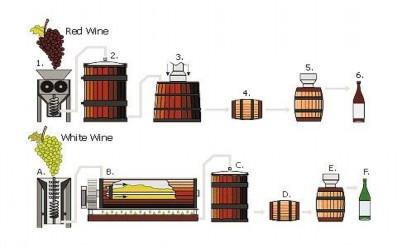
In today's wine production, grapes are harvested in vineyards and brought to the winery, where they are put through a destemming machine and crushed.
To produce white wine, people use green-skinned grapes. The grapes are steam-pressed to separate the juice from the skin before fermentation. The amount of pressure used to press also affects the flavor of the substances obtained from the skin. After pressing, the white juice without the skin is transferred to a tank for fermentation. White wine, in fact, ranges in color from pale yellow to amber.
To produce red wine, people use dark-skinned grape varieties. After being put through a de-stemming machine and crushed, the grapes are immediately taken to the fermentation tank. Red wine is fermented with the grape skins. The red color and other compounds in the skins will be absorbed into the juice during the fermentation process, so the wine has a red color. In addition, Tannin is also formed, so red wine often has an astringent taste.
Rose wine has a light pink color, also produced from red grapes but when fermented without the grape skins soaked in the must or only soaked for a short period of time.
Fermentation tanks must be sealed to prevent oxidation. Fermentation is initiated in the tank by natural or added yeast. Fermentation tanks are mostly made of stainless steel or wood. The type of tank used and the temperature at which the wine is fermented affect the characteristics of the wine. Many flavors in wine are very volatile. Evaporation occurs more quickly at high temperatures, so the temperature during fermentation must be controlled to retain the characteristic fruit flavors in the wine. Fermentation tanks are always cooled directly. Metal tanks are easier to cool than wooden tanks.
Fermentation stops when all the sugar in the grapes has been converted. In the case of sweet wine production, some of the sugar is retained in the wine after the yeast has died.
The wine is stored in very large wooden or stainless steel barrels so that it can be kept for a long time and the sediment can settle. After about 6 months, the wine is filtered into new wooden barrels to remove the sediment.
During the following year the wine is filtered three more times. After the final filtration the wine is left to age in wooden barrels for varying periods of time depending on the type of wine, producer, etc.
Finally, the wine is bottled, the standards for bottles, corks and labeling are also given specifically and all manufacturers must follow. From the time it is put on the market until it is consumed (drinking), the wine must still be stored in low temperature conditions and protected from light.
2.2.1.4. FRANCE - THE COUNTRY OF WINE
With nearly a million acres of grapes, France still lags behind Spain and Italy.
Wine production in Italy is 24%, France is 21%, Spain is 10%, USA is 6%, other countries are 39%.
However, the harvest in good years is still greater than that of Italy or Spain.
French wines range from the most luxurious and expensive to the cheapest for everyday drinking.
Unlike Germany, French wine is classified according to its origin, for example:
Vin de table : The wine must be produced in France
Vin de Pays : Although it bears the name of the production region, this wine is not allowed to be called "Château" or "Clos"
VDQS – Vins Délimités de Qualité Superieur : Wine producing regions that follow certain standards are allowed to label their wines with this label.
AOC – Appellation d´Origine Contrôllée : Only for wines from regions recognized by the state. Strict control will ensure minimum quality as well as the characteristics of the wine. AOC is usually only granted to large wine-growing regions such as Bordeaux.
Important wine growing regions:
Bordeaux is the name given to wines produced in the Bordelais , a region that encompasses the Garonne and Dordogne. With 100,000 acres of vines, the Bordelaise is the largest contiguous region producing quality wine. Bordeaux wines are mostly made from a combination of different grape varieties. Red wines are made from Cabernet Sauvignon, Merlot and Cabernet franc, white wines are made from Sémillon,
Sauvignon blanc and Muscadelle. The composition of each grape variety will determine the individual characteristics of the wine.
La Loire is made up of four wine-growing regions, each producing a very different wine. This is the region for Muscadet, a light, low-acid wine that pairs well with seafood. In recent years, white Sancerre has become popular. This is made from Sauvignon blanc grapes, like Pouilly-Fumé.
Alsace occupies a special place among the wine-growing regions of France. The classification of wines here depends not on the region and place of production but on the grape variety. Here, white wines are produced mainly. Besides the famous Edelzwicker and table wines from Sylvaner, Pinot blanc and Chasselas, there are also varieties such as Rieslinge, Gewürztraminer and Muscat d´Alsace.
Burgund has always competed with Bordeaux as the region with the best wine! They grow only four grapes: Pinot noir or Gamay for red wines and Chardonnay or Aligoté for white wines. The five famous wine growing regions of Burgund are Chablis, Côte d´Or, Côte Chalonnaise, Mâconnais, and in the south Beaujolais.
The Rhôntal , which is 200 km long, produces a wide variety of wines due to the influence of the different climates in the region. The dark Syrah is produced here. The famous wine is Chateauneuf du Pape, made from 13 red and white grape varieties.
Languedoc Roussillon is known as the red wine region of France. Stretching from the Rhone Delta along the Mediterranean coast to the Pyrenees (the mountain range between France and Spain), it is the largest continuous red wine growing region in the world. Besides cheap wines, they also produce famous wines. Corbières, a fragrant red wine with high alcohol and tannin, as well as the famous Roussillon dessert wine.
2.2.1.5. WINE AND FOOD
Several recent studies have shown that, in moderation, wine can be good for your heart, lowering blood pressure and cholesterol. But be aware that some wines pair well with certain foods.
Do not drink wine with dishes that have strong flavors such as chocolate or asparagus because they will overpower the flavor of the wine.
Cold ice cream can also numb your tongue, making it difficult to enjoy other mild flavors. The egg whites coat your tongue, dulling the sensation.
Yogurt, soup, pho, hu tieu... are also not companions with wine.
People often use clams and oysters with Champagne; lamb and beef with Cabernet Sauvignon and Sauvignon Blanche; birds, deer, salmon and mackerel... with Shiraz and Pinot Noir.
Typically, people drink white wine before red wine, light wine before strong wine, young wine before old wine, red wine before sweet wine. You can start the meal with a glass of champagne or cherry and end it with a glass of sweet wine.
2.2.1.6. WINE STORAGE
When aging red and white wines for a considerable period of time, the following specific standards must be strictly adhered to.
Ideally, wine should be stored in a dark cellar at a temperature no lower than 50 0 – 55 0 F (10 0 - 12 0 C). A general rule of thumb is that the temperature in the wine storage area should never exceed 70 0 F (21 0 C) for wines that are to be aged for up to 5 years, 65 0 F if the wine is to be aged for up to 15 years, and 60 0 F (18 0 C) for any period of storage within 15 years.
Humidity in the wine storage area must be kept at 50% to avoid cork damage and mold.
Table wine and sparkling wine are preserved by placing the bottle horizontally to maintain the humidity of the cork, preventing air and bacteria from entering the bottle, and for sparkling wine it will prevent gas from escaping.
Note : There is an exception for Vintage Port. This is a specially corked wine, a full-bodied wine so the bottle should be stored upright as the high alcohol content in the bottle can easily damage the cork.
2.2.1.7. WINE TASTING
For thousands of years, wine has been considered a precious gift from God to mankind. The most precious thing is that it can be enjoyed with all five of human's sensitive senses.
The wine that is poured into the glass reveals its shimmering color to our eyes, whether it is the light red of Pinot Noir, the deep red of Caberbet Sauvignon, the pale ivory of Chardonnay, or the amber of Sauternes. That is the color of the wine, which Americans call “color,” or “la robe du vin” in French. Let’s raise the glass to look at that color to see the purity, whether there are bubbles or other objects in the wine. You will see crystals of tartaric acid - a natural substance in grape juice and often found in aperitifs or in aged white wines. Pay attention to the color of the wine and the color transition from the center of the glass to the rim. The larger the color transition, the better the wine. For white wine, the longer it is left, the darker the color. Conversely, red wine, the longer it is left, the lighter the color. If the wine clings to the glass and flows slowly and clearly, it is a thick wine with high alcohol or sugar content.
If the wine near the rim of the glass is purple, it is young, and if the color changes from orange to brown, the wine is mature enough.
Before smelling, swirl the wine glass, letting air into the wine to help the aroma of the wine spread. Then, bring the glass close to your nose and take a deep breath. Swirl the glass again, then bring your nose deeper and inhale more deeply, you will smell the different scents of each type of wine. Depending on the type of grape, we will see that the scent seems to contain a whole bouquet of wildflowers, a little bit of myrtle flower, mixed with cherry blossoms, rosehips, orange blossoms, grapefruit flowers, the smell of new straw, the smell of grass.
Now take a sip of wine, if it is good wine, the first feeling we have is a rich, mellow taste on the tip of the tongue. It must give us a full, passionate feeling like when we hold our lover in our arms. That is the body of the wine (le corps du vin). Good wine must be a harmonious synthesis of many different flavors, including the sour and sweet taste of grape juice, the astringent taste of grape skin, the bitter taste of grape stems, the strong taste of yeast, and the strong taste of oak.
We must also let our ears enjoy it. Perhaps that is why people often drink wine from glass or crystal glasses. Drinking wine from crystal glasses is wonderful. When we clink glasses, the crystal will create clear sounds. This pleasant sound makes parties and reunions even more enjoyable.
Oh, and what about the sense of touch? We can’t touch wine. When we hold a glass of wine in our hands, whether it’s a tall, round stemmed glass for red wine, a long, slender glass for white wine, or a small, tapered goblet for Champagne, we still have the feeling that our sense of touch is caressing the wine inside. Not to mention the times when we hold a glass of Port (a fortified wine) on a winter evening by the fireplace, the wine in the glass gradually warms up due to the heat transmitted from our palms. Isn’t that a joy of touch?
White wine should always be served chilled, at a serving temperature of around 10 0 – 12 0 C.
Rose wine is served at a chilled temperature similar to white wine.
Red wine always has more flavor than white wine, red wine is served at room temperature, around 18 0 – 21 0 C.
2.2.1.8. SERVING WINE BY THE BOTTLE