
different to your customers to gradually increase the percentage of loyal and regular customers.
To make a good impression on customers, the shop owner cannot only think about how to make a cup of fragrant, delicious coffee, but also need to think that "Selling coffee is selling relaxation, selling the rich and polite love of a cup of coffee". In fact, the quality of a cup of coffee also depends on many things related to the management work of the shop owner such as:
Where to buy ground coffee, how to control the quality of ground coffee?
- What kind of sugar should I use, powdered sugar or sugar cubes?
- How much coffee and sugar should be in stock so that there is neither shortage nor excess?
- What time is the store open?
- How to choose sales staff, how to train them to serve well, to satisfy customers, and to have few complaints.
- How much should a cup of coffee cost to accumulate and develop, but customers do not consider it expensive?
- Mornings and evenings are usually crowded with customers, but during the day there are few customers, so how to arrange sales staff to save the most money?
- How to establish regular relationships with customers, so that "customers are satisfied when they come, and remember when they leave"?
1.6. COCOA
The cocoa tree is native to the Amazon and Central Americas, especially Mexico. Natives of this region found and used it, and it was considered the “Food of the Gods.”
Christopher Columbus discovered cocoa beans in the Americas in 1502 and 20 years later, Hernando Cotes invented a more bitter beverage from cocoa.
In 1828, the cocoa press technique was developed which allowed the cocoa butter to be extracted. Then, around 1879, the Swiss developed both milk chocolate and cake chocolate.
Cocoa beans are the commercial source of cocoa, there are four types of direct cocoa products: cocoa drinks, cocoa butter, cocoa cake and cocoa powder and a cocoa product is chocolate. Of these, cocoa powder is necessary to create aroma for biscuits, ice cream, milk powder and cakes. Cocoa powder is also used in beverage technology such as in the production of chocolate milk.
Cocoa butter is also used in the production of tobacco, soap, cosmetics. It is also used as a folk medicine to treat burns, coughs, fever, malaria, rheumatism, snake bites... At the same time, it has antiseptic and diuretic effects.
Like coffee and tea, cocoa is one of the drinks that millions of people around the world love every morning. This choice is not accidental. It turns out that cocoa drinks are not only delicious but also very nutritious. According to nutritionists, cocoa contains a large number of beneficial active ingredients such as caffeine (less than in coffee), theophylline and theobromine, as well as stress-reducing substances and pheninetinlamine.
Cocoa is rich in protein (12.9%), fatty acids, and can neutralize cholesterol levels in the blood. Cocoa contains a lot of cellulose and vitamins, especially folic acid (vitamin B9). In addition, cocoa also contains many different minerals. According to some studies, cocoa contains a lot of iron and zinc. Zinc plays a very important role in human activities. It participates in the creation of enzyme systems, protein synthesis and nucleic acid, without zinc cells will not be able to function normally. Zinc is essential for human sexual development and reproduction. Zinc supports blood production and has the ability to heal wounds. The daily requirement of zinc for adults is 15mg, for pregnant and lactating mothers is 5mg.
Cocoa drinks are best consumed as breakfast and snacks, in the afternoon with honey and dried fruits. However, cocoa and chocolate also contain natural melanin pigments that have the ability to absorb heat energy and the sun's attack. Melanin is also found in dark-colored fruits. In addition to cocoa, it is also found in coffee, black tea, prunes, and black grapes.
BEVERAGE & BAR KNOWLEDGE COURSE
NON-ALCOHOLIC DRINKS CHART
NON ALCOHOLIC DRINKS
BEVERAGE
(Refreshing drinks)
NUTRITIONAL DRINK
(Nourishing drinks)
STIMULANT DRINKS
(Stimulating drinks
Spring
(Mineral Water)
Pure water
(Purified Water)
Soft drink
(Soft Drinks)
Milk
(Milk)
Fruit juice
(Fruit Juices)
Tea
(Tea) Green Tea Black Tea
Coffee
(Coffee)
Cacao
(Cocoa)
CO2
No CO2
Milk powder
Fresh milk
Milk fat
Fresh
Condensed milk
Powder Box
Oolong Tea Flavored
CHAPTER II ALCOHOLIC BEVERAGES
Objectives: After completing this lesson, students should:
Understanding alcoholic beverages
Serves alcoholic beverages
2. ALCOHOLIC BEVERAGES
2.1. BEER
2.1.1. HISTORY
Beer is believed to have been around for over 10,000 years. While no one knows exactly when it first came about, many agricultural historians believe that beer was first made accidentally when stored grain became soaked in rainwater and warmed by the sun. While the mixture fermented spontaneously, naturally occurring bacteria—which thrive in hot, humid conditions—beer was formed.
Initially brewers used very simple brewing processes and fermented beer for only a short period of time, mostly one to two days. By about 1100 AD (anno domini), brewing techniques had become much more sophisticated. In Europe brewers had joined together in organizations to protect their businesses while setting brewing standards. Hops were introduced into the brewing process around 1300. While European brewers embraced hops, English brewers refused to add bittering plants to their beer until the 16th century. The first beer produced in England to contain hops was Bitter Ale.
For centuries, brewers roasted (dried) grain over open fire, which gave the malt a dark, smoky flavor, and so most beers were dark. When the industrial revolution hit in the 1800s, brewers invented a way to dry malt in large rotating drums, which lightened the malt and produced pale to golden beers. The next technological breakthrough came in the late 19th century with the invention of cold pressurization. Brewers no longer had to follow a schedule of different stages of drying and cooling during production, and did not have to depend on seasonal temperatures. Refrigeration also helped to keep the beer from spoiling during long-distance shipping. This innovation paved the way for the major breweries of today.
With the development of technology, many manufacturers have switched to mass production, large number of employees, machinery and equipment to produce beer with
large quantities. In the late 1970s and early 1980s the American beer industry grew rapidly, and by 1983 six breweries accounted for 90% of the beer sold in the United States. By the early 1990s, the largest American brewers, such as Anheuser-Busch and Miller Brewing Company , were producing nearly 60 million barrels (about 150 liters/barrel) a year.
Recently, brewers have returned to some of the old ways of brewing beer, such as making small batches and skipping filtration and pasteurization to produce beers that retain more flavor and the characteristics of the bacteria used in fermentation. Microbreweries (those who produce high-quality beer but in small quantities – under 15,000 barrels per year) have also returned to more local, traditional methods than the big breweries in the US today.
2.1.2. PRODUCTION PROCESS
In the beer making process, people need more technical machinery than in the wine making process. Steps such as roasting, increasing temperature, cooking, evaporating, cooling, stirring, fermenting... require high technology to ensure quality.
Beer, of which water accounts for about 90%, 3.5% alcohol by volume, 0.5% CO2 , 6% proteins, carbohydrates, minerals and aromas.
2.1.2.1. Ingredients:
Cereal grains have high starch content and a necessary amount of sugar to ferment and create color and aroma for beer such as: barley, rye, corn, rice... in which barley is the best raw material for production.
Hops: Small, green, corn-shaped, climbing plants. There are over 50 species of hops grown around the world, mostly in Europe, Australia, and North America. Hops give beer:
o Bitter taste to balance the sweetness of malt sugar
o Produces flavors ranging from floral to citrus or herbal
o Creates antibiotic effects that help yeast function better against unwanted microorganisms.
o The use of hops helps to maintain a longer head of foam (created by the beer's carbonation).
Sugar : used as a secondary ingredient in the production of some beers, to aid fermentation and create sweetness.
Yeast is responsible for converting sugar into alcohol and CO2. There are two main types of yeast used in beer production: Saccharomyces cerevisiae (Ale beer – surface fermentation) and Saccharomyces uvarum (Lager beer – surface fermentation).
at the bottom). Each is produced using a different fermentation method and produces different types of beer. On average, the alcohol content of beer is around 4-6% alcohol by volume, although it can be as low as 2% and as high as 14% in some cases. Some brewers even produce beers that contain up to 20% alcohol.
Water: Since beer is primarily made of water, the source and characteristics of the water have a major influence on the characteristics of the beer. Water accounts for 95% of the ingredients used in the production process. Many beers are influenced or even determined by the characteristics of the water in the brewing area. The minerals in the water – the amount of salts such as calcium, sulfate, chloride dissolved in the water – affect the quality and taste of the beer. Places where the water contains certain minerals will give the beer a more distinctive taste, and these beers are often named after the city where the water is sourced, such as Munich, Pilsener. As a general rule, hard water is better suited to dark beers such as stouts, while soft water is better suited to light beers, such as the Czech Pilsener.
Nowadays, manufacturers also add mineral salts and natural substances to the water so that the water used in production always has the same properties (flavor). This helps manufacturers to produce beer all over the world but with the same flavor.
2.1.2.2. Production process
Malting

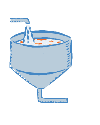
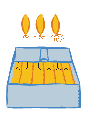
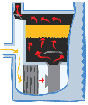
Barley... ...is soaked in water... ...and germinated... ...then dried.
Barley is the most important ingredient in beer production. Barley is carefully inspected before being brought to the brewery and is always focused on quality control.
The barley is then dried, sifted and transferred into very large containers. The barley is soaked in water for about 50 hours.
After being soaked, the barley is transferred to other containers to germinate, which takes about 6 to 8 days. It forms young barley.
Yeast is formed during germination. This yeast is necessary for the next fermentation process.
After the germination process, the malt is piped to the drying kiln and dried with hot air.
During the drying process, the malt obtained will affect the characteristic aroma and color of the beer.
After drying the young roots are separated, while the malt is cooled and stored in cellars.
INCUBATE
In the brewery, the malt is ground and mixed with water to form a thick paste. The paste is then heated to 760C in copper pots. This process converts the starch into malt sugar. Barley is about 70% starch.
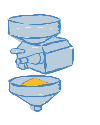
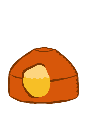

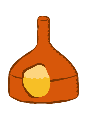
...and mix with water, | The mixture is given | The mixture after filtering is | |
heated at 76 0 C in a copper pot | to the filter to separate the grain in the wort | boiled with hops then separated |
Maybe you are interested!
-
 Beverage and Bar Knowledge - Vung Tau Tourism College - 8
 -
 Experiences Learned for Sustainable Tourism Development in Ba Ria - Vung Tau
 -
 Orientation and Solutions for Tourism Development in Ba Ria - Vung Tau to 2020
 -
 Cronbach's Alpha Reliability Coefficient of Components of the Scale of Factors Affecting Investment Capital Attraction for Tourism in Ba Ria Vung Tau Province
 -
 Review of service quality of Vung Tau - Con Dao tour at ATZ Travel Company - 2

This process takes about 3 and a half hours, after which the mixture is passed through a filter, and the filtered wort is transferred to a copper pot to boil with hops for about 1 and a half hours. The filtered grains are used as animal feed.
Hop resins contribute to the characteristic flavor of beer and are dissolved during the brewing process.
After the wort is boiled, the hops are separated for removal.
Fermentation & preservation process
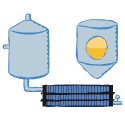

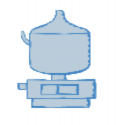
Fermentation takes place | ...beer is separated from the sediment by | |
yeast added | in tanks. Beer is stored and matured... | centrifuge then pass through the filter |
After filtering and boiling, the wort is pumped to a stainless steel cooler to cool the wort to about 13 0 C.
The next step in the production cycle is fermentation. Yeast is added and converts the malt sugars in the wort into alcohol and CO2 gas .
The fermentation process lasts about a week, during which the beer is kept at a temperature of 13 0 C. During the last day or two of this process the temperature of the beer is adjusted down to about 7 0 C, the yeast falls to the bottom and is removed.
After fermentation, the beer is matured in tanks, developing the desired flavor. The average maturation time for beer is about 2 to 3 weeks.
Before filtering and bottling, the beer is transferred to underground aluminum tanks and stored at -2 0 C for about 48 hours to affect the shelf life of the beer.
After the maturation stage, the beer is pumped to the filtration room, first the beer is passed through a centrifuge to separate the sediment and yeast. The beer is then carefully filtered to create foam, clarity and is ready for bottling.
After being produced and brought to the market, beer is packaged in bottles, cans or sterile aluminum barrels.
Draft beers:
Used to refer to all types of beer from the brewery being packed into sterile aluminium kegs or tank trucks from which they are pumped into tanks in the pub cellar. Pipes are connected to the tanks and led to the taps at the bar.