
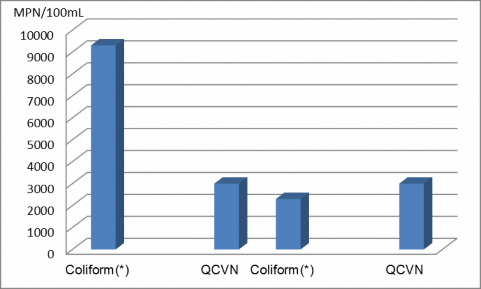
Figure 4.3. Graph showing Coliform concentration before and after treatment compared to
QCVN
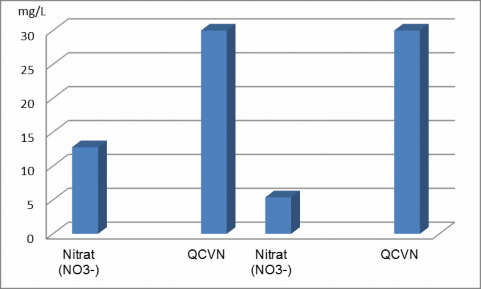
Figure 4.3. Graph showing Nitrate concentration before and after treatment compared to
QCVN
4.3.4. Wastewater treatment system of Gieng Vuong market
4.3.4.1. Domestic wastewater
Domestic wastewater from 03 toilets: in the market area will be preliminarily treated through a 3-compartment tank and collected by D300 sewer to the centralized wastewater treatment system in the South of the market and discharged into the environment.
Description of 3-compartment septic tank
Septic tank is a structure that simultaneously performs two functions: sedimentation and sediment decomposition. Organic matter and sediment in the septic tank are decomposed by anaerobic microorganisms, partly creating gases and creating dissolved inorganic substances. Wastewater after passing through sedimentation tank 1 continues through sedimentation tanks 2 and 3 before being discharged. Through the 3 compartments of the septic tank, due to the process of sedimentation, filtration and anaerobic decomposition, the content of organic matter, suspended solids, and harmful microorganisms is significantly reduced. The tank is designed so that wastewater from the previous tank flows to the next tank, simultaneously stirring the activated sludge layer containing anaerobic microorganisms so that the wastewater treatment process achieves the highest efficiency.
Each compartment has its own separate function. Wastewater after passing through settling tank 1 will continue through biological treatment tank and then through settling tank 3.
In addition, to increase the treatment efficiency of the 3-compartment septic tank, the Company will take the following measures:
- At the same time, add EM biological products to the septic tank to improve the efficiency of treatment and cleaning the septic tank.
- Hire a unit with the function of periodically cleaning septic tanks with a frequency of once a year.
The 3-compartment septic tank model is as follows:
Snorkel
Concrete panels
Wastewater after treatment
Water
Prevent and control
yeast
Compartment
settle
Filter
Partition
Sediment
Filter material layer
Figure 4.4. Diagram of 3-compartment septic tank structure
The septic tank has two functions at the same time: settling and anaerobic decomposition of sediment. Each compartment has separate functions. Wastewater after passing through settling tank 1 will continue through the biological treatment tank and then through settling tank 3.
In addition, to increase the treatment efficiency of the 3-compartment septic tank, the Company will take the following measures:
- At the same time, add EM biological products to the septic tank to improve the efficiency of treatment and cleaning the septic tank.
- Hire a unit with the function of periodically cleaning septic tanks with a frequency of once a year.
4.3.4.2. Production wastewater
Domestic wastewater from business activities of households : is collected through sewer D300 to the centralized wastewater treatment system.
*Production wastewater: Market production wastewater, also known as poultry wastewater from the business process and slaughtering of fresh food items, will be collected by D300 pipe to the poultry wastewater treatment tank for preliminary treatment of sediment and bacteria, then led to the centralized wastewater treatment system for re-treatment and discharge into the environment.
Sedimentation chamber
Sand filter
Activated carbon filter
Figure 4.5. Schematic diagram of poultry wastewater preliminary treatment system
*Overflowing rainwater: 1 part is freely absorbed into the ground and 1 part is collected by the D600 and D1250 collection trench system located underground with trash racks and then discharged directly into the environment.
With a wastewater flow of 49.6 m3 / day, the City People's Committee has invested in building a centralized wastewater treatment system with a capacity of 70 m3 / day.
4.3.5. Centralized wastewater treatment system at Gieng Vuong market
Among the sources, wastewater from poultry slaughtering activities is the highest source of surface water pollution. Wastewater from the slaughtering process includes blood, feces, feathers, fat, epidermis from poultry feathers, ..., fishy smell, stench ... so AAO wastewater treatment technology with biological cushion material was chosen with advantages suitable for the water source that needs to be treated at Gieng Vuong market, suitable for the necessary solutions to cope with flooding, overflow ... Therefore, choosing to use AAO technology with biological cushion material with low operating costs, underground construction to take advantage of the market's rental space and the efficiency of the environment that is often flooded.
To treat wastewater from the market, Lang Son City People's Committee has invested in building a centralized wastewater treatment system with AAO technology - combined with microbial buffer with a capacity of 70m3 / day.
Domestic wastewater and wastewater from fresh food stalls, after being pre-treated in separate tanks, will be collected at the collection tank of the market's centralized wastewater treatment system for treatment before being discharged into the environment.
- Centralized wastewater treatment system of Gieng Vuong market (completed in 2017, and put into trial operation in 2018)
The project "Wastewater treatment system of Gieng Vuong market, Lang Son city" includes wastewater manholes, equalization tanks and AAO technology treatment equipment cluster located underground, and an operator house containing machinery and control equipment located above ground.
The area for arranging the project's construction items is 273m2 . Of which, the area for arranging the tank, the operator's house and the project's equipment is 95m2 . The operator's house has a flat roof, 2 floors, size 4220x2720x7300 (length x width x height). The operator's house is designed with the 2nd floor level of 4.4m, 0.5m higher than the flood peak in 2008. The 2nd floor of the operator's house is designed with a concrete base 0.1m higher than the 2nd floor level to ensure safe working conditions and flood resistance of the equipment, measurement and control systems.
The wastewater treatment technology process of the system is as follows:


Circulating water
Sedimentation chamber
Air filter
Aerobic contact filter
Septic tank
Waste water
Sterilization compartment
Water storage
Overflow
Figure 4.6. AAO wastewater treatment technology – using microbial buffer
The treatment principle of the system is a combination of anaerobic, anoxic and aerobic treatment processes. The outstanding feature of the system is the addition of materials into the treatment chambers to create a substrate for microorganisms to adhere to, which brings the benefit of the treatment process.
Capacity of wastewater treatment system using AAO technology - using microbial buffer: 70m3 / day and night.
The wastewater treatment system of Gieng Vuong market includes: centralized wastewater collection tank, compartment, separation and settling compartment, air filter compartment, aerobic contact filter compartment, water retention compartment and disinfection compartment. All compartments are built of reinforced concrete and have tight covers.
Aerobic microbial tanks are used to treat nitrogenized carbonaceous organic matter, anaerobic microbial tanks and anoxic microbial tanks are used to remove nitrogen and phosphate.
. The processing is as follows:
- Aerobic process:
+ 𝑂𝑥𝑖 ℎó𝑎 − −
𝑁𝐻 4 → 𝑁𝑂 2 + 𝑁𝑂 3
- Anaerobic process:
− − 𝑔𝑖𝑚𝑚
𝑁𝑂 2 , 𝑁𝑂 3 → 𝑁 2 ⇒ Escape into the air
Birthday
𝑃𝑂 −3 (
−3 )
⇒ Mud
4 →
𝑃𝑂 4
𝑚𝑢𝑖𝑡
Septic tank: Used to collect wastewater before treatment.
Settling tank:
Preliminary separation of trash in the manhole with trash rack will then be brought to the compartment and mechanical sedimentation to let total suspended solids (SS) pass through the trash rack. Wastewater will be divided into 3 layers:
- The light weight fat layer will float to the top.
- The middle layer of wastewater is the part that will be further treated.
- Sediment layer at the bottom (soil, sand...)
Air filter compartment (anaerobic compartment):
In the anaerobic tank, the decomposition of dissolved organic matter occurs with the participation of anaerobic microorganisms. Anaerobic microorganisms will absorb dissolved organic matter in wastewater, decompose or convert them into gaseous compounds (70-80% is methane, 20-30% is carbon dioxide). Gas bubbles are produced and stick to the sludge.
The sludge particles now float on top, causing disturbance, causing local circulation in the suspended sludge layer. The BOD and COD removal efficiency can reach 70-90%. Nitrogen is almost completely reduced and converted into ammonium (NH 4 )
Aerobic filtration and contact:
Wastewater contains nitrogen and phosphorus compounds, which need to be removed from wastewater. Under anoxic conditions, anaerobic microorganisms will develop and process N and P through the process of Nitrification and Phosphorylation.
The nitrification process occurs as follows: Two types of bacteria involved in this process are Nitrosonas and Nitrobacter. In an oxygen-deficient environment, these bacteria will reduce Nitrate (NO 3 - ) and Nitrite (NO 3 - ) according to the metabolic chain: NO 3 - → NO 2 - → N 2 O → N 2 ↑ . The formed molecular nitrogen gas N 2 will escape from the water and go outside. Thus, the nitrogen has been processed.
Through the process of Phosphorylation: The species involved in this process is Acinetobacter. Organic compounds containing phosphorus will be converted by Acinetobacter bacteria into new compounds that do not contain phosphorus and compounds containing phosphorus but are easily decomposed by aerobic bacteria. For the Nitrification and Phosphorylation processes to take place smoothly, a submersible mixer with a suitable stirring speed is arranged in the anaerobic tank. The mixer has the function of stirring the water flow to create an oxygen-deficient environment for anaerobic microorganisms to develop.
To increase treatment efficiency and provide shelter for anaerobic microorganisms, the tank has a biological buffer system made from PVC plastic, with an active surface.
anaerobic microorganisms adhere to the surface of the biological cushion material to grow and develop .
Water storage:
Microbiological oxidation of hydrocarbon, sulfide and phosphorus compounds (reducing BOD, COD, converting H 2 S) and performing the Ammonium (NH 4 ) Nitrification process. This tank will store wastewater for 4 hours by using MBBR media enhancement method.
The product of this process will be:
- Hydrocarbons are converted to CO 2 + H 2 O, significantly reducing BOD and COD.
- NH 4 → NO 3
- H 2 S → SO 4 -2
- P – T → PO 4 -
Denitrification through anoxic process, where NO 3 is converted to N 2 in the absence of oxygen. AO module performs oxidation to reduce BOD, converts NH 4 → NO 3 and creates a mechanism to recycle liquid NO 3 (dissolved in wastewater) and a part of activated sludge to the anoxic compartment for denitrification.
After the oxidation process (by aeration) in aerobic with dynamic microbial buffer, activated sludge (ie the amount of microorganisms that develop and participate in the treatment process) is retained on the compartment. These carriers allow increasing the microbial density up to 8000-14000 g/m 3 . With this density, the oxidation process to reduce BOD, COD and NH 4 takes place much faster.
Suspended activated sludge (i.e. sludge that does not adhere to the bio-bed) will be transferred to the filter compartment. Here, a portion of the sludge is retained to be transferred to the storage compartment and processed, a small portion of the sludge is pumped back to the anaerobic tank to perform the denitrification process.
Sterilization compartment:
By microfiltration or by chemicals (Chlorine) - mainly using Calcium Hpocloride (Ca(OCl) 2 ) to remove pathogenic bacteria.
4.3.6. Assessment of the quality of receiving water sources of waste sources
Table 4.4. Results of surface water sample analysis of Lao Ly stream
STT | Parameter | Unit | Analytical method | NM1 Results | QCVN 08- MT:2015/ BTNMT Column B1 |
1 | pH | - | TCVN 6492:2011 | 7.14 | 5.5 ÷ 9 |
2 | BOD 5 | mg/L | SMEWW 5210B:2012 | 12 | 15 |
3 | COD | mg/L | SMEWW 5220C:2012 | 28 | 30 |
4 | DO | mg/L | TCVN 7325:2005 | 4.6 | ≥ 4 |
5 | TSS | mg/L | TCVN 6625:2000 | 42 | 50 |
6 | Ammonium (NH 4 + ) (Property) according to N) | mg/L | TCVN 5988:1995 | 0.26 | 0.9 |
7 | Chloride (Cl - ) | mg/L | TCVN 6194:1996 | 8.5 | 350 |
8 | Nitrate (NO 3 - ) | mg/L | SMEWW 4500- NO 3 - .E:2012 | 0.6 | 10 |
9 | 3- Phosphate PO 4 | mg/L | TCVN 6202:2008 | 0.12 | 0.3 |
10 | Manganese (Mn) | mg/L | SMEWW 3500- Mn.B:2012 | 0.14 | 0.5 |
11 | Surfactant | mg/L | TCVN 6622-1:2009 | 0.18 | 0.4 |
12 | Total oil, grease | mg/L | TCVN 5070:1995 | 0.6 | 1 |
13 | Cadmium (Cd) (*) | mg/L | US EPA Method 200.8 | <0.001 | 0.01 |
14 | Coliform (*) | MPN/100 mL | TCVN 6187-2:2009 | 4,600 | 7,500 |
Maybe you are interested!
-

 Assessment of the Current Status of the Policy on Developing Female Human Resources in the People's Public Security Force
 -
 Assessment of the Current Status of Access to Bank Credit Capital of Small and Medium Enterprises in Thai Nguyen Area in the Period of 2013 - 2018
 -
 Assessment of the current status of groundwater resources in the inner city of Hanoi - 2
 -
 Assessment of the current status of compensation, support and resettlement when the state acquires land in some projects in Hong Bang district, Hai Phong city - 1
 -
 Assessment of the Current Status of IT Application Investment Project Management at the Department of Information Technology and Customs Statistics
(Source: Environmental Technology Application and Transfer Research Company Limited)
Note :
+ QCVN 08-MT:2015/BTNMT: National technical regulation on surface water quality; Column B1 - Used for irrigation, water resources or other purposes requiring similar water quality or purposes as type B2;
+ NM.01: At Lao Ly stream receiving wastewater from Gieng Vuong market
Comment: The analysis results show that the parameters in the surface water source of the wastewater discharged into Lao Ly stream receiving wastewater from Gieng Vuong market are all within the allowable limits such as BOD 5 is 1.25 times smaller; TSS is 1.19 times smaller; surface active substances are 2.22 times smaller, Coliform is 1.6 times smaller, etc.
4.4. Assessment of the impact of wastewater discharge and the receiving capacity of water sources
4.4.1. Assessment of the impact of wastewater discharge on the hydrological regime of the receiving water source
- Lao Ly stream originates from Cao Loc town, through Ky Lua area, Lang Son city, is the place to receive wastewater from Gieng Vuong market and residential areas, households in the area it flows through. The stream has an average width of about 2 - 3m.
- The average discharge volume of the market is 49.6 m3 / day and the largest is 68.23 m3 /day. Thus, the discharge of the factory through the drainage ditch to Lao Ly stream does not significantly affect the flow of the stream. Thus, the discharge of Gieng Vuong market to Lao Ly stream does not significantly affect the flow of the stream.
-Impact of wastewater discharge on receiving water sources
The process of discharging waste into receiving sources will inevitably have impacts on the quality of receiving water sources. Pollutants cause a decline in water quality, affecting the life and development of aquatic systems.
+ Domestic waste can increase the nutrient content in pond water, creating favorable conditions for the growth of microorganisms such as fungi, algae in water, including pathogenic microorganisms.
+ Wastewater rich in Nitrogen and Phosphorus can cause eutrophication, making the water dark green and muddy at the bottom due to algae, causing sedimentation over a long period of time.
Severe pond sedimentation, more seriously can lead to mass death of animals in the pond due to algae poisoning and lack of oxygen.
+ Reduces dissolved oxygen in water because microorganisms in the water use up all the oxygen to decompose organic compounds.
+ Domestic wastewater when decomposing (especially in anaerobic conditions) causes unpleasant odors (due to the creation of NH3 and H2S ) , affecting the aesthetics of the surrounding area.
+ High levels of suspended solids increase water turbidity, reduce the ability of oxygen to dissolve from the air into water, thereby adversely affecting aquatic life.
+ Residual acid and base in wastewater causes the pH of the receiving source to decrease or increase. The pH threshold from 6.5 - 9 is the level at which aquatic organisms develop well. Lower or higher pH will slow down the growth of aquatic organisms and prevent them from reproducing. When pH <4 and pH> 11, most aquatic organisms will die.
+ Ions in wastewater are absorbed by living organisms, causing metal residues in animals and plants. These metals can enter the body through the food web cycle, causing harm to human health.
However, the results of the analysis of the quality of wastewater after treatment through the centralized wastewater treatment system of the market show that the content of pollution parameters are all within the allowable limits of QCVN 14:2008/BTNMT, column A - regulations on the limits of parameters in domestic wastewater when discharged into water sources used for domestic water supply purposes. Therefore, the discharge of wastewater from Gieng Vuong market has a negligible impact on the surrounding environment and the self-cleaning ability as well as the quality of the receiving water source.
-Assessing the impact of wastewater discharge on aquatic ecosystems
Domestic wastewater with high organic content, when entering the receiving source, can cause the following negative consequences:
- Increases the nutrient content in water, creating favorable conditions for the growth of microorganisms such as fungi, algae in water, including pathogenic microorganisms. With water used for irrigation, microorganisms will be indirectly spread into the community through fruit and vegetable products, causing digestive diseases.
- In some cases, wastewater rich in Nitrogen and Phosphorus can cause algae blooms (eutrophication) making the water dark green, the bottom muddy due to algae, over a long period of time causing heavy sedimentation at the bottom of the water.
- Reduces dissolved oxygen in water because microorganisms in the water use up all the oxygen to decompose organic compounds.
However, all domestic wastewater at the market will be collected and treated to meet standards before being discharged into the receiving source. In addition, the aquatic ecosystem in the market's wastewater receiving basin is very poor, mainly seaweed, algae, and some small fish such as flag fish, perch, ... in addition to crabs, snails, and some other typical small aquatic organisms. Thus, when the quality of wastewater after treatment at Gieng Vuong market is guaranteed to be within the allowable limit, when discharged into the receiving source, it will have a negligible impact on the living environment of the aquatic ecosystem.
-Assess the impact of wastewater discharge on other economic and social activities.
According to the analysis results of wastewater quality after treatment through the centralized wastewater treatment system at the market, all indicators are within the allowable limits in QCVN 14:2008/BTNMT, column A: National technical regulation on domestic wastewater, column A stipulates the C value of pollution parameters in wastewater when discharged into water sources used for domestic water supply purposes. In addition, the source receiving wastewater from the market is the canal system supplying water for agricultural irrigation. Therefore, wastewater after treatment through the market's treatment system and discharged into the receiving source does not affect the receiving water source and the water use activities of people in the area. Due to
Therefore, the impact of market wastewater discharge on other economic and social activities is considered insignificant.
4.4.2. Assessment of wastewater reception capacity of water sources
Assess the wastewater reception capacity of the canal leading to Lao Ly stream according to Circular 76/2017/TT-BTNMT of the Ministry of Natural Resources and Environment dated December 29, 2017 regulating the assessment of wastewater reception capacity and the load capacity of river and lake water sources.
Assessment of wastewater reception capacity and river carrying capacity by indirect assessment method is stipulated in Clause 2, Article 9 of Circular 76/2017/TT-BTNMT. Accordingly, we have:
L tn = (L tđ - L nm - L t ) x F S (1)
In there:
- L tn : Wastewater reception capacity, load capacity for each pollution parameter (kg/day);
- L tđ : Maximum load of surface water quality parameters for the stream section (kg/day);
- L nm : Load of existing water quality parameters in the water source of the stream section (kg/day);
- L t : Load of pollution parameters in wastewater source (kg/day);
- F S : Safety factor, F S = 0.6
* Determine the maximum load of surface water quality parameters (L tđ )
We have the formula:
L tđ = C qc x Q s x 86.4
In there:
- C qc : limit value of surface water quality parameter according to technical standards on surface water quality corresponding to the purpose of water use of the stream section, unit is mg/l;
- Q S : flow rate of the evaluated stream section, unit is m 3 /s; Q s = 0.05m 3 /s;
- The value 86.4 is the dimension conversion factor (converted from the unit of mg/l, m 3 /s to the unit of kg/day).
Because the receiving source of wastewater at the market is used for irrigation purposes, the limit value of pollutants in the water source C qc is determined according to QCVN 08-MT:2015/BTNMT, column B1.
We have the maximum load of surface water quality parameters of wastewater receiving source as follows:
Table 4.5. Maximum load of surface water quality parameters
Parameter | BOD 5 | TSS | NH 4 + | NO 3 - | PO 4 3- | Grease | Coliform |
C qc | 15 | 50 | 0.9 | 10 | 0.3 | 1 | 7,500 |
L tđ | 64.8 | 216 | 3,888 | 43.2 | 1,296 | 4.32 | 32,400 |
* Determine the load of water quality parameters present in the water source (L nm )
Recipe:
L nm = C m x Q s x 86.4
In there:
- C m : result of surface water quality parameter analysis, unit is mg/l;
- Q S : flow rate of the evaluated stream section, unit is m 3 /s; Q s = 0.05m 3 /s;
- The value 86.4 is the dimension conversion factor.
Based on the analysis results of water quality parameters of the receiving channel, the load of existing water quality parameters in the wastewater receiving channel of Gieng Vuong market is shown in the following table:
Table 4.6. Loads of existing water quality parameters in water sources
Parameter | BOD 5 | TSS | NH 4 + | NO 3 - | PO 4 3- | Grease | Coliform |
C m | 12 | 42 | 0.26 | 0.6 | 0.12 | 0.6 | 4,600 |
L nm | 51.84 | 181.44 | 1,1232 | 2,592 | 0.518 | 2,592 | 19,872 |
* Determine the load of pollution parameters in wastewater sources
Recipe:
L t = C t x Q t x 86.4
In there:
- C t : result of analysis of pollution parameters in wastewater discharged into the stream, unit is mg/l;
- Q t : maximum flow of wastewater discharged into the stream, unit is m 3 /s; Q t = 0.000355 m 3 /s;
- The value 86.4 is the dimension conversion factor.
Based on the analysis results of wastewater samples after being treated through the centralized wastewater treatment system of Gieng Vuong market before being discharged into the receiving source, the load of pollution parameters in the wastewater is shown in the following table:
Table 4.7. Pollution parameters load in wastewater
Parameter | BOD 5 | TSS | NH 4 + | NO 3 - | PO 4 3- | Grease | Coliform |
C t | 26 | 45 | 4.7 | 5.4 | 1.06 | 3.6 | 2,300 |
L t | 0.797 | 1.38 | 0.144 | 0.166 | 0.033 | 0.1104 | 70,5456 |
From formula (1) and tables 4.5, 4.6, 4.7, we have the wastewater reception capacity and load capacity for each pollution parameter shown in the following table: