
training, fostering and using process. One of the criteria for evaluating the effectiveness of this process is whether the expertise that the human resource is trained in is really suitable for the work they are doing? The study shows that 45.2% of young human resources evaluate their current job as "completely suitable" with the expertise trained in universities; 36% of the survey sample answered that their training expertise is "relatively suitable" with the current job they are doing; The proportion of young human resources evaluating the job as "unsuitable" and "very unsuitable" accounts for 10.6%; the remaining proportion of young human resources in the sample did not give any comments (8.2%) because they have not had the opportunity to participate in the training process at university level. Research results show that young human resources highly appreciate the level of suitability between the majors trained at universities and the jobs they are currently doing. This is the initial success of young human resources in finding jobs suitable for their majors after graduation within 10 years.
Although the rate of young human resources who consider their jobs to be “unsuitable” and “very unsuitable” for their training is not high compared to previous studies, it also shows that some young human resources are doing jobs that are not in line with their training. However, this is also one of the problems in the practice of using human resources for current job positions in public service agencies and state administration. There are reasons leading to the mismatch between the training and current job such as: When recruited, the job is suitable for the trained expertise, after a while due to changes in structure, organization, job position determination, the workplace does not require the expertise they were trained for, or due to the requirement to change the job position; Or immediately after being recruited, the worker agrees with the recruiting agency to do another job that is not suitable for the trained expertise; There are cases where people are able to work in their trained major, but in reality, the actual work requirements are different from the knowledge, methods, and skills they have been trained in. This means that the current expertise being trained at training institutions is not really suitable for actual requirements. In other words, they are training what they have without paying attention to what society needs... Thus, the mismatch between the trained expertise and actual work may stem from the need to find a job and the ability to meet the job requirements of young workers, but it may also stem from the reality of training and the rapid changes in society.
It can be seen that the mismatch between training expertise and current jobs is the motivation and opportunity for young workers to participate in courses with knowledge suitable for the job, supplementing professional qualifications and skills to meet job requirements. At the same time, training institutions also recognize the shortcomings in training programs to change training directions to suit social requirements on the basis of innovating program content, implementation methods and training skills to suit the development requirements of society.
b. Ability to use foreign languages and information technology at work
In addition to assessing the appropriateness of training to the work that young human resources are doing, the study raises a number of questions to measure the capacity of young human resources for the work they are doing. To ensure better and better work, workers need to make every effort to supplement their knowledge and skills to improve their capacity, meeting the increasingly high demands of the job. In reality, when recruited and any position, any agency, in addition to professional and technical requirements, employers are also interested in the ability to use foreign languages and information technology during the work process, which is an even more practical requirement for young labor today. Therefore, when studying the characteristics of young human resources in general and the two cities with the strongest labor attraction in the country, Hanoi and Ho Chi Minh City, it is impossible to ignore the need to learn about the ability to use foreign languages and information technology of this group during the work process. The survey results show that:
Table 2.2: Assessment of foreign language and computer skills used in work
Level of use in work
Foreign language | Information technology | |||
Quantity | Rate (%) | Quantity | Rate (%) | |
1. Meet job requirements well | 108 | 10.8 | 165 | 16.5 |
2. Relatively/basically meets job requirements | 164 | 16.4 | 296 | 29.6 |
3. Partial job response | 430 | 43.0 | 429 | 42.9 |
4. Having difficulty at work | 216 | 21.6 | 73 | 7.3 |
5. Obstructing work | 81 | 8.1 | 36 | 3.6 |
Maybe you are interested!
-
 Identify Rating Levels and Rating Scales
zt2i3t4l5ee
zt2a3gstourism,quan lan,quang ninh,ecology,ecotourism,minh chau,van don,geography,geographical basis,tourism development,science
zt2a3ge
zc2o3n4t5e6n7ts
of the islanders. Therefore, this indicator will be divided into two sub-indicators:
a1. Natural tourism attractiveness a2. Cultural tourism attractiveness
b. Tourist capacity
The two island communes in Quan Lan have different capacities to receive tourists. Minh Chau Commune is home to many standard hotels and resorts, attracting high-income domestic and international tourists. Meanwhile, Quan Lan Commune has many motels mainly built and operated by local people, so the scale and quality are not high, and will be suitable for ordinary tourists such as students.
c. Time of exploitation of Quan Lan Island Commune:
Quan Lan tourism is seasonal due to weather and climate conditions and festivals only take place on certain days of the year, specifically in spring. In Quan Lan commune, the period from April to June and from September to November is considered the best time to visit Quan Lan because the cultural tourism activities are mainly associated with festivals taking place during this time.
Minh Chau island commune:
Tourism exploitation time is all year round, because this is a place with a number of tourist attractions with diverse ecosystems such as Bai Tu Long National Park Research Center, Tram forest, Turtle Laying Beach, so besides coming to the beach for tourism and vacation in the summer, Minh Chau will attract research groups to come for tourism combined with research at other times of the year.
d. Sustainability
The sustainability of ecotourism sites in Quan Lan and Minh Chau communes depends on the sensitivity of the ecosystems to climate changes.
landscape. In general, these tourist destinations have a fairly high level of sustainability, because they are natural ecosystems, planned and protected. However, if a large number of tourists gather at certain times, it can exceed the carrying capacity and affect the sustainability of the environment (polluted beaches, damaged trees, animals moving away from their habitats, etc.), then the sustainability of the above ecosystems (natural ecosystems, human ecosystems) will also be affected and become less sustainable.
e. Location and accessibility
Both island communes have ports to take tourists to visit from Van Don wharf:
- Quan Lan – Van Don traffic route:
Phuc Thinh – Viet Anh high-speed boat and Quang Minh high-speed boat, depart at 8am and 2pm from Van Don to Quan Lan, and at 7am and 1pm from Quan Lan to Van Don. There are also wooden boats departing at 7am and 1pm.
- Van Don - Minh Chau traffic route:
Chung Huong high-speed train, Minh Chau train, morning 7:30 and afternoon 13:30 from Van Don to Minh Chau, morning 6:30 and afternoon 13:00 from Minh Chau to Van Don.
f. Infrastructure
Despite receiving investment attention, the issue of infrastructure and technical facilities for tourism on Quan Lan Island is still an issue that needs to be resolved because it has a direct impact on the implementation of ecotourism activities. The minimum conditions for serving tourists such as accommodation, electricity, water, communication, especially medical services, and security work need to be given top priority. Ecotourism spots in Minh Chau commune are assessed to have better infrastructure and technical facilities for tourism because there are quite complete and synchronous conditions for serving tourists, meeting many needs of domestic and foreign tourists.
3.2.1.4. Determine assessment levels and assessment scales
Corresponding to the levels of each criterion, the index is the score of those levels in the order of 4, 3, 2, 1 decreasing according to the standard of each level: very attractive (4), attractive (3), average (2), less attractive (1).
3.2.1.5. Determining the coefficients of the criteria
For the assessment of DLST in the two communes of Quan Lan and Minh Chau islands, the students added evaluation coefficients to show the importance of the criteria and indicators as follows:
Coefficient 3 with criteria: Attractiveness, Exploitation time. These are the 2 most important criteria for attracting tourists to tourism in general and eco-tourism in particular, so they have the highest coefficient.
Coefficient 2 with criteria: Capacity, Infrastructure, Location and accessibility . Because the assessment area is an island commune of Van Don district, the above criteria are selected by the author with appropriate coefficients at the average level.
Coefficient 1 with criteria: Sustainability. Quan Lan has natural and human-made ecotourism sites, with high biodiversity and little impact from local human factors. Most of the ecotourism sites are still wild, so they are highly sustainable.
3.2.1.6. Results of DLST assessment on Quan Lan island
a. Assessment of the potential for natural tourism development
For Minh Chau commune:
+ Natural tourism attractiveness is determined to be very attractive (4 points) and the most important coefficient (coefficient 3), so the score of the Attractiveness criterion is 4 x 3 = 12.
+ Capacity is determined as average (2 points) and the coefficient is quite important (coefficient 2), then the score of Capacity criterion is 2 x 2 = 4.
+ Exploitation time is long (4 points), the most important coefficient (coefficient 3) so the score of the Exploitation time criterion is 4 x 3 = 12.
+ Sustainability is determined as sustainable (4 points), the important coefficient is the average coefficient (coefficient 1), so the score of the Sustainability criterion is 4 x 1 = 4 points
+ Location and accessibility are determined to be quite favorable (2 points), the coefficient is quite important (coefficient 2), the criterion score is 2 x 2 = 4 points.
+ Infrastructure is assessed as good (3 points), the coefficient is quite important (coefficient 2), then the score of the Infrastructure criterion is 3 x 2 = 6 points.
The total score for evaluating DLST in Minh Chau commune according to 6 evaluation criteria is determined as: 12 + 4 + 12 + 4 + 4 + 6 = 42 points
Similar assessment for Quan Lan commune, we have the following table:
Table 3.3: Assessment of the potential for natural ecotourism development in Quan Lan and Minh Chau communes
Attractiveness of self-tourismof course
Capacity
Mining time
Sustainability
Location and accessibility
Infrastructure
Result
Point
DarkMulti
Point
DarkMulti
Point
DarkMulti
Point
DarkMulti
Point
DarkMulti
Point
DarkMulti
CommuneMinh Chau
12
12
4
8
12
12
4
4
4
8
6
8
42/52
Quan CommuneLan
6
12
6
8
9
12
4
4
4
8
4
8
33/52
b. Assessment of the potential for humanistic tourism development
For Quan Lan commune:
+ The attractiveness of human tourism is determined to be very attractive (4 points) and the most important coefficient (coefficient 3), so the score of the Attractiveness criterion is 4 x 3 = 12.
+ Capacity is determined to be large (3 points) and the coefficient is quite important (coefficient 2), then the score of the Capacity criterion is 3 x 2 = 6.
+ Mining time is average (3 points), the most important coefficient (coefficient 3) so the score of the Mining time criterion is 3 x 3 = 9.
+ Sustainability is determined as sustainable (4 points), the important coefficient is the average coefficient (coefficient 1), so the score of the Sustainability criterion is 4 x 1 = 4 points.
+ Location and accessibility are determined to be quite favorable (2 points), the coefficient is quite important (coefficient 2), the criterion score is 2 x 2 = 4 points.
+ Infrastructure is rated as average (2 points), the coefficient is quite important (coefficient 2), then the score of the Infrastructure criterion is 2 x 2 = 4 points.
The total score for evaluating DLST in Quan Lan commune according to 6 evaluation criteria is determined as: 12 + 6 + 6 + 4 + 4 + 4 = 36 points.
Similar assessment with Minh Chau commune we have the following table:
Table 3.4: Assessment of the potential for developing humanistic eco-tourism in Quan Lan and Minh Chau communes
Attractiveness of human tourismliterature
Capacity
Mining time
Sustainability
Location and accessibility
Infrastructure
Result
Point
DarkMulti
Point
DarkMulti
Point
DarkMulti
Point
DarkMulti
Point
DarkMulti
Point
DarkMulti
Quan CommuneLan
12
12
6
8
9
12
4
4
4
8
4
8
39/52
Minh CommuneChau
6
12
4
8
12
12
4
4
4
8
6
8
36/52
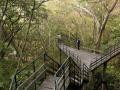
Basically, both Minh Chau and Quan Lan localities have quite favorable conditions for developing ecotourism. However, Quan Lan commune has more advantages to develop ecotourism in a humanistic direction, because this is an area with many famous historical relics such as Quan Lan Communal House, Quan Lan Pagoda, Temple worshiping the hero Tran Khanh Du, ... along with local festivals held annually such as the wind praying ceremony (March 15), Quan Lan festival (June 10-19); due to its location near the port and long exploitation time, the beaches in Quan Lan commune (especially Quan Lan beach) are no longer hygienic and clean to ensure the needs of tourists coming to relax and swim; this is also an area with many beautiful landscapes such as Got Beo wind pass, Ong Phong head, Voi Voi cave, but the ability to access these places is still very limited (dirt hill road, lots of gravel and rocks), especially during rainy and windy times; In addition, other natural resources such as mangrove forests and sea worms have not been really exploited for tourism purposes and ecotourism development. On the contrary, Minh Chau commune has more advantages in developing ecotourism in the direction of natural tourism, this is an area with diverse ecosystems such as at Rua De Beach, Bai Tu Long National Park Conservation Center...; Minh Chau beach is highly appreciated for its natural beauty and cleanliness, ranked in the top ten most beautiful beaches in Vietnam; Minh Chau commune is also home to Tram forest with a large area and a purity of up to 90%, suitable for building bridges through the forest (a very effective type of natural ecotourism currently applied by many countries) for tourists to sightsee, as well as for the purpose of studying and researching.
Figure 3.1: Thenmala Forest Bridge (India) Source: https://www.thenmalaecotourism.com/(August 21, 2019)
3.2.2. Using SWOT matrix to evaluate Quan Lan island tourism
General assessment of current tourism activities of Quan Lan island is shown through the following SWOT matrix:
Table 3.5: SWOT matrix evaluating tourism activities on Quan Lan island
Internal agent
Strengths- There is a lot of potential for tourism development, especially natural ecotourism and humanistic ecotourism.- The unskilled labor force is relatively abundant.- resource environmentunpolluted, still
Weaknesses- Poorly developed infrastructure, especially traffic routes to tourist destinations on the island.- The team of professional staff is still weak.- Tourism products in general
quite wild, originalintact
general and DLST in particularalone is monotonous.
External agents
Opportunity- Tourism is a key industry in the socio-economic development strategy of the province and Van Don economic zone.- Quan Lan was selected as a pilot area for eco-tourism development within the framework of the green growth project between Quang Ninh province and the Japanese organization JICA.- The flow of tourists and especially ecotourism in the world tends toincreasing
Challenge- Weather and climate change abnormally.- Competition in tourism products is increasingly fierce, especially with other localities in the province such as Ha Long, Mong Cai...- Awareness of tourists, especially domestic tourists, about ecotourism and nature conservation is not high.
Through summary analysis using SWOT matrix we see that:
To exploit strengths and take advantage of opportunities, it is necessary to:
- Diversify products and service types (build more tourism routes aimed at specific needs of tourists: experiential tourism immersed in nature, spiritual cultural tourism...)
- Effective exploitation of resources and differentiated products (natural resources and human resources)
div.maincontent .p { color: black; font-family:"Times New Roman", serif; font-style: normal; font-weight: normal; text-decoration: none; font-size: 14pt; margin:0pt; } div.maincontent p { color: black; font-family:"Times New Roman", serif; font-style: normal; font-weight: normal; text-decoration: none; font-size: 14pt; margin:0pt; } div.maincontent .s1 { color: black; font-family:"Times New Roman", serif; font-style: normal; font-weight: normal; text-decoration: none; font-size: 13pt; } div.maincontent .s2 { color: black; font-family:"Times New Roman", serif; font-style: normal; font-weight: normal; text-decoration: none; font-size: 13pt; } div.maincontent .s3 { color: #0D0D0D; font-family:"Times New Roman", serif; font-style: normal; font-weight: bold; text-decoration: none; font-size: 14pt; } div.maincontent .s4 { color: black; font-family:"Times New Roman", serif; font-style: italic; font-weight: normal; text-decoration: none; font-size: 14pt; } div.maincontent .s5 { color: black; font-family:"Times New Roman", serif; font-style: italic; font-weight: bold; text-decoration: none; font-size: 14pt; } div.maincontent .s6 { color: black; font-family:"Times New Roman", serif; font-style: italic; font-weight: normal; text-decoration: none; font-size: 14pt; vertical-align: -3pt; } div.maincontent .s7 { color: black; font-family:"Times New Roman", serif; font-style: italic; font-weight: normal; text-decoration: none; font-size: 14pt; vertical-align: -2pt; } div.maincontent .s8 { color: black; font-family:"Times New Roman", serif; font-style: italic; font-weight: normal; text-decoration: none; font-size: 14pt; vertical-align: -1pt; } div.maincontent .s9 { color: black; font-family:"Times New Roman", serif; font-style: normal; font-weight: normal; text-decoration: none; font-size: 14pt; } div.maincontent .s10 { color: black; font-family:"Times New Roman", serif; font-style: normal; font-weight: bold; text-decoration: none; font-size: 14pt; } div.maincontent .s11 { color: black; font-family:"Times New Roman", serif; font-style: normal; font-weight: normal; text-decoration: none; font-size: 14pt; } div.maincontent .s12 { color: black; font-family:Symbol, serif; font-style: normal; font-weight: normal; text-decoration: none; font-size: 14pt; } div.maincontent .s13 { color: black; font-family:Wingdings; font-style: normal; font-weight: normal; text-decoration: none; font-size: 14pt; } div.maincontent .s14 { color: black; font-family:"Times New Roman", serif; font-style: normal; font-weight: normal; text-decoration: none; font-size: 9pt; vertical-align: 5pt; } div.maincontent .s15 { color: black; font-family:"Times New Roman", serif; font-style: normal; font-weight: normal; text-decoration: none; font-size: 9pt; vertical-align: 5pt; } div.maincontent .s16 { color: black; font-family:Cambria, serif; font-style: italic; font-weight: normal; text-decoration: none; font-size: 14pt; } div.maincontent .s17 { color: #080808; font-family:"Times New Roman", serif; font-style: normal; font-weight: bold; text-decoration: none; font-size: 14pt; } div.maincontent .s18 { color: #080808; font-family:"Times New Roman", serif; font-style: normal; font-weight: normal; text-decoration: none; font-size: 14pt; } div.maincontent .s19 { color: black; font-family:"Times New Roman", serif; font-style: normal; font-weight: normal; text-decoration: none; font-size: 11pt; } div.maincontent .s20 { color: black; font-family:"Times New Roman", serif; font-style: normal; font-weight: normal; text-decoration: none; font-size: 10pt; } div.maincontent .s21 { color: black; font-family:"Times New Roman", serif; font-style: normal; font-weight: bold; text-decoration: none; font-size: 11pt; } div.maincontent .s22 { color: black; font-family:"Times New Roman", serif; font-style: normal; font-weight: normal; text-decoration: none; font-size: 11pt; } div.maincontent .s23 { color: black; font-family:"Times New Roman", serif; font-style: italic; font-weight: normal; text-decoration: none; font-size: 14pt; } div.maincontent .s24 { color: #212121; font-family:"Times New Roman", serif; font-style: normal; font-weight: normal; tex
Identify Rating Levels and Rating Scales
zt2i3t4l5ee
zt2a3gstourism,quan lan,quang ninh,ecology,ecotourism,minh chau,van don,geography,geographical basis,tourism development,science
zt2a3ge
zc2o3n4t5e6n7ts
of the islanders. Therefore, this indicator will be divided into two sub-indicators:
a1. Natural tourism attractiveness a2. Cultural tourism attractiveness
b. Tourist capacity
The two island communes in Quan Lan have different capacities to receive tourists. Minh Chau Commune is home to many standard hotels and resorts, attracting high-income domestic and international tourists. Meanwhile, Quan Lan Commune has many motels mainly built and operated by local people, so the scale and quality are not high, and will be suitable for ordinary tourists such as students.
c. Time of exploitation of Quan Lan Island Commune:
Quan Lan tourism is seasonal due to weather and climate conditions and festivals only take place on certain days of the year, specifically in spring. In Quan Lan commune, the period from April to June and from September to November is considered the best time to visit Quan Lan because the cultural tourism activities are mainly associated with festivals taking place during this time.
Minh Chau island commune:
Tourism exploitation time is all year round, because this is a place with a number of tourist attractions with diverse ecosystems such as Bai Tu Long National Park Research Center, Tram forest, Turtle Laying Beach, so besides coming to the beach for tourism and vacation in the summer, Minh Chau will attract research groups to come for tourism combined with research at other times of the year.
d. Sustainability
The sustainability of ecotourism sites in Quan Lan and Minh Chau communes depends on the sensitivity of the ecosystems to climate changes.
landscape. In general, these tourist destinations have a fairly high level of sustainability, because they are natural ecosystems, planned and protected. However, if a large number of tourists gather at certain times, it can exceed the carrying capacity and affect the sustainability of the environment (polluted beaches, damaged trees, animals moving away from their habitats, etc.), then the sustainability of the above ecosystems (natural ecosystems, human ecosystems) will also be affected and become less sustainable.
e. Location and accessibility
Both island communes have ports to take tourists to visit from Van Don wharf:
- Quan Lan – Van Don traffic route:
Phuc Thinh – Viet Anh high-speed boat and Quang Minh high-speed boat, depart at 8am and 2pm from Van Don to Quan Lan, and at 7am and 1pm from Quan Lan to Van Don. There are also wooden boats departing at 7am and 1pm.
- Van Don - Minh Chau traffic route:
Chung Huong high-speed train, Minh Chau train, morning 7:30 and afternoon 13:30 from Van Don to Minh Chau, morning 6:30 and afternoon 13:00 from Minh Chau to Van Don.
f. Infrastructure
Despite receiving investment attention, the issue of infrastructure and technical facilities for tourism on Quan Lan Island is still an issue that needs to be resolved because it has a direct impact on the implementation of ecotourism activities. The minimum conditions for serving tourists such as accommodation, electricity, water, communication, especially medical services, and security work need to be given top priority. Ecotourism spots in Minh Chau commune are assessed to have better infrastructure and technical facilities for tourism because there are quite complete and synchronous conditions for serving tourists, meeting many needs of domestic and foreign tourists.
3.2.1.4. Determine assessment levels and assessment scales
Corresponding to the levels of each criterion, the index is the score of those levels in the order of 4, 3, 2, 1 decreasing according to the standard of each level: very attractive (4), attractive (3), average (2), less attractive (1).
3.2.1.5. Determining the coefficients of the criteria
For the assessment of DLST in the two communes of Quan Lan and Minh Chau islands, the students added evaluation coefficients to show the importance of the criteria and indicators as follows:
Coefficient 3 with criteria: Attractiveness, Exploitation time. These are the 2 most important criteria for attracting tourists to tourism in general and eco-tourism in particular, so they have the highest coefficient.
Coefficient 2 with criteria: Capacity, Infrastructure, Location and accessibility . Because the assessment area is an island commune of Van Don district, the above criteria are selected by the author with appropriate coefficients at the average level.
Coefficient 1 with criteria: Sustainability. Quan Lan has natural and human-made ecotourism sites, with high biodiversity and little impact from local human factors. Most of the ecotourism sites are still wild, so they are highly sustainable.
3.2.1.6. Results of DLST assessment on Quan Lan island
a. Assessment of the potential for natural tourism development
For Minh Chau commune:
+ Natural tourism attractiveness is determined to be very attractive (4 points) and the most important coefficient (coefficient 3), so the score of the Attractiveness criterion is 4 x 3 = 12.
+ Capacity is determined as average (2 points) and the coefficient is quite important (coefficient 2), then the score of Capacity criterion is 2 x 2 = 4.
+ Exploitation time is long (4 points), the most important coefficient (coefficient 3) so the score of the Exploitation time criterion is 4 x 3 = 12.
+ Sustainability is determined as sustainable (4 points), the important coefficient is the average coefficient (coefficient 1), so the score of the Sustainability criterion is 4 x 1 = 4 points
+ Location and accessibility are determined to be quite favorable (2 points), the coefficient is quite important (coefficient 2), the criterion score is 2 x 2 = 4 points.
+ Infrastructure is assessed as good (3 points), the coefficient is quite important (coefficient 2), then the score of the Infrastructure criterion is 3 x 2 = 6 points.
The total score for evaluating DLST in Minh Chau commune according to 6 evaluation criteria is determined as: 12 + 4 + 12 + 4 + 4 + 6 = 42 points
Similar assessment for Quan Lan commune, we have the following table:
Table 3.3: Assessment of the potential for natural ecotourism development in Quan Lan and Minh Chau communes
Attractiveness of self-tourismof course
Capacity
Mining time
Sustainability
Location and accessibility
Infrastructure
Result
Point
DarkMulti
Point
DarkMulti
Point
DarkMulti
Point
DarkMulti
Point
DarkMulti
Point
DarkMulti
CommuneMinh Chau
12
12
4
8
12
12
4
4
4
8
6
8
42/52
Quan CommuneLan
6
12
6
8
9
12
4
4
4
8
4
8
33/52
b. Assessment of the potential for humanistic tourism development
For Quan Lan commune:
+ The attractiveness of human tourism is determined to be very attractive (4 points) and the most important coefficient (coefficient 3), so the score of the Attractiveness criterion is 4 x 3 = 12.
+ Capacity is determined to be large (3 points) and the coefficient is quite important (coefficient 2), then the score of the Capacity criterion is 3 x 2 = 6.
+ Mining time is average (3 points), the most important coefficient (coefficient 3) so the score of the Mining time criterion is 3 x 3 = 9.
+ Sustainability is determined as sustainable (4 points), the important coefficient is the average coefficient (coefficient 1), so the score of the Sustainability criterion is 4 x 1 = 4 points.
+ Location and accessibility are determined to be quite favorable (2 points), the coefficient is quite important (coefficient 2), the criterion score is 2 x 2 = 4 points.
+ Infrastructure is rated as average (2 points), the coefficient is quite important (coefficient 2), then the score of the Infrastructure criterion is 2 x 2 = 4 points.
The total score for evaluating DLST in Quan Lan commune according to 6 evaluation criteria is determined as: 12 + 6 + 6 + 4 + 4 + 4 = 36 points.
Similar assessment with Minh Chau commune we have the following table:
Table 3.4: Assessment of the potential for developing humanistic eco-tourism in Quan Lan and Minh Chau communes
Attractiveness of human tourismliterature
Capacity
Mining time
Sustainability
Location and accessibility
Infrastructure
Result
Point
DarkMulti
Point
DarkMulti
Point
DarkMulti
Point
DarkMulti
Point
DarkMulti
Point
DarkMulti
Quan CommuneLan
12
12
6
8
9
12
4
4
4
8
4
8
39/52
Minh CommuneChau
6
12
4
8
12
12
4
4
4
8
6
8
36/52
Basically, both Minh Chau and Quan Lan localities have quite favorable conditions for developing ecotourism. However, Quan Lan commune has more advantages to develop ecotourism in a humanistic direction, because this is an area with many famous historical relics such as Quan Lan Communal House, Quan Lan Pagoda, Temple worshiping the hero Tran Khanh Du, ... along with local festivals held annually such as the wind praying ceremony (March 15), Quan Lan festival (June 10-19); due to its location near the port and long exploitation time, the beaches in Quan Lan commune (especially Quan Lan beach) are no longer hygienic and clean to ensure the needs of tourists coming to relax and swim; this is also an area with many beautiful landscapes such as Got Beo wind pass, Ong Phong head, Voi Voi cave, but the ability to access these places is still very limited (dirt hill road, lots of gravel and rocks), especially during rainy and windy times; In addition, other natural resources such as mangrove forests and sea worms have not been really exploited for tourism purposes and ecotourism development. On the contrary, Minh Chau commune has more advantages in developing ecotourism in the direction of natural tourism, this is an area with diverse ecosystems such as at Rua De Beach, Bai Tu Long National Park Conservation Center...; Minh Chau beach is highly appreciated for its natural beauty and cleanliness, ranked in the top ten most beautiful beaches in Vietnam; Minh Chau commune is also home to Tram forest with a large area and a purity of up to 90%, suitable for building bridges through the forest (a very effective type of natural ecotourism currently applied by many countries) for tourists to sightsee, as well as for the purpose of studying and researching.
Figure 3.1: Thenmala Forest Bridge (India) Source: https://www.thenmalaecotourism.com/(August 21, 2019)
3.2.2. Using SWOT matrix to evaluate Quan Lan island tourism
General assessment of current tourism activities of Quan Lan island is shown through the following SWOT matrix:
Table 3.5: SWOT matrix evaluating tourism activities on Quan Lan island
Internal agent
Strengths- There is a lot of potential for tourism development, especially natural ecotourism and humanistic ecotourism.- The unskilled labor force is relatively abundant.- resource environmentunpolluted, still
Weaknesses- Poorly developed infrastructure, especially traffic routes to tourist destinations on the island.- The team of professional staff is still weak.- Tourism products in general
quite wild, originalintact
general and DLST in particularalone is monotonous.
External agents
Opportunity- Tourism is a key industry in the socio-economic development strategy of the province and Van Don economic zone.- Quan Lan was selected as a pilot area for eco-tourism development within the framework of the green growth project between Quang Ninh province and the Japanese organization JICA.- The flow of tourists and especially ecotourism in the world tends toincreasing
Challenge- Weather and climate change abnormally.- Competition in tourism products is increasingly fierce, especially with other localities in the province such as Ha Long, Mong Cai...- Awareness of tourists, especially domestic tourists, about ecotourism and nature conservation is not high.
Through summary analysis using SWOT matrix we see that:
To exploit strengths and take advantage of opportunities, it is necessary to:
- Diversify products and service types (build more tourism routes aimed at specific needs of tourists: experiential tourism immersed in nature, spiritual cultural tourism...)
- Effective exploitation of resources and differentiated products (natural resources and human resources)
div.maincontent .p { color: black; font-family:"Times New Roman", serif; font-style: normal; font-weight: normal; text-decoration: none; font-size: 14pt; margin:0pt; } div.maincontent p { color: black; font-family:"Times New Roman", serif; font-style: normal; font-weight: normal; text-decoration: none; font-size: 14pt; margin:0pt; } div.maincontent .s1 { color: black; font-family:"Times New Roman", serif; font-style: normal; font-weight: normal; text-decoration: none; font-size: 13pt; } div.maincontent .s2 { color: black; font-family:"Times New Roman", serif; font-style: normal; font-weight: normal; text-decoration: none; font-size: 13pt; } div.maincontent .s3 { color: #0D0D0D; font-family:"Times New Roman", serif; font-style: normal; font-weight: bold; text-decoration: none; font-size: 14pt; } div.maincontent .s4 { color: black; font-family:"Times New Roman", serif; font-style: italic; font-weight: normal; text-decoration: none; font-size: 14pt; } div.maincontent .s5 { color: black; font-family:"Times New Roman", serif; font-style: italic; font-weight: bold; text-decoration: none; font-size: 14pt; } div.maincontent .s6 { color: black; font-family:"Times New Roman", serif; font-style: italic; font-weight: normal; text-decoration: none; font-size: 14pt; vertical-align: -3pt; } div.maincontent .s7 { color: black; font-family:"Times New Roman", serif; font-style: italic; font-weight: normal; text-decoration: none; font-size: 14pt; vertical-align: -2pt; } div.maincontent .s8 { color: black; font-family:"Times New Roman", serif; font-style: italic; font-weight: normal; text-decoration: none; font-size: 14pt; vertical-align: -1pt; } div.maincontent .s9 { color: black; font-family:"Times New Roman", serif; font-style: normal; font-weight: normal; text-decoration: none; font-size: 14pt; } div.maincontent .s10 { color: black; font-family:"Times New Roman", serif; font-style: normal; font-weight: bold; text-decoration: none; font-size: 14pt; } div.maincontent .s11 { color: black; font-family:"Times New Roman", serif; font-style: normal; font-weight: normal; text-decoration: none; font-size: 14pt; } div.maincontent .s12 { color: black; font-family:Symbol, serif; font-style: normal; font-weight: normal; text-decoration: none; font-size: 14pt; } div.maincontent .s13 { color: black; font-family:Wingdings; font-style: normal; font-weight: normal; text-decoration: none; font-size: 14pt; } div.maincontent .s14 { color: black; font-family:"Times New Roman", serif; font-style: normal; font-weight: normal; text-decoration: none; font-size: 9pt; vertical-align: 5pt; } div.maincontent .s15 { color: black; font-family:"Times New Roman", serif; font-style: normal; font-weight: normal; text-decoration: none; font-size: 9pt; vertical-align: 5pt; } div.maincontent .s16 { color: black; font-family:Cambria, serif; font-style: italic; font-weight: normal; text-decoration: none; font-size: 14pt; } div.maincontent .s17 { color: #080808; font-family:"Times New Roman", serif; font-style: normal; font-weight: bold; text-decoration: none; font-size: 14pt; } div.maincontent .s18 { color: #080808; font-family:"Times New Roman", serif; font-style: normal; font-weight: normal; text-decoration: none; font-size: 14pt; } div.maincontent .s19 { color: black; font-family:"Times New Roman", serif; font-style: normal; font-weight: normal; text-decoration: none; font-size: 11pt; } div.maincontent .s20 { color: black; font-family:"Times New Roman", serif; font-style: normal; font-weight: normal; text-decoration: none; font-size: 10pt; } div.maincontent .s21 { color: black; font-family:"Times New Roman", serif; font-style: normal; font-weight: bold; text-decoration: none; font-size: 11pt; } div.maincontent .s22 { color: black; font-family:"Times New Roman", serif; font-style: normal; font-weight: normal; text-decoration: none; font-size: 11pt; } div.maincontent .s23 { color: black; font-family:"Times New Roman", serif; font-style: italic; font-weight: normal; text-decoration: none; font-size: 14pt; } div.maincontent .s24 { color: #212121; font-family:"Times New Roman", serif; font-style: normal; font-weight: normal; tex -
 Assessment of the Current Status of the Policy on Developing Female Human Resources in the People's Public Security Force
 -
 Study on the construction and exploitation of foreign language information resources at the National Library of Vietnam - 7
 -
 Study on the construction and exploitation of foreign language information resources at the National Library of Vietnam - 2
 -
 Assessment of surface water resources in Dong Nai river basin to serve sustainable development goals in the context of climate change - 2

Source: Survey results of topic KX.03.09/11-15
The ability to use a foreign language well at work is one of the conditions that helps employees have a good chance of getting the job they want to be recruited. However, not every individual or every specific job requires the ability to use a foreign language, because in reality in state administrative agencies, these certificates are sometimes only needed to complete the recruitment profile. Therefore, if assessing foreign language and IT skills through degrees and certificates does not really reflect the ability of individuals to use them at work. The assessment of an individual's foreign language and IT proficiency will be more accurate through the individual's self-assessment when using foreign languages and IT to serve their daily work at the agency. Survey results in Hanoi and Ho Chi Minh City show that young workers themselves have assessed their ability to use foreign languages to meet their work requirements at a low level, with 10.8% saying that they have good foreign language skills in their current job and 16.4% basically assessing their ability to use foreign languages to meet their work requirements. The number of young workers who self-assess their foreign language skills only partially meet their work requirements accounts for a high percentage of 43%, the rest say they have difficulty using foreign languages in their work (21.6%) or their foreign language skills become an obstacle to their current job (8.1%).
The researcher expected to find a significant difference in the ability to use foreign languages at work for the human resources of Hanoi and Ho Chi Minh City compared to other provinces and cities because young cadres in these two cities have the opportunity to access the best and most modern foreign language training methods and forms, but the results obtained basically showed no difference. The research of the topic KX 03.09/11-15 surveyed 3,000 young cadres working in state agencies, organizations, and enterprises in 6 provinces/cities in Vietnam and concluded: "Less than 1/10 of them have the ability to use foreign languages to meet the requirements of the work they are undertaking. Less than 1/5 of the surveyed young cadres consider their foreign language ability to basically meet the requirements of the job" [Nguyen Tuan Anh, Nguyen Hoi Loan, Nguyen Thi Kim Hoa, 2015]. This reflects the general weakness in foreign language proficiency of young civil servants and public employees in Vietnamese administrative and public service units.
One of the indispensable requirements for young human resources in the recruitment process is the ability to use information technology in work, especially for young workers in administrative and career agencies. In fact,
If assessing IT skills through training certificates in the recruitment profile does not reflect the actual ability to use IT of an individual, because to obtain an IT certificate, it may not be difficult for the owner. Therefore, the young workforce themselves assess their ability to use IT in the work they undertake is the most realistic assessment. Compared with the results of self-assessment of foreign language proficiency at work, the results of self-assessment of IT skills are somewhat higher with 16.5% and 29.6% saying that they basically meet the requirements of the job. However, the number of young workers who self-assess their IT skills only partially meet the requirements of the job is quite high at 42.9%, similar to the rate of foreign language skills assessed above. In addition, the rate of workers admitting that their poor IT skills have caused difficulties and obstacles in their work is about 10%. The use of IT skills in the work of young human resources in administrative and career units is an essential requirement. The above results show that young human resources have not really focused on improving their IT skills in their work. Employers have not yet made requirements or demands for practical use in daily work for this group.
It can be seen that, in the process of national innovation and international economic integration, foreign language proficiency and IT skills are two indispensable factors for young human resources in the working process. However, young human resources in administrative and career units have not really proactively improved their foreign language and IT skills to meet the increasing demands of society. This reflects the inevitability of the poor quality of young human resources in Vietnam during the period of "golden population" structure. This is one of the issues raised in the training, fostering, use and assessment of work performance capacity for young human resources in administrative and career agencies in Vietnam in general and in Hanoi and Ho Chi Minh City in particular. Young human resources need to be aware of the challenges and difficulties in the integration process with the weakness of professional capacity as well as other skills serving the job, including foreign languages and IT.
2.3. Research method
The research method used in the thesis is mainly quantitative research method with synchronic research strategy. The research design combines quantitative and qualitative research.
2.3.1. Information collection method
2.3.1.1. Method of analyzing available documents
The author uses the method of analyzing available documents in two aspects:
Firstly, the author conducts research, analysis, and systematization of legal documents, scientific research works, annual summary reports, statistical data of state agencies and prestigious organizations, research reports of previous topics, articles in domestic and foreign books and magazines related to the research content to identify theoretical and practical issues related to the research topic to determine the direction, feasible research questions, and explore research results.
Second, the author uses the survey data set of Hanoi and Ho Chi Minh City in the topic KX.03.09/11-15. The topic KX03.09/11-15 was surveyed in 6 provinces/cities in Vietnam including: Hanoi , Ho Chi Minh City, Tuyen Quang, Nghe An, Dak Lak, Dong Thap. In each province/city, 2 districts/counties were selected for survey; each district/county selected 250 young cadres as research subjects. The topic has a survey sample size of 3,000 young cadres, civil servants, and public employees working in state agencies, organizations, and enterprises. However, the thesis only uses raw data with the number of ballots: 1000 ballots (Hanoi 500 ballots and Ho Chi Minh City 500 ballots) on the basis of creating variables, rerunning the variables and using Chi - Square to test the statistical significance between variables.
Third, the author uses the in-depth interview data set of Hanoi and Ho Chi Minh City in the topic KX.03.09/11-15 including: 10 in-depth interviews/1 city to identify the most general role of social capital in developing young human resources in these two cities but does not use it to quote in the thesis. From there, a separate in-depth interview table is designed for the thesis to explain more clearly the findings on creating, maintaining, and using social capital of young human resources on quantitative data that has been tested by Chi-Square.
In this thesis, the author uses the method of data analysis, available data is the main research method. This is a method of collecting information based on available data of previous research topics, with the available data set, the author analyzes, creates new variables to find out the causal relationships between the variables in his topic.
Some advantages of the available document analysis method are noted as
(1) Compared with the author conducting a large-scale survey in Hanoi and Ho Chi Minh City with a sample size of 1,000 cases in a personal topic, it is beyond the author's ability; (2) Topic KX.03.09/11-15 took up to 2 years to complete the survey and have this data set, the author participated in the topic and collected data for the topic and was allowed to use the data set in the fastest time; (3) This is a state-level topic, with a basis for purposeful random sampling according to industry groups in state administrative agencies, so the data set collected information is large and diverse. The survey was organized within the framework of a state topic, so the information collection was ensured to follow the correct procedures, principles of sample selection, research techniques, and information collection techniques to produce a reliable data set, statistically significant and representative.
However, the method of analyzing available data also shows some disadvantages such as (1) any data set of a research topic serves the research purpose of that topic. Therefore, the author's biggest difficulty is how to create new variables, process data to find new causal relationships and make new discoveries for his thesis without depending much on the results and findings of the topic KX.03.09/11-15; (2) With the method of analyzing available documents, there is no specific rule for selecting information in the available quantitative and qualitative data sets, but depending on each analyzed problem and measurement indicators, screening, creating new and selecting necessary information and findings; (3) The author participated in collecting qualitative information of the topic but did not participate in the research design process as well as the design of research tools, so the author also encountered many difficulties in "perceiving" quantitative data as well as qualitative data to be able to have certain attractions with this large data set.
2.3.1.2. In-depth interviews
After the completion of the KX.03.09/11-15 topic, the author participated in writing the research topic and used the data set as well as the research data to explain the issue of interest and present the findings in the topic. The author's own point in the thesis is that after processing the quantitative and qualitative data of the topic, the author designed a separate research direction and conducted in-depth interviews to supplement, develop and explain the findings from the data set of the KX.03.09/11-15 topic. Group
Providing in-depth interview information is divided into two main groups. The first group is the young workforce, young workers currently working in state agencies in Hanoi and Ho Chi Minh City. In order to exploit the maintenance and use of social capital of young workforce in work. On that basis, analyze the correlations and factors affecting the maintenance and development of their capital. The second group that the author conducted in-depth interviews with is the managers and users of young workforce in Hanoi and Ho Chi Minh City. The purpose is to have a comprehensive, multi-dimensional perspective from both workers and managers in consolidating, maintaining and using social capital in work. Qualitative quotes to explain the quantitative results in the thesis are taken from in-depth interviews conducted by the author according to the thesis's own in-depth interview design.
Table 2.3: Number of in-depth interviews by characteristics
Characteristic
PVS | ||
Location | Hanoi | 8 |
Ho Chi Minh City | 8 | |
Sex | Male | 8 |
Female | 8 | |
Occupational group | Armed Forces | 4 |
Government Agency | 4 | |
Education | 4 | |
Research Institute | 4 | |
Total | 16 |
Case study - case study , analyzing 4 typical cases (2 men, 2 women, divided equally in 2 locations). This method analyzes events and situations based on real-life contexts, helping the thesis delve into the relationship between social capital and career development of young people. The thesis uses the case study method for two purposes. Firstly, to clarify the analysis of real-life situations and delve into answering the questions "how" and "why", which strongly supports the results of existing quantitative research. In particular, using case studies helps the thesis delve into certain cases, from which it can explain and provide some specific solutions and lessons for the group of young people in the two research locations.
2.3.1.3. Group discussion
Similar to in-depth interviews, the author conducted focus group discussions in 4 wards in Hanoi and Ho Chi Minh City.
5 group discussions:
(1) 2 male groups, mixed occupation and age
(2) 2 groups of women with mixed occupations and ages
(3) 1 mixed group of men and women, diverse in profession and age
2.3.2. Methods of information analysis and processing
The author uses quantitative data statistical software SPSS22.0 and qualitative data processing software Nvivo12.0.
The research results are presented in three analytical forms:
- Descriptive analysis (frequency table): provides general information about proportions.
- Bivariate analysis (two-way correlation): Test the relationship between groups of demographic factors, personal characteristics and the quality of social capital. Through that, it is possible to consider how those factors are related to the use of capital in maintaining and developing human resources. Chi-square test is used to examine the level of relationship between variables.
- Correlation analysis of 3 variables: To see the multi-dimensional impact between factors.
Chapter 2 Summary
Social capital was first recorded by Hanifan (1916) and it was not until 40 years later that the term was mentioned again by Jane Jacobs and it was not until the 1970s that Bourdieu used this concept in his research and 16 years later that this concept was defined by Bourdieu (1986). However, it was not until Coleman that a relatively clear theoretical framework was created and Putnam (1993) mentioned it in his research. After that, social capital was discussed heatedly and many authors pointed out that when referring to social capital, we are referring to social networks, social relations; associated with the concept of resources; created through investment in social relations, social networks; that is trust and reciprocity.
Human resources consider people as a resource, the driving force of development. The analyzed definitions show that human resources include (1) existing and future labor force; (2) physical, intellectual,