
future provincial tourism. According to this model, the author of the thesis has evaluated the development period of tourism in Thua Thien Hue province from 1989 to 2020 as going through three stages: Stage 1: Investment research, Stage 2: Investment and Stage 3: Business development. Although there are many data that have not been specifically mentioned, through this assessment, the author has illustrated the tourism picture of Thua Thien Hue province in the past 30 years in Figure 3.4.
3.4. Assessment of the impact of factors on tourism development in Thua Thien Hue
The main factors affecting tourism have been stated in Chapter 2 (Section
2.2.3. Factors affecting tourism ) have been analyzed and selected to specifically assess the level of its impact on Thua Thien Hue tourism, including 5 groups of factors: Destination selection, Cost, Attraction, Transportation and Support , with 21 factors ( Table 2.4. Factors affecting Thua Thien Hue tourism ) . These factors have separate and overall impacts on tourism in general and the tourism economy in particular of Thua Thien Hue in the context of international economic integration. Researching the impacts of these factors helps tourism businesses and the government of Thua Thien Hue have policies, strategies and solutions to promote the province's tourism to develop strongly and sustainably, while helping tourism integrate into the international economy firmly and compete fairly with tourism of countries in the region.
3.4.1. Sampling method, scale and survey
Sampling survey is a survey on a number of units to save time, effort and cost; ensuring that the total sample must be able to represent the general population. Currently, there are many sampling methods such as: random sampling, simple random sampling, systematic random sampling, stratified sampling, block sampling, multi-stage sampling... However, for this thesis, the author has chosen the random sampling method and formula to apply to calculate with a large number of samples, the World Bank's enterprise survey (2009) has developed in accordance with the total number of samples.
The sample size needed to investigate is about several million samples (suitable for the number of tourists in Thua Thien Hue). The equation to produce a representative sample with the ratio:
1
2
n 1
N 1 1 k
(1)
N
NP . Q z 1 / 2
(1): World Bank 2009, World Bank enterprise survey: Sampling methodology, World Bank, Washington DC.
Where n is the sample size, z is the abscissa of the normal curve and the intercept α the area at the two-tailed test 1 - α/2 is equal to the desired confidence level, for example, 95%), P is the desired probability given the current distribution of the sample, and Q is 1 - P, N is the population size to be surveyed, and k is the desired level of precision.
With this formula, applying large sample size selection, calculating the number of samples to be selected is simple but quite accurate, with many parameters, it gives the optimal sample selection result.
+ Survey questions and scales:
During the research process, the author of the thesis will design a number of survey forms for three main subjects: tourists, tourism staff and managers. For each survey form, depending on the subject, the author of the thesis has designed the content of the questions to suit the respondents.
The author of the thesis applied the Likert scale to the survey forms for each appropriate measurement level (5 levels or higher).
+ Survey method:
Survey investigation.
+ Survey organization:
Develop questionnaires; conduct surveys; collect responses.
3.4.2. Implementation results
3.4.2.1. Survey subjects
According to formula (1), the survey subjects are 397 randomly selected people.
of 3 million tourists visiting Hue in 2018 (N = 3 million)
person, PxQ = 0.5 x 0.5 = 0.25,
z 1 / 2
with 95% probability of 1.96 and k = 5%), then the number
The number of questionnaires needed to be surveyed was 397. However, the author of the thesis distributed 700 questionnaires and collected 432. The number of questionnaires collected was selected, and the reliability of the respondents was assessed, and the number of questionnaires used for analysis was 400 (details in Table 3.1).
Table 3.2. Classification of tourists visiting Thua Thien Hue
STT
Guests in the area | Number of votes | |
1 | Vietnam | 70 |
2 | Southeast Asia | 69 |
3 | Northeast Asia | 72 |
4 | America | 67 |
5 | Europe | 66 |
6 | West Asia and Africa | 56 |
Total | 400 |
Maybe you are interested!
-

 Identify Rating Levels and Rating Scales
zt2i3t4l5ee
zt2a3gstourism,quan lan,quang ninh,ecology,ecotourism,minh chau,van don,geography,geographical basis,tourism development,science
zt2a3ge
zc2o3n4t5e6n7ts
of the islanders. Therefore, this indicator will be divided into two sub-indicators:
a1. Natural tourism attractiveness a2. Cultural tourism attractiveness
b. Tourist capacity
The two island communes in Quan Lan have different capacities to receive tourists. Minh Chau Commune is home to many standard hotels and resorts, attracting high-income domestic and international tourists. Meanwhile, Quan Lan Commune has many motels mainly built and operated by local people, so the scale and quality are not high, and will be suitable for ordinary tourists such as students.
c. Time of exploitation of Quan Lan Island Commune:
Quan Lan tourism is seasonal due to weather and climate conditions and festivals only take place on certain days of the year, specifically in spring. In Quan Lan commune, the period from April to June and from September to November is considered the best time to visit Quan Lan because the cultural tourism activities are mainly associated with festivals taking place during this time.
Minh Chau island commune:
Tourism exploitation time is all year round, because this is a place with a number of tourist attractions with diverse ecosystems such as Bai Tu Long National Park Research Center, Tram forest, Turtle Laying Beach, so besides coming to the beach for tourism and vacation in the summer, Minh Chau will attract research groups to come for tourism combined with research at other times of the year.
d. Sustainability
The sustainability of ecotourism sites in Quan Lan and Minh Chau communes depends on the sensitivity of the ecosystems to climate changes.
landscape. In general, these tourist destinations have a fairly high level of sustainability, because they are natural ecosystems, planned and protected. However, if a large number of tourists gather at certain times, it can exceed the carrying capacity and affect the sustainability of the environment (polluted beaches, damaged trees, animals moving away from their habitats, etc.), then the sustainability of the above ecosystems (natural ecosystems, human ecosystems) will also be affected and become less sustainable.
e. Location and accessibility
Both island communes have ports to take tourists to visit from Van Don wharf:
- Quan Lan – Van Don traffic route:
Phuc Thinh – Viet Anh high-speed boat and Quang Minh high-speed boat, depart at 8am and 2pm from Van Don to Quan Lan, and at 7am and 1pm from Quan Lan to Van Don. There are also wooden boats departing at 7am and 1pm.
- Van Don - Minh Chau traffic route:
Chung Huong high-speed train, Minh Chau train, morning 7:30 and afternoon 13:30 from Van Don to Minh Chau, morning 6:30 and afternoon 13:00 from Minh Chau to Van Don.
f. Infrastructure
Despite receiving investment attention, the issue of infrastructure and technical facilities for tourism on Quan Lan Island is still an issue that needs to be resolved because it has a direct impact on the implementation of ecotourism activities. The minimum conditions for serving tourists such as accommodation, electricity, water, communication, especially medical services, and security work need to be given top priority. Ecotourism spots in Minh Chau commune are assessed to have better infrastructure and technical facilities for tourism because there are quite complete and synchronous conditions for serving tourists, meeting many needs of domestic and foreign tourists.
3.2.1.4. Determine assessment levels and assessment scales
Corresponding to the levels of each criterion, the index is the score of those levels in the order of 4, 3, 2, 1 decreasing according to the standard of each level: very attractive (4), attractive (3), average (2), less attractive (1).
3.2.1.5. Determining the coefficients of the criteria
For the assessment of DLST in the two communes of Quan Lan and Minh Chau islands, the students added evaluation coefficients to show the importance of the criteria and indicators as follows:
Coefficient 3 with criteria: Attractiveness, Exploitation time. These are the 2 most important criteria for attracting tourists to tourism in general and eco-tourism in particular, so they have the highest coefficient.
Coefficient 2 with criteria: Capacity, Infrastructure, Location and accessibility . Because the assessment area is an island commune of Van Don district, the above criteria are selected by the author with appropriate coefficients at the average level.
Coefficient 1 with criteria: Sustainability. Quan Lan has natural and human-made ecotourism sites, with high biodiversity and little impact from local human factors. Most of the ecotourism sites are still wild, so they are highly sustainable.
3.2.1.6. Results of DLST assessment on Quan Lan island
a. Assessment of the potential for natural tourism development
For Minh Chau commune:
+ Natural tourism attractiveness is determined to be very attractive (4 points) and the most important coefficient (coefficient 3), so the score of the Attractiveness criterion is 4 x 3 = 12.
+ Capacity is determined as average (2 points) and the coefficient is quite important (coefficient 2), then the score of Capacity criterion is 2 x 2 = 4.
+ Exploitation time is long (4 points), the most important coefficient (coefficient 3) so the score of the Exploitation time criterion is 4 x 3 = 12.
+ Sustainability is determined as sustainable (4 points), the important coefficient is the average coefficient (coefficient 1), so the score of the Sustainability criterion is 4 x 1 = 4 points
+ Location and accessibility are determined to be quite favorable (2 points), the coefficient is quite important (coefficient 2), the criterion score is 2 x 2 = 4 points.
+ Infrastructure is assessed as good (3 points), the coefficient is quite important (coefficient 2), then the score of the Infrastructure criterion is 3 x 2 = 6 points.
The total score for evaluating DLST in Minh Chau commune according to 6 evaluation criteria is determined as: 12 + 4 + 12 + 4 + 4 + 6 = 42 points
Similar assessment for Quan Lan commune, we have the following table:
Table 3.3: Assessment of the potential for natural ecotourism development in Quan Lan and Minh Chau communes
Attractiveness of self-tourismof course
Capacity
Mining time
Sustainability
Location and accessibility
Infrastructure
Result
Point
DarkMulti
Point
DarkMulti
Point
DarkMulti
Point
DarkMulti
Point
DarkMulti
Point
DarkMulti
CommuneMinh Chau
12
12
4
8
12
12
4
4
4
8
6
8
42/52
Quan CommuneLan
6
12
6
8
9
12
4
4
4
8
4
8
33/52
b. Assessment of the potential for humanistic tourism development
For Quan Lan commune:
+ The attractiveness of human tourism is determined to be very attractive (4 points) and the most important coefficient (coefficient 3), so the score of the Attractiveness criterion is 4 x 3 = 12.
+ Capacity is determined to be large (3 points) and the coefficient is quite important (coefficient 2), then the score of the Capacity criterion is 3 x 2 = 6.
+ Mining time is average (3 points), the most important coefficient (coefficient 3) so the score of the Mining time criterion is 3 x 3 = 9.
+ Sustainability is determined as sustainable (4 points), the important coefficient is the average coefficient (coefficient 1), so the score of the Sustainability criterion is 4 x 1 = 4 points.
+ Location and accessibility are determined to be quite favorable (2 points), the coefficient is quite important (coefficient 2), the criterion score is 2 x 2 = 4 points.
+ Infrastructure is rated as average (2 points), the coefficient is quite important (coefficient 2), then the score of the Infrastructure criterion is 2 x 2 = 4 points.
The total score for evaluating DLST in Quan Lan commune according to 6 evaluation criteria is determined as: 12 + 6 + 6 + 4 + 4 + 4 = 36 points.
Similar assessment with Minh Chau commune we have the following table:
Table 3.4: Assessment of the potential for developing humanistic eco-tourism in Quan Lan and Minh Chau communes
Attractiveness of human tourismliterature
Capacity
Mining time
Sustainability
Location and accessibility
Infrastructure
Result
Point
DarkMulti
Point
DarkMulti
Point
DarkMulti
Point
DarkMulti
Point
DarkMulti
Point
DarkMulti
Quan CommuneLan
12
12
6
8
9
12
4
4
4
8
4
8
39/52
Minh CommuneChau
6
12
4
8
12
12
4
4
4
8
6
8
36/52
Basically, both Minh Chau and Quan Lan localities have quite favorable conditions for developing ecotourism. However, Quan Lan commune has more advantages to develop ecotourism in a humanistic direction, because this is an area with many famous historical relics such as Quan Lan Communal House, Quan Lan Pagoda, Temple worshiping the hero Tran Khanh Du, ... along with local festivals held annually such as the wind praying ceremony (March 15), Quan Lan festival (June 10-19); due to its location near the port and long exploitation time, the beaches in Quan Lan commune (especially Quan Lan beach) are no longer hygienic and clean to ensure the needs of tourists coming to relax and swim; this is also an area with many beautiful landscapes such as Got Beo wind pass, Ong Phong head, Voi Voi cave, but the ability to access these places is still very limited (dirt hill road, lots of gravel and rocks), especially during rainy and windy times; In addition, other natural resources such as mangrove forests and sea worms have not been really exploited for tourism purposes and ecotourism development. On the contrary, Minh Chau commune has more advantages in developing ecotourism in the direction of natural tourism, this is an area with diverse ecosystems such as at Rua De Beach, Bai Tu Long National Park Conservation Center...; Minh Chau beach is highly appreciated for its natural beauty and cleanliness, ranked in the top ten most beautiful beaches in Vietnam; Minh Chau commune is also home to Tram forest with a large area and a purity of up to 90%, suitable for building bridges through the forest (a very effective type of natural ecotourism currently applied by many countries) for tourists to sightsee, as well as for the purpose of studying and researching.
Figure 3.1: Thenmala Forest Bridge (India) Source: https://www.thenmalaecotourism.com/(August 21, 2019)
3.2.2. Using SWOT matrix to evaluate Quan Lan island tourism
General assessment of current tourism activities of Quan Lan island is shown through the following SWOT matrix:
Table 3.5: SWOT matrix evaluating tourism activities on Quan Lan island
Internal agent
Strengths- There is a lot of potential for tourism development, especially natural ecotourism and humanistic ecotourism.- The unskilled labor force is relatively abundant.- resource environmentunpolluted, still
Weaknesses- Poorly developed infrastructure, especially traffic routes to tourist destinations on the island.- The team of professional staff is still weak.- Tourism products in general
quite wild, originalintact
general and DLST in particularalone is monotonous.
External agents
Opportunity- Tourism is a key industry in the socio-economic development strategy of the province and Van Don economic zone.- Quan Lan was selected as a pilot area for eco-tourism development within the framework of the green growth project between Quang Ninh province and the Japanese organization JICA.- The flow of tourists and especially ecotourism in the world tends toincreasing
Challenge- Weather and climate change abnormally.- Competition in tourism products is increasingly fierce, especially with other localities in the province such as Ha Long, Mong Cai...- Awareness of tourists, especially domestic tourists, about ecotourism and nature conservation is not high.
Through summary analysis using SWOT matrix we see that:
To exploit strengths and take advantage of opportunities, it is necessary to:
- Diversify products and service types (build more tourism routes aimed at specific needs of tourists: experiential tourism immersed in nature, spiritual cultural tourism...)
- Effective exploitation of resources and differentiated products (natural resources and human resources)
div.maincontent .p { color: black; font-family:"Times New Roman", serif; font-style: normal; font-weight: normal; text-decoration: none; font-size: 14pt; margin:0pt; } div.maincontent p { color: black; font-family:"Times New Roman", serif; font-style: normal; font-weight: normal; text-decoration: none; font-size: 14pt; margin:0pt; } div.maincontent .s1 { color: black; font-family:"Times New Roman", serif; font-style: normal; font-weight: normal; text-decoration: none; font-size: 13pt; } div.maincontent .s2 { color: black; font-family:"Times New Roman", serif; font-style: normal; font-weight: normal; text-decoration: none; font-size: 13pt; } div.maincontent .s3 { color: #0D0D0D; font-family:"Times New Roman", serif; font-style: normal; font-weight: bold; text-decoration: none; font-size: 14pt; } div.maincontent .s4 { color: black; font-family:"Times New Roman", serif; font-style: italic; font-weight: normal; text-decoration: none; font-size: 14pt; } div.maincontent .s5 { color: black; font-family:"Times New Roman", serif; font-style: italic; font-weight: bold; text-decoration: none; font-size: 14pt; } div.maincontent .s6 { color: black; font-family:"Times New Roman", serif; font-style: italic; font-weight: normal; text-decoration: none; font-size: 14pt; vertical-align: -3pt; } div.maincontent .s7 { color: black; font-family:"Times New Roman", serif; font-style: italic; font-weight: normal; text-decoration: none; font-size: 14pt; vertical-align: -2pt; } div.maincontent .s8 { color: black; font-family:"Times New Roman", serif; font-style: italic; font-weight: normal; text-decoration: none; font-size: 14pt; vertical-align: -1pt; } div.maincontent .s9 { color: black; font-family:"Times New Roman", serif; font-style: normal; font-weight: normal; text-decoration: none; font-size: 14pt; } div.maincontent .s10 { color: black; font-family:"Times New Roman", serif; font-style: normal; font-weight: bold; text-decoration: none; font-size: 14pt; } div.maincontent .s11 { color: black; font-family:"Times New Roman", serif; font-style: normal; font-weight: normal; text-decoration: none; font-size: 14pt; } div.maincontent .s12 { color: black; font-family:Symbol, serif; font-style: normal; font-weight: normal; text-decoration: none; font-size: 14pt; } div.maincontent .s13 { color: black; font-family:Wingdings; font-style: normal; font-weight: normal; text-decoration: none; font-size: 14pt; } div.maincontent .s14 { color: black; font-family:"Times New Roman", serif; font-style: normal; font-weight: normal; text-decoration: none; font-size: 9pt; vertical-align: 5pt; } div.maincontent .s15 { color: black; font-family:"Times New Roman", serif; font-style: normal; font-weight: normal; text-decoration: none; font-size: 9pt; vertical-align: 5pt; } div.maincontent .s16 { color: black; font-family:Cambria, serif; font-style: italic; font-weight: normal; text-decoration: none; font-size: 14pt; } div.maincontent .s17 { color: #080808; font-family:"Times New Roman", serif; font-style: normal; font-weight: bold; text-decoration: none; font-size: 14pt; } div.maincontent .s18 { color: #080808; font-family:"Times New Roman", serif; font-style: normal; font-weight: normal; text-decoration: none; font-size: 14pt; } div.maincontent .s19 { color: black; font-family:"Times New Roman", serif; font-style: normal; font-weight: normal; text-decoration: none; font-size: 11pt; } div.maincontent .s20 { color: black; font-family:"Times New Roman", serif; font-style: normal; font-weight: normal; text-decoration: none; font-size: 10pt; } div.maincontent .s21 { color: black; font-family:"Times New Roman", serif; font-style: normal; font-weight: bold; text-decoration: none; font-size: 11pt; } div.maincontent .s22 { color: black; font-family:"Times New Roman", serif; font-style: normal; font-weight: normal; text-decoration: none; font-size: 11pt; } div.maincontent .s23 { color: black; font-family:"Times New Roman", serif; font-style: italic; font-weight: normal; text-decoration: none; font-size: 14pt; } div.maincontent .s24 { color: #212121; font-family:"Times New Roman", serif; font-style: normal; font-weight: normal; tex
Identify Rating Levels and Rating Scales
zt2i3t4l5ee
zt2a3gstourism,quan lan,quang ninh,ecology,ecotourism,minh chau,van don,geography,geographical basis,tourism development,science
zt2a3ge
zc2o3n4t5e6n7ts
of the islanders. Therefore, this indicator will be divided into two sub-indicators:
a1. Natural tourism attractiveness a2. Cultural tourism attractiveness
b. Tourist capacity
The two island communes in Quan Lan have different capacities to receive tourists. Minh Chau Commune is home to many standard hotels and resorts, attracting high-income domestic and international tourists. Meanwhile, Quan Lan Commune has many motels mainly built and operated by local people, so the scale and quality are not high, and will be suitable for ordinary tourists such as students.
c. Time of exploitation of Quan Lan Island Commune:
Quan Lan tourism is seasonal due to weather and climate conditions and festivals only take place on certain days of the year, specifically in spring. In Quan Lan commune, the period from April to June and from September to November is considered the best time to visit Quan Lan because the cultural tourism activities are mainly associated with festivals taking place during this time.
Minh Chau island commune:
Tourism exploitation time is all year round, because this is a place with a number of tourist attractions with diverse ecosystems such as Bai Tu Long National Park Research Center, Tram forest, Turtle Laying Beach, so besides coming to the beach for tourism and vacation in the summer, Minh Chau will attract research groups to come for tourism combined with research at other times of the year.
d. Sustainability
The sustainability of ecotourism sites in Quan Lan and Minh Chau communes depends on the sensitivity of the ecosystems to climate changes.
landscape. In general, these tourist destinations have a fairly high level of sustainability, because they are natural ecosystems, planned and protected. However, if a large number of tourists gather at certain times, it can exceed the carrying capacity and affect the sustainability of the environment (polluted beaches, damaged trees, animals moving away from their habitats, etc.), then the sustainability of the above ecosystems (natural ecosystems, human ecosystems) will also be affected and become less sustainable.
e. Location and accessibility
Both island communes have ports to take tourists to visit from Van Don wharf:
- Quan Lan – Van Don traffic route:
Phuc Thinh – Viet Anh high-speed boat and Quang Minh high-speed boat, depart at 8am and 2pm from Van Don to Quan Lan, and at 7am and 1pm from Quan Lan to Van Don. There are also wooden boats departing at 7am and 1pm.
- Van Don - Minh Chau traffic route:
Chung Huong high-speed train, Minh Chau train, morning 7:30 and afternoon 13:30 from Van Don to Minh Chau, morning 6:30 and afternoon 13:00 from Minh Chau to Van Don.
f. Infrastructure
Despite receiving investment attention, the issue of infrastructure and technical facilities for tourism on Quan Lan Island is still an issue that needs to be resolved because it has a direct impact on the implementation of ecotourism activities. The minimum conditions for serving tourists such as accommodation, electricity, water, communication, especially medical services, and security work need to be given top priority. Ecotourism spots in Minh Chau commune are assessed to have better infrastructure and technical facilities for tourism because there are quite complete and synchronous conditions for serving tourists, meeting many needs of domestic and foreign tourists.
3.2.1.4. Determine assessment levels and assessment scales
Corresponding to the levels of each criterion, the index is the score of those levels in the order of 4, 3, 2, 1 decreasing according to the standard of each level: very attractive (4), attractive (3), average (2), less attractive (1).
3.2.1.5. Determining the coefficients of the criteria
For the assessment of DLST in the two communes of Quan Lan and Minh Chau islands, the students added evaluation coefficients to show the importance of the criteria and indicators as follows:
Coefficient 3 with criteria: Attractiveness, Exploitation time. These are the 2 most important criteria for attracting tourists to tourism in general and eco-tourism in particular, so they have the highest coefficient.
Coefficient 2 with criteria: Capacity, Infrastructure, Location and accessibility . Because the assessment area is an island commune of Van Don district, the above criteria are selected by the author with appropriate coefficients at the average level.
Coefficient 1 with criteria: Sustainability. Quan Lan has natural and human-made ecotourism sites, with high biodiversity and little impact from local human factors. Most of the ecotourism sites are still wild, so they are highly sustainable.
3.2.1.6. Results of DLST assessment on Quan Lan island
a. Assessment of the potential for natural tourism development
For Minh Chau commune:
+ Natural tourism attractiveness is determined to be very attractive (4 points) and the most important coefficient (coefficient 3), so the score of the Attractiveness criterion is 4 x 3 = 12.
+ Capacity is determined as average (2 points) and the coefficient is quite important (coefficient 2), then the score of Capacity criterion is 2 x 2 = 4.
+ Exploitation time is long (4 points), the most important coefficient (coefficient 3) so the score of the Exploitation time criterion is 4 x 3 = 12.
+ Sustainability is determined as sustainable (4 points), the important coefficient is the average coefficient (coefficient 1), so the score of the Sustainability criterion is 4 x 1 = 4 points
+ Location and accessibility are determined to be quite favorable (2 points), the coefficient is quite important (coefficient 2), the criterion score is 2 x 2 = 4 points.
+ Infrastructure is assessed as good (3 points), the coefficient is quite important (coefficient 2), then the score of the Infrastructure criterion is 3 x 2 = 6 points.
The total score for evaluating DLST in Minh Chau commune according to 6 evaluation criteria is determined as: 12 + 4 + 12 + 4 + 4 + 6 = 42 points
Similar assessment for Quan Lan commune, we have the following table:
Table 3.3: Assessment of the potential for natural ecotourism development in Quan Lan and Minh Chau communes
Attractiveness of self-tourismof course
Capacity
Mining time
Sustainability
Location and accessibility
Infrastructure
Result
Point
DarkMulti
Point
DarkMulti
Point
DarkMulti
Point
DarkMulti
Point
DarkMulti
Point
DarkMulti
CommuneMinh Chau
12
12
4
8
12
12
4
4
4
8
6
8
42/52
Quan CommuneLan
6
12
6
8
9
12
4
4
4
8
4
8
33/52
b. Assessment of the potential for humanistic tourism development
For Quan Lan commune:
+ The attractiveness of human tourism is determined to be very attractive (4 points) and the most important coefficient (coefficient 3), so the score of the Attractiveness criterion is 4 x 3 = 12.
+ Capacity is determined to be large (3 points) and the coefficient is quite important (coefficient 2), then the score of the Capacity criterion is 3 x 2 = 6.
+ Mining time is average (3 points), the most important coefficient (coefficient 3) so the score of the Mining time criterion is 3 x 3 = 9.
+ Sustainability is determined as sustainable (4 points), the important coefficient is the average coefficient (coefficient 1), so the score of the Sustainability criterion is 4 x 1 = 4 points.
+ Location and accessibility are determined to be quite favorable (2 points), the coefficient is quite important (coefficient 2), the criterion score is 2 x 2 = 4 points.
+ Infrastructure is rated as average (2 points), the coefficient is quite important (coefficient 2), then the score of the Infrastructure criterion is 2 x 2 = 4 points.
The total score for evaluating DLST in Quan Lan commune according to 6 evaluation criteria is determined as: 12 + 6 + 6 + 4 + 4 + 4 = 36 points.
Similar assessment with Minh Chau commune we have the following table:
Table 3.4: Assessment of the potential for developing humanistic eco-tourism in Quan Lan and Minh Chau communes
Attractiveness of human tourismliterature
Capacity
Mining time
Sustainability
Location and accessibility
Infrastructure
Result
Point
DarkMulti
Point
DarkMulti
Point
DarkMulti
Point
DarkMulti
Point
DarkMulti
Point
DarkMulti
Quan CommuneLan
12
12
6
8
9
12
4
4
4
8
4
8
39/52
Minh CommuneChau
6
12
4
8
12
12
4
4
4
8
6
8
36/52
Basically, both Minh Chau and Quan Lan localities have quite favorable conditions for developing ecotourism. However, Quan Lan commune has more advantages to develop ecotourism in a humanistic direction, because this is an area with many famous historical relics such as Quan Lan Communal House, Quan Lan Pagoda, Temple worshiping the hero Tran Khanh Du, ... along with local festivals held annually such as the wind praying ceremony (March 15), Quan Lan festival (June 10-19); due to its location near the port and long exploitation time, the beaches in Quan Lan commune (especially Quan Lan beach) are no longer hygienic and clean to ensure the needs of tourists coming to relax and swim; this is also an area with many beautiful landscapes such as Got Beo wind pass, Ong Phong head, Voi Voi cave, but the ability to access these places is still very limited (dirt hill road, lots of gravel and rocks), especially during rainy and windy times; In addition, other natural resources such as mangrove forests and sea worms have not been really exploited for tourism purposes and ecotourism development. On the contrary, Minh Chau commune has more advantages in developing ecotourism in the direction of natural tourism, this is an area with diverse ecosystems such as at Rua De Beach, Bai Tu Long National Park Conservation Center...; Minh Chau beach is highly appreciated for its natural beauty and cleanliness, ranked in the top ten most beautiful beaches in Vietnam; Minh Chau commune is also home to Tram forest with a large area and a purity of up to 90%, suitable for building bridges through the forest (a very effective type of natural ecotourism currently applied by many countries) for tourists to sightsee, as well as for the purpose of studying and researching.
Figure 3.1: Thenmala Forest Bridge (India) Source: https://www.thenmalaecotourism.com/(August 21, 2019)
3.2.2. Using SWOT matrix to evaluate Quan Lan island tourism
General assessment of current tourism activities of Quan Lan island is shown through the following SWOT matrix:
Table 3.5: SWOT matrix evaluating tourism activities on Quan Lan island
Internal agent
Strengths- There is a lot of potential for tourism development, especially natural ecotourism and humanistic ecotourism.- The unskilled labor force is relatively abundant.- resource environmentunpolluted, still
Weaknesses- Poorly developed infrastructure, especially traffic routes to tourist destinations on the island.- The team of professional staff is still weak.- Tourism products in general
quite wild, originalintact
general and DLST in particularalone is monotonous.
External agents
Opportunity- Tourism is a key industry in the socio-economic development strategy of the province and Van Don economic zone.- Quan Lan was selected as a pilot area for eco-tourism development within the framework of the green growth project between Quang Ninh province and the Japanese organization JICA.- The flow of tourists and especially ecotourism in the world tends toincreasing
Challenge- Weather and climate change abnormally.- Competition in tourism products is increasingly fierce, especially with other localities in the province such as Ha Long, Mong Cai...- Awareness of tourists, especially domestic tourists, about ecotourism and nature conservation is not high.
Through summary analysis using SWOT matrix we see that:
To exploit strengths and take advantage of opportunities, it is necessary to:
- Diversify products and service types (build more tourism routes aimed at specific needs of tourists: experiential tourism immersed in nature, spiritual cultural tourism...)
- Effective exploitation of resources and differentiated products (natural resources and human resources)
div.maincontent .p { color: black; font-family:"Times New Roman", serif; font-style: normal; font-weight: normal; text-decoration: none; font-size: 14pt; margin:0pt; } div.maincontent p { color: black; font-family:"Times New Roman", serif; font-style: normal; font-weight: normal; text-decoration: none; font-size: 14pt; margin:0pt; } div.maincontent .s1 { color: black; font-family:"Times New Roman", serif; font-style: normal; font-weight: normal; text-decoration: none; font-size: 13pt; } div.maincontent .s2 { color: black; font-family:"Times New Roman", serif; font-style: normal; font-weight: normal; text-decoration: none; font-size: 13pt; } div.maincontent .s3 { color: #0D0D0D; font-family:"Times New Roman", serif; font-style: normal; font-weight: bold; text-decoration: none; font-size: 14pt; } div.maincontent .s4 { color: black; font-family:"Times New Roman", serif; font-style: italic; font-weight: normal; text-decoration: none; font-size: 14pt; } div.maincontent .s5 { color: black; font-family:"Times New Roman", serif; font-style: italic; font-weight: bold; text-decoration: none; font-size: 14pt; } div.maincontent .s6 { color: black; font-family:"Times New Roman", serif; font-style: italic; font-weight: normal; text-decoration: none; font-size: 14pt; vertical-align: -3pt; } div.maincontent .s7 { color: black; font-family:"Times New Roman", serif; font-style: italic; font-weight: normal; text-decoration: none; font-size: 14pt; vertical-align: -2pt; } div.maincontent .s8 { color: black; font-family:"Times New Roman", serif; font-style: italic; font-weight: normal; text-decoration: none; font-size: 14pt; vertical-align: -1pt; } div.maincontent .s9 { color: black; font-family:"Times New Roman", serif; font-style: normal; font-weight: normal; text-decoration: none; font-size: 14pt; } div.maincontent .s10 { color: black; font-family:"Times New Roman", serif; font-style: normal; font-weight: bold; text-decoration: none; font-size: 14pt; } div.maincontent .s11 { color: black; font-family:"Times New Roman", serif; font-style: normal; font-weight: normal; text-decoration: none; font-size: 14pt; } div.maincontent .s12 { color: black; font-family:Symbol, serif; font-style: normal; font-weight: normal; text-decoration: none; font-size: 14pt; } div.maincontent .s13 { color: black; font-family:Wingdings; font-style: normal; font-weight: normal; text-decoration: none; font-size: 14pt; } div.maincontent .s14 { color: black; font-family:"Times New Roman", serif; font-style: normal; font-weight: normal; text-decoration: none; font-size: 9pt; vertical-align: 5pt; } div.maincontent .s15 { color: black; font-family:"Times New Roman", serif; font-style: normal; font-weight: normal; text-decoration: none; font-size: 9pt; vertical-align: 5pt; } div.maincontent .s16 { color: black; font-family:Cambria, serif; font-style: italic; font-weight: normal; text-decoration: none; font-size: 14pt; } div.maincontent .s17 { color: #080808; font-family:"Times New Roman", serif; font-style: normal; font-weight: bold; text-decoration: none; font-size: 14pt; } div.maincontent .s18 { color: #080808; font-family:"Times New Roman", serif; font-style: normal; font-weight: normal; text-decoration: none; font-size: 14pt; } div.maincontent .s19 { color: black; font-family:"Times New Roman", serif; font-style: normal; font-weight: normal; text-decoration: none; font-size: 11pt; } div.maincontent .s20 { color: black; font-family:"Times New Roman", serif; font-style: normal; font-weight: normal; text-decoration: none; font-size: 10pt; } div.maincontent .s21 { color: black; font-family:"Times New Roman", serif; font-style: normal; font-weight: bold; text-decoration: none; font-size: 11pt; } div.maincontent .s22 { color: black; font-family:"Times New Roman", serif; font-style: normal; font-weight: normal; text-decoration: none; font-size: 11pt; } div.maincontent .s23 { color: black; font-family:"Times New Roman", serif; font-style: italic; font-weight: normal; text-decoration: none; font-size: 14pt; } div.maincontent .s24 { color: #212121; font-family:"Times New Roman", serif; font-style: normal; font-weight: normal; tex -
 Assessment of the Quality of Sustainable Tourism Development Factors in Nghe An Province from Provincial Tourism Management Officers
 -
 Impact of tourism on the cultural and social life of Thai people in Mai Chau - Hoa Binh and development solutions Case study of 4 villages: Lac village, Pom Coong village, Van village, Nhot village - 1
 -
 General Assessment of Factors Affecting Tourism Development in Vientiane City
 -
 Impact of tourism on the cultural and social life of Thai people in Mai Chau - Hoa Binh and development solutions Case study of 4 villages: Lac village, Pom Coong village, Van village, Nhot village - 18
Source: Author's statistical data compilation
3.4.2.2. Survey questions and scales
a) Survey questions
Survey questions are extracted from Table 2.4. Factors affecting Thua Thien Hue tourism with 5 groups of factors, specifically:
- Destination selection: This concept is understood as the choice of tourist destination based on preferences or suggestions from other subjects. This aspect includes 5 measurement items: (1) Thua Thien Hue tourism image on the internet; (2) Friends and relatives residing in Thua Thien Hue act as a bridge for tourists to Thua Thien Hue; (3) Thua Thien Hue hotel standards; (4) Thua Thien Hue tourism promotion image attracts tourists; (5) Thua Thien Hue tourism is known for the popularity of available tourist attractions.
- Cost: is the ability to pay for a tourist's tour.
The measurement items of this aspect include: (1) Income ability to meet the travel needs to Thua Thien Hue; (2) Reasonable prices of means of transport serving the travel in Thua Thien Hue; (3) Transparent and public policies on prices and tourism services.
- Attractiveness: is the attraction for tourists to explore and recognize the customs, landscapes, culinary culture, and sharing of the local people. This aspect has 6 measurement items: (1) The customs in Thua Thien Hue are very impressive to tourists; (2) The system of historical, cultural and social relics attracts tourists; (3) Thua Thien Hue's natural resources are rich and diverse; (4) Thua Thien Hue's cultural resources are rich and imbued with local identity; (5) Attractive and hygienic cuisine; (6) The attitude of local people is friendly to tourists.
- Transportation: is the transport infrastructure system connecting the inside and outside of a tourist destination, the convenience of public and private transport systems in accessing and transporting tourists. The measurement items of this aspect include: (1) Thua Thien Hue's geographical location is convenient for traveling; (2) Convenient means of transport to Thua Thien Hue; (3) Convenient transport infrastructure;
- Support: are support services to ensure safety and convenience for tourists visiting tourist destinations. The measurement items of this aspect include: (1) Visa procedures/residence registration are convenient and quick; (2) Security and social order issues ensure safety for tourists; (3) Tourism support services (Medical, shopping, banking, telecommunications, etc.) Thua Thien Hue meets the requirements; (4) Optimizing the tour itinerary based on technology (Internet, computers and applications on smartphones).
- General assessment: is to comprehensively assess the factors affecting tourism development in Thua Thien Hue.
b) Scale
In this study, the author uses a Likert scale with 5 levels.
levels, where 1 corresponds to the level of “No influence” , 2 corresponds to the level of “Little influence” , 3 corresponds to the level of “Normal” adaptation , 4 corresponds to the level of “Influence” and 5 corresponds to the level of “Very influence” .
3.4.2.3. Analysis method
Using SPSS and AMOS statistical software to serve statistics and analyze survey data.
3.4.2.4. Analysis of survey results
a) Exploratory factor analysis and descriptive statistics
The results of the exploratory factor analysis (EFA) presented in Table 3.2 show that the scale is quite suitable for the survey. Among the 21 independent observed variables, the loadings ranged from 0.5 to 0.9 and were grouped into 5 factors with a total extracted variance (Extraction Sums of Squared Loadings) of 70.33%, with no significant change in order, so the names of the factors were kept as they were originally. The Cronbach Alpha coefficients of the factors had quite high values, from 0.68 to 0.99. Level 2 indicators (calculated by the average score of the factors) had loadings ranging from 0.40 to 0.70 and Cronbach Alpha coefficient = 0.87.
Table 3.3. Factors, items measured, factor loadings and descriptive statistics
Element
Survey Question | Measurement item (level 1 indicator) | Medium | SD | Download number * | α | |
Choose your destination | 1. | Thua Thien Hue tourism images via the Internet | 3.17 | 0.75 | 0.99 | 0.99 |
2. | Friends and relatives in TTH act as a bridge for tourists to come to TTH | 3.15 | 0.74 | 0.98 | ||
3. | TTH Hotel Standards | 3.17 | 0.75 | 0.98 | ||
4. | TTH tourism promotional images attract tourists | 3.19 | 0.75 | 0.97 | ||
5. | TTH Tourism is known for the popularity of its available tourist attractions. | 3.17 | 0.74 | 0.97 | ||
Expense | 6. | Ability to afford travel to TTH | 3.14 | 0.82 | 0.97 | 0.99 |
7. | Transportation prices for tours in THH | 3.13 | 0.82 | 0.96 |
Element
Survey Question | Measurement item (level 1 indicator) | Medium | SD | Download number * | α | |
is reasonable | ||||||
8. | Transparent and public pricing and tourism service policies | 3.15 | 0.81 | 0.93 | ||
Attractive | 9. | The customs in TTH are very impressive to tourists. | 3.31 | 0.80 | 0.92 | 0.91 |
10. | The system of historical, cultural and social relics attracts tourists | 3.29 | 0.83 | 0.92 | ||
11. | TTH natural resources are rich and diverse. | 3.36 | 0.82 | 0.85 | ||
12. | TTH cultural resources are rich and imbued with local identity. | 3.31 | 0.78 | 0.83 | ||
13. | Delicious and hygienic food | 3.13 | 0.91 | 0.68 | ||
14. | Local people's attitude towards tourists is friendly. | 3.32 | 0.78 | 0.61 | ||
Traffic | 15. | TTH's geographical location is convenient for traveling. | 3.13 | 0.77 | 0.77 | 0.68 |
16. | Convenient means of transportation to TTH | 3.35 | 0.77 | 0.64 | ||
17. | Convenient transportation infrastructure | 3.15 | 0.78 | 0.54 | ||
Support | 18. | Visa/residence registration procedures are convenient and quick | 3.32 | 0.83 | 0.72 | 0.74 |
19. | Security and social order issues ensure safety for tourists | 3.18 | 0.94 | 0.70 | ||
20. | Tourism support services (Medical, shopping, banking, telecommunications...) TTH meets the requirements | 3.41 | 0.76 | 0.60 | ||
21. | Optimize your tour itinerary using technology (Internet, computers and smartphone apps) | 2.64 | 0.71 | 0.58 | ||
Element | Factor (level 2 indicator) | Medium | SD | Download number * | α | |
Potential for tourism development | 1 | Choose your destination | 3.17 | 0.73 | 0.57 | 0.87 |
2 | Expense | 3.14 | 0.81 | 0.69 | ||
3 | Attractive | 3.29 | 0.69 | 0.70 | ||
4 | Traffic | 3.21 | 0.61 | 0.44 |
Element
Survey Question | Measurement item (level 1 indicator) | Medium | SD | Download number * | α | |
calendar | 5 | Support | 3.13 | 0.61 | 0.45 | |
General assessment | 6 | General assessment of factors affecting Hue tourism development | 3.16 | 0.50 | 0.63 |
Source: Author's statistical analysis
* These loadings are calculated using Principal Axis Factoring and Promax factor rotation with Kaiser Normalization.
Factor loading coefficient (loading number) is an indicator to ensure the practical significance of EFA. According to Hair et al., loading number greater than 0.3 is considered to achieve the minimum level, greater than 0.4 is considered important and greater than 0.5 is considered to have practical significance. However, these authors also believe that if choosing loading number greater than 0.3, the survey sample size must be at least 350, if the sample size is about 100, the loading number should be greater than 0.55 and if the sample size is about 50, the loading number must be greater than 0.75 with a significance level of p ≤ 0.01 (Hair et al ., 1998). In this study, with a sample size of 400, according to the thesis author, a loading greater than 0.4 is also acceptable (this will test the model by confirmatory factor analysis (CFA) and structural model (SEM) with a significance level of p ≤ 0.01 in the next section) .
b) Assessment of tourism development potential
The descriptive statistics in Table 3.2 show that most indicators scored at an average level or higher. The lowest average score was assessed as Optimizing the tour itinerary based on technology (Internet, computers and smartphone applications) (2.64/5), followed by Thua Thien Hue's geographical location is convenient for traveling (3.13/5), the cost of transportation for tourism in Thua Thien Hue is reasonable (3.13/5) and the cuisine is attractive and hygienic (3.13/5).
The highest average score was assessed as Thua Thien Hue's tourism support services meeting requirements (3.41/5), followed by Thua Thien Hue's natural resources.
Thien Hue is rich and diverse (3.36/5) and transportation to Thua Thien Hue is convenient (3.35/5).
Level 2 indicators calculate the average score of the factors, measuring the potential for tourism development for 5 aspects, with the evaluation scores ranked from low to high as: Support (3.13/5), followed by Cost (3.14/5), Destination selection (3.17/5), Transportation (3.21/5) and the highest is Attractiveness (3.29/5). The standard errors are all less than 1.0.
For the Destination Choice factor , there are five survey questions (indicators) which are question 1, question 2, question 3, question 4 and question 5; the average score of each question is shown in Figure 3.5 as follows:
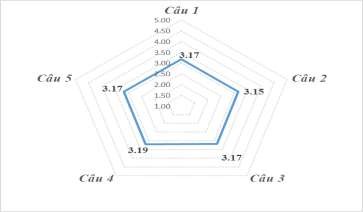
Figure 3.5. Average score of the Destination Choice factor
Source: Author's statistical analysis
The average scores for question 1 are 3.17/5, question 2 is 3.15/5, question 3 is 3.17/5, question 4 is 3.19/5, question 5 is 3.17/5. These scores are almost equal and are all higher than the average score of the survey (2.50/5). This shows that the choice of Thua Thien Hue as a destination of tourists is through the introduction of friends and relatives; Hotel standards; tourism promotion channels of media channels and information about the popularity of available tourist attractions.
For the Cost factor , there are three survey questions: question 6, question 7 and question 8; the average score for each question is shown in Figure 3.6 as follows: