
The model is built with the predicted variable being a binary variable, taking on two values corresponding to the presence or absence of a characteristic or outcome of interest. The coefficients in the regression equation can be used to estimate the elasticity coefficients (odds ratios) for each independent variable in the model. Combined with the binary logistic regression method, the topic also uses the methods of dialectical materialism, historical materialism, comparison, and analysis.
5. Contributions of the thesis
- In terms of scientific research development, it has: (i) Detected and assessed factors affecting the demand for distance education and quantified the level of influence of each factor, (ii) Constructed the demand function for distance education in Vietnam.
- In practice: Based on the factors affecting the demand for distance education and the relationship between them that have been studied, solutions are proposed to perfect policies for distance education development, suitable to the practical conditions and circumstances of Vietnam.
Maybe you are interested!
-
 Analysis of factors affecting the demand for distance learning in Vietnam - 16
 -
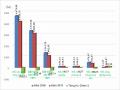 Results of Linear Regression Analysis on Factors Affecting Land Complaints in Vinh City
 -
 Exploratory Factor Analysis (EFA) Results for Factors Affecting Customer Satisfaction
 -
 Analysis of factors affecting customer satisfaction with the quality of FiberVNN fiber optic internet service of Can Tho Telecom - 2
 -
 Analysis of factors affecting revenue at YOKOHAMA Tire Vietnam Company - 2
6. Structure of the thesis
In addition to the introduction, conclusion, list of author's research works, references and appendices, the thesis includes the following chapters:
Chapter 1: Theoretical basis and research overview. Chapter 2: Current status of distance education in Vietnam.
Chapter 3: Experimental results of estimating the demand function for distance education in Vietnam.
Chapter 4: Application of research results in distance education policy planning in Vietnam.
CHAPTER 1: THEORETICAL BASIS AND RESEARCH OVERVIEW
1.1. Theoretical basis for estimating and forecasting distance education demand
1.1.1. Concept and characteristics of distance learning
1.1.1.1. Progress of the distance learning concept
Modern distance education began in 1963 (Peraton, 2007)[58]. In that year in the United Kingdom, the National Institute for the Promotion of Learning was established, which was a model for the Open University. The methodology of distance education in recent years has been called distance learning, which sets out the principle that: Education must be open to all. Open education, also known as open learning, must be a vision of the educational system, open to all with minimal restrictions. This philosophy emphasizes the flexibility and adaptability of the system, minimizing barriers caused by age, geographical location, time constraints and economic status (Bates, 1995)[16]. Therefore, open and distance education is a system that combines the methodology of distance education with the concepts of open and flexible learning. Open and distance education is an ideal concept that is difficult to implement in practice. Distance learning experts argue that many of the principles of open learning can be better implemented using distance learning than with face-to-face education approaches.
The development of distance education has been dominated by the educational philosophy of using standardized and pre-prepared teaching and learning materials to achieve economies of scale. This also emphasizes the philosophy of openness of education and the need for learner independence. The desire to increase access to education has been a major driving force in many countries that have adopted distance education (Garrison, 1993)[27]. Moore (1993)[49] argues that when learning materials are prepared in advance, learners can take charge of their own learning process, according to their own conditions. Based on this view, distance education is considered a form of industrial education, and also a product of an industrial society (Peters, 1997)[56]. According to Peters, the distance learning system has many similarities to an industrial factory, with a clear division of labor, operating mechanisms, and orientation towards large output.
standardization, and centralization of the system. Due to industrial similarities, distance education has been accepted by industrial societies as a form of mass labor training. Peters argues that the mode of distance education should also change to meet the changes of post-industrial societies. This is the case today in the information society. The process of distance education in the past was mainly based on the use of pre-prepared learning materials with postal delivery, the addition today of information and communication technology makes the learning process personalized and interactive. However, the training needs of post-industrial societies are different from those of industrial societies. This is due to the change in the demand for vocational skills and areas of expertise. The classical distance learning model based on mass-prepared correspondence courses no longer meets today's requirements, the need for an interactive training style that can be adjusted to the training needs of the growing distance learning method is effectively individualized. Modern information and communication technology can add features that the previous distance learning model did not have.
Today's production methods, communication technologies, problem perception and problem solving strategies may no longer be appropriate in the future (Peters, 1999)[59].
On this basis, there is a need for a model of distance education development with effective two-way communication between teachers and students, between students and materials, and between learners and training institutions. One-way processes (e.g., printed learning materials, audio-visual recordings or broadcasts), supplemented by two-way feedback between teachers and students, training institutions can supplement programs. Holmberg (1983)[38] pointed out that, although distance education is designed for independent learning, it cannot be without support services. Even though communication in the form of direct conversation is difficult, distance education can be implemented in many other ways to create an interactive environment for learners. Holmberg (1983) in his book “The Concept of Interactive Instruction” mentioned a two-way interactive way
effective way, for example, print by phone. The goal and spirit of this atmosphere is realized in the sensitive design of learning materials, assignments, and learning supports. Through good learning materials, students can have an “atmosphere” like in a conversation with their teachers, and this will help the self-learning process to achieve results with the support of learning materials.
The “Guide to Creating Interaction” emphasizes the importance of: (i) Clear presentation of the material, in easy-to-understand language, (ii) Clear instructions on what to do and what not to do, what to observe and why, (iii) An encouragement for learners to discuss, question, and evaluate the material, (iv) An effort to motivate learners to engage with the material and the subject matter, (v) A personal style of writing, including the use of pronouns, (vi) A clear demarcation of topics and themes, for example: By noting variations, or in the production of recorded material using different voices.
According to Sewart (1984)[64], however, pre-produced learning materials cannot completely replace the functions and roles of teachers. The absence of feedback for distance learners can negatively affect learning outcomes. Learners have different needs that learning materials cannot anticipate, and may not be satisfied with mass-produced learning materials. Similarly, Sewart mentioned the importance of organizing learner support services. One of these types of support is the instructor, the consultant who is responsible for the learning and the individual guidance of the learner. Sewart believes that the instructor as a professional teacher and personal consultant can significantly improve the quality of the distance teaching and learning process. The development of information technology, such as audio, television classrooms, has increased the interactive process, minimizing the distance between teaching and learning activities that previously created a psychology and remote transactions in the learning process (Moore, 1993)[49].
1.1.1.2. From Distance Learning to Open Learning
The benefits of modern information and communication technology have created a broader way of thinking about distance education. The solution to the problem of distance between teachers and students in distance education allows for a wider use of media. When teaching and learning activities are effective in asynchronous time , two main problems are solved: (i) The traditional teacher/student ratio often limits the ability to absorb, (ii) The classroom wall often limits the ability to train. Overcoming the barriers, moving from essentially “closed” training to a more “open” process in practice, and classes are no longer tied to classes.
The development of the socio-economic over the decades has also changed the requirements of education. In the pre-industrial era, distance education was mainly a means of providing a high-quality workforce, while post-industrial society is gradually moving towards improving the quality of human life. In the post-industrial era, education focuses more on self-awareness and meeting individual needs, for example increasing happiness and satisfaction with life (Peters, 1993)[55]. The need for training is no longer limited to the “school-age” group, but is related to the need for lifelong learning of the people. This is manifested in the increasing popularity of non-formal and continuing education, which gives people more comfort than a diploma. In addition, advanced technology and the service industry have changed the type of skills needed in the labor market (Peters, 1999)[59]. This has led to an increased need for continuing professional education. And distance education has expanded, from pure distance education to blended continuing education.
Thus, distance education can be seen as a suitable method for pursuing various goals, including improving professional skills, satisfying hobbies, and the need for autonomy. In developing countries, where people live in economic hardship and isolation in rural areas, distance education is seen as a means of providing a second chance for those who cannot attend formal education in a face-to-face training system. Distance education
Distance learning has become more popular than a purely alternative training system, and is the only factor capable of promoting the openness of education, reducing barriers of time, place, economic circumstances, age and initial qualifications. The concepts of lifelong learning and education for all emphasize that everyone must have the opportunity to learn and to receive an education throughout their lives. The United Nations Educational, Scientific and Cultural Organization ( 1996) has recognized the implications of the concept of open education:
“ Education is a basic human right, a universal human value, which needs to be implemented throughout the entire life of each individual ” [67] .
1.1.1.3. Enhancing Openness: System Design and Technology
Although the concept of open education has been widely popularized, no open and distance education provider has achieved 100% openness. In fact, many distance education providers still impose admission requirements, which reduce openness. Openness in distance education can be enhanced in designing a more flexible learning system (Belawati, 1999)[18], for example, through: (i) More flexible entry and exit systems: Learners can start and finish their studies at any time during the year, depending on their personal circumstances, (ii) No selection criteria: Anyone applying for a programme will be accepted as long as they meet the minimum basic qualifications required to support their studies.
An open enrollment system: Individuals can enroll in a single course or an entire program, or enroll in specific courses. Open enrollment should also allow students to accumulate credits from previous courses toward graduation.
Designing a training system with the above three points will increase the openness of distance education. The response to the distance education program via the Internet shows that the public demand for this type of training is high. Distance education is a new type of training, training institutions that only provide face-to-face or distance to open universities are considered as single-model training institutions. In the 2000s, distance education was enhanced in openness thanks to the participation of new technology. Online training
E-Learning is a form of learning in which every process uses the Internet, including the delivery of learning content and the interaction between teachers and students (Belawati, 2003)[19]. The widespread popularity of E-Learning in education has been enhanced by the emergence of Open -source Software , which makes Learning Management Systems software also available and often free of charge. With such software, open and distance education can be set up and maintained with low investment. E-Learning makes distance education more interactive, personalized and less expensive, while increasing its geographic and social reach. As a result, E-Learning has increased the profile of open and distance learning, attracting educators who previously shunned distance learning, and E-Learning has led many schools that were not distance learning institutions to offer distance learning programs in addition to their face-to-face programs. In doing so, they have become dual-model institutions. Collaborative associations between multiple distance learning institutions, often to share learning resources, are called “consortiums.”
The advancement of distance learning has been enhanced mainly by the development of hardware and infrastructure, and by the growing “Open Educational Resources” movement that allows the free use or reuse of materials in teaching, learning, and research. The increasing use of sophisticated hardware and software systems, of course, cannot exclude the use of printed materials in courses. Printed materials still play a dominant role in many distance learning institutions, with high-tech used to supplement and support the teaching and learning process. Each technology/medium has different capabilities in terms of accessibility and interaction, while many information and communication technologies are capable of conducting long-distance communication, their public access is still limited. Panda (2005)[59] argues that online programs at Indira Gandhi National Open University in India are only successful for the wealthy, those with digital devices that access the Internet or who attend regular learning centers. Furthermore, the high cost of these sophisticated technologies
For both learners and institutions, issues of access and cost, technical support, regulation, applications and political barriers (Latchem, Lockwood & Baggaley, 2008)[45] may take many years to resolve in some developing countries. The convergence of system design and high technology, information technology is only a small step towards fully increasing the openness of education.
1.1.1.4. Conclusion
Thus, open and distance education is a concept that originated from the distance correspondence training method in the industrial era. Distance education systems still play a role in meeting social needs in the post-industrial era and develop towards self-improvement and personal needs. In addition, the technological development of the new era has increased the need for continuing vocational training, and the change in orientation towards continuing education has increased the openness of the concept of lifelong learning for all. The advancement of information and communication technology has increased the interactivity of distance education. However, many countries focus on the use of sophisticated technologies that may reduce the number of people accessing education. The choice of technology and the design of appropriate learning systems play an important role in determining the openness of distance education systems. In theory, open and distance education is a system that aims to overcome the difficulties of distance, temporary or permanent, economic factors, personal limitations, with the ideal of opening learning opportunities for everyone.
1.1.2. Factors affecting the demand for distance learning
Economists believe that training in general and distance training in particular is a training service, distance training service systems play a role in meeting social needs and developing in the direction of people self-improving and meeting personal needs [3(a)].
1.1.2.1. Basic concepts