
- The Journal - Ledger accounting form includes the following types of accounting books:
+ General accounting books: Journal - Ledger;
+ Detailed accounting books: Detailed accounting cards, detailed material books, detailed books of customer receivables, payables to sellers, etc.
Diagram 1.5. Sequence of accounting entries in the form of Journal Accounting - book
Maybe you are interested!
-
 Sequence of Recording in General Journal Accounting Form.
 -
 Detailed Accounting Procedure for Cost of Goods Sold
 -
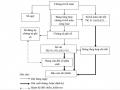 Accounting Sequence Diagram in Journal - Ledger Form.
 -
 Sequence Diagram of Recording Revenue, Expenses and Determining Business Results in the General Journal Accounting Form
 -
 Accounting Procedure According to Computerized Accounting
the (Appendix 1.5)
1.2.4.2. Accounting form: Bookkeeping vouchers
- Characteristics: This is a form of accounting commonly used in medium-sized enterprises, using many accounting accounts, with advantages: easy to do, easy to check, compare, accounting work is distributed evenly throughout the month, easy to divide work. Suitable for many types and sizes of units. Disadvantages: duplicated records, increased workload, reduced productivity and efficiency of accounting work.
This form separates the chronological recording from the economic content recording of economic and financial transactions arising to record in two separate general accounting books: the Voucher Registration Book and the General Ledger.
The direct basis for recording in the general accounting books is the "Recording voucher". Recording in the general accounting books includes:
+ Record in chronological order on the Voucher Registration Book.
+ Record according to the economic content of the economic transactions arising in the General Ledger. Accounting vouchers are prepared by accountants based on each accounting voucher or Table.
Summary of accounting vouchers of the same type, with the same economic content and numbered consecutively each month or year (according to the serial number in the Register of Accounting Vouchers) and with attached accounting vouchers, must be approved by the chief accountant before being recorded in the accounting books.
Detailed accounting entries are based on the accounting documents attached to the entry documents. Thus, general accounting entries and detailed accounting entries are separate.
Each level 1 accounting account is recorded on a separate ledger, so at the end of the month, a reconciliation table of arising numbers (account balance sheet) must be prepared to check the accuracy of the ledger entries.
Book system
Accounting forms of accounting vouchers include the following types of accounting books:
- General accounting books: Accounting vouchers; Accounting voucher register; General ledger;
- Detailed accounting books: Detailed accounting books of materials, Detailed accounting cards; Detailed books of receivables from customers, payables to sellers
- Accounting entry procedure according to accounting form of Bookkeeping vouchers
Diagram 1.6 Sequence of accounting entries in the form of accounting vouchers (Appendix 1.6)
1.2.4.3. General Journal accounting form
- Characteristics: It is a simple form of accounting, widely used in large-scale enterprises that have used computers in accounting work. The advantage of the General Journal form is that it is convenient for checking and comparing details according to each original document, convenient for using computer accounting, but it has a disadvantage: some transactions are duplicated, so at the end of the month, duplicate data must be eliminated before being recorded in the general ledger.
Basic characteristics of the General Journal accounting form: All economic and financial transactions must be recorded in the Journal, focusing on the General Journal, in chronological order and according to the economic content (accounting entries) of that transaction. Then take the data from the Journals to record in the General Ledger according to each transaction.
Thus, this form also has the same characteristics as the form of bookkeeping vouchers, but the difference is that there is no need to create bookkeeping vouchers, but only based on accounting vouchers to make direct entries in the General Journal or special journal. Then, based on the entries in these journals, record in the general ledger.
- Book system: General Journal accounting form includes the following main types of books:
+ General Journal, Special Journal; - General Ledger;
+ Detailed accounting books and cards.
- Accounting procedures in the form of General Journal accounting
Diagram 1.7. Accounting entry sequence in the form of General Journal (Appendix 1.7)
1.2.4.4. Accounting form Journal - voucher
- Characteristics: This is an accounting form used in medium and large enterprises, with good qualifications and capacity of accounting staff. This is a form that ensures specialization and division of accounting labor. The advantage is to reduce duplicate recording, reduce the volume of daily recording, and improve labor productivity for accounting staff. Convenient for accounting staff specialization. Disadvantages: Complicated book forms,
Not suitable for small-scale units, with few economic operations or units with weak accounting staff.
This form has the following main characteristics: Closely combining the recording of economic transactions arising in chronological order with the systematization of transactions according to economic content (by account) into a separate general accounting book, the Journal - voucher. Widely combining general accounting with detailed accounting on the same accounting book and in the same recording process. Using pre-printed book templates for corresponding account relationships, economic and financial management indicators and preparing financial statements. There is no need to create a reconciliation table of the arising numbers of general accounts because the sums in the Journal - vouchers are accounting entries recorded as Debit and Credit to the accounts that must be balanced.
- Book system
The Journal-Voucher accounting form includes the following types of accounting books:
+ General accounting books include: Voucher journal; Statement; Ledger.
+ Detailed accounting books or cards, including: Detailed accounting books for materials; Detailed accounting books for fixed assets; Detailed accounting books for receivables and payables...
- Accounting recording procedure in the form of Journal - Voucher accounting
Diagram 1.8. Sequence of accounting entries in the form of Journals - Vouchers
(Appendix 1.8)
1.2.4.5. Computerized accounting
“Basic characteristics of Computerized Accounting: Accounting work is performed according to a computerized accounting software program. Accounting software is designed according to the principles of one of the four accounting forms or a combination of the accounting forms specified above. Accounting software does not fully display the accounting bookkeeping process, but must be able to print complete accounting books and financial reports according to regulations. Accounting software designed according to a particular accounting form will have the types of books of that accounting form, but they are not exactly the same as handwritten accounting books.
Accounting Procedures in Computerized Accounting
- Daily, accountants base on accounting vouchers or Summary of accounting vouchers of the same type that have been checked, used as basis for recording, determining assets.
Debit and Credit accounts are used to enter data into the computer according to tables and charts designed in the accounting software. According to the accounting software process, the information is automatically entered into the general accounting books (General Ledger or Journal-Ledger...) and related detailed accounting books and cards.
- At the end of the month (or at any necessary time), the accountant performs the closing operations (addition of books) and prepares the financial report. The comparison between the summary data and the detailed data is done automatically and always ensures accuracy and honesty according to the information entered in the book. The accountant can check and compare the data between the accounting books and the financial report after printing it on paper. At the end of the month and the end of the year, the summary accounting books and the detailed accounting books are printed on paper, bound into volumes and legal procedures are carried out according to regulations" [2].
Diagram 1.9. Accounting entry sequence in computerized accounting form
(Appendix 1.9)
Thus, each form of accounting has its own content, advantages, disadvantages and appropriate scope of application. In each form of accounting, there are specific regulations on quantity, structure, order, recording method and relationship between accounting books. The order of recording books according to each form can be summarized as follows:
(1) Check to ensure the validity and legality of documents
(2) Detailed accounting records
(3) General accounting
(4) Check and compare data
(5) Synthesize data to prepare financial statements.
The accounting system must ensure that it reflects and provides complete economic and financial information to prepare financial reports and meet other needs for management and business operations of the enterprise. The accounting system includes general ledgers and detailed ledgers. General ledgers are used to classify and summarize economic and financial information according to economic content. Detailed accounting books are used to track detailed information according to the requirements of business management and provide economic and financial information to prepare accounting reports. Enterprises are specified in the selected accounting system to serve the requirements of business management at the enterprise.
1.2.5. Organization of preparation and analysis of financial reports
“Financial statements are a system of economic and financial information of an accounting unit presented according to the form prescribed in accounting standards and accounting regimes ” [8].
Accounting information is information obtained by accountants collecting, processing, systematizing and providing. Accounting information is provided by enterprises to those who need to use it through accountants preparing financial statements and analyzing those financial statements.
Financial statements are mandatory reports for enterprises. They also provide complete information about the financial situation and business performance of the enterprise. Identify the person who prepared them, the person who controlled them, the time of preparation, publication and use of the report to serve the management and meet the information needs of internal and external parties of the enterprise.
* About the organization of financial statement preparation
- Financial statements include annual financial statements and interim financial statements. Enterprises implementing Circular 200/2014/TT-BTC shall have periodic reports applied uniformly to all enterprises. Circular 202/2014/TT-BTC shall apply to enterprises operating in the form of parent company - subsidiary company to prepare and present consolidated financial statements.
- Annual financial statements include: Balance sheet; Business performance report; Cash flow report; Notes to financial statements. Enterprises must prepare annual financial statements according to the provisions of the Accounting Law.
The preparation and presentation of financial statements must comply with the requirements specified in accounting standard No. 21 - Presentation of financial statements; accounting standard No. 25 - Consolidated financial statements and other relevant standards as well as follow the guidance of Circular 200/2014/TT-BTC on guidance on enterprise accounting regime; Circular 202/2014/TT-BTC on guidance on preparation of consolidated financial statements.
Financial reporting indicators must be appropriate to the requirements of information users in order to achieve the purpose of using information in a timely manner. The content of reporting indicators must be consistent to ensure that they can be summarized and compared. Reported data must ensure reliability. To implement this requirement in the entire accounting process, it is necessary to comply with accounting principles and use accounting methods correctly in order to reflect the reality and objectivity of the economic and financial activities of the enterprise.
After preparing financial statements, accountants need to pay attention to the deadline for submitting these financial statements to state agencies according to regulations.
* Financial statement analysis organization
Based on the established financial statements, accountants need to analyze the reports to provide useful detailed information for enterprise management and provide complete information to related information users. Financial statement analysis is an indispensable part after establishing financial statements. The indicators will help information users assess whether the enterprise's operations are growing or declining, how is its financial health... In addition, this is also a tool to help forecast the financial situation of the enterprise in the future. In particular, for enterprises listed on the stock market, providing accurate and complete information about the financial situation to investors is an extremely important issue, helping them choose and make the most effective investment decisions.
When calculating financial indicators in the organization of financial statement analysis, it is necessary to pay attention to: compare with the previous period: to evaluate the horizontal development trend of the enterprise; compare with enterprises in the same industry, or with the industry average: to evaluate the strengths and weaknesses of the enterprise. When calculating the indicators, it is necessary to pay attention to whether the number represents the time or the period to be able to get the most accurate assessment of the enterprise's situation.
Financial indicators calculated from the Balance Sheet will be time-based numbers; while those on the Income Statement will have a time factor. Typical financial indicators, often used in analysis
The financial statements of the enterprise are:
- Payment capacity analysis
Use payment ratios to evaluate the solvency of a business: Current solvency ratio (Current assets/Current liabilities); Interest coverage ratio: (Profit before tax and interest/Interest payable); Accounts receivable turnover ratio: (Sales revenue/Average receivables); Inventory turnover ratio: (Cost of goods sold/Average inventory).
- Financial leverage analysis
Use Debt Ratio to evaluate. (Liabilities / Total Capital) shows the proportion of debt in the total capital of the enterprise.
- Analyze profitability using the following indicators: Return on Sales (ROS) : Profit after tax/Net revenue and Gross profit margin (or Gross profit margin): Gross profit/Net revenue.
Return on Assets (ROA) : Profit after tax / Average total assets and Return on Equity (ROE) : Profit after tax / Average equity.
- Cash flow analysis: The purpose of cash flow analysis is to evaluate the financial capacity as well as the quality of the company's cash flow. Net cash flow from business operations/Net revenue. This ratio shows how many dong the company receives per 1 dong of net revenue?
From the above analysis, the author finds that a good information organization means a plan to prepare financial statements and analyze the data on those financial statements. Through the indicators on the financial statements, information users can know the business situation of the enterprise. Even if information users do not need to have accounting expertise, they can still see and understand the content and nature of the information on the financial statements.
1.2.6. Organization of accounting inspection
Organizing accounting inspection is one of the important aspects in accounting organization to ensure that accounting work is performed in accordance with regulations, effectively and provides information that accurately reflects the actual situation of the enterprise. In the long term, organizing accounting inspection will be carried out through the auditing system in which internal auditing has a very important meaning and position. Currently, the auditing system does not have specific regulations on content and form of operation, so for now, accounting inspection is still organized (due to the important nature of accounting inspection, it should be presented in a separate section).
The necessity of accounting inspection: Protecting assets and improving production and business efficiency are the most important tasks of enterprises in a market economy. To perform these tasks well, accounting inspection holds an important position. Accounting has an inspection function due to its recording and reflection methods and procedures. Accounting records are comprehensive and complete in chronological order combined with systematic classification, with bookkeeping work, balancing and comparing between the stages of recording operations, between summary and detailed documents, between
Accounting documents and reports between departments not only create tight control over financial and economic activities, but also ensure control over the accuracy of the accounting work itself.
Through the results of accounting inspection, propose measures to overcome shortcomings in the management of enterprises. Requirements of accounting inspection: To carry out the above tasks, accounting inspection work must ensure the following requirements: carefulness, seriousness, honesty, objectivity in the inspection process. Conclusions must be checked clearly, accurately, and strictly based on comparison with accounting regimes and regulations as well as current economic and financial management policies and regimes. Thereby, shortcomings and problems that need to be overcome are exposed.
There must be timely reports to superiors and agencies summarizing the inspection results; good experiences in accounting inspection work, as well as issues that need to be supplemented and revised regarding accounting regimes and policies, and financial economic regimes.
The inspected units must fully and seriously implement within the prescribed time the recommendations of the inspection agency on correcting the shortcomings discovered through the accounting inspection. Forms of accounting inspection: Including regular inspection and irregular inspection.
Regular inspection: Regular internal accounting inspection is the responsibility of the head and accountant of the enterprise to ensure compliance with accounting regimes and regulations, ensure the accuracy, completeness and timeliness of accounting data and documents, and ensure the basis for the implementation of the director's function of accounting.
Regular internal audits in enterprises include pre-audits, internal audits and post-audits. Pre-audits are conducted before performing economic, financial and accounting operations, specifically checking documents before these documents are recorded in the books.
Checking during implementation is checking right in the process of performing economic transactions, through bookkeeping, data analysis tables... through the control relationship between transactions and the accounting section.
Systematically check the implementation of the principles, regimes, rules and accounting procedures based on accounting books and reports.