
FURTHER READING
1. Ota Keizaburo, Tanaka Ichir, Udagawa Taketoshi and Munekate Ken. Field Ecology . Agricultural Publishing House, Hanoi 1981 (Translated by Doan Minh Khang).
2. Ahuja, L.R., Ma, L., and Howell, TA Whole System Integration and Modeling - Essential to Agricultural Science and Technology in the 21 st Century ; pp. 1-8. In: LR Ahuja, L. Ma, TA Howell (eds.), Agricultural system models in field research and technology transfer. Lewis publishers; Boca Raton, USA. 2002.
3. Nguyen Cong Tan, Ngo The Dan, Hoang Tuyet Minh, Nguyen Thi Tram, Nguyen Tri Hoan, Quach Ngoc An. Hybrid rice in Vietnam . Agriculture Publishing House. Hanoi. 2002.
4. Nguyen Thi Tram. Results of breeding hybrid rice variety TH3-3 with short growth time, high yield and quality . Journal of Agriculture and Rural Development 6: 686-688. 2003.
5. Nguyen Tat Canh. Research on simulation model of soil moisture dynamics and diagnosis of irrigation needs for corn and soybean on degraded soil of Dong Anh and alluvial soil of Red River, Gia Lam . PhD thesis in Agriculture. Hanoi University of Agriculture, 2000.
6. Pham Chi Thanh, Pham Tien Dung, Dao Chau Thu, Tran Duc Vien. Agricultural system . Agricultural Publishing House. Hanoi. 1996.
7. Odum, EP Basic Ecology . Saunders college publishing. Tokyo. 1983.
8. Tran Duc Vien. Agricultural Ecology . Education Publishing House. Hanoi. 1998.
9. Tsuji, G.Y., duToit, A., Jintrawet, A., Jones, J.W., Bowen, WT, Ogoshi, R.M., and Uehara, G. Benefit of models in Research and Decision support: The IBSNAT Experience ; pp: 71-90. In: LR Ahuja, L. Ma, TA Howell (eds.), Agricultural system models in field research and technology transfer. Lewis publishers; Boca Raton, USA. 2002.
138
Chapter V
SYSTEMS ENGINEERING OF FIELD ECOSYSTEMS
Content
The natural world is very complex and diverse, requiring humans to have a systematic approach in studying field ecosystems. Plant populations growing in fields have a close relationship not only with meteorological conditions, soil, water regime but also deeply influenced by relationships with other species and socio-economic conditions of each locality. The basic content of this chapter is to model the above relationships to study the function and structure of field ecosystems in order to provide an overall view of agricultural production.
The following topics will be covered in this chapter:
For undergraduate students:
Ecology and systems engineering
For graduate students:
Prepare mathematics to describe and analyze ecosystems
Computer modeling
System analysis of some ecological models
Target
After completing this chapter, students should :
Understand the relationship between ecology and systems engineering
Understand the methods of describing and analyzing ecosystems
Understand how to process ecological models on computers ( postgraduate students )
1. Ecology and systems engineering
The synthesis of ecology
Scientific research usually has two main directions: one is to try to divide the research object into very small, very pure parts; the other is to synthesize and organize the divided objects. The methodology of the first direction is to extract an element from a very complex real system, try to isolate it from the surrounding environment, form a pure field of "fixed temperature and humidity" that is beneficial for the experiment, find some law in that part of the system; avoid things outside the research system "mixing" into the experimental scope, find every way to make the experimental system the "purest" and purest; even destroy the complex cell tissue, do it over and over again to get a certain type of yeast, then use that "pure" yeast to conduct biochemical experiments in the style of a "test tube system".
139
No matter how “pure” an empirical system may be, if studied more closely it can be made up of many secondary components, meaning that the subdivision can continue indefinitely.
Any new discovery in such a small-scale study, as long as it is related to the nature of the same thing, can sometimes have a direct effect and have a relatively large application. For example, if a substance is discovered that has a strong damaging effect on the respiratory system or the photosynthetic system of an organism, perhaps a very small part, it can become an effective measure to limit pests and weeds.
Up to now, most scientific research has followed this “division” method. However, such research results, when simply applied to complex reality, often stumble, and sometimes even give results contrary to expectations. For example: spraying pesticides to protect crops and the resistance of pests. Weeds that are less affected by herbicides grow strongly when we use herbicides (such as Eleocharis in rice fields). From these realities, people realize that nature is complex, so we must treat it as complex things and need to conduct comprehensive research. From there, some terms such as “systems” and “systems engineering” are used more and more commonly.
As mentioned above, there are many analytical methods that ecology applies, but in the end, they all revolve around the requirement of synthesis. Ecology is a science with a very high synthesis. Because: 1) the formation of ecology is still relatively young, and has not been divided into small parts; 2) ecology is a science that must take the field research area as the main area for development; 3) in real conditions, the relationship between organisms and the environment, the relationship between organisms and organisms is very complicated in both structure and function, and it is not easy to take a part and put it in the laboratory. People say that the synthesis of ecology is very high, which is also reflected in those aspects.
In the field of engineering, recently the mechanization of production has become extremely complex and on an increasingly large scale. When using the previous architectural “parts” to study the overall operation of these equipment, because these wholes are too complex, the system concept was born. Some such complex systems are synthesized together for a certain purpose, or are applied according to a certain rule (universal method). These synthesis methods are constantly developed and are called system engineering.
The following section will discuss the research process of ecology and engineering, which at first glance seem to be opposite. The research object of ecology has existed for a long time, while systems engineering has just been formed. Although the positions of the two fields are different, their system concepts are the same. The key part of the system treatment method proposed by engineering has important reference significance for ecology.
140
System structure
System : A system consists of many components that are related to each other and combined together in a very complex way to form a whole with a certain meaning.
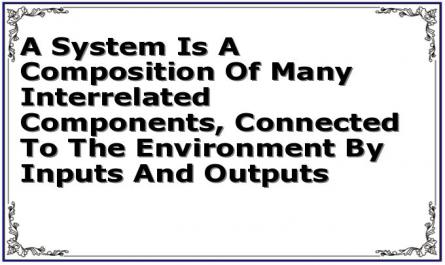
First of all, we need to discuss the issue of determining the structure of the system. In a set of many components, the arrangement of which one is placed in a system is of course different due to the purpose of the research, but it cannot be arranged arbitrarily. Figure 1.5 shows that, assuming there are 6 components, the component set [1, 2] and the set [3, 4, 5, 6], the components in brackets [ ] have a closer relationship, so they have become different sets. In the case, if there is no special reason to arbitrarily draw a dotted line and consider [1, 2, 3] as a system, it will cause difficulties for the next research step. In other words, a system is a set of several components organically combined together, it can be distinguished from the environment or other systems and has a certain degree of relative "independence".
System 1 System 1I
Uu | Output signal |
Ingredients 1 |
Maybe you are interested!
-
 Building a system to monitor water level, temperature and send warnings via SMS/GSM network - 2
 -
 Rules for Building a Fair Performance Management System
 -
 Two Elements A And B Are In Two Consecutive Main Groups In The Periodic System. In Their Pure Substance State, A And B Do Not React With Each Other. Total Number Of Protons
 -
 Mapreduce And Hdfs (Optimal Features Of Mapreduce When Combined With Hdfs):hdfs Is Just A Distributed File System With Management Mechanisms Inside It.
 -
 Building a service delivery system via SMS based on mobile subscriber location - 1
Trust in
Environment
Input signal
3 component
Component 5
Output signal
Ingredients 6
Environment
Component 2
Component 4
Figure 1.5 . A system is a combination of many interrelated components, connected to the environment by inputs and outputs.
Component components: the so-called component components are a number of “parts” that make up the “system”, which are themselves composed of lower-level components. These lower-level components are created by even lower-level components. As mentioned above, if we continue to divide it into infinite parts, we can eventually (with our current level) reach the level of elementary particles. However, even if we do not reach the level of elementary particles or atoms, we are still able to understand and master the field ecosystem, so the division of component components should be done to an appropriate level; as for the content of the components (what they are made of), we must still admit that there exists a “component unit” beyond which no further questions can be asked. That is the “component component” we are referring to.
141
The component is like a black box with inputs and outputs (Figure 2.5). Like a vending machine, put in a coin (put in) and something pops out (put out), whether it is a pack of cigarettes or a bottle of water.
Input signal Xi [= f(Ym)]
Yi's constituent components
Yi (Black Box)
Output signal Zi [= f(Xi)]
As a result, the internal structure seems to be thoughtless. The relationship between the “input quantity” and “output quantity” of those components can be determined through experimentation, and the research results of relevant experts can also be used.
Figure 2.5. Block diagram of the constituent components (elements) of a typical system. The smallest processing unit is considered a black box.
But in any case, a situation may arise in which the actions of more complex components cannot be well represented without considering the lower-level or even lower-level components of the component. In this case, we call them the subsystem and the subsubsystem, respectively (Figure 3.5).
System
Subsystem Components
Environment (input signal)
Sunlight
Air Temperature Weed
Dry matter (plant) reproduction system
The system of constituent parts
Component components
component
Insects +
Photosynthetic organ | |||
Transport agency | Archives | ||
Nutritional agency | |||
Microorganisms +
Ingredient
soil +
Soil microorganisms +
Figure 3.5. Relationship between system components, subsystems, and grandchild systems
Field ecosystem
Figure 4.5 . Scope of the system. There are differences due to the different problem categories that people study.
The components (elements) of the field ecosystem are referred to as the plant population, weeds, insect population, NH B 3in soil, mass and quantity of soil microorganisms...
System and environment : The environment of a system is the sum of all components outside the system, its properties change will affect the system and vice versa, due to the operation of the system, the properties of the environmental components are also affected.
In fact, what is considered an internal factor of the system and what is considered an environment depends on the way people view the system, especially how large the scale of the system is, the length of the time coordinates considered (taking the problem arising in a few months as the object, or considering the time after 10 years, 20 years) is different.
142
but there are many differences. For example, the field system, as shown in Figure 4.5, if we take crops as the main thing, then the things outside the crops such as solar energy, air temperature, insects, weeds, microorganisms... are all its "environment". Taking crops as the main thing is the subjective explanation of humans who take advantage of crops. If we think that insects and microorganisms in the formation of the field ecosystem are as important as plants, then it is suitable for reality, then a part of the environment can be included in the system (Figure 5.5).
In the study of field ecology, the synthesis is very strong. Although it initially starts from a small-scale system, as the research progresses (gradually bringing the environment into the system), the scale of the natural system will tend to expand, and eventually become a "biosphere".
3
Environment A
1
Y 1 Y 4
Y 2 Y 3
2 Lips
school
B
System Limits
Figure 5.5. Boundary between system and environment
Characteristics of the ecosystem
Compared with technical systems, ecosystems generally have the following characteristics:
1/ There are many reactions that are slower than the technical system. Comparing the production process of a chemist and biological production that takes a long time, the difference is very clear. Therefore, the control of the field ecosystem, whether it is really necessary to have a “linear computer system” (Computer online system) is a matter of great concern.
2/ Components with extremely fast reactions and components with very slow reactions are in the same system. For example, the photosynthesis process has reactions that take seconds or minutes as units; morphological changes due to growth need to be considered for many days, months or years. In addition, such as the decomposition of organic matter in the soil or the process of changing the physical and chemical properties of the soil, it takes a relatively long time to reach general equilibrium. Therefore, when considering the problem of changes in a short time, for components that seem to be basically stable, if they are still considered as unchangeable over a long period of time, it often leads to large deviations. For systems with a mixture of different fast and slow reaction rates (time parameters), when calculated by computer, it is also often easy to become the cause of calculation errors.
143
3/ The “structure” of the system’s structure (component) itself also changes. In a factory, the structure itself cannot change much over a period of time. Therefore, the “relational structure” of the input and output of the component units does not change much, but in a biological system, there is no such guarantee. There are even components that do not exist at all for a certain period of time, but at another period of time, they appear as an additional part of the system (such as the formation of plant reserve organs).
4/ In the input and output functional relationships of the components, most of them have a fairly clear saturation and non-linearity. For example, the relationship between the concentration of nutrients in the soil and the absorption rate of the roots; the relationship between the light intensity and the rate of photosynthesis. Therefore, a series of linear methods and algorithms developed from the engineering system cannot be used in their entirety, which has brought many difficulties to the mathematical treatment of biological systems.
5/ Regardless of whether it is inside or outside the system, there are many human factors that are difficult to control. Therefore, although mathematical or computer models have been created and experiments have been conducted, it is sometimes extremely difficult to verify the results obtained in the actual ecosystem.
System analysis process (modeling and model testing)
The technical system is a newly formed object, while the field ecological system is an existing object of analysis. Therefore, the purpose and process of analyzing the two types of systems are more or less different. But the common point is the same: both models have important effects.
The process of engineering : The process of engineering system composition, first of all, is to create a system with what function, that is, to start from a careful examination of its design conditions. Based on these conditions, to form a specific design, go through the process of testing all kinds of details, and finally form the system that we require.
The system is tested in various environmental conditions before being put into use. The test results are compared with the desired design conditions and any unsuitable parts are corrected. To produce a high-quality system, it must be repaired many times.
However, in a large-scale system environment that requires a huge investment, using plants to conduct “test runs” under different conditions, or to review the results to make corrections, has become increasingly difficult both economically and technically, and even impossible to do so. Therefore, before “manufacturing” a real object, a model must be pre-made, the model must be repeatedly tested, pre-analyzed, and the system must be modified in advance (Figure 5.6).
In systems engineering, model experimentation has become an important method of system analysis and system composition. Therefore, the method of
144
Modeling, the method of obtaining more and more information using models and model experiments, has developed by leaps and bounds. Such methods are also very promising in ecological research.
[ Technical research procedures ] 5
Set up
model
Perform
model
Description of 1 2
possible features
System integration
Manipulate
purpose
of the target system
4-way correction circuit
3
6
Deviation
How to use the system
Ecosystem
Experimental investigation of real systems
[ Ecological research procedures ]
Figure 1
experimental investigation
2
Modeling
Model Implementation
3
Deviation
4-way correction circuit
Using the system
Ecology
Discover new experimental topics5
How to control the ecosystem6
Figure 6.5. Comparison of the process of technical system formation and the process of ecological research.
Ecological research process (the meaning of model in ecology): The system taken as the object of research in ecology is something that already exists, there is relatively little intention to research and invent new things like in engineering. But in ecology, the more complex the system to be studied, the more the system analysis needs a model (pattern).
Ecological research is first of all through field investigation and field experiment to collect data and documents about the system of research objects. As the research progresses, those documents become more and more abundant (describing phenomena), and then from there find out the main meaningful relationship, the essential relationship about the action of the system, put forward the laws of universality. To make some of these abstract perceptions (or so-called working hypotheses) become reality, it is necessary to apply different models. As will be said later, there are miniature models that abstract the large grassland into a sand table, circuit-type models, mathematical models and computer models.
145