
After checking, we will synthesize and process using SPSS 20.0 software.
Excel to conduct statistics, coding and data analysis.
Descriptive statistical analysis:
Maybe you are interested!
-

 The impact of job satisfaction on employee commitment to the Bank for Agriculture and Rural Development of Ben Tre - 3
 -
 Theoretical and Practical Basis of Employee Job Satisfaction
 -
 The impact of job satisfaction on employee commitment to the Bank for Agriculture and Rural Development of Ben Tre - 5
 -
 Solutions to improve employee job satisfaction at Vietnam Joint Stock Commercial Bank for Investment and Development - North Saigon Branch - 15
 -
 Solutions to improve employee job satisfaction at Vietnam Joint Stock Commercial Bank for Investment and Development - North Saigon Branch - 1
Descriptive statistics used in this study to analyze and describe data include frequencies, proportions, means, and standard deviations. Descriptive statistics are used to describe the basic characteristics of data collected from empirical research through different methods.
Testing the reliability of the scale – Cronbach's Alpha:
The Cronbach's Alpha coefficient has a value ranging from 0 to 1. In theory, the higher this coefficient, the more reliable the scale is, however, this is not entirely accurate. A Cronbach's Alpha coefficient that is too large (>0.95) shows that there are many variables in the scale that are not different from each other, this phenomenon is called overlap in the scale [15].
If a measurement variable has a Corrected Item – Total Correlation coefficient ≥ 0.3, then that variable meets the requirements [10].
Cronbach's Alpha coefficient value level [10] :
+ From 0.8 to close to 1: very good measurement scale.
+ From 0.7 to close to 0.8: good measurement scale.
+ From 0.6 and above: usable measurement scale.
Exploratory Factor Analysis (EFA)
Exploratory factor analysis (EFA) is a method used to reduce many interdependent observed variables into a smaller set of variables (called factors) so that they are more meaningful but still contain most of the information of the original set of variables (Hai et al., 1998).
Conditions in EFA analysis:
- KMO coefficient (Kaiser-Meyer-Olkin): is an index used to evaluate the suitability of factor analysis. A KMO value of 0.5 or higher (0.5 ≤ KMO ≤ 1) is a sufficient condition for factor analysis to be appropriate.
- Bartlett's test of sphericity: used to examine variables
Observe whether factors are correlated with each other.
+ Sig Bartlett's test < 0.5: Bartlett's test is statistically significant, observed variables are correlated with each other in the factor.
+ Sig Bartlett's test > 0.5: The test is not statistically significant, factor analysis should not be applied to the variables under consideration.
- Eigenvalue: used to determine the number of factors in EFA analysis. Only keep factors with Eigenvalue ≥ 1.
- Total Variance Explained ≥ 50% then EFA model is suitable.
- Factor Loading: Indicates the correlation between the observed variable and the factor. The higher the factor loading, the greater the correlation between the observed variable and the factor and vice versa.
Linear regression analysis
Using the multivariate regression method helps determine which factors contribute to the change in the dependent variable, thereby providing the most appropriate solutions.
General regression model:
Y = β 0 + β 1 X 1 + β 2 X 2 + β 3 X 3 +….+ ε
In there:
Y is the dependent variable. X i : Independent variables.
β i : Regression coefficient corresponding to independent variable X i.
Overall mean test (One Sample T-Test): To analyze the employees' assessments of factors affecting job satisfaction, the study will conduct an overall mean test of one sample T-Test, in addition to clarifying the statements, as well as finding differences between different groups of employees when evaluating the statements.
Hypothesis:
H 0 : µ = µ 0
H 1: µ ≠ µ 1
Hypothesis rejection principle: Sig. < 0.05: reject hypothesis H 0
Sig. > 0.05: there is no basis to reject the hypothesis H 0
5. Research process:
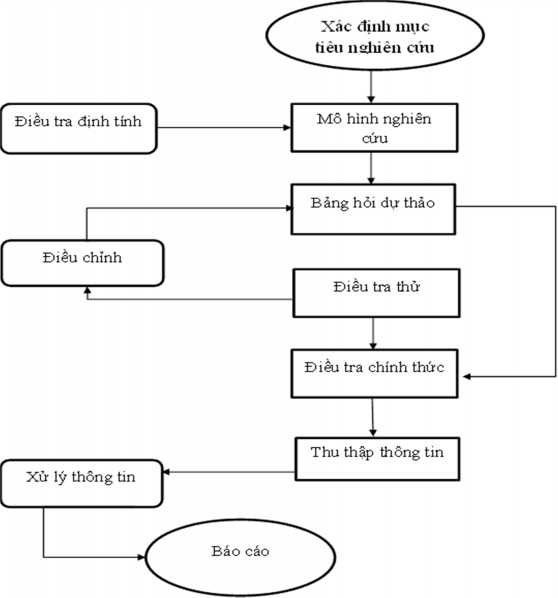
Figure 1.1: Research process
6. Research summary:
The structure of the research paper consists of 3 parts: Part I: Problem statement
This section mainly focuses on presenting basic issues including: reasons for choosing the topic, research objectives, research objects and scope, and research methods.
Part II: Research content and results Includes three chapters:
Chapter 1: Theoretical basis of job satisfaction of employees. Chapter 2: Research on factors affecting job satisfaction of employees.
Employees at MITRUDOOR Trading & Technical Company Limited.
Chapter 3: Some solutions to improve job satisfaction of employees
active in the company.
Part III: Conclusion and recommendations.
PART II: RESEARCH CONTENT AND RESULTS CHAPTER 1 : SCIENTIFIC BASIS OF RESEARCH ON FACTORS AFFECTING EMPLOYEES' JOB SATISFACTION
ACTION
1.1. Theoretical basis of the research problem
1.1.1. Concept of worker
According to the Vietnamese dictionary: "A worker is someone who puts effort into doing something"[16].
According to Article 3, Labor Code 2019: "An employee is a person who works for an employer according to an agreement, is paid a salary and is subject to the management, direction and supervision of the employer".
According to Psychology: Worker is the name used to refer to the subject of a
a special form of human activity, that is labor activity.
1.1.2. Concept of work
According to Article 9 of the 2019 Labor Code: “Employment is a labor activity that generates income and is not prohibited by law. The State, employers and society have the responsibility to participate in solving employment, ensuring that everyone with the ability to work has the opportunity to have a job.”
According to the Vietnamese dictionary edited by Nguyen Nhu Y (1999):
- Work: Is something that must be done
- Work: Is a daily job or profession to make a living
- Profession: Being proficient in a certain job. [16]
1.1.3. Theory of employee satisfaction with work
- The concept of job satisfaction has many different definitions from
various researchers such as:
According to Philip Kotler (2001), satisfaction is the level of a person's emotional state resulting from comparing the results obtained from reality with that person's expectations.
Hoppock (1935), job satisfaction is a synthesis of psychological, physiological and environmental factors that make a person feel truly satisfied with their job.
According to Weiss (1967) definition: job satisfaction is an attitude about work.
work is expressed through the feelings, beliefs and behaviors of workers.
According to Vroom (1964), job satisfaction is expressed in the degree to which employees have positive feelings and orientations towards work in the organization.
Spector (1997), job satisfaction is simply how much people feel like their jobs and aspects of their jobs. Since it is a general evaluation, it is an attitudinal variable.
According to Ellickson & Logsdon (2002), job satisfaction is the extent to which employees like their jobs, which is an attitude based on employees' perceptions (positive or negative) of their jobs or work environment. Simply put, the more the work environment meets the needs, values and personalities of employees, the higher the job satisfaction.
Although there are many views on job satisfaction, job satisfaction is considered as a general emotional variable that affects employees and includes components that affect employee satisfaction with work. When those factors are properly met, employee satisfaction will increase and will have a positive impact on the business.
1.1.4. The importance of job satisfaction
Employee satisfaction is extremely important in any organization, large or small. Making employees happy has a two-way effect, both for the organization and the employees themselves, but the degree and intensity of importance vary.
For organizations, a satisfied workforce impacts every aspect of business operations including:
Increase employee productivity. Employees who are satisfied with their jobs will have better attitudes and behaviors, be more dedicated, devoted, and proactive in learning and developing at work. This increases the overall productivity of the company and helps the company achieve its goals.
Maintaining and stabilizing the human resources in the company, satisfied employees will have a higher spirit of attachment to the business, less swayed by outside invitations. Besides, employees will promote collective interests because when they want to be attached, they will "care for", "build" and "protect" their common home.
When employees are satisfied with their jobs, they will treat customers better.
and provide better service to customers.
Employees will promote the company to the outside and that helps the company attract talent, build a good image in the eyes of customers and partners.
Save money on training new candidates and recruiting candidates.
Minimize errors in the working process as well as procedural risks because employees are more responsible and dedicated, so they always strive to do their jobs better.
As for employees, job satisfaction not only helps them to be more committed to the company but also strengthens their trust in the company. Employees will start to care about their work instead of worrying about other issues, they feel responsible for the organization and try to produce better results to gain appreciation from the company. They will also deal with customers better and build strong relationships with them.
1.1.5. Theoretical model of employee satisfaction at work
1.1.5.1. Abraham Maslow's Hierarchy of Needs Theory
Maslow's Hierarchy of Needs is a psychological theory proposed by Abraham Maslow (1908-1970). His theory aims to explain how certain human needs must be met in order for an individual to lead a healthy and productive life both physically and mentally.
Maslow's theory has brought different types of human needs, based on their demandingness and the order in which they arise, to 5 types arranged into a hierarchy of human needs from low to high.
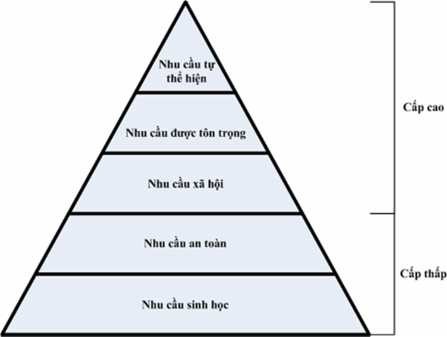
(Source: Organizational Bihavior)
Figure 1.1: Maslow's hierarchy of needs
Basically, human needs are divided into two main groups: Basic needs
basic and higher needs.
Basic needs are related to the physiological and physical needs of humans, which are the means for them to survive. This is the most basic need that humans need to meet. When people have met their basic needs, they move on to meet higher-level needs.