
career, job content, compensation and rewards including promotions, physical conditions of the work environment, as well as the structure of the organization.
According to Kreitner and Kinicki (2007), job satisfaction mainly reflects the extent to which an individual loves his or her job. It is the employee's feelings or emotions towards his or her job.
Thus, there are many different definitions of job satisfaction, but we can conclude that a person is considered to have job satisfaction if he or she feels comfortable and at ease with his or her job. Regarding the causes that lead to job satisfaction, each researcher has his or her own perspective through their research. The next section will discuss satisfaction and the scale of measuring the components of job satisfaction.
1.1.2. Theory of building a scale to measure job satisfaction
1.1.2.1 Abraham Maslow's hierarchy of needs theory (1943)
According to Maslow, human needs include two main groups: basic needs and higher-order needs.
Basic needs such as eating, drinking, sleeping, resting, and wearing clothes… are indispensable needs to maintain life. If they do not have these needs, they will fight to achieve these needs first at all costs.
Higher-order needs are spiritual needs such as security, fairness, social status, affection, joy, etc.
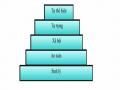
Basic needs will take precedence over the 5-level higher needs in Maslow's Hierarchy of Needs:
 First level : The most basic needs are "physical"
–biological needs - food, water, shelter, sex, excretion, breathing, rest.
 Second level : Safety needs - need to feel secure about physical safety, job, family, health, and property.
 Third level : The need for emotional exchange and belonging (love/belonging) - wanting to be in a certain community group, wanting to have a warm family, and trustworthy friends.
 Fourth level : The need to be respected and admired (esteem) - the need to feel respected, admired, and trusted.
 Level 5 : Self-actualization needs - the desire to be creative, to demonstrate one's abilities, to express oneself, to perform, to have and be recognized as successful.
Table 1.1 Summary of elements in Maslow's hierarchy of needs in and outside the workplace
First floor
Biological needs (eating, drinking, clothing, shelter...) |
| |
Second floor | Safety needs (health, security…) |
|
Level 2 three | The need for sexual intercourse feel (communication, love…) |
|
Fourth floor | The need to be respected, admired (to be respected, to have status, prestige...) |
|
Fifth floor | The need for self-expression (humanity, compassion, knowledge, beauty…) |
|


Maybe you are interested!
-
 Theory of Employee Job Satisfaction
 -
 Le Thai Phong (2015), “The Relationship Between the Nature of Work and Employee Job Satisfaction: A Study in Hanoi” Journal of Economics for
 -
 The impact of job satisfaction on employee commitment to the Bank for Agriculture and Rural Development of Ben Tre - 3
 -
 Theoretical and Practical Basis of Employee Job Satisfaction
 -
 Solutions to improve job satisfaction at KL - 2 Information Services Company Limited

Need for self-expression
Need to be respected
Social needs
festival
Figure 1.1: Maslow's hierarchy of needs
(Source: Synthesis from Maslow's hierarchy of needs theory)
1.1.2.2 Clayton Alderfer's Theory of Needs (ERG)
ERG theory recognizes three main types of human needs:
 Existence needs: The desire to be physically and mentally healthy, to have all basic needs for survival met such as physiological needs, food, clothing, housing, transportation, education... and safety needs.
 Relatedness needs: The desire to be satisfied in relationships with people. Each person has different desires to establish and maintain personal relationships. It is estimated that a person usually spends about half of his time communicating with the relationships he aims for.
 Growth needs: The desire for personal growth and development in both life and work. Jobs, professions and even higher, personal careers will ensure significant satisfaction of growth needs.
The ERG theory suggests that at the same time there can be multiple needs influencing motivation - When a higher need cannot be satisfied (frustration), a lower need is ready to recover (regression).
This model is built on Maslow's Hierarchy of Needs and is a good complement to the pyramid model. In fact, there is more research supporting this theory than Maslow's theory.
Alderfer's ERG theory also suggests that more than one need can often be active in the same person at the same time. If higher-level needs are not adequately met, the desire to satisfy lower-level needs (of the model) will increase.
ERG theory explains why employees seek higher wages and better working conditions even when these conditions are good and meet labor market standards. When employees are not satisfied with their current social and growth needs, they will seek to satisfy them.
1.1.2.3 Herzberg's two-factor theory (1959)
This theory is divided into two factors that have a motivational effect:
Motivating factors: Motivating factors are factors that are internal to the job. These are factors that create satisfaction, achievement, recognition of achievements, the work itself, responsibility and work function, and promotion. These are the 5 basic needs of employees when participating in work. The characteristic of this group is that if not satisfied, it leads to dissatisfaction, if satisfied, it will have a motivating effect.
Maintenance factors: These are factors related to the working environment of employees, the management policies of the enterprise, salary, job guidance, human relations, working conditions. These factors, when well organized, have the effect of preventing dissatisfaction with the work of employees.
Herzberg suggested that five factors typically contribute to “job satisfaction.”
To be:

Achievement: personal satisfaction from completing a task, solving a problem
solve a problem and see the results of your efforts. (People are motivated when they are able to carry out their intentions.)
 The work itself: the positive effects of the job on the individual. For example, a job can be interesting, varied, creative and challenging.
 Recognition: The recognition of a job well done. This can be generated from the individual himself or from the evaluation of others. (People are motivated when their behavior is evaluated correctly through praise (when good results are achieved) or punishment (when not up to standard).)
 Responsibility: the amount of influence a person has over a job. The amount of control a person has over a job can be influenced to some extent by the authority and responsibility that comes with it.
 Advancement and progress: are opportunities for advancement and self-improvement within the business. Opportunities for growth also arise in daily work if people have more decision-making power to implement initiatives.
The factors that Herzberg found that cause dissatisfaction but do not increase work motivation are called hygiene factors.
Maintenance factors may reduce the efficiency of work but do not increase it. Similarly, lack of maintenance may cause equipment failure but regular maintenance cannot increase its efficiency.
Maintenance factors:
 Corporate policies and regulations: This refers to how the entire business is managed and organized. For example, if corporate policies conflict with the goals of departments and individuals, it will have negative consequences. It is quite common for employees to object or feel angry with certain policies or decisions made by a certain department in the organization. Herzberg is absolutely correct in this regard, corporate policies and regulations can become obstacles but when employees are not affected by them, they will not even think about them.
 Supervision: Many experts disagree with Herzberg on this point. Leadership plays a very important role in motivating work, especially for a group of employees. Often employees will not spend much time caring about their superiors, they only think about them when they need them or when their superiors put pressure on them.
 Working conditions: Herzberg found that working conditions did not affect group performance as long as they were fairly good. Conversely, if working conditions worsened, work was negatively affected. When working conditions went beyond fairly good, it only made work performance slightly better.
 Personal relationships.
 Herzberg argues that when relationships between team members deteriorate, it can hinder work. But when relationships are good, it makes no significant difference.
 Wages:A surprising finding of Herzberg was that wages generally had no effect on motivating employees, although delayed payments could make people dissatisfied.
 Status: Status is an individual’s position in relation to others. Status “symbols” such as job titles are important. Perceptions of reduced status can severely reduce morale.
 Job Security: Not having to worry about keeping a job. It can be said that most people do not find encouragement in having a job but will be very depressed if there is a risk of losing it.
Disgruntled and unmotivated employees
motivated
Maintenance factor
Employees are no longer dissatisfied but unmotivated
force
Motivating factor
Employees are no longer dissatisfied and motivated.
force
Figure 1.2 Herzberg's two-factor theory
1.1.2.4 Stacy John Adams's Equity Theory (1963)
Equity theory was proposed by John Stacey Adams - a behavioral and management psychologist in 1963. According to this theory, if an organization creates equity, it will help strengthen the relationship between each individual and the organization, motivate and increase their satisfaction, thereby they will work more effectively and be more attached to the organization. On the contrary, when each individual feels that what they contribute is more than what they receive, they will lose their excitement and enthusiasm for their work. At that time, each individual will express their dissatisfaction in many ways, such as reduced excitement, lack of effort, working perfunctorily... In serious cases, they may have disruptive actions or "leave" to find a new workplace.
This theory suggests that, to create fairness in an organization, leaders and managers need to consider and evaluate the balance between what each individual in the organization contributes and the results they receive and find every measure to balance them. Only when
Only when individuals feel that there is fairness will they work hard for the common goals of the organization.
The theory of equity requires a balance between contribution and enjoyment. The principle of “proportionate rights and obligations” must be respected in each agency and organization. When individual rights are respected, it will have a great motivating and encouraging effect. Rights need to be divided fairly based on capacity, qualifications, efforts, enthusiasm, diligence, flexibility, self-sacrifice, loyalty, performance and efficiency in work, and the contribution of each individual to the organization. The rights that each individual receives can be salary, bonus, welfare, being given the opportunity to study to improve qualifications, recognition or promotion.
1.1.2.5 Victor Vroom's Expectancy Theory
The expectancy theory of V. Vroom, a professor at Yale School of Business Administration (and a PhD at the University of Michigan), suggests that an individual will act in a certain way based on expectations about a certain outcome or the attractiveness of that outcome to the individual. This model was proposed by V. Vroom in 1964, then modified and supplemented by several others, including scholars Porter and Lawler (1968 ) and is built according to the formula:
Motivation = Valence x Expectancy x Means
Valence (reward) = attraction for a certain goal (What is the reward for me)
Expectancy (performance) = employee's belief that if they work hard, the task will be completed (How hard do I have to work to achieve the goal)
Instrumentality (belief) = employee's belief that they will be rewarded for completing the task (Will people notice and appreciate my efforts)
The result of these three elements is motivation. This is the source of power that leaders can use to steer the group to achieve the set goals. When an employee wants to advance in his or her job, promotion has a high appeal to him or her.