
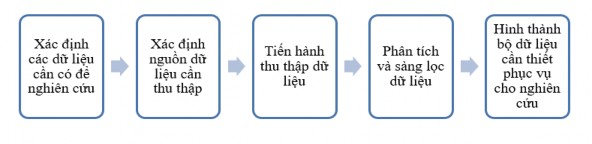
Procedure for collecting secondary data in the thesis:
b. Primary data: Primary data was collected by the author through survey and interviews.
Maybe you are interested!
-
 Theoretical and Practical Contributions of the Thesis
 -
 Improving the law on gender equality in the civil, marriage and family fields - Theoretical and practical issues - 1
 -
 Theoretical and Practical Basis for Sustainable Tourism Development
 -
 Theoretical and Practical Basis of Employee Job Satisfaction
 -
 Research on environmental improvement and restoration in open-pit coal mining activities at the intersection mine of Quang Hanh Coal One Member Limited Liability Company - Vinacomin, Cam Pha city, Quang Ninh province - 1
Purpose of survey and interview
+ Conducting surveys and interviews to gain an objective view, supplementing the secondary data the author has compiled, and seeing the shortcomings and inadequacies in the management of coal mining activities in Quang Ninh province.
About the survey subjects:
+ The survey subjects are people living near coal mining areas of Cao Son Coal Joint Stock Company, Khe Cham Coal Mine, Ha Lam Coal Joint Stock Company, Ha Tu Coal Joint Stock Company and Dong Bac Corporation.
+ The survey subjects are coal mining enterprises in Quang Ninh province including: Cao Son Coal Joint Stock Company, Khe Cham Coal Mine, Ha Lam Coal Joint Stock Company, Ha Tu Coal Joint Stock Company, Thong Nhat Coal Joint Stock Company, Nui Beo Coal Joint Stock Company, Coc Sau Coal Joint Stock Company, Deo Nai Coal Joint Stock Company, Vang Danh Coal Joint Stock Company and Dong Bac Corporation.
+ The interviewees are officials working at local State management agencies. The following persons (named below) working at the Department of Natural Resources and Environment of Quang Ninh province were directly consulted: Mr. Do Xuan Quang - Deputy Head of the Department of Water Resources, Minerals and Climate Change; Mr. Doan Trong Luat - Expert of the Department of Water Resources, Minerals and Climate Change; Ms. Tran Thi Hoang Hue - Expert of the Department of Land Planning and Planning.
Investigation and survey content:
+ The specific content of the survey focuses on: the current status of management and environmental quality around coal mining areas in Quang Ninh province, existing problems and solutions in state management of coal mining in Quang Ninh province.
+ Sample survey and interview forms: see Appendix 02, 03, 04 (pages 88, 91, 93).
Conduct survey:
The author distributed 130 survey forms to relevant subjects (100 survey forms for people living near coal mining areas, 30 survey forms for coal mining enterprises in Quang Ninh province) and interviewed 03 relevant subjects. The distribution of forms was carried out directly and sent via email. The survey period took place from March 1, 2021 to May 31, 2021.
5.2.2. Data processing method
- For secondary data:
Based on documents and data collected from research works of some scientists, experts, teaching materials of teachers, master's theses, articles, magazines, articles on the Internet..., the author classified, evaluated and selected the content and data to include in the study. Arrange appropriate documents by chapter, section, time. The author divided the problem into parts, approached them from different angles, different documents, then synthesized them to have the most general, correct and complete perception of the problem, thereby finding the nature and laws of the research object.
- For primary data: The completed survey form will be checked and entered into the computer using Excel software for synthesis and processing, in order to provide data for evaluating the state management of coal mining in the province.
6. THEORETICAL AND PRACTICAL CONTRIBUTIONS OF THE TOPIC
- In theory:
The thesis has systematized a number of theories on local state management of mineral exploitation activities in the province. From there, it clarifies the concept, role as well as the content, principles, and tools of local state management of mineral exploitation activities in the province. The contents of local state management of mineral exploitation activities focus on promulgating and implementing policies and laws on mineral exploitation activities; developing and implementing plans and plans for mineral exploitation activities; organizing the state management apparatus for mineral exploitation activities and the inspection and examination of mineral exploitation activities. The thesis also mentions factors affecting local state management of mineral exploitation activities in the province such as mechanisms and policies of the State and localities; apparatus, capacity and management level of the government; level of socio-economic development; organizations and individuals exploiting minerals.
minerals and communities. In addition, the thesis also clarifies the practical basis through research on management experiences of some localities such as Quang Binh and Thai Nguyen.
- In practice:
Based on an overview of natural conditions, socio-economic conditions, coal resource potential and the current status of coal mining activities in the period of 2017-2021 of Quang Ninh province, the thesis focuses on studying the current status of local state management of coal mining activities such as promulgating policies and laws on coal mining activities; developing and implementing plans and plans for coal mining activities; organizing the state management apparatus for coal mining and inspection and examination of coal mining activities in Quang Ninh province. The results of the current status study show that state management of coal mining activities in the province has achieved certain achievements. In addition, the thesis also points out some shortcomings and limitations in state management of coal mining activities such as compensation and resettlement support for organizations and individuals using land recovered to implement coal mining projects are still unreasonable; The planning management work has not been adjusted in a timely manner, leading to difficulties in ensuring the correct implementation of the roadmap for the end of exploitation; The organization of the state management apparatus for coal mining still faces difficulties in terms of quantity and quality of human resources and the inspection and examination of illegal coal mining activities by the Provincial People's Committee and relevant departments and agencies have not been timely and have not fully performed the state management function. Based on theoretical and practical arguments, from the viewpoint and orientation of Quang Ninh Province, the thesis presents a number of solutions to improve the state management of coal mining activities in Quang Ninh Province until 2025 and the following years.
7. STRUCTURE OF THE TOPIC
In addition to the introduction, conclusion, list of abbreviations, list of tables, list of references, appendix, the thesis is structured in 3 chapters as follows:
Chapter 1: Some theoretical bases and practical experiences on state management of mineral exploitation activities at the provincial level.
Chapter 2: Analysis and evaluation of the current state management of coal mining activities in Quang Ninh province.
Chapter 3: Orientation and solutions to strengthen state management of coal mining activities in Quang Ninh province until 2025 and the following years.
Chapter 1: SOME THEORETICAL BASIS AND PRACTICAL EXPERIENCE ON STATE MANAGEMENT OF MINERAL EXPLOITATION ACTIVITIES AT THE PROVINCIAL LEVEL
1.1. MINERAL EXPLOITATION AND STATE MANAGEMENT OF MINERAL EXPLOITATION ACTIVITIES
1.1.1. Minerals
a. Concept
Hoang Phe's Vietnamese Dictionary (2019, page 638) defines "Minerals are minerals and rocks in the earth's crust that can be exploited to become economic resources".
According to Tong Duy Thanh (2008): “ Minerals are familiar forms of matter and play an important role in human life such as coal, iron, gold, natural mineral water...” . With the great value of minerals, in the process of surveying, exploring, exploiting and processing minerals, social relations arise, requiring the State to manage them by law.
According to Article 2 of the 2010 Law on Minerals (amended and supplemented in 2018): “Minerals are useful minerals and minerals naturally accumulated in solid, liquid, and gaseous forms existing underground and on the ground, including minerals and minerals at mine waste sites”.
Thus, mineral resources can be understood as mineral components of the Earth's crust whose chemical composition and physical properties allow them to be used effectively and bring benefits in the field of material wealth production of the national economy.
b. Mineral classification
Mineral resources are classified in several ways:
- By origin: Endogenous (born underground), exogenous (born on the Earth's surface).
- By physical state: Solid minerals (metal ores, non-metals, colored stones, precious stones); liquid minerals (oil, mineral water...); gas minerals (gas, inert gas).
- According to properties, uses and chemical composition: Metallic minerals, non-metallic minerals, energy minerals and water minerals.
+ Metal minerals (or ores) through the smelting process, extracting metals or their compounds include: ferrous metal minerals (iron, manganese, titanium, chromium...) used as raw materials for the ferrous metallurgy industry to produce cast iron, steel...; non-ferrous metal minerals (copper, lead, zinc...) used as raw materials for the non-ferrous metallurgy industry to produce copper, lead, zinc... and rare or very rare metals.
+ Non-metallic minerals are ores that are used directly or processed to extract non-metallic elements or compounds such as rock salt, quartz, apatite, limestone, sand, gravel... used to produce fertilizers, ceramics and construction materials.
+ Energy minerals include rocks of biological origin such as coal, peat, oil, gas... used as fuel for the energy industry (as fuel,...) or raw materials for the chemical industry (chemicals, pharmaceuticals, artificial fibers, molding materials...).
+ Mineral water includes types of water such as fresh water used for daily life, mineral water for industry and mineral mud used in medicine and daily life.
1.1.2. Mineral exploitation activities
a. Concept
In Vietnam, the concept of mineral exploitation has been legalized in Article 2 of the 2010 Mineral Law (amended and supplemented in 2018), accordingly: "Mineral exploitation is an activity aimed at recovering minerals, including basic mine construction, island exploitation, classification, enrichment and other related activities" .
b. Characteristics of mineral exploitation activities
- Mineral exploitation activities are activities with subjects and objects.
Mineral exploitation is an activity carried out after the competent state agency issues a mining license and is calculated from the time the mine begins basic construction (also known as opening the mine) until the mine ends exploitation (closing the mine - environmental restoration). Thus, mineral exploitation activities have specific exploitation subjects and objects.
+ Mineral exploitation entities are organizations and individuals who must fully satisfy the relatively strict conditions according to the 2010 Mineral Law and the Decree guiding the implementation of the regulations. According to Article 51 of the 2010 Mineral Law, the necessary conditions to become a mineral exploitation entity include the following two requirements:
Is an organization (enterprise established under the Law on Enterprises; cooperative, cooperative union established under the Law on Cooperatives) or business household.
Having registered business in the mineral exploitation industry, in which "business households registered for business in the mineral exploitation industry are only allowed to exploit minerals for common construction materials and exploit minerals to the fullest extent" .
+ Exploitation object: Mineral exploitation is an activity to recover minerals, so this activity has minerals as the exploitation object.
- Mineral exploitation is a special activity.
Firstly, mineral exploitation can be carried out in many different forms:
+ According to the exploitation method
There are two forms of mining: open pit mining and underground mining.
Open pit mining is a form of mining that involves removing the rock and soil that cover the mineral being mined. Most open pit mining uses large machinery such as excavators to remove the surface rock and soil, followed by a cable-pulled excavator or a roto-type multi-bucket excavator to extract the mineral.
There are many types of open pit mining, of which strip mining and open pit mining are the two most common.
Underground mining is a form of mining in which there is no stripping of the cover but people dig tunnels below the ground to get ore. These mines have invested in innovative technology, equipment and mining techniques, especially mechanized underground mining, which has contributed to increasing the output of natural resources of the mine.
+ According to scale and mining technology
According to Clause 2, Article 1, Decision No. 588-CNNg/QLTN dated August 1, 1992 of the Ministry of Heavy Industry, the forms and scales of mineral exploitation are prescribed as follows:
“Manual exploitation by individuals, mainly using primitive, hand-held tools, can use small, mobile mechanical tools, and transport by human or animal power.
Small-scale mining with a total volume of minerals and rocks under 30,000 m3 or under 50,000 t/year, with basic investment capital not exceeding 1 million USD.
Large-scale mining has a total volume of minerals and rocks, the basic investment capital is not small-scale mining.”
Currently, based on the scale and technology of exploitation, documents often refer to industrial-scale exploitation and small-scale, artisanal exploitation.
Industrial-scale mining is a form of mining with a large scale, long mining time, mainly using machinery in mining activities.
Small-scale, salvage mining: This form of mining is taking place in many localities across the country and focuses mainly on minerals used as construction materials.
+ According to legality: licensed exploitation and illegal exploitation.
Second, mineral exploitation is a conditional activity. The conditions for granting mining licenses are approved by competent state agencies.
According to Clause 2, Article 53 of the 2010 Law on Minerals (amended and supplemented in 2018), organizations and individuals granted a Mineral Exploitation License must meet the following conditions:
“There is a mineral exploitation investment project in an area that has been explored and has approved reserves in accordance with the planning specified in Points b, c and d, Clause 1, Article 10 of this Law. The mineral exploitation investment project must have a plan for using specialized human resources, equipment, technology, and appropriate advanced exploitation methods; for toxic minerals, it must also be approved in writing by the Prime Minister;
Have an environmental impact assessment report or environmental protection commitment in accordance with the provisions of law on environmental protection;
Have equity capital of at least 30% of the total investment capital of the mineral exploitation investment project.”
Business households specified in Clause 2, Article 51 of the 2010 Law on Minerals (amended and supplemented in 2018) are allowed to exploit minerals for common construction materials and exploit minerals to the fullest extent when meeting all the conditions prescribed by the Government in Article 36 - Decree 158/2016/ND-CP guiding the Law on Minerals. Business households are granted a Mining License when meeting all the following conditions:
“There is a technical economic report on mineral exploitation in the area where the exploration and approved reserves are in accordance with the planning for mineral exploration, exploitation and use of the province or city where the minerals are located. The technical economic report on mineral exploitation must have a plan for using specialized human resources, equipment, technology and appropriate exploitation methods;
Have an environmental protection plan with approval documents from competent authorities according to regulations of law on environmental protection;
The mining capacity scale does not exceed 3,000 m3 of raw mineral products/year.”
Thus, the condition for organizations, business households and individuals to exploit minerals is to be granted a Mineral Exploitation License by competent state agencies.
Third, mineral exploitation activities bring benefits to socio-economic development but have a strong impact on the natural environment and people.
+ Mineral exploitation causes environmental pollution.
Mineral exploitation has been and is increasingly occupying an important position in the economies of countries. However, besides the positive aspects achieved, humans are also facing many environmental problems. In the process of mineral exploitation, humans have changed the surrounding environment. The main factors affecting the environment are the exploitation of mines, waste dumps, toxic gases, dust and wastewater... which disrupt the ecological balance that has been formed for tens of millions of years, causing serious pollution to the environment.
Mineral exploitation pollutes water sources in neighboring areas.
The breakdown of the structure of ore-bearing soil and rock during excavation and blasting will promote the processes of leaching the components contained in the ore and soil and rock, leading to the dissolution of waste into water sources, solid waste, and dust that are not strictly managed and treated, participating in the composition of rainwater, runoff water supplying natural water sources, etc. are chemical impacts that change the physical properties and chemical composition such as increasing turbidity, changing pH and reducing the quality of water sources around the mining area. In addition, mining also affects the groundwater level, including lowering the groundwater level of neighboring areas and changing the flow direction in the groundwater bag; pollution of the groundwater bag located below the mining area due to polluted water infiltrating from the surface layer.
Mining causes air pollution: In addition, mining and mineral transportation activities also have negative impacts on the air environment due to smoke and dust during transportation and unloading. The amount of smoke and dust reduces air quality in the mining area, causing harm to the health of mine workers as well as the surrounding area.
+ Mineral exploitation changes the landscape: The process of mineral exploitation usually goes through three steps: opening the mine, exploiting and closing the mine. Thus, all stages of exploitation affect land resources and environment. Moreover, current exploitation technology is not reasonable, especially metal mines and mining areas are mostly located in mountainous and midland areas. Therefore, mineral exploitation