
- Pay more attention to the quality of employees. Banks can only operate effectively if they have a quality staff. Therefore, joint stock commercial banks are tending to adjust and rotate employees to more suitable positions, or those who do not meet the requirements are retrained to improve their capacity and continue working [5].
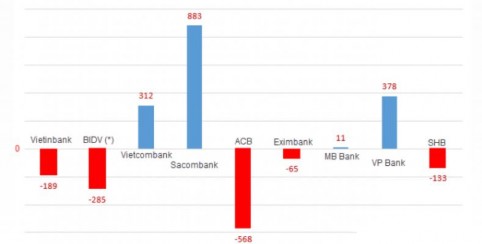
Figure 2.2: Chart of changes in recruitment at banks in the first 6 months of 2013 (Source http://cafebiz.vn/viec-lam/ngan-hang-nao-lap-ky-luc-cat-giam-nhan-su-trong-nua-dau-nam 2013)
Does the culture of joint stock commercial banks, especially internal changes, affect employee engagement? This is one of the bases for the author to choose to study.
2.2.1 Concept
The concept of organizational culture is often defined in different ways by different authors and researchers. However, there are many arguments that organizational culture can be viewed as a system of meanings, values, dominant beliefs, perceptions and ways of thinking that are shared by all members of an organization and that have a broad influence on the way members act (Lund, 2003; Pool, 2000). Author Luthans (1992) defined
Corporate culture includes the ethical norms, value systems, beliefs and atmosphere in the working environment of a company. According to Schein (1992), culture is a form of basic assumptions - invented, discovered, developed by a group as they learn to cope with the problems of external adaptation and internal integration - that have come into play and are considered valid and therefore communicated to new members to follow. According to the two authors Ricardo and Jolly (1997), when talking about corporate culture, people often talk about the system of values and beliefs that are understood and shared by members in an organization. A culture helps to shape and determine the behavior of members and the policies in the organization.
In general, “culture is deep, broad and complex” (Schein, 1992) and it can be understood that corporate culture is the foundation for the behaviors and activities of each individual in the organization, the product and asset of each company. Based on the inheritance of the research of scholars and the logical research system on culture and business culture, corporate culture is defined by Do Thi Phi Hoai (2009) as follows: “Corporate culture is a system of meanings, values, dominant beliefs, ways of perception and thinking methods that are agreed upon by all members of the company and have a wide range of influence on the way each member acts in business activities, creating the business identity of the company”.
2.2.2 Organizational culture components
The organizational culture component has been studied by many scholars and presented different factors. The author has summarized some of the following examples:
Table 2.1 Summary of the different components of a literary text
STT
Author | Literary components | |
1 | Wallach (1983) | 1. Innovative culture 2. Support literature 3. Administrative office |
Maybe you are interested!
-
 The impact of organizational culture factors on employee engagement at Ho Chi Minh City Joint Stock Commercial Banks - 2
 -
 Organizational Chart of Lien Viet Post and Commercial Joint Stock Bank
 -
 Organizational Structure of Joint Stock Commercial Bank for Foreign Trade of Vietnam - Bac Ninh Branch
 -
 Factors affecting the debt repayment ability of corporate customers at Vietnam Joint Stock Commercial Bank for Investment and Development - Long An Branch - 1
 -
 Corporate culture of Vietnam Industrial and Commercial Bank, case study of Hai Ba Trung Industrial and Commercial Bank branch - 11
2
Charles Handy | 1. The culture of power | |
(1985) | 2. Role of culture | |
3. Task literature | ||
4. Personal writing | ||
3 | Denison | 1. Cultural integration |
(1990) | 2. Consistent writing 3. Adaptive culture | |
4. Mission statement | ||
4 | O'Reilly et al | 1. Respect people |
(1991) | 2. Team orientation | |
3. Principle details | ||
4. Stability | ||
5. Improvement | ||
6. Results Oriented | ||
7. Energetic and resourceful | ||
5 | Ricardo and | 1. Communication |
Jolly (1997) | 2. Training and development | |
3. Rewards and recognition | ||
4. Make a decision | ||
5. Take risks through creativity and innovation | ||
6. Planning orientation | ||
7. Work hard | ||
8. How to manage policy | ||
6 | Lau and Idris | 1. Information exchange |
(2001) | 2. Training and development | |
3. Rewards and recognition | ||
4. Work hard | ||
7 | Delobbe et al (2002) | 1. Recognition - support 2. Solidarity - team spirit |
3. Improvement - work efficiency 4. Principles and rules 5. Continuous learning |
Source: Author's summary from reference
According to Wallach (1983), there are three types of organizational culture namely administrative, creative and supportive to measure organizational culture:
Administrative culture : a type of culture in which authority and responsibility are clearly defined and work is well planned and organized. This culture is based on power and control.
Innovative culture : results-oriented and challenging work environment. An innovative culture focuses primarily on the organization's internal systems and the search for competitive advantage, encouraging openness to new thinking and internal capabilities to successfully implement new ideas, new processes or new products.
Supportive culture : teamwork, trust, encouragement and people-oriented environment.
Charles Handy (1985) proposed four types of corporate culture as follows:
Power culture : power is concentrated in a few people, control is at the center. Power culture has few rules and some bureaucracy, decisions are made quickly. Individuals working in organizations with power culture are motivated by rewards and punishments and expect to work under a good leader. The leader in this organization must be a person with enough power, fairness and generosity. In power culture, the role of the manager is very important.
Role culture : people are assigned clear tasks in the organization. This type of organizational culture is an orderly machine. Power is divided from job position and a little from professional capacity. Role culture gives stable, fair and useful work results. The rights and responsibilities in the role of each member are clearly defined. A role culture system
A well-designed system is one in which the results come from the structure rather than from the control of managers.
Task culture : groups are formed to solve specific problems. Power is distributed from the expertise of the group as well as from the expertise of the group. This culture is often characterized by diversity and matrix structure.
Individualistic culture : exists in organizations where individuals believe in their own abilities and work towards the organization. They include groups of experts such as doctors, lawyers, and non-profit organizations. Cooperation can occur between people of equal ability and who are oriented towards the goals of the organization. This structure becomes more common as organizations increasingly contract out work that requires expertise and specialization from those who are only used when needed. Each individual in the organization has his or her own expertise and customers for the company.
Denison (1990) divided literature into four components:
Inclusive culture: focuses primarily on engaging the participation of members in the organization in response to rapid changes in the external environment. Inclusive culture often focuses on caring for the needs of employees and sees it as a way to achieve high labor results. Enthusiastic and engaging participation of employees enhances the sense of responsibility and ownership, thereby making them act more consciously and proactively in the work of the organization.
Inclusive culture includes the following elements: decentralization, teamwork, and development capabilities.
Consistent culture : focuses on internal issues and on consistently building and maintaining a stable environment. Organizations that adopt this philosophy often promote a systematic, methodical, and consistent approach to operations. Icons, role models, and anecdotes are often used to promote cooperation and strengthen
Traditional. Policies and measures are designed to reinforce the “traditional” philosophy. The enthusiasm of each member is only ranked in secondary position, but this weakness of the organization is balanced by the level of consistency, consensus and cooperation among members. The strength of the organization is created from harmony and efficiency.
Consistent culture includes elements: corporate values, cooperative exchanges, and reward policies.
Adaptive culture : characterized by a strategy that focuses on the external environment to achieve flexibility and change to suit the requirements of the environment. Adaptive culture emphasizes norms and beliefs that enhance the ability to detect, process and translate signals from the external environment into adaptive behaviors of the organization. This type of business may need to be able to adjust its structure or adapt to the requirements of the situation and the way of acting of new jobs.
Adaptive culture includes elements: Creativity in work, customer care, training and development.
Mission culture : Organizations that are concerned with meeting the demands of the external environment but do not necessarily require rapid change are considered to be consistent with a mission culture. A mission culture places great importance on alignment with the overall mission of the organization. A shared mission makes the work of each member of the organization more meaningful than what is expressed in their job descriptions and responsibilities. Employees have a better understanding and direction of their roles and missions in the organization. Organizational leaders guide their behavior by indicating the desired future goals and making the country meaningful to everyone.
Mission statement includes the following elements: strategy, vision, and goals.
In 1991, O'Reilly et al published in the journal "The Academy of Management Journal" a model of OCP corporate culture consisting of 7 cultural components:
Respect for people: component measures fairness, respect for people, behaviors, communication between employees, company, superiors and employees, recognition, training, employee development.
Team orientation: component measuring human relations in the group, in the company, team spirit and support, cooperation when working.
Principled details : components that measure carefulness, detail, and accuracy in work, requirements for compliance with regulations and laws in work and company.
Stability : component measuring safety, stability, and peace of mind at work.
Innovation : a component that measures the desire for innovation, change, exploration, opportunity exploitation, creativity, and risk taking in innovation.
Consistent culture: employees, action-oriented to achieve the highest results.
Energetic/Resourceful: component measures the energetic, resourceful, dedicated, proactive attitude in work as well as other activities inside and outside the company.
Ricardo and Jolly's (1997) theory of corporate culture includes eight cultural components:
Information exchange: is considered a means by which individuals and organizations carry out their work in different ways within different scopes and authorities but all towards the common goal of bringing good results and success to the organization.
Training and development : is the process of providing employees with the necessary skills for the job or helping employees correct deficient skills in the process of performing the job.
Rewards and recognition : what behaviors are rewarded and what forms of rewards are used, are employees rewarded individually or collectively?
salary, promotion criteria, and the extent to which the organization provides feedback on job performance.
Decision making : concerns questions such as how decisions are made and how conflicts are resolved. Are decisions fast or slow. Is the organization hierarchical. And is decision making centralized or decentralized.
Risk taking by creativity and innovation : creativity and innovation are valued and rewarded, risk taking is encouraged, and openness to new ideas. People are punished or encouraged to experiment with new ideas.
Planning orientation : long-term or short-term planning, and future planning orientation; what visions, strategies, and goals are shared with employees.
Teamwork : This component is concerned with the importance, form, and effectiveness of teamwork in the organization. It includes the importance of cooperation between different departments, trust between different functions or units, and the level of support for the work process.
Management policies : measure the fairness and consistency with which policies are implemented, the influence of management style on employees, and the extent to which managers provide a safe working environment.
Based on the 08 cultural components of Ricardo & Jolly (1997), Lau and Iris (2001) proposed 04 components including: information exchange, training and development, rewards and recognition, teamwork.
The study “Measuring cultural components: synthesis of research and development of a new tool” by Delobbe et al (2002) synthesized the corporate culture models that have been studied and proposed a new corporate culture model ECO consisting of 5 cultural components: