
1.3 Research object and scope
- Research object: Organizational cultural factors that affect employee commitment to the organization.
- Research scope: The research is limited to joint stock commercial banks in Ho Chi Minh City.
- Survey subjects: Employees working at joint stock commercial banks in Ho Chi Minh City.
Maybe you are interested!
-
 The impact of organizational culture factors on employee engagement at Ho Chi Minh City Joint Stock Commercial Banks - 3
 -
 Organizational Chart of Lien Viet Post and Commercial Joint Stock Bank
 -
 Organizational Structure of Joint Stock Commercial Bank for Foreign Trade of Vietnam - Bac Ninh Branch
 -
 Factors affecting the debt repayment ability of corporate customers at Vietnam Joint Stock Commercial Bank for Investment and Development - Long An Branch - 1
 -
 Corporate culture of Vietnam Industrial and Commercial Bank, case study of Hai Ba Trung Industrial and Commercial Bank branch - 11
1.4 Research methods
1.4.1 Data sources used
The topic uses primary data sources obtained by direct or indirect interview survey method with pre-designed questionnaire.
1.4.2 Implementation method
The research topic is carried out through two stages: preliminary research and official research:
- Preliminary research was conducted through qualitative methods. Based on the research objectives, theories of corporate culture, theories of employee engagement to form a research model. Then, qualitative research was conducted using interview and discussion techniques to adjust the scales and concepts accordingly.
- The official research was conducted using quantitative methods through surveys based on pre-designed questionnaires. The survey sample in the official research was conducted using the convenience sampling method. The collected data was processed using SPSS software to preliminarily evaluate the scales, analyze exploratory factors, analyze correlations, and regression to clarify issues related to the research hypothesis.
1.5 Thesis structure
The thesis consists of 5 chapters, specifically as follows: CHAPTER 1 - TOPIC OVERVIEW
CHAPTER 2- THEORETICAL BASIS AND RESEARCH MODEL CHAPTER 3- RESEARCH METHODOLOGY
CHAPTER 4- RESEARCH RESULTS
CHAPTER 5 - IMPLICATIONS FOR MANAGERS AND CONCLUSION REFERENCES
APPENDIX
CHAPTER 2
THEORETICAL BASIS AND RESEARCH MODEL
Chapter 2 presents the concept and theory of organizational culture, employee commitment to the organization, the relationship between organizational culture and employee commitment and reviews previous studies conducted in the world and in the country on the relationship between organizational culture and employee commitment to the organization. Chapter 2 also presents the characteristics of the joint stock commercial banking system and the cultural characteristics of joint stock commercial banks. These theories will serve as the basis for selecting, designing research models and hypotheses.
2.1 Joint stock commercial banks and some characteristics of joint stock commercial banks
2.1.1 Joint stock commercial bank
Joint stock commercial banks are the name in Vietnam for banks that operate in business and commerce under the joint stock model and comply with the Government's own laws and the regulations and rules of the State Bank of Vietnam when operating. They are called joint stock commercial banks to distinguish them from state-owned commercial banks, joint venture commercial banks, and branches of foreign commercial banks in Vietnam [2].
2.1.2 Characteristics of joint stock commercial banks
According to information from the State Bank of Vietnam, as of June 30, 2013, there were 34 joint stock commercial banks [3]. The banks have all undergone a formation process of over 15 years (See Appendix 1). With a long period of formation and development, each joint stock commercial bank has built its own cultural identity. However, joint stock commercial banks also have similarities.
- Business philosophy
Banks are both capital mobilizers and lenders to customers; from the intermediary position, the mission - or the statement of the reason for existence of commercial banks is "connecting different money needs in the economy".
From the mission, the bank's business strategy will be built, combined with the appropriate socio-economic conditions in each situation, so as to create the best conditions for customers to deposit and borrow money. The business strategies of different banks are different and depend on the business environment at each time, however, the main contents of the strategy that the bank must ensure are: Continuously improving products to best serve the needs of customers; having support services for customers to maximize the exploitation of the products provided; creating conveniences, improving procedures and documents...
Thus, business philosophy plays a very important role in all banking activities because it is a system of principles, missions, goals, strategies... that plays a guiding role for the entire banking operation process. Building a correct business philosophy is the top condition for implementing the following activities.
- Business ethics
For bank employees, ethical standards and qualifications play an even more important role than anyone else, because they are the ones who directly create products to serve the needs of customers and because the nature of banking activities is closely linked to "money" - a very sensitive field - it is easy to make people change. Each bank has regulations on the standards required of bank employees, specifically "having both heart and vision, good at professional skills, acting according to the law, having ethics in banking business, civilized in communication, having a healthy lifestyle" ...
- Culture of bank management
If we imagine a commercial bank as a ship, then the bank's leadership will have the position of a captain, the leadership is the soul and the one who plays a decisive role in creating the business culture of a commercial bank. The bank's leadership may not be present continuously, not directly involved in the bank's activities, but when necessary, especially in difficult times, they are always a solid support in both work and spirit for the entire bank. They are not only the ones who decide on the organizational structure, technology, operating strategy, target customer group of the bank, but also the ones who create the symbols, ideology, language, beliefs, rituals and myths of the bank, the ones who create the environment for individuals to promote their creativity and the ones who contribute to bringing a free space, a cozy atmosphere in the bank. In the process of formation and development, the culture of the leader will reflect on the culture of the bank. As far as leaders are concerned, the way in which a leader evaluates, rewards, or reprimands employees directly affects the behavior of all employees under his or her control.
Besides, leaders also actively contribute in sharing experiences and cultural values learned in the process of handling common problems. Bank leaders will use these experiences to achieve high management efficiency, creating a cultural environment that effectively supports the bank's operations.
- Rewards and benefits
Ethical rules, forms of rewards and treatment are one of the contents of business ethics of the bank, it has the effect of regulating the daily activities of the bank, deterring the staff to cultivate ethics to help form people who are devoted to the common cause in an organization with discipline and cultural behavior.
Performance appraisals at banks are usually held every 6 months or every 12 months. Bonuses are based on employee evaluation results.
Employees are often rewarded at the year-end party. Banks also often organize trips, festivals to celebrate the bank's founding anniversary, etc. for employees and their families to participate in, creating intimacy and solidarity. Holidays are the occasion for employees to relax together, temporarily forget about work and have fun.
- Training and development
In particular, working in the banking sector - where work pressure and competition are very high, always requires staff to constantly improve their qualifications, expertise, and soft skills to serve their work. Through training, employees will improve their knowledge, professional expertise, and other skills, thereby creating the greatest value for themselves and the bank. At the same time, through the training process, employees can also determine their own development goals in line with the Bank's development goals.
Banks regularly organize courses on professional skills, courses to improve professional skills and skills. Some banks even have their own training centers such as Asia Commercial Joint Stock Bank. This shows that joint stock commercial banks pay much attention to employee training.
- Other physical and non-physical forms
Symbol :
As a tool to express the characteristics of the business culture of a commercial bank, it represents the value and belief that the bank wants to convey. Architectural works, rituals, legendary anecdotes, slogans, product designs, bank layouts, etc. all contain the characteristics of symbols, because through specific, tangible material values, these symbols all want to convey values, ideas, and hidden, profound meanings to customers.
Customers receive in different ways. So the signs of branches at all levels must be consistent in design and color.
Language, slogans, costumes and model specifications :
During operations, banks can choose one or more different languages, but in the integration trend, proficiency in English is also one of the essential conditions for bank staff.
Slogan:
Slogans are short, concise, memorable, and easy to remember forms of business philosophy. Not only employees but also partners always mention slogans. Slogans are often used with simple language, so to understand their hidden meaning, it is necessary to relate them to the bank's mission statement.
About clothing :
During working hours, at the headquarters and transaction counter, all officers and employees must wear uniforms, badges, and logos according to unified regulations. The color of the uniform is unified according to the background color of the logo.
Typical publications :
These are official documents that can help relevant people to understand more about the bank's business culture. These documents help to clarify more about the bank's goals, principles, beliefs, core values, attitudes towards employees, customers and society. It is an important symbol and an important basis for understanding the business culture of a bank.
Customs :
In professional activities and collective activities, individuals and each member branch will build behavioral habits that have social and ethical meanings.
Humanity within the bank, towards the social community, is supported by everyone. It is expressed in forms such as: Customs within the bank; Customs with the social community; Customs with customers...
Each bank has a different culture. In each department, division, unit from the Head Office to the Branches/Transaction Offices of the bank, there are additional separate cultures. However, although there are different separate cultures in each internal unit, each bank, because they operate in the same organization and in the same field, there are still common and characteristic cultures.
In the context of banking operations being particularly difficult since 2012, banks have had a number of changes such as:
- Find ways to cut costs and many banks have drastically cut bonuses . When answering questions before the National Assembly in November 2012, the Governor of the State Bank clearly stated his opinion, strictly prohibiting banks from giving bonuses and increasing salaries if they do not set aside enough risk reserves and must reserve profits to handle bad debts. The Governor's opinion was written in the content of Directive No. 06 on banking activities in the last months of 2012 and 2013 issued on November 9. According to some financial and banking experts, the bonus level of the banking industry does not exclude many banks from cutting bonuses completely due to business losses [4].
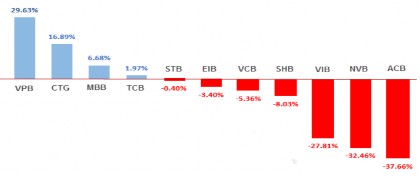
Figure 2.1: Chart of increase/decrease in average employee expenses at banks in the first 6 months of 2013, compared to the same period in 2012 (Source http://cafebiz.vn/viec-lam/thu-nhap-nganh-ngan-hang-6-thang-dau-nam)