
competitiveness of travel businesses. Many times, in order to pursue a specific strategy/goal, businesses may sacrifice a large part of their profits. However, in the medium and long term, maintaining and improving business efficiency is vital to the business and reflects the true competitiveness of travel businesses.
This ability is determined by three basic indicators and the ratio of profit/cost , profit/customer and profit/employee . Calculation of these indicators can apply either static or dynamic method. If the static method is applied, the data entered and calculated will be the business results of the enterprise at the research period. When applying the dynamic method in the research, the data entered and calculated will use the weighted average ratio of 2 to 3 years before the research time. The data source used for calculation according to both dynamic and static methods can be taken from the annual reports of the research enterprises.
Management and innovation capacity : This capacity reflects the level of management and strategic orientation of the enterprise. This factor is determined by the indicators of the level of strategy development and implementation , the ability to resolve crises and the application of management tools . Since these indicators are very difficult to quantify, indirect methods can be applied for calculation. The method often applied by economic research is the method of scoring according to certain criteria for each indicator of the research enterprises. In addition, if the sample size is large enough, these indicators can also be determined by ranking the enterprises for each indicator in ascending order of value through direct survey results at the research enterprises.
Ability to connect and cooperate : This is a particularly important factor in the travel business in general and international travel business in particular. This ability not only affects the competitiveness of international travel businesses at the time of research but also has an impact on
Maybe you are interested!
-

 Tourism and Travel Services Business is a Conditional Business Line
 -
 The relationship between social responsibility, green marketing strategy, corporate reputation and business performance: a study of tourism and travel businesses in Ho Chi Minh City - 20
 -
 The Impact of Website Quality on Tourist Satisfaction and Purchase Intention - The Case of a Travel and Tourism Business - 14
 -
 The relationship between travel motivation, destination image and destination choice - A case study of Binh Dinh province tourism destination - 1
 -
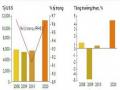 Business Performance of the Company in the Period 2009–2011 Table 2.1. Business Results of Viet Holiday Travel Company
strong impact in the future. This ability will be determined by three factors: the number of traditional sending companies , traditional receiving companies , and traditional suppliers of the company. These figures can be easily quantified through direct surveys at the research enterprises.

TBCI
Business resources
Ability to maintain and expand market share
Product competitiveness
Ability to maintain and improve business performance
Management and innovation capabilities
Ability to connect and collaborate
- Capital
- Human resources
- Trademark
- Actual market share - Price level
- Growth rate - New products increase market share
- R&D costs
- Profit/cost
- Profit/customer
- Profit/employee
- Strategy - Sending company
- Customer management
Panic - Company received
guest
- Method - Suppliers manage the level
Figure 1.3. TBCI calculation model
1.3.2.2. Method of calculating TBCI
+ Determine the values of indicators and factors:
The six groups of factors of the model include 17 basic indicators. Most of these indicators can be calculated from data sources reported by enterprises, state management agencies or from direct survey results. However, there are some indicators that are very difficult to determine quantitative values (such as brand , management methods , etc.). For these indicators, the model will arrange the enterprises in ascending order of value of each indicator. The order number of each enterprise will be used to calculate the value of the indicators.
The value of the indexes ( C i ) in a factor ( y k ) is very different for different businesses. For example, some businesses have capital up to hundreds of billions while this number in other businesses can be only a few billion. If we compare these values directly, the deviation between the indexes will be very large. Therefore, to calculate the value of the factors, we will assign the value
of the indices in the range from 0 to 1 according to the following formula:
C
C
~ C d min C d
i
d
C
i
i max d
C
~
i
i
min d
(formula 1.9)
In there:
d
i is the conversion value for the i index of enterprise d
C
i
d is the real value for the index i of enterprise d
Then the value of each factor will be determined by the following formula:
y d 1
~
i
C d
with k = (1÷6) (formula 1.10)
n
k
k i ( 1: n k )
In there:
y
d
-k
-n k
is the calculated value for the k factor of the enterprise d
is the number of indices in factor k
+ Determine the weights and calculate TBCI:
As analyzed above, all six factors included in the model, namely enterprise resources, ability to maintain and expand market share, product competitiveness, ability to maintain and improve business efficiency, management and innovation capabilities, and ability to connect and cooperate, all have a positive impact on the competitiveness of the enterprise. Therefore, in theory, the number of these factors must have a positive (+) sign. If one of the six weights has a negative (-) sign, the model is definitely flawed and cannot be used to calculate the competitiveness of the enterprise.
First, the model will use the multivariate regression method to determine the expected weights of the factors ( f k ). Accordingly, the model can identify a number of businesses with very different competitive capabilities and then rank them in order of competitiveness from low to high. Then, based on this order, the model will conduct multivariate regression to determine the coefficient ( β k ) of each factor. In addition, the model can also reduce the values of the factors to the same scale and because in theory, the weights all have positive signs, the total value of the factors can be used to conduct regression to determine the value of the coefficient ( β k ).
On that basis, the model will calculate the weight of each factor ( f i ) according to the formula:
fk
k
k
k (1: 6)
then
fk 1
k (1:6)
(formula 1.11)
Based on the obtained weights, the model will recalculate the ability score.
Expected competition of each business ( tbci d ) according to the formula:
tbci d
y
k
with d
f
k (1:6)
d
y
kk
is the value for the k factor of the enterprise d
(formula 1.12)
y
d
Based on the tbci of each business obtained, the model conducts multivariate regression to re-determine the coefficient of each factor to calculate the weight. This process will be repeated several times to minimize errors. The final value obtained is the weight ( F k ) used to calculate the TBCI. Then the official TBCI of international travel businesses will be determined according to the formula:
TBCI d
F k kk (1:6)
(formula 1.13)
With TBCI d is the competitiveness score of the enterprise d F k is the weight of factor k ( k = 1÷ 6)
In summary, the method of determining the competitiveness of international travel businesses is conducted through 3 main steps and is shown in the following diagram:
Rating Index (17)
~
Step 1
C d
C d min C d
i
max C d min C d
i
i
i
i
Conversion Rating Index (17)
Step 2
y
d
~
1
k
n
k i (1: n k )
C d
i
Summary of factors (6)
Competitiveness Index
Step 3
TBCI F y
d
d
kk
k (1:6)
Figure 1.4 . Steps to determine the competitiveness of international enterprises
1.3.3.3. Meaning of TBCI index
The TBCI index reflects the current competitiveness of travel businesses in general. This index includes not only internal factors of travel businesses but also market factors, inputs and outputs of the production process. From a general perspective, this index can be divided into the following levels:
0 < TBCI < 0.25: Enterprises have low competitiveness
0.25 ≤ TBCI < 0.5: Enterprise has average competitiveness
0.5 ≤ TBCI < 0.75: Enterprises have high competitiveness
0.75 ≤ TBCI: Enterprises have the ability to dominate the market
or exclusive
1.4. Experience in improving competitiveness for international enterprises of some countries after joining the WTO
1.4.1. China's experience in enhancing the competitiveness of travel businesses after joining the WTO
China officially joined the WTO in November 2001 at the WTO Ministerial Conference in Doha (Qatar), ending a 15-year negotiation process. China's entry into the WTO and under what conditions is considered an important international event, affecting many countries, trade powers such as the United States, the European Union, Japan, Canada, as well as emerging countries such as Mexico, Brazil, India, South Korea, etc. and even Vietnam.
1.4.1.1. China's commitments and implementation of WTO commitments on tourism business
Like other countries, China's WTO commitments on tourism business in general and travel in particular are much simpler than its trade commitments. China's commitments in the field of travel business when joining the WTO mainly focus on the following issues: Establishment and ownership of travel agencies; minimum capital; scope of activities and geographical limitations .
Accordingly, within the first 3 years after joining the WTO, China committed to allowing foreign companies to buy and hold shares of domestic travel companies as well as establish agencies. After 3 years of becoming an official member of the WTO, China committed to allowing foreign-invested travel companies to be established in certain areas (geographically limited). These companies are allowed to operate domestic travel programs but are not allowed to organize overseas tours.
China also pledged that after five years of joining the WTO, it would allow foreign-invested travel companies to establish branches, lower the minimum capital required to establish travel agencies for foreign companies to the same level as domestic companies (2.5 million yuan), and remove geographical restrictions.
After joining the WTO, China has focused on amending and promulgating a series of new laws and regulations, promoting the reform of domestic economic institutions. The large-scale adjustment of the legal framework has promoted the improvement of the market economy legal system.
Along with the law amendment, China has paid special attention to comprehensive human resource development and has quickly trained a team of experts who are well-versed in WTO law and those of other countries in the world to be ready to face the WTO integration process. In addition, China's state management system has also been strengthened and upgraded to be capable of meeting post-WTO requirements.
In terms of tourism, all indicators such as the number of international tourist arrivals, total spending by international tourists, etc. have grown at a spectacular rate. China has become one of the most attractive tourist destinations in the world and is the fourth country in terms of outbound tourists. Currently, tourism revenue accounts for about 8% of China's GDP and accounts for about 7.8% of the global tourism market share.
1.4.1.2. Solutions to improve competitiveness for Chinese travel businesses
Before, during and after the WTO accession process, China has paid great attention to improving the competitiveness of domestic enterprises and considered this the most important solution to take advantage of the advantages and opportunities brought about by the international economic integration process. In the field of tourism business, to improve the competitiveness of domestic enterprises, China has focused on the following 7 main contents:
* Improve business environment
After becoming an official member of the WTO, China immediately focused on perfecting its legal system by amending more than 3,000 laws. These amendments were aimed at ensuring the requirements and commitments of joining the WTO, but more importantly, they were aimed at creating an equal legal environment for domestic enterprises while still ensuring regional development goals and political goals.
China has asked ministries and localities to provide maximum support to non-state enterprises, especially small and medium-sized enterprises, to ensure fair treatment through economic policies and build a public opinion environment that supports non-state economic development.
The Chinese government has also requested all ministries (including tourism) to build a system of quality standards, production techniques, and high-quality services for domestic and foreign markets to create a legal basis for improving the quality of products and services as well as fair treatment between businesses and ensuring and maintaining the reputation and brand of domestic businesses. In addition, the Chinese government also encourages businesses to apply for international quality and environmental certificates such as ISO 9001, S1400, etc.
* Use macro tools effectively
To ensure the competitiveness of the entire system of domestic tourism enterprises, China still maintains and uses state-owned enterprises to play the role of guiding and leading the market.
In parallel with that process, the Chinese government has expanded and facilitated businesses, especially small and medium enterprises.