
1
q
r
Maybe you are interested!
-
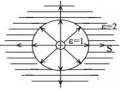
 Electric Field Lines Caused by Point Charges
 -
 Vietnamese law on loan contracts in the field of banking credit - 28
 -
 The relationship between travel motivation, destination image and destination choice - A case study of Binh Dinh province tourism destination - 1
 -
 The Impact of Investor Protection Rights on the Relationship Between Liquidity and Firm Value
 -
 Relationship Between Research Variables in the Model
E
4 0 rr
2
where the vector radius r is directed from charge q to the considered point.
If q 0 then E ↗↗ r : E points away from charge q .
If q 0 then E ↗↙ r : E is directed towards charge q .
About size :
1 q
0
E 4 r 2
4. Principle of electric field superposition
a. Electric field caused by a system of loosely distributed point charges
n
n
1 qr
E E iii
4 r 2 r
i 1
i 1
0 ii
b. Electric field caused by a system of continuously distributed point charges
(conductor)
1 dq r
2
E
5. Electric induction vector
all things
d E
all things
4 0 rr
D 0 E
Electric induction vector due to point charge q at a point M q away
an interval r is:
1
q
r
D
4 r 2 r
6. Electricity
a. Definition
The electric flux sent through an area S is a quantity whose value is proportional to the number of electric induction lines that intersect that area.
b. Expression
The electric flux of a uniform electric field sent through a flat cross section .
e D . S 0 D . S . cos D . S
The electric flux of any electric field sent through a cross-section of arbitrary shape.
d e D . dS D . dS . cos( D , dS )
e d e
( S )
D . dS
( S )
Note : For closed surfaces, we always choose the direction of the normal n to be the direction outwards of that closed surface.
7. OG theorem for electric field
The electric flux sent through a closed surface is equal to the algebraic sum of the charges contained in that closed surface:
e( S ) D . dS q i
( S ) i
8. Work of electrostatic force
Power tool
believe
electric field in the movement of charge q from M to N
in the electric field of:
Charge Q:
A MN
4 0 r M
4 0 r N
System of point charges Q 1 , Q 2 , ...., Q n :
A MN
qQ i
i 4 0 r iM
qQ i
i 4 0 r iN
where r i M and r i N respectively are the distances from the charge Q ito points M and N.
Comment: The work of the electrostatic force does not depend on the shape of the displacement trajectory but only on the position of the initial and final points. So the electrostatic field is a potential force field.
9. Potential energy of electric charge in electric field
The convention for choosing the potential energy at infinity is zero (W ∞ = 0).
Electric field caused by a point charge
W qQ
4 0 r
Electric field caused by a system of point charges
W Wi
i
qQ i
i 4 0 r i
Electric field caused by a point charge
g
W M qEds
M
where: g is the origin of potential energy (W g =0).
10. Voltage
a. Definition
Electric potential is a quantity characterizing the electric field at the point under consideration, with a value determined by the expression:
V W
q
b . Expression for calculating electric potential of electric field for some cases
Electric field caused by a point charge:
V Q
4 0 r
Electric field caused by a system of point charges:
V V i
Q i
4 r
ii 0 ii
Electric field caused by a continuously distributed charged object Q:
V dQ
object 4 0 r
Any electric field:
g
V Eds
M
where g is the origin of the potential energy.
11. Voltage
A MN W M W N q ( VM VN )
Power tool
believe
electric field in the displacement of point charge q from point M
at point N in the electric field is equal to the product of the charge q and the electric potential difference between the two points M and N.
12. Equipotential surface
a. Definition
Equipotential surface is the product of points having the same electric potential in an electric field (V = const).
b. Properties of equipotential surfaces
The electric force in the displacement of any charge on a
a zero equipotential surface.
At every point on an equipotential surface , the electric field intensity vector is perpendicular to the equipotential surface .
13. Relationship between electric field intensity vector and electric potential
The projection of E onto a certain axis is numerically equal to the voltage drop over a given length of that axis :
E dV
s ds
Vector expression in Cartesian coordinate system:
E gradV
THEORETICAL QUESTIONS
1. State Coulomb's law. Write the expression for Coulomb's law on the interaction force between two point charges in vacuum and in various environments.
2. Define electric field, electric field intensity vector, electric induction vector. Write expressions to determine electric field intensity vector and electric induction vector caused by a point charge, method to calculate electric field intensity vector.
3. Describe the principle of electric field superposition.
4. Define lines of force. Draw a picture of the electric field lines caused by a positive and negative point charge. What quantity does the density of the lines of force represent? In what cases are the electric field lines interrupted?
5. A point charge moves perpendicular to the line of force in a
electric field . Force
believe
what is the effect
g on it?
6. Define electric flux, write the expression (in both cases of uniform electric field, plane cross section and in the general case).
7. State the OG theorem for electric fields. Write expressions and explain the quantities.
8. Define electric potential. Write the expression to determine the electric potential and potential energy in the electric field of a point charge.
9. Do electrons tend to move towards high or low potential?
10.Definition of equipotential surface. Can two different equipotential surfaces intersect? Why?
11.Relationship between electric field strength and electric potential.
CHAPTER 1 EXERCISES
Lesson 1.1.
Two spheres placed in a vacuum with the same radius and mass are suspended at the two ends of a string so that their outer surfaces touch each other. Then
0
When the balls are given a charge q = 4.10 7 C , they repel each other and the angle
between the two strings is now 60 0 . Calculate the mass of the balls if
The distance from the hanging point to the center of the sphere is equal to
Lesson 1.2.
l 20 cm .
Two electrically charged spheres of equal radius and mass are suspended at the ends of strings of equal length. They are immersed in a substance.
dielectric (oil) has specific gravity
1 and dielectric constant
(*) . Ask the block
What must the density of the sphere ( ) be so that the angle between the strings
in air and in dielectric is the same.
Lesson 1.3.
There are two equal and opposite charges. We prove that at every
point equidistant from the two charges, direction of force acting on test charge q 0
parallel to the line connecting the two charges.
Lesson 1.4.
Find the force acting on a point charge
q 5 .10 9 C
3
center half circle
air radius torus).
Lesson 1.5.
r0 5 cm
evenly charged with electric charge
Q 3.10 7 C
(set in
C
q 1
1
There are two point charges q 8.10 8 C and
2
q 3.10 8 C
spaced apart
q 2
d 10 cm in air ( Figure 1 ). Calculate:
a. Electric field intensity caused by B
that charge at points A, B, C. Given:
MAN
Figure 1
MN d 10 cm , MA 4 cm , MB 5 cm , MC 9 cm , NC 7 cm .
b. Force acting on electric charge
Lesson 1.6.
q 5.10 10 C
located at C.
A
A
Given charges q and 2q placed 10cm apart . Ask at which point on the line connecting the two charges do the electric fields cancel each other out.
Lesson 1.7.
On Figure 2 AA is an infinite plane of uniform charge
with surface charge density 4.10 9 C / cm 2 and B is a positive sphere
electric charge of the same sign as the charge on the plane. The mass of
two spheres equal to m = 1 gram , its charge equal to q = 10 9 C.
Ask the angle the string hanging the ball is deflected by compared to the vertical.
Lesson 1.8.
B
Figure 2
A circular disk of radius a=8cm is uniformly charged with surface charge density
10 3 C / cm 2 .
a. Determine the electric field strength at a point on the axis of the disc and a distance b=6cm from the center of the disc .
b. Prove that if b 0 then the obtained expression will transform to
expression for calculating the electric field intensity caused by an infinite plane carrying a uniform charge.
c. Prove that if b a then the obtained expression can be converted into an expression for calculating the electric field strength caused by a point charge.
Lesson 1.9.
2
A dust particle carries a charge q 1.7.10 16 C is 0.4cm away from a straight wire and near the perpendicular bisector of the wire. The wire segment
1
This rod is 150cm long and carries a charge q = 2.10 7 C. Determine the force acting on the dust particle.
Assume that q 1 is uniformly distributed on the string and the presence of q 2 has no effect on that distribution.
Lesson 1.10.
A thin metal bar carries a charge q = 2.10 7 C. Determine the electric field strength at a point located 300cm from the two ends of the bar and 10cm from the midpoint of the bar . Assume that the charge is evenly distributed on the bar.
Lesson 1.11.
A uniformly charged spherical surface has surface charge density 10 9 C / cm 2 . Determine the electric field strength at center O of the hemisphere.
Lesson 1.12.
An infinite plane carrying uniform charge has surface charge density
2.10 9 C / cm 2 . Ask the electric field force of that plane acting on a unit length of an infinitely long wire carrying a uniform charge. Given the electric density
of wire 3.10 8 C / cm .
Lesson 1.13.
Between two parallel cylindrical conductors a distance apart
l 15 cm
People apply a voltage U=1500V . The cross-sectional radius of each wire is r=0.1cm . Determine the electric field strength at the midpoint of the distance between the two wires, knowing that the wires are placed in air.
Lesson 1.14.
1
Given two point charges q
2.10 6 C , q
10 6 C placed 10cm apart . Calculate
2
work of electrostatic force when charge q 2 moves on the straight line connecting the two charges further 90cm .
Lesson 1.15.
Calculate the work required to move a charge q = 10 8 C from a point M at a distance R = 10cm from a charged sphere of radius r = 1cm to infinity. Knowing that the sphere has a surface electric density 10 11 C / cm 2 .
Lesson 1.16.
Calculate the electric potential at a point on the axis of a circular disk carrying a uniform charge and a distance h from the center of the disk . The disk has radius R and surface electric density .
Lesson 1.17.