
received with sincerity and warmth. Firm handshakes, stories about the days when Muong Bi heaven and earth were still one, meals
frugal with wild vegetables and stream fish,... No matter where you go on Muong Bi land, visitors still feel warm and happy before the
the eyes and joyful smiles of the local people. Indeed, when coming to Muong Bi, visitors feel like they are lost in a cultural space imbued with traditional features, forgetting all worldly concerns to be fascinated and to explore...
3.3. Exploitation solutions to serve tourism development
Maybe you are interested!
-

 Strategic orientation for tourism development in Quang Ngai to 2010 - 2
 -
 Exploiting the Buckwheat Flower Festival in Ha Giang to serve tourism development - 4
 -
 Current Status of Exploiting Tran Temple Festival, Thai Binh to Serve Tourism Development.
 -
 Orientation and Solutions for Tourism Development in Ba Ria - Vung Tau to 2020
 -
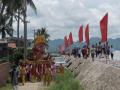 Xa Ma Procession Festival in Hoang Chau Commune, Cat Hai District - current exploitation status and development solutions to serve local tourism - 11
3.3.1. Premises for tourism development orientation
To have solutions to effectively exploit traditional cultural values in tourism business activities in Muong Bi, Tan Lac, Hoa Binh, we not only need to grasp the situation and policies of the local government but also need to know the general development direction of the whole industry. On that basis, we can propose the right direction to exploit traditional cultural values in tourism activities.
In July 2002, the Prime Minister approved the “Vietnam tourism development strategy for 2001-2010”. The general goal is to develop tourism into a spearhead economic sector, based on effectively exploiting advantages in nature, ecology, cultural and historical traditions. Maximally mobilizing domestic resources and seeking international support, contributing to the industrialization and modernization of the country. At the same time, gradually turning our country into a major tourist center.
To successfully implement the tourism development strategy, the entire industry has deployed: "National Action Program" with specific goals:
+ Tourism will affirm itself as a key economic sector after 2005.
+ Strive to become a developed country in tourism in the region by 2005. Have appropriate technical facilities, unique tourism products imbued with Vietnamese national identity and establish Vietnam as a
attractive destination for tourists around the world.
+ Enhance the image of Vietnam in general and determine the worthy position of Vietnamese tourism in particular in the international arena, on the basis of promoting and advertising tourism and raising social awareness about tourism.
+ Create a tourism product, a unique tourism type that is competitive and attractive to tourists. Increase spending and length of stay of visitors on the basis of upgrading, investing, building new tourist areas, high-quality entertainment areas and exploiting well the tourism potential which is the strength of Vietnam.
+ Rectify and improve the effectiveness of State management of tourism.
In the coming period, the Vietnam National Administration of Tourism will continue to focus on upgrading and perfecting the policy system serving tourism activities. The goal by 2010 is to welcome 6-7 million international visitors and 25 million domestic visitors with total revenue of 4-5 billion USD.
Thus, after the tourism ordinance was implemented, the Government established the National Steering Committee on Tourism, and issued many "national action programs on tourism", which is an important fulcrum to help the tourism industry grow strongly.
Applying the orientations and strategies set by the state to develop tourism, Hoa Binh province as well as Tan Lac district People's Committee have had certain strategies to develop local tourism, with the goal of Muong Bi tourism must be
is identified as an important destination and stop of the Northern tourist region. But tourism exploitation always ensures the quality of the local environment.
method. Thereby actively contributing to the process of economic restructuring of
local industrialization and modernization
3.3.2. Exploitation solutions to serve tourism development
Khai Ha Festival is a typical cultural feature of Muong Bi people until now, although there have been many changes in the rituals, it is still preserved from generation to generation in Muong Bi. Therefore, protecting and exploiting it to become a tourism resource to bring it to visitors is a very meaningful work. Besides preserving those rituals in their original state, it is necessary to inherit and transform them to suit the current customs and practices of the local people.
on the basis of inheriting fine customs and eliminating outdated customs. However, it is necessary to limit the commercialization and reproduction of these rituals on stage, which will destroy the ritual and natural features of a traditional festival, which will certainly affect the attractiveness to tourists.
For these tourist destination managers need to rely on the following perspectives,
general guidelines, along with the efforts of the unit directly managing this place to
provide specific directions for tourism development in Muong Bi in general and for the Khai Ha festival of the Muong Bi people in particular. From there, remove the remaining difficulties with the aim of further promoting the rich potential of the region, integrating into the general development of Hoa Binh. When implementing, how can general and comprehensive planning strategies and policies be flexibly applied. In which, sustainable tourism development combined with the construction of a cultural environment in tourism is the top priority.
set for the tourist area. Besides, the effectiveness in terms of economy, politics, security and order, ecological environment,... also need to be paid great attention. Moreover, the activities
Tourism activities are interdisciplinary, inter-regional, and highly socialized. Therefore, tourism development in Muong Bi is not only the responsibility of Tan Lac tourism but also
is the task of all levels, sectors, and people's organizations... therefore, in the process of tourism activities, there needs to be high unity and close coordination between sectors, calling for support from all sides, especially local authorities and the Muong Bi community.
To realize the tourism potential of this festival, the Party Committee and the government of Tan Lac district need to have a breakthrough in economic development, which is to mobilize all capital sources, focusing on investment in Thach Bi and Muong Bi tourist areas. At the same time, carry out new construction, renovation and upgrading of small hotels, restaurants, motels, improve the quality of service activities, develop post and telecommunications, banking, credit, electricity and water, meet the increasing needs of tourists, form clusters of ethnic cultural tourism villages and develop traditional cultural activities of the Muong Bi people in Ai hamlet and Luy hamlet (Phong Phu).
Expanding the Muong Bi cultural space through research and implementation of measures to preserve the rituals of the Khai Ha festival in particular and the traditional rituals of the Muong Bi people in general. In order to restore, preserve and promote the historical and socio-cultural values of the Khai Ha Muong Bi festival, we first need the following solutions:
Collect lost artifacts.
Buy and add some worship items to the temple.
Build some additional auxiliary structures to make the temple more spacious.
Restore the altars in the temple to the correct positions of the village's tutelary gods.
Investigate, develop a scenario, restore and allow the annual organization of Khai Ha festival in the entire Muong Bi area.
Every year, it is necessary to train an additional team of worshipers with additional training and allowances for the caretakers and incense burners of the shrine.
Organize quarterly and annual competitions on issues related to the content of the Khai Ha Muong Bi festival.
Write a detailed book about the festival as well as the socio-economic geography of Hoa Binh province and publish it, and produce film discs.
CDs and photo albums ... about festivals and Hoa Binh province.
Since 2000, the Khai Ha Muong Bi festival has received attention from all levels and sectors to restore some traditional activities. However, the content of the rituals and ceremonies of the festival is no longer as complete as before. Therefore, we need time to conduct investigations, collect as well as build and plan projects and proposals for festivals not only in Hoa Binh but also in many other places.
It is necessary to build cultural centers of the Muong people such as: Cultural tourism in accordance with the correct and sustainable process to maintain the cultural environment. People come to visit and learn about the unique cultural features of the Muong and to enjoy a brilliant culture that has existed since ancient times and is still preserved and developed.
Develop mass art teams.
Propaganda to the people, to make them aware of the cultural values in the Khai Ha festival to have the awareness to preserve and promote the superiority of the festival.
At the same time, it is necessary to train a team of cultural cadres with professional qualifications and understanding of the customs and practices of each region and each ethnic group.
For local people residing in Muong Bi, first of all, it is necessary to have appropriate measures to raise awareness for people, creating conditions for them to realize the positive and valuable features of old customs in order to
they preserve, what are the bad customs that are causing difficulties for their lives so that they can voluntarily eliminate them. Most importantly, we must make the Muong Bi people proud of their Muong ethnic group with its fine traditions and precious cultural characteristics. Only then will they truly have the responsibility to preserve and develop their ethnic culture. That will certainly create favorable conditions for the construction of a new cultural life today, as well as putting it into practice.
tourism exploitation
Overall, along with the above-mentioned tasks, the most important thing is still the overall socio-economic development policy, hunger eradication and poverty reduction, improving living standards, people's knowledge and cultural level, and taking good care of people's health. Then people will love life more, love the regime more, they will eliminate bad customs and seek out valuable things to preserve and promote.
On the other hand, the relationship between local people and tourism is sometimes only indirect, tourism has not been able to take advantage of their potential. Therefore, tourism managers need to mobilize local people to provide products that they make to serve tourism purposes such as brocade weaving, clean vegetables, etc. to increase their income. On the contrary, local people must also help managers in creating a good relationship between themselves and tourists when they come here with a warm, polite attitude, helping visitors when they want to learn about the local culture here. At the same time, when selling goods, local people must learn the rules and regulations when serving tourists, and must have professional actions like a tourist. Only then can tourists leave many good impressions.
beautiful for this Muong Bi land.
3.4. Some ideas for building a tourist tour in Muong Bi
3.4.1. Regional tours
To build a regional tour, we can start from Muong Khen town to small attractions such as Ma cave, But cave, Chien Xen cave,
Ton cave, Muong ethnic village, Khanh waterfall, Trang waterfall,... These places are located at a moderate distance from each other, from 500 m to 30 km, can be walked, by bicycle, motorbike, car,... (can also build a tour from Hoa Binh to these places)
This has created a clear advantage in the movement of tourists when visiting, very suitable for the types of tourism that our country is focusing on.
That is exploiting cultural tourism to learn about the cultural life of local people.
location, attracting the attention of many tourists.
 Regional travel program
Program: Hoa Binh – Tan Lac – Kim Boi (2 days 1 night ) Day 1 : Hoa Binh – Tan Lac
Morning: follow Highway 6 to visit Hoa Binh Hydropower Plant (reception center, traditional house, century letter, memorial, generators, flood discharge dam, statue).
Ho Chi Minh station). Then continue to Tan Lac.
Noon: Check in and have dinner at An Lac Hotel (Tan Lac).
Afternoon: Visit the Muong cultural space museum (learn about the K Hai Ha festival of the Muong Bi people), Hoa Tien cave, Chua cave, Trieng Xen cave, Trang waterfall, Khanh waterfall, May valley.
Evening: watch folk art performance and stay at hotel
Day 2 : Tan Lac - Kim Boi mineral water tourist area
Morning: Have breakfast in Tan Lac, visit Muoi cave, But cave. Lunch: Have lunch and rest in Kim Boi
Afternoon: take a mineral bath then return to Hoa Binh city.
3.4.2. Out-of-area tours
Taking Hanoi as the starting point, including attractions combined in one tour will have great appeal to tourists. This combination helps tourists learn a lot about the indigenous culture of local people without having to travel many times, creating conditions for this tourism model to be widely deployed in Hoa Binh.
 Out-of-area travel program
Program 1 : Hanoi - Hoa Binh (4 days - 3 nights)
Day 1 : Hanoi - Tan Lac
Morning: Take a car to Muong Khen town, have lunch in Muong Khen town. Afternoon: visit Muong Chua, Muoi cave, But cave, Trieng Xen cave,
Trien Xen I, II, III rock roof.
Evening: Stay at An Lac, watch Muong ethnic cultural performance. Day 2 : Tan Lac
Morning: breakfast at hotel, visit Hoa Tien cave, May valley, Khanh waterfall.
Lunch: lunch at hotel.
Afternoon: visit the Muong cultural space museum (combined with learning about the Khai Ha festival of the Muong Bi people)
Evening: enjoy Muong cuisine Day 3 : Tan Lac - Mai Chau
Morning: Go to Van village, Xo village for sightseeing and shopping. Noon: Have lunch at Van village.
Afternoon: Walk from Van village to visit Lac village. Evening: Have dinner and watch Thai ethnic performance. Day 4 : Lac village - Hanoi
Morning: Ban Lac - Kim Boi.