
Although there have been some authors who have researched the transfer of land use rights in some localities across the country, the results have only stopped at stating the current status of the transfer of land use rights, pointing out some difficulties, obstacles, and shortcomings that still exist in the process of implementing the transfer of land use rights without providing solutions to overcome them or the solutions are not highly feasible and have not been applied by localities.
In addition, Lai Chau city, Lai Chau province is currently built as a key economic zone of the province, the city has achieved encouraging results, the city's socio-economic development has been constantly developing, the development speed, economic growth rate is always at a high level. With the rapid urbanization process of the city, the land in the area has fluctuated quite strongly, many residential areas have sprung up, which means the population has developed, so the transfer of land use rights has been quite active and complicated, especially in recent years, the implementation of the rights and obligations of the State representing the owner and land user in land management and use has achieved many remarkable achievements but still faces many difficulties in the implementation of the Land Law. Therefore, to see the existing problems and weaknesses in the state management of land in general and in ensuring the rights and obligations of the State and land users in the process of land management and use, we need to objectively evaluate the achieved results and draw lessons from them to manage and use land most effectively.
I find that the study on the transfer, donation and inheritance of land use rights in Lai Chau city, Lai Chau province in the period of 2014 - 2019 is very necessary to contribute to perfecting the process and mechanism, in order to increase the effectiveness of land use rights transfer in Lai Chau city, Lai Chau province and the whole country in general.
Maybe you are interested!
-
 Natural Conditions, Socio-Economics and Resources for Tourism Development of Hai Phong
 -
 Building GIS Database on Natural Conditions - Socio-Economics to Serve Tourism Development Orientation of Savannakhet Province - Laos
 -
 Natural - Socio-Economic Conditions and Land Use Situation of Pho Lu Town
 -
 Overview of Natural and Social Conditions of the Study Area
 -
 General Assessment of Hanoi's Natural and Socio-Economic Conditions Impacting on the Activities of TNCs.
Chapter 2
RESEARCH CONTENT AND METHODS
2.1. Research object and scope
2.1.1. Research subjects
- The topic conducts the evaluation of land use rights transfer in Lai Chau city in the period of 2014 - 2019. However, because other forms of rights transfer are quite rare, the topic only focuses on evaluating the three main forms of rights transfer: transfer, donation, and inheritance of land use rights.
- The project only conducts assessments on land users who are elderly households and individuals in the city.
2.1.2. Scope of research
- Time scope: Research topic in the period 2014 - 2019.
- Spatial scope: The research topic is in Lai Chau city including 5 wards and 2 communes.
2.2. Research location and time
- Research period: from August 2019 to November 2020
- Research location: Branch of Lai Chau City Land Registration Office.
2.3. Research content
2.3.1. Overview of natural conditions, socio-economic conditions and current land use status in Lai Chau city, Lai Chau province
- Natural conditions
- Socio-economic conditions
- Current status of land use in Lai Chau city in 2019
2.3.2. Assessment of the current status of land use rights transfer, donation and inheritance in Lai Chau city in the period 2014 - 2019
- Evaluation of the results of land use rights transfer in Lai Chau city, Lai Chau province in the period 2014 - 2019
- Evaluation of the results of land use rights donation in Lai Chau city, Lai Chau province in the period 2014 - 2019
- Evaluation of the results of land use rights inheritance work in Lai Chau city, Lai Chau province in the period 2014 - 2019
- Summary of results of land use rights transfer, donation and inheritance in Lai Chau city, Lai Chau province in the period 2014 - 2019
- Budget collection situation through transfer, donation and inheritance of land use rights in Lai Chau city, Lai Chau province in the period 2014 - 2019
2.3.3. People's opinions on the transfer, donation and inheritance of land use rights in Lai Chau city in the period 2014 - 2019
- Synthesize people's opinions on the current status of land use rights transfer, donation and inheritance in Lai Chau city, Lai Chau province in the period 2014 - 2019
- Assessing people's opinions on the transfer, donation and inheritance of land use rights in Lai Chau city, Lai Chau province in the period 2014 - 2019
2.3.4. Evaluate the advantages and disadvantages and propose some solutions to improve the effectiveness of land use rights transfer, donation and inheritance in Lai Chau city, Lai Chau province.
- Favorable
- Hard
- Propose some solutions to improve the efficiency of land use rights transfer.
2.4. Research methods
2.4.1. Investigation of secondary data
- Collect and research legal documents of the Central and local levels related to the transfer, donation and inheritance of land use rights.
- Collect documents and data on land recovery from facilities and departments related to the transfer, donation and inheritance of land use rights.
- Collect documents and data on the economic and social situation in rural areas, the economy of production sectors, and the lives of households in the research area.
- Collect data from the Statistics Office, Land Registration Office, Department of Natural Resources and Environment and relevant departments, agencies and sectors.
- Collect documents from newspapers and mass media.
2.4.2. Interview method
+ Interviewing professional staff: To clarify the difficulties and limitations, as well as to find out the causes of existence in the regulations on procedures, time, subjects, etc. of the work of transferring, donating, and inheriting land use rights. The topic conducts a survey of professional staff directly performing procedures on land use rights inheritance and experts on land use rights inheritance. Specifically, the staff directly performing procedures on land use rights inheritance of the People's Committees of wards and communes in Lai Chau city, branches of the land registration office, and staff of the Department of Natural Resources and Environment of Lai Chau city. With the content of investigating professional staff, the topic does not create a survey form but only conducts direct interviews, records the opinions of the staff on the current situation, difficulties, causes of existence and solutions to improve the effectiveness of the work of transferring, donating, and inheriting land use rights in the locality.
+ Interviewing people: To objectively assess the current status of land use rights transfer, donation and inheritance in Lai Chau city. The project conducted and distributed survey forms (with attached form) to 150 subjects receiving land use rights transfer, donation and inheritance. Including:
++ 70 subjects received land use rights transfer
++ 50 subjects received land use rights.
++ 30 subjects inherit land use rights.
2.4.3. Method of selecting survey points
Choosing the survey point is an important issue because it affects the objectivity, accuracy and practicality of the research results of the topic.
The selection of communes and wards must ensure the requirement of representing the situation of land use rights transfer. To draw lessons for the work of land use rights transfer in the city.
To evaluate the effectiveness, as well as find out the shortcomings, limitations and causes in the work of transferring land use rights, the chosen topic is:
+ 1 commune and ward in the city has a high rate of records transferring land use rights.
land is resolved most effectively.
+ 1 commune and ward in the city has an average rate of land use rights transfer records resolved effectively.
+ 1 commune and ward in the city has the lowest rate of land use rights transfer records resolved effectively.
According to the results of research and evaluation on the transfer of land use rights in general and in three forms of transfer, donation, and inheritance of land use rights in particular in Lai Chau city in the period of 2014 - 2019, the project has selected 3 commune-level administrative units that meet the requirements for selecting research sites. These are:
+ Dong Phong Ward is the administrative unit with the highest number of land use rights transfer records in Lai Chau city during the research period. The number of survey forms for each specific form of land use rights transfer is:
++ 25 survey forms for land use rights transfer.
++ 15 survey forms for the form of land use rights donation.
++ 10 survey forms for land use rights inheritance.
+ Doan Ket Ward is an administrative unit with the number of transfer records achieving an average effective resolution rate in Lai Chau city during the research period. The number of survey forms for each specific form of land use right transfer is:
++ 25 survey forms for land use rights transfer.
+ + 15 survey forms for the form of land use rights donation.
++ 10 survey forms for land use rights inheritance.
+ Nam Loong commune is the administrative unit with the lowest number of land use rights transfer records in Lai Chau city during the research period. The number of survey forms for each specific form of land use rights transfer is:
+ + 20 survey forms for land use rights transfer.
+ + 20 survey forms for the form of land use rights donation.
++ 10 survey forms for land use rights inheritance.
Students will conduct survey questionnaires for subjects from December 2019 to
May 2020, then the survey will be compiled.
2.4.4. Methods of data analysis, synthesis and processing
- Method of data analysis and synthesis: Data is collected from many different sources using different methods, to serve as a basis for comparison and to find trends during analysis. Data is synthesized from a small analytical unit to a larger analytical unit.
- Data processing method: data is collected, calculated, analyzed in tables, charts, combined with explanations. The collected input data is analyzed and processed with the support of computer software to provide faster and more accurate results.
Chapter 3
RESEARCH RESULTS AND DISCUSSION
3.1. Overview of natural conditions, socio-economic conditions and current land use status in Lai Chau city, Lai Chau province
3.1.1. Natural conditions
3.1.1.1. Geographical location
Lai Chau City is the political, economic, cultural and social administrative center of the province, established under Decree No. 131/ND-CP dated December 27, 2013 of the Government, with geographical coordinates from 20°20' to 20°27' North latitude; 103°20' to 103°32' East longitude, with the following border locations:
+ To the North, it borders Phong Tho district and Tam Duong district;
+ East borders Tam Duong district;
+ South borders Tam Duong district;
+ West borders Sin Ho district.
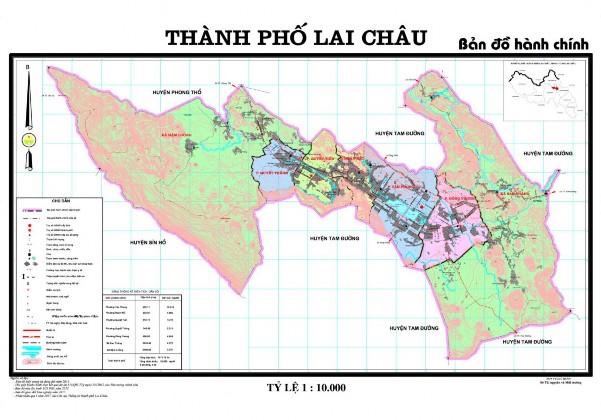
Figure 3.1: Administrative map of Lai Chau city, Lai Chau province
As the center of the province, and located on the main traffic route connecting the Northwest region with the economic development center of the country, Hanoi, via National Highway 4D connecting with Sa Pa tourist area and Hanoi - Lao Cai highway, Lai Chau city has a favorable geographical location for economic, social and cultural development on a regional scale connecting the Northwest region with major economic centers of the country.
3.1.1.2. Topography, geomorphology
Lai Chau city is located in a valley formed by two mountain ranges of Sung Phai and Pu Sam Cap with terrain running from Northwest to Southeast, the structure is mainly hills, dirt mountains, average slope from 5-10%, the slope of the terrain in two directions from the area of Quyet Thang ward to the Southwest and from Doan Ket and Tan Phong wards to the Southeast of the city. In particular, the West and Southwest are high mountain ranges, the North and Northeast have interspersed bowl terrain with an average height of 940 m, slope > 6.5%.
3.1.1.3. Climate
Lai Chau city has a typical climate of the Northwest highland tropical monsoon region, hot days, cold nights, and little affected by storms. The climate is divided into two distinct seasons: the rainy season from April to September with high temperature and humidity; the dry season from October to March of the following year, with cold climate, low humidity and rainfall (April and October are the transitional periods between the two seasons), in which:
- The average annual temperature is 19.3 0 C, the lowest average temperature is 13.5 0 C (in January) and the highest average is 23.0 0 C (in July). Months with average temperatures less than 20 0 C are common from November to April, months with temperatures above 20 0 C are common from May to September, the total annual temperature is on average 1,637 0 C;
- Rainfall is quite large and unevenly distributed throughout the year. Heavy rains are concentrated in the summer, especially in June, July, and August, and often account for up to 90% of the annual rainfall. The dry season months (from October to March of the following year) have very little rainfall, accounting for only about 10% of the annual rainfall. The seasonal distribution of rainfall has significantly affected agricultural and forestry production as well as construction works in the city (in the rainy season, heavy rainfall concentrated in a short period of time often causes flooding; in the dry season, short periods of low rainfall last for a long time, causing water shortages and droughts);