Traditional food production : Most businesses in this industry group are small and medium-sized enterprises, household scale and have poor production conditions.
Information technology industry in Ho Chi Minh City
Vietnam recognizes the information technology (IT) industry as a spearhead economic sector and social development. In June 2006, the Law on Information Technology was promulgated, creating a legal framework for the development of information technology in Vietnam. The Law on Information Technology will be combined with the Law on E-commerce and support a series of projects to develop related industries such as software, digital devices and e-government....
Vietnam's software and information technology services industry achieved 250 million USD in 2005, with 180 million USD earned from the domestic market (61.1%) and 70 million USD from external sources (38.9%), up 47% over 2004.
Ho Chi Minh City is a major center of information technology - telecommunications in Vietnam. In recent years, the City government, businesses, associations, research institutes ... have implemented many measures to develop the City's information technology - telecommunications industry.
Ho Chi Minh City has achieved initial results in applying information technology to state management at the department, district/county levels. Currently, 81% of units in the city's government agencies have established an intranet, 72% of units have internet connection, 49% of units have a database backup system. These are the results of the initial implementation steps of the E-Government Program, contributing to improving the quality of state management and encouraging people's transactions and trade activities.
Regarding information technology and communication infrastructure, the scale of Internet supply and subscription in the City has developed at a fairly rapid rate in the past 2 years.
2003, 2004 more than 100%/year. Up to now, the city has 5 service providers for over 800,000 converted subscribers and about more than 10,000 ADSL subscribers.
The growth rate of the information technology industry in the period 2003 - 2004 reached 40%/year, accounting for 40% of the country's information technology industry revenue.
In 2003 and 2004, the number of foreign-invested enterprises operating in the information technology sector doubled (from 64 enterprises to 128 enterprises). The number of enterprises operating in the city in the information technology sector is currently about 4,000 enterprises and compared to 2002, in 2004 the number of enterprises increased by 75.6%. The city's software industry is currently leading the country with a turnover of 66 million USD in 2004, a growth rate of 30%/year. The number of units registered to participate in software activities is 3,026 units with
6,000 programmers, revenue reaches about 10,000 USD/person/year. The city currently has 399 units participating in hardware activities. Hardware industry revenue grows 19%/year, especially in 2004 reaching 231 million USD.
While HBI focuses on incubating customers in 5 industry/sub-industry groups, SBI focuses on customers who are startups, young businesses and strategic partners operating in the software industry, specifically in the design, production and provision of software products and services, including packaged software production; custom software production; embedded software production; software outsourcing activities and activities providing and implementing software services.
Types of software products include:
1. System software;
2. Application software;
3. Utility software;
4. Software tools,
5. Other software.
Types of software services include:
1. Administration, warranty and maintenance services for software and information systems;
2. Software quality consulting, evaluation and appraisal services;
3. Consulting services, software project development;
4. Software valuation consulting services;
5. Software technology transfer services;
6. System integration services;
7. Services to ensure safety and security for software products and information systems;
8. Software product distribution and supply services
9. Other software services
2.2.3.2. Objectives and tasks
The aim is to promote the development of innovative SMEs and boost job creation in Vietnam by creating a model centre with best practices and replicability for incubators in general and incubators in the food processing (or IT) industry in particular.
The strategic mission is to promote the establishment of innovative and dynamic businesses and encourage the growth of existing SMEs in the food processing (or IT) industry through incubation and the provision of high quality business development services.
2.2.3.3. Operating model and organizational structure
Along with the organizational structure of VPSSP, VUDN operating companies were established under the public-private entity model and operated non-profit to operate and manage 2 VUDN.
In Hanoi : On September 30, 2005, a Cooperation Agreement was signed between the Ministry of Planning and Investment, the Hanoi People's Committee and EU Food Joint Stock Company (a public-private entity model between Hanoi Trade Corporation (HAPRO), Ha Thanh Company Limited, Viet Thang Company Limited and the Hanoi Association of SMEs). The purpose of this Agreement is to establish a legal framework as a basis for coordination between relevant parties to build and operate the VDN in Hanoi and assist the Ministry of Planning and Investment and the Hanoi People's Committee in implementing Component 2 of the VPSSP under the Funding Agreement (FA) between the Government of Vietnam and the EU. However, the participating parties have encountered many difficulties (subjective and objective) in implementing this Agreement. As a result, the activities to establish the VDN in Hanoi have stalled and reached a deadlock due to the failure to reach an agreement between the participating parties.
By April 2006 (after nearly 1 year), a new Agreement between the Ministry of Planning and Investment, Hanoi People's Committee and HBI (a public-private partnership model between HAPRO and Hapro Traditional Food Joint Stock Company (HTJSC) was signed and implemented to establish Hanoi VUDN. HBI is responsible for directly managing and operating Hanoi VUDN, has its own account and seal, with a charter capital of 500 million VND, of which HAPRO (representing state capital) accounts for 95% and HTJSC (representing private capital) accounts for 5%.
To effectively manage and operate the VUDN, a VUDN Executive Board was established consisting of representatives of the parties involved in the construction and operation of the Hanoi VUDN.
According to the VPSSP Overall Operational Plan (OWP), HBI is allocated a budget of EUR 625,000 for the following equipment:
500,000 EUR invested in food processing and packaging machinery and equipment.
EUR 100,000 for laboratory services and equipment to support businesses.
Budget of 15,000 EUR for equipment for management and administration.
Budget of 10,000 EUR to equip meeting rooms and training equipment.
According to the funding agreement, the EU also funded all operating costs of the incubator during the project implementation period (2005-2008) and the Hanoi People's Committee provided more than 10,000m2 of land in the Hapro Food Industrial Park (Le Chi, Gia Lam, Hanoi) and more than 13 billion VND to build infrastructure and the incubator building.
In Ho Chi Minh City : The public-private entity model in Ho Chi Minh City is Quang Trung Software Business Incubator Company Limited (abbreviated as SBI), which was officially established with the participation of Quang Trung Software Park Company (QSTC), representing the state capital, accounting for 85% and Ho Chi Minh City Information Technology Association (HCA), representing the private capital, accounting for 15%. SBI operates non-profit during the project implementation period.
Similar to Hanoi, but the process of establishing a public-private entity model to establish the Ho Chi Minh City Business Startup Center was more favorable than that of the Hanoi Business Startup Center. On May 26, 2005, a Cooperation Agreement was also signed between the Ministry of Planning and Investment, the Hanoi People's Committee and SBI as the legal basis for the establishment and operation of the Ho Chi Minh City Business Startup Center.
According to OWP, SBI is also funded with a budget of 200,000 EUR to purchase computer equipment, software, laboratory equipment, meeting rooms, seminars, training...
Similar to the HBI model, the EU also funded the operating costs for SBI during the project implementation period, from 2005-2008. The Ho Chi Minh City People's Committee granted nearly
2,000 m2 of land in Quang Trung Software Park in District 12, Ho Chi Minh City and nearly 14 billion VND to build an incubator building for businesses.
These Cooperation Agreements clearly define the responsibilities and powers of the parties in participating in the management and operation of the incubator. The parties concerned have the right to send representatives to participate in the Incubator Management Board.
With the non-profit operating model, both incubators are not allowed to distribute profits to members until December 31, 2008. Profits generated during the effective period will be reinvested in the company to develop the incubator.
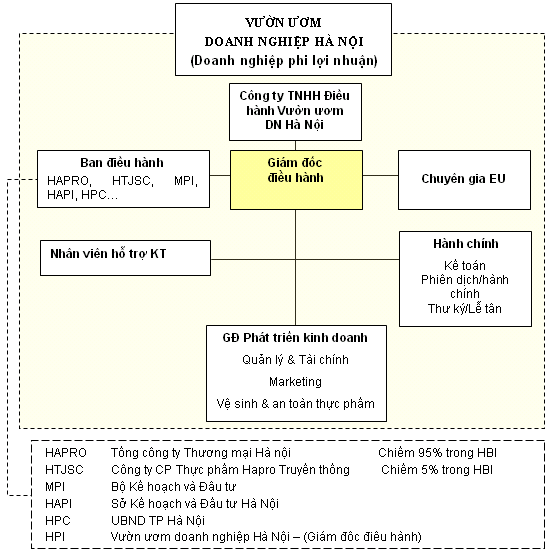
In terms of organizational structure, SBI and HBI have similar organizational models and structures (see Figure 2.6). In which:
The CEO is fully responsible for the day-to-day operations of the incubator and adherence to established policies and procedures. The CEO is also a member of the incubator's Client Recruitment Board, together with at least 2 representatives from the Executive Board and EU experts.
The Incubator Management Board is established to monitor the activities of the Incubator and ensure that the activities of the Incubator are consistent with the principles and objectives of the establishment of the Incubator. This Board includes representatives from the Ministry of Planning and Investment (represented by the Department of SME Development, Head of the Board), the Provincial/City People's Committee (HCMC People's Committee and Hanoi People's Committee, represented by the Department of Planning and Investment of HCMC or Hanoi), and representatives of participating partners, Quang Trung Software Park Company (QTSC) and the Ho Chi Minh City Information Technology Association (HCA). The Management Board has the function of monitoring to ensure that the implementation of the project is consistent with the Funding Agreement and the Cooperation Agreement, specifically 28 :
- Approve and monitor the implementation of the business incubator's operating plan and budget.
- Directing the development and implementation of criteria, methods, and processes for selecting directors and key staff of HBI. Co., Ltd.
- Direct the development and implementation of criteria and procedures for selecting businesses to participate in the incubator.
- Monitor spending on activities using EC funding and the state budget.
28 Cooperation Agreement
In addition, the EU Senior Advisor and the Incubator CEO are allowed to attend meetings, have the right to speak but not to vote. The Executive Board will meet quarterly.
Figure 2.6: Organizational structure of HBISource: HBI |
Maybe you are interested!
-

 Organizational Structure of Management Apparatus: The Organizational Model and Operation of the Nghe An Provincial People's Credit Fund is Shown in Diagram 3.1. Below.
 -
 Organizational Structure Model at Vietinbank – Dong Hai Duong Branch
 -
 Organizational Structure of Joint Stock Commercial Bank for Foreign Trade of Vietnam - Bac Ninh Branch
 -
 Economic Structure by Sector 2005 - 2015.
 -
 Some Theoretical Models on Economic Sector Structure Shift
Business Development Directors ( BDMs) are responsible for working closely with incubator clients and partners. BDMs provide training and consulting services to incubator clients (management, marketing, accounting, finance, human resources, communications, etc.) and undertake administrative and other incubator tasks to achieve incubator and Program goals. In addition, BDMs proactively
Transfer know-how and experience to other colleagues at the incubator as well as to incubator clients and other customers.
2.2.3.4. Business incubation process
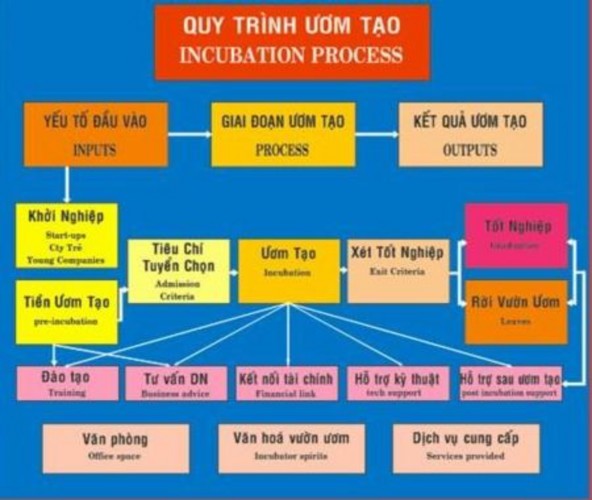
Although incubation activities between HBI and SBI take place in different industry sectors (food processing industry at HBI and information technology industry at SBI), the current incubation process can be summarized into the following steps:
1) Information gathering phase - in this phase, startups, young businesses and strategic partners learn, meet and exchange information with the incubator. The incubator will provide documents such as leaflets; answer frequently asked questions for customers (FAQ); guide customers to fill out the registration form to work with the incubator.
Figure 2.7: Incubation process in IT industry at SBI