- After drying, cool in a vacuum flask for 25-30 minutes and weigh once.
- Put back in the oven, dry at 100-105 degrees Celsius for 30 minutes. Leave in the desiccator and weigh a second time.
- If the next value is the same as the previous value, stop.
Maybe you are interested!
-
 Improved Ebb Method for Determining Void Volume
 -
 Method for Determining Non-Toxic Potential to Human Cells
 -
 Method of Determining Some Indicators Reflecting Economic Growth
 -
 Method for Determining the Amount of K Provided by Rainwater, the Amount of K Lost by Erosion and the Amount of K Lost by Leaching
 -
 Method of determining costs based on activities at some manufacturing enterprises of Viglacera Corporation - JSC - 32
k. Results:
- Initial starch content: average = 5g
- Starch and lactose content: M = 5 + 41.26 = 46.26 g
- Weight after first sampling : m = 45.66 g
2nd time : m = 45.66 g
- Total water content in starch = 46.26 – 45.66 = 0.6 g
- Humidity of starch:
0.6 * 100%
X =5
= 12%
2.4.2 Method for determining protein content of cassava starch by Micro – Kjeldahl method: [5]
g. Principle:
When the product is heated and analyzed with concentrated H 2 SO 4 , organic compounds are oxidized. Carbon and Hydrogen form CO 2 and H 2 O. Nitrogen, after being released in the form of NH 3 , combines with H 2 SO 4 to form (NH 4 ) 2 SO 4, which is dissolved in solution. Remove NH 3 from the solution with NaOH, simultaneously decant and collect NH 3 with an excess amount of 0.1N H 2 SO 4 . Titrate 0.1N H 2 SO 4 with standard 0.1N NaOH solution, thereby calculating the amount of Nitrogen in the experimental raw material sample.
h. Experimental equipment:
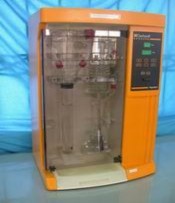
- Semi-automatic sandblasting machine, Tuû Hotte.
- 50ml Kjeldahl flask.
- Measure 25ml.
- Pipette 2ml; 10ml.
- Erlenmeyer 500ml.
- 100ml measuring cylinder.
- Burette 25 ml.
- Becher 100ml; 250ml.
i. Chemicals:
- Concentrated H 2 SO 4 , 40% NaOH, pure HClO 4 .
- 0.1N NaOH solution, 0.1N H 2 SO 4 standard solution .
- Phenolphthalein 1%.
j. Definition:
- Starch is the main component of many roots and seeds.
- Correct determination will help us accurately predict the amount of product obtained as well as losses during the production process.
k. How to proceed:

Sample poem:
- Take the sample and put it in a Kjeldahl flask. Weigh 2g of cassava starch, add 10ml of concentrated H 2 SO 4. To speed up the sample oxidation process, a catalyst must be added. Perchloric acid HClO 4 can be used as a catalyst , releasing CO 2 for the oxidation reaction.
- After adding the catalyst, heat the mixture gently to avoid boiling over and only heat vigorously when the mixture has completely turned into a liquid. During the heating process, shake gently and carefully so that there are no black traces of the undecomposed experimental material sample left on the walls of the flask. Heat until the solution in the flask is completely white.

Sand:
- Transfer the entire sample solution after it has been evaporated in the Kjeldahl flask into a 100ml volumetric flask, add distilled water up to the mark. At this time, the heat released is very strong.
Let the water evaporate partially. Cool and readjust the water level to avoid errors, then pour into the Erlenmeyer flask to easily shake the sample solution evenly.
- Take 10 ml of 0.1N H 2 SO 4 solution into the Erlenmeyer flask and put it into the sandblasting machine. Be careful not to immerse the flask into the liquid.
- Take 10 ml of the test solution from the measuring flask into the reaction vessel. Place it in the ventilation system, being careful not to move it too much, or the gas will escape and contaminate the sample.
- Conducted in automatic sanding machine:

Classification:
Remove the flask from the machine after rinsing with distilled water to remove all the sample stuck on the plate. Add 10 drops of phenolphthalein to the flask and titrate with 0.1N NaOH.
l. Results:
(a-bK) * 0.0014 * V * 100
N = v * m
a: number of ml of 0.1N H 2 SO 4 standard solution used to absorb NH 3 b: number of ml of 0.1N NaOH used for titration
m: mass of sample to be homogenized (g)
V: total volume of the standard oxidizing solution (100ml) v: volume of the oxidizing solution used for distillation (10ml) 0.0014: amount of grams of Nitrogen corresponding to 1ml of 0.1N H 2 SO 4
K: 0.1N NaOH titration correction coefficient
a = 10 ml
b = 9.55 ml m = 2 g
V = 100 ml
v = 10 ml K = 1
( 10 – 9.95*1) * 0.0014 * 100 * 100
N = 10 * 2
N = 0.035 %
Protein (%) = Nitrogen (%) * 5.7 ( 5.7 : conversion factor)
= 0.045 * 5.7 = 0.1995 (%)
2.4.3 Determination of initial starch content: [4]
a. Definition:
- Starch is the main component of many roots and seeds.
- Correct determination will help us accurately predict the amount of product obtained as well as losses during the production process.
b. Principle:
- Hydrolyze starch into sugar in 2% HCl solution under boiling conditions in a water bath for t = 2 hours.
- The hydrolyzed solution was cooled and neutralized with NaOH using methyl orange indicator.
- Solution content is determined by the bectra, Lain-Anynol,
Graxianop …
c. Tools:
- Volumetric flask: 100,250 ml.
- Triangle bottle: 250 ml.
- Glass bottles: 100, 250 ml
- Glass surgery.
- Measuring: 100 ml
- Anti-corrosion mineral.
- Outside the water.
- Electric kettle.
- Analytical balance with accuracy of 0.001 g.
- Temperature: 100 o C.
d. Chemicals:
- Hydrochloric acid.
- 10% sodium hydroxide solution
- Methyl orange 1%.
e. Implementation:
- Weigh 2g of cassava starch and transfer to a 250ml volumetric flask.
- Add 100 ml of 2% HCl (100 ml of sand water + 6 ml of 35% HCl).
- And talk to the cold air.
- Boil the water bath for 2 hours. The water level outside the water bath must be higher than the water level in the hydrolysis flask.
- After 2 hours of hydrolysis, cool the starch that has been converted into glucose to room temperature and then add a few drops of methyl orange using 10% NaOH to neutralize the excess acid to the color line.
- After neutralization, transfer the entire solution into a 250 ml volumetric flask and measure the free sugar using the ferrycyanure method.
- Put into a conical flask 20 ml of K 3 Fe(CN) 6 1% + 5 ml of KOH 2.5 N.
- Boil and measure directly on the stove with the sugar solution drop by drop and shake vigorously.
- The initial solution has the lemon yellow color of ferrycyanide. The titration stop point is determined when the lemon yellow color disappears, the solution becomes clear and colorless for about 30 seconds and then changes to the very bright chrome yellow color of ferrycyanide.
- Do the same for the standard sugar solution, which is 0.5% glucose solution.
l. Results:
Standard glucose = 4.7 ml .
Amount of glucose needed to reduce 20ml of K 3 Fe 2 (CN) 6 : 4.7 * 0.5
= = 0.0235 g 100
Hydrolysis solution used : V = 3.1 ml
The amount of free sugar in starch is 0.0235
X k =* 250 = 1.895g 3.1
Amount of starch used = X k * 0.9 = 1.895 * 0.9 = 1.7055g Initial starch content:
1.7055 * 100%
= = 85.275% 2
2.4.4 Determination of total sugar and free sugar content by DNS method: [4]
a. Principle:
- Based on the color reaction between reducing sugar and the reagent dinitrosalicylic acid DNS. The color intensity of the reaction mixture is proportional to the intensity of the reducing sugar within a certain range. Based on the graph of the standard sugar with pure glucose, the content of reducing sugar in the analyzed sample can be calculated.
b. Tools:
- Color comparator.
c. Chemicals:
+ Dinitrosalicylic acid DNS.
+ Double tartrate salt KNaC 4 H 4 O 6 .4H 2 O.
+ 4N NaOH solution.
Add 5g DNS and 300ml distilled water to the beaker, dissolve completely at 50 0 C. Then add 50ml 4N NaOH solution. Finally add 150g double tartrate salt, dissolve completely then put into 500ml volumetric flask. Add distilled water to the mark. Store in a dark glass bottle. If after 1-2 days you see sediment, filter it.
d. Procedure:

Standard glucose curve:
- Weigh 99% pure glucose using an analytical balance (take 3 decimal places after the decimal point).
- Mix 1% glucose solution (1g glucose in 100ml water).
- Aspirate the solution into the test tubes in turn:
Test 1: 1.27ml glucose solution + 8.73ml water. Test 2: 1.9ml glucose solution + 8.1ml water.
Test 3: 2.63ml glucose solution + 7.37ml water. Test 4: 3.05ml glucose solution + 6.95ml water. Test 5: 3.56ml glucose solution + 6.44ml water.
- Pipette 2ml from each test tube and 1ml of DNS into a clean test tube and seal.
- Boil for 5 minutes at 90 o C.
- Cool rapidly and measure OD at 540 nm.
- Standard curve with vertical axis as OD, horizontal axis as density (g/l).

Determination of total sugar content in the analytical sample:
- Dilute the sample so that the total sugar content is in the range of 0.12 - 0.42 g/l.
- Add 5 drops of concentrated HCl to 5 ml of the solution to be determined, then boil at 90 0 C for 30 minutes. Neutralize with 5N KOH solution.
- From the above solution, pipet 2 ml into a tightly stoppered test tube and add 1 ml of DNS, then boil at 90 0 C for 5 minutes, take it out to cool quickly and then measure OD. The reference sample is sand water.
- Based on the standard sugar graph, the total sugar content in the analyzed sample can be determined.

Determination of free sugar content in analytical samples:
- Dilute the sample so that the total sugar content is in the range of 0.12 - 0.42 g/l.
- Pipette 2 ml of diluted solution into a tightly closed test tube and 1 ml of DNS, then boil at 90 0 C for 5 minutes, take it out, let it cool quickly and then measure OD. The reference sample is sand water.
- Based on the standard curve, determine the amount of free sugar in the analyzed sample.
2.5 Machinery and equipment:
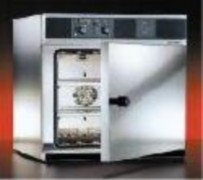
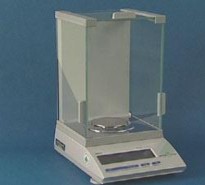
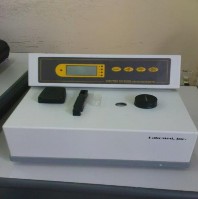
Figure 2.1 : Drying cabinet Figure 2.2 : 4 - digit electronic scale
odd
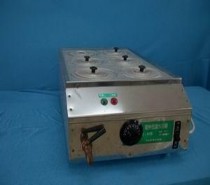
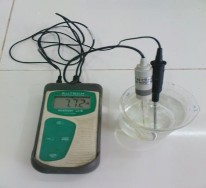
Figure 2.3: Water bath Figure 2.4: pH meter