
3.2.3.3. Implementation organization
- Raise awareness about the need to innovate methods of organizing play activities for children and be conscious in deciding to find and apply positive teaching methods in a reasonable and effective way. .
- Organize innovative methods through contests: excellent teachers, lesson plan contests, contests for making utensils and toys from scrap materials, etc.
- Apply information technology and use modern methods in organizing fun activities for children.
- Teachers need to create many opportunities for children to learn through a learning environment. The environment here does not stop at the classroom but takes advantage of all spaces inside and outside the classroom to create conditions for children to learn, experience, and explore anytime, anywhere.
Maybe you are interested!
-
 Car body electrical practice - 8
zt2i3t4l5ee
zt2a3gs
zt2a3ge
zc2o3n4t5e6n7ts
If the voltage is out of specification, replace the wire or connector.
If the voltage is within specification, install the front fog light relay and follow step 5.
Step 5 Check the front fog light switch
- Remove the D4 connector of the fog light switch
- Use a multimeter to measure the resistance of the front fog light switch.
Measurement location
Condition
Standard
D4-3 (BFG) -D4-4 (LFG)
Light switchFront Fog OFF
>10kΩ
D4-3 (BFG) -D4-4 (LFG)
Front fog light switchON
<1 Ω
- Standard resistor
D4 connector is located on the combination switch assembly.
If the resistance is out of specification, replace the combination switch (the fog light switch is located in the combination switch).
If the resistance is within specification, follow step 6.
Step 6 Check wiring and connectors (front fog light relay-light selector switch)
- Disconnect connector D4 of the combination switch assembly
- Use a voltmeter to measure the voltage value of jack D4 on the wire side.
Measurement location
Control modecontrol
Standard
D4-3 (BFG) - (-) AQ
TAIL
11 to 14 V
D4 connector for the wiring of the combination switch assembly
If the voltage does not meet the standard, replace the wire or connector.
If the voltage is within standard, there may have been an error in the previous measurements.
Step 7 Check the front fog lights
- Remove the front fog light electrical connector.
- Supply battery voltage to the fog lamp terminals
Jack 8, B9 of front fog lamp on the electrical side
blind first.
Power supply location
Terms and Conditions
Battery positive terminal - Terminal 2Battery negative terminal - Terminal 1
Fog lightsbefore morning
- If the light does not come on, replace the bulb.
If the light is on, re-plug the jack and continue to step 8.
Step 8 Check wiring and connectors (relay and front fog lights)
- Disconnect the B8 and B9 connectors of the front fog lights.
- Use a voltmeter to measure voltage at the following locations:
Measurement location
Switch location
Terms and Conditions
B8-2 - (-) AQ
Electric lock ON TAIL size switchFog switch ON
11 to 14 V
B9-2 - (-) AQ
Electric lock ONTAIL size switch Fog switch ON
11 to 14 V
B8 and B9 connectors on the front fog lamp wiring side
Voltage is not up to standard, repair or replace the jack. If up to standard, there may have been an error in the measurement process.
2.2.4. Procedure for removing, installing and adjusting fog lights 1. Procedure for removing
- Remove the front inner ear pads
Use a screwdriver to remove the 3 screws and remove the front part of the front inner ear liner
-Remove the fog light assembly
+ Disconnect the connector.
+ Use a screwdriver to remove 3 screws to remove the fog light cover
2. Installation sequence
-Rotate the fog lamp bulb in the direction indicated by the arrow as shown in the figure and remove the fog lamp from the fog lamp assembly.
-Rotate the fog light bulb in the direction indicated by the arrow as shown in the figure and install the light into the fog light assembly.
- Use a screwdriver to install the fog light cover
-Install the electrical connector
Attention: Be careful not to damage the plastic thread on the lamp assembly.
- Install the front inner ear pads
Use a screwdriver to install the front inner bumper with 3 screws.
3. Prepare the vehicle to adjust the fog light convergence. Prepare the vehicle:
- Make sure there is no damage or deformation to the vehicle body around the fog lights.
- Add fuel to the fuel tank
- Add oil to standard level.
- Add engine coolant to standard level.
- Inflate the tire to standard pressure.
- Place spare tire, tools and jack in original design position
- Do not leave any load in the luggage compartment.
- Let a person weighing about 75 kg sit in the driver's seat.
4. Prepare to check the fog light convergence
a/ Prepare the vehicle status as follows:
- Place the car in a dark enough place to see the lines. The lines are the dividing line, below which the light from the fog lights can be seen but above which it cannot.
- Place the car perpendicular to the wall.
- Keep a distance of 7.62 m between the center of the fog lamp and the wall.
- Park the car on level ground.
- Press the car down a few times to stabilize the suspension.
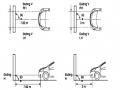
Note: A distance of approximately 7.62 m is required between the vehicle (fog lamp center) and the wall to adjust the convergence correctly. If the distance of 7.62 m cannot be achieved, set the correct distance of 3 m to check and adjust the fog lamp convergence. (Since the target area varies with the distance, please follow the instructions as shown in the figure.)
b/ Prepare a piece of thick white paper about 2 m high and 4 m wide to use as a screen.
c/ Draw a vertical line through the center of the screen (line V).
d/ Set the screen as shown in the picture. Note:
- Keep the screen perpendicular to the ground.
- Align the V line on the screen with the center of the vehicle.
e/Draw the reference lines (H, V LH and V RH lines) on the screen as shown in the figure.HINT:
Mark the center of the fog lamp on the screen. If the center mark cannot be seen on the fog lamp, use the center of the fog lamp or the manufacturer's name mark on the fog lamp as the center mark.
H line (fog light height):
Draw a line across the screen so that it passes through the center mark. Line H should be at the same height as the center mark of the fog light bulb.
Line V LH, V RH (center mark position of left fog lamp LH and right fog lamp RH):
Draw two lines so that they intersect line H at the center marks.
5. Check the fog light convergence
a/ Cover the fog lamp or remove the connector of the other side fog lamp to prevent light from the unchecked fog lamp from affecting the fog lamp convergence test.
b/ Start the engine.
c/ Turn on the fog lights and make sure that the dividing line is outside the standard area as shown in the drawing.
6. Adjust the fog light convergence
Use a screwdriver to adjust the fog light to the standard area by turning the toe adjustment screw.
Note: If the screw is adjusted too far, loosen it and then tighten it again, so that the last rotation of the light adjustment screw is clockwise.
3. Self-study questions
1. Describe the operating principle of the lighting system with automatic headlight function
2. Describe the operating principle of the lighting system with the function of rotating headlights when turning
3. Draw diagram and connect lighting system on Hyundai Porter car
4. Draw diagram and connect lighting system on Honda Accord 1992
5. Draw the lighting circuit on a 1993 Toyota Lexus
LESSON 3 MAINTENANCE AND REPAIR OF SIGNAL SYSTEM
I. IMPLEMENTATION GOAL
After completing this lesson, students will be able to:
- Distinguish between types of signals on cars
- Correctly describe common symptoms and suspected areas causing damage.
- Connecting signal circuits ensures technical requirements
- Disassemble, install, check, maintain and repair the signal system to ensure technical requirements.
- Ensure safety in work and industrial hygiene
II. LESSON CONTENT
1. General description
The signal system equipped on cars aims to create signals to notify other vehicles participating in traffic about the vehicle's operating status such as: stopping, parking, braking, reversing, turning...
Signals are used either by light such as headlamps, brake lights, turn signals….. or by sound such as horns, reverse music….
Just like the lighting system. A signal system circuit usually consists of: battery, fuse, wire, relay, electrical load and control switch. Only some switches of the signal system are on the combination switch. The switches of other signals are usually located in different locations such as in the gearbox or brake pedal……
2. Maintenance and repair
2.1. Turn signals and hazard lights
The installation location of the turn signal is shown in Figure 3.1. The turn signal control switch is located in the combination switch under the steering wheel. Turning this switch to the right or left will make the turn signal turn right or left.
The hazard light switch is used when the vehicle has a problem while participating in traffic. When the hazard light switch is turned on, all the turn signals on the vehicle will light up at a certain frequency. The hazard light switch is usually placed separately from the turn signal switch (some old cars integrate the hazard and turn signal switches on the same combination switch cluster).
Figure 3.1 Turn signal switch Figure 3.2 Hazard switch
The part that generates the flashing frequency for the lights is called a turn signal relay. The turn signal relay usually has 3 terminals: B (positive power supply); E (negative power supply); L (providing the turn signal switch to distribute to the
lamp)
2.1.1. Circuit diagram
To generate the frequency for the turn signal, a turn signal relay is used in the turn signal circuit. The current from the turn signal relay will be sent to the turn signal switch assembly to distribute the current to the turn signal lights for the driver's purpose.
Figure 3.3. Schematic diagram of a turn signal circuit without a hazard switch
1. Battery; 2. Electric lock; 3. Turn signal relay; 4. Turn signal switch; 5. Turn signal lamp; 6. Turn signal lamp; 7. Hazard switch
Figure 3.4 Schematic diagram of turn signal circuit with hazard switch
1. Battery; 2. Combination switch cluster; 3. Turn signal;
4. Turn signal light; 5. Turn signal relay
Today's cars no longer use three-pin turn signal relays (B, L, E) but use eight-pin turn signal relays (figure 3.5) (pin number 8 is used for hazard lights).
For this type, the current supplying the turn signal lights is supplied directly from the turn signal relay to the lights.
div.maincontent .p { color: black; font-family:"Times New Roman", serif; font-style: normal; font-weight: normal; text-decoration: none; font-size: 14pt; margin:0pt; } div.maincontent p { color: black; font-family:"Times New Roman", serif; font-style: normal; font-weight: normal; text-decoration: none; font-size: 14pt; margin:0pt; } div.maincontent .s1 { color: black; font-family:"Times New Roman", serif; font-style: normal; font-weight: normal; text-decoration: none; font-size: 13pt; } div.maincontent .s2 { color: black; font-family:"Times New Roman", serif; font-style: italic; font-weight: normal; text-decoration: none; font-size: 14pt; } div.maincontent .s3 { color: black; font-family:"Times New Roman", serif; font-style: normal; font-weight: normal; text-decoration: none; font-size: 14pt; } div.maincontent .s4 { color: black; font-family:"Times New Roman", serif; font-style: normal; font-weight: normal; text-decoration: none; font-size: 13pt; } div.maincontent .s5 { color: black; font-family:"Times New Roman", serif; font-style: normal; font-weight: normal; text-decoration: none; font-size: 13pt; vertical-align: 1pt; } div.maincontent .s6 { color: black; font-family:"Times New Roman", serif; font-style: normal; font-weight: normal; text-decoration: none; font-size: 11pt; } div.maincontent .s7 { color: black; font-family:"Times New Roman", serif; font-style: normal; font-weight: normal; text-decoration: none; font-size: 14pt; vertical-align: -9pt; } div.maincontent .s8 { color: black; font-family:"Times New Roman", serif; font-style: normal; font-weight: normal; text-decoration: none; font-size: 11pt; } div.maincontent .s9 { color: #008000; font-family:"Times New Roman", serif; font-style: normal; font-weight: normal; text-decoration: none; font-size: 14pt; } div.maincontent .s10 { color: black; font-family:"Times New Roman", serif; font-style: italic; font-weight: normal; te
Car body electrical practice - 8
zt2i3t4l5ee
zt2a3gs
zt2a3ge
zc2o3n4t5e6n7ts
If the voltage is out of specification, replace the wire or connector.
If the voltage is within specification, install the front fog light relay and follow step 5.
Step 5 Check the front fog light switch
- Remove the D4 connector of the fog light switch
- Use a multimeter to measure the resistance of the front fog light switch.
Measurement location
Condition
Standard
D4-3 (BFG) -D4-4 (LFG)
Light switchFront Fog OFF
>10kΩ
D4-3 (BFG) -D4-4 (LFG)
Front fog light switchON
<1 Ω
- Standard resistor
D4 connector is located on the combination switch assembly.
If the resistance is out of specification, replace the combination switch (the fog light switch is located in the combination switch).
If the resistance is within specification, follow step 6.
Step 6 Check wiring and connectors (front fog light relay-light selector switch)
- Disconnect connector D4 of the combination switch assembly
- Use a voltmeter to measure the voltage value of jack D4 on the wire side.
Measurement location
Control modecontrol
Standard
D4-3 (BFG) - (-) AQ
TAIL
11 to 14 V
D4 connector for the wiring of the combination switch assembly
If the voltage does not meet the standard, replace the wire or connector.
If the voltage is within standard, there may have been an error in the previous measurements.
Step 7 Check the front fog lights
- Remove the front fog light electrical connector.
- Supply battery voltage to the fog lamp terminals
Jack 8, B9 of front fog lamp on the electrical side
blind first.
Power supply location
Terms and Conditions
Battery positive terminal - Terminal 2Battery negative terminal - Terminal 1
Fog lightsbefore morning
- If the light does not come on, replace the bulb.
If the light is on, re-plug the jack and continue to step 8.
Step 8 Check wiring and connectors (relay and front fog lights)
- Disconnect the B8 and B9 connectors of the front fog lights.
- Use a voltmeter to measure voltage at the following locations:
Measurement location
Switch location
Terms and Conditions
B8-2 - (-) AQ
Electric lock ON TAIL size switchFog switch ON
11 to 14 V
B9-2 - (-) AQ
Electric lock ONTAIL size switch Fog switch ON
11 to 14 V
B8 and B9 connectors on the front fog lamp wiring side
Voltage is not up to standard, repair or replace the jack. If up to standard, there may have been an error in the measurement process.
2.2.4. Procedure for removing, installing and adjusting fog lights 1. Procedure for removing
- Remove the front inner ear pads
Use a screwdriver to remove the 3 screws and remove the front part of the front inner ear liner
-Remove the fog light assembly
+ Disconnect the connector.
+ Use a screwdriver to remove 3 screws to remove the fog light cover
2. Installation sequence
-Rotate the fog lamp bulb in the direction indicated by the arrow as shown in the figure and remove the fog lamp from the fog lamp assembly.
-Rotate the fog light bulb in the direction indicated by the arrow as shown in the figure and install the light into the fog light assembly.
- Use a screwdriver to install the fog light cover
-Install the electrical connector
Attention: Be careful not to damage the plastic thread on the lamp assembly.
- Install the front inner ear pads
Use a screwdriver to install the front inner bumper with 3 screws.
3. Prepare the vehicle to adjust the fog light convergence. Prepare the vehicle:
- Make sure there is no damage or deformation to the vehicle body around the fog lights.
- Add fuel to the fuel tank
- Add oil to standard level.
- Add engine coolant to standard level.
- Inflate the tire to standard pressure.
- Place spare tire, tools and jack in original design position
- Do not leave any load in the luggage compartment.
- Let a person weighing about 75 kg sit in the driver's seat.
4. Prepare to check the fog light convergence
a/ Prepare the vehicle status as follows:
- Place the car in a dark enough place to see the lines. The lines are the dividing line, below which the light from the fog lights can be seen but above which it cannot.
- Place the car perpendicular to the wall.
- Keep a distance of 7.62 m between the center of the fog lamp and the wall.
- Park the car on level ground.
- Press the car down a few times to stabilize the suspension.
Note: A distance of approximately 7.62 m is required between the vehicle (fog lamp center) and the wall to adjust the convergence correctly. If the distance of 7.62 m cannot be achieved, set the correct distance of 3 m to check and adjust the fog lamp convergence. (Since the target area varies with the distance, please follow the instructions as shown in the figure.)
b/ Prepare a piece of thick white paper about 2 m high and 4 m wide to use as a screen.
c/ Draw a vertical line through the center of the screen (line V).
d/ Set the screen as shown in the picture. Note:
- Keep the screen perpendicular to the ground.
- Align the V line on the screen with the center of the vehicle.
e/Draw the reference lines (H, V LH and V RH lines) on the screen as shown in the figure.HINT:
Mark the center of the fog lamp on the screen. If the center mark cannot be seen on the fog lamp, use the center of the fog lamp or the manufacturer's name mark on the fog lamp as the center mark.
H line (fog light height):
Draw a line across the screen so that it passes through the center mark. Line H should be at the same height as the center mark of the fog light bulb.
Line V LH, V RH (center mark position of left fog lamp LH and right fog lamp RH):
Draw two lines so that they intersect line H at the center marks.
5. Check the fog light convergence
a/ Cover the fog lamp or remove the connector of the other side fog lamp to prevent light from the unchecked fog lamp from affecting the fog lamp convergence test.
b/ Start the engine.
c/ Turn on the fog lights and make sure that the dividing line is outside the standard area as shown in the drawing.
6. Adjust the fog light convergence
Use a screwdriver to adjust the fog light to the standard area by turning the toe adjustment screw.
Note: If the screw is adjusted too far, loosen it and then tighten it again, so that the last rotation of the light adjustment screw is clockwise.
3. Self-study questions
1. Describe the operating principle of the lighting system with automatic headlight function
2. Describe the operating principle of the lighting system with the function of rotating headlights when turning
3. Draw diagram and connect lighting system on Hyundai Porter car
4. Draw diagram and connect lighting system on Honda Accord 1992
5. Draw the lighting circuit on a 1993 Toyota Lexus
LESSON 3 MAINTENANCE AND REPAIR OF SIGNAL SYSTEM
I. IMPLEMENTATION GOAL
After completing this lesson, students will be able to:
- Distinguish between types of signals on cars
- Correctly describe common symptoms and suspected areas causing damage.
- Connecting signal circuits ensures technical requirements
- Disassemble, install, check, maintain and repair the signal system to ensure technical requirements.
- Ensure safety in work and industrial hygiene
II. LESSON CONTENT
1. General description
The signal system equipped on cars aims to create signals to notify other vehicles participating in traffic about the vehicle's operating status such as: stopping, parking, braking, reversing, turning...
Signals are used either by light such as headlamps, brake lights, turn signals….. or by sound such as horns, reverse music….
Just like the lighting system. A signal system circuit usually consists of: battery, fuse, wire, relay, electrical load and control switch. Only some switches of the signal system are on the combination switch. The switches of other signals are usually located in different locations such as in the gearbox or brake pedal……
2. Maintenance and repair
2.1. Turn signals and hazard lights
The installation location of the turn signal is shown in Figure 3.1. The turn signal control switch is located in the combination switch under the steering wheel. Turning this switch to the right or left will make the turn signal turn right or left.
The hazard light switch is used when the vehicle has a problem while participating in traffic. When the hazard light switch is turned on, all the turn signals on the vehicle will light up at a certain frequency. The hazard light switch is usually placed separately from the turn signal switch (some old cars integrate the hazard and turn signal switches on the same combination switch cluster).
Figure 3.1 Turn signal switch Figure 3.2 Hazard switch
The part that generates the flashing frequency for the lights is called a turn signal relay. The turn signal relay usually has 3 terminals: B (positive power supply); E (negative power supply); L (providing the turn signal switch to distribute to the
lamp)
2.1.1. Circuit diagram
To generate the frequency for the turn signal, a turn signal relay is used in the turn signal circuit. The current from the turn signal relay will be sent to the turn signal switch assembly to distribute the current to the turn signal lights for the driver's purpose.
Figure 3.3. Schematic diagram of a turn signal circuit without a hazard switch
1. Battery; 2. Electric lock; 3. Turn signal relay; 4. Turn signal switch; 5. Turn signal lamp; 6. Turn signal lamp; 7. Hazard switch
Figure 3.4 Schematic diagram of turn signal circuit with hazard switch
1. Battery; 2. Combination switch cluster; 3. Turn signal;
4. Turn signal light; 5. Turn signal relay
Today's cars no longer use three-pin turn signal relays (B, L, E) but use eight-pin turn signal relays (figure 3.5) (pin number 8 is used for hazard lights).
For this type, the current supplying the turn signal lights is supplied directly from the turn signal relay to the lights.
div.maincontent .p { color: black; font-family:"Times New Roman", serif; font-style: normal; font-weight: normal; text-decoration: none; font-size: 14pt; margin:0pt; } div.maincontent p { color: black; font-family:"Times New Roman", serif; font-style: normal; font-weight: normal; text-decoration: none; font-size: 14pt; margin:0pt; } div.maincontent .s1 { color: black; font-family:"Times New Roman", serif; font-style: normal; font-weight: normal; text-decoration: none; font-size: 13pt; } div.maincontent .s2 { color: black; font-family:"Times New Roman", serif; font-style: italic; font-weight: normal; text-decoration: none; font-size: 14pt; } div.maincontent .s3 { color: black; font-family:"Times New Roman", serif; font-style: normal; font-weight: normal; text-decoration: none; font-size: 14pt; } div.maincontent .s4 { color: black; font-family:"Times New Roman", serif; font-style: normal; font-weight: normal; text-decoration: none; font-size: 13pt; } div.maincontent .s5 { color: black; font-family:"Times New Roman", serif; font-style: normal; font-weight: normal; text-decoration: none; font-size: 13pt; vertical-align: 1pt; } div.maincontent .s6 { color: black; font-family:"Times New Roman", serif; font-style: normal; font-weight: normal; text-decoration: none; font-size: 11pt; } div.maincontent .s7 { color: black; font-family:"Times New Roman", serif; font-style: normal; font-weight: normal; text-decoration: none; font-size: 14pt; vertical-align: -9pt; } div.maincontent .s8 { color: black; font-family:"Times New Roman", serif; font-style: normal; font-weight: normal; text-decoration: none; font-size: 11pt; } div.maincontent .s9 { color: #008000; font-family:"Times New Roman", serif; font-style: normal; font-weight: normal; text-decoration: none; font-size: 14pt; } div.maincontent .s10 { color: black; font-family:"Times New Roman", serif; font-style: italic; font-weight: normal; te -
 Internal control of revenue and expenditure activities at the National Children's Hospital - 2
 -
 Current Status of Testing and Evaluating Children's Rights and Duties Education Through Experiential Activities at Secondary Schools in Hung Yen City,
 -
 Incorporating Human Rights, Children's Rights, and School Violence Prevention into the Secondary School Curriculum
 -
 Manifestations of Observation Skills of 5-6 Year Old Preschool Children in Puzzle Activities
- Teachers create opportunities for children to learn in many different ways so that children can actively participate in fun activities, explore and experience according to the motto "learn to play, play to learn"
3.2.3.4. Conditions for implementation
Teachers must organize correct awareness about organizing fun activities for children, about commenting on children when they do things right or wrong. Show children how to change to a new way of doing things.
Teachers must be aware of the importance of organization, firmly grasp the implementation of their expertise in content, methods, and evaluate children when they perform according to the requirements of organizational activities.
Teachers must be dedicated to their duties and profession, really care about children, and always create favorable conditions for children when they play as well as when they play at home.
3.2.4. Measure 4: Make utensils and toys to use in fun activities for children
3.2.4.1. Target
The effectiveness of organizing children's play activities has many influencing factors, including the physical environment in general, equipment, and toys for various types of games.
associated with organizational forms and educational tasks that have important influences. In many games, without tools or toys, children cannot perform the game. Originating from the fact that the source of children's supplies and toys in preschools in Pack district, Xieng Khouang province is still limited. If teachers can make many tools and toys, it will enhance the prerequisites for the quality of children's play activities.
3.2.4.2. Content
Organize the making of utensils and toys with diverse shapes, colors and uses from many different raw materials to use in organizing fun activities for children, including:
Outdoor items and toys used in children's outdoor activity areas: Natural area, Sand and water activity area, Area for organizing physical games and folk games; Free play area with open materials made from gravel, sand,
The items and toys in the classroom to use in organizing fun activities in activity corners for children are made from simple, easy-to-find and easy-to-collect materials such as cardboard, old calendars, and paper. color.
3.2.4.3. How to do it
The school develops a plan to organize teachers to make supplies and toys for children according to the school year;
Based on the school's plan, teachers proactively review children's supplies and toys available in class; Based on the goals and plans of organizing youth councils for children, make a list of missing items and toys. Identify items and toys that can be supplemented according to the teacher's ability to make items and toys. (including classroom supplies, toys and outdoor toys);
Coordinate with families, mobilize parents to respond and participate in creative activities to serve fun activities for children in the class in charge by asking for family donations for the cause. material; time
Time and participation of people and teachers in making tools and toys for each class.
Organize fun activities that integrate practical experiences with open materials such as leaves, pebbles, newspapers, sand, chalk... to create visual products that children can use right away during the learning process. Play and preserve for future play activities for yourself and the class.
For example:
Storybook corner: Make use of leftover paper and old calendars. Teachers help children make books, then let them collect pictures to cut or tear and paste them according to learning games on topics, each child feels. Get the unique beauty of a book you make yourself and get help from your teacher.
Role play corner: Cake boxes, milk boxes, cosmetic boxes with beautiful colors are used as cooking toys: pots, pots, bowls, and for display in department stores; create dishes from modeling clay: beef, sticky rice and beans; Make spring rolls from plastic bags (to make spring rolls wrappers), shredded colored paper, and shredded colored foam (to make spring rolls filling); make cakes from white and yellow clay (drift cake and donut); Create pictures from drawing paper and crayons of beautiful and attractive dishes by teaching children to cut and paste to decorate the play corner and do it together;
Construction corner: Create flowers (let children take colored foam, cut it into petals, then stick it to jelly shells, use straws as branches, or make them from wrinkled paper and foam wrapped around steel wire); Create coconut trees and cycad trees (using old cardboard for the trunk, foam for the leaves); Make a fence (use diagonal yogurt spoons and green foam as grass).
Learning corner: Use children's drawn and painted images of costumes to decorate the corner. To create closeness and excitement for children because it is their product, children create it, play with it and decorate it according to the teacher's instructions.
Organize competitions to make tools and toys for children in all classes and grades, contests for teachers to make tools and toys to help school and district levels and immediately use the products created for children. children's play activities.
3.2.4.4. Implementation conditions
Department of Education and Training; The school pays attention to the importance of making tools and toys for children's play activities;
The school has plans and measures to direct teachers and coordinate with families to organize activities of making utensils and toys for children in teachers' classes;
Organized many competitions on teacher capacity, especially the capacity to make utensils and toys to serve the professional activities of teachers in general, and to serve the organization of youth councils for children in particular;
The school has funding to support teachers in making supplies and toys; There are effective measures to coordinate with families.
Teachers are enthusiastic, responsible, and capable of making tools and toys for children; Actively participate in professional activities, promote your own creativity, be able to propose teaching tools for children from mobilization on the spot to replace broken, old tools... and to exchange, learn from each other's experiences.
3.2.5. Measure 5: Design and use an environment to organize play activities for 5-6 year old children from a child-centered perspective
3.2.5.1. Target
The play environment in preschools plays an important role in children's learning and play. Designing and using the environment for organizing youth activities for children from a child-centered perspective will help children satisfy their need to play, develop curiosity, actively play, learn, and promote creativity. creation, through which the child's personality is formed and comprehensively developed.
3.2.5.2. Content
In order for children's play activities to take place according to the teacher's pedagogical requirements and the children's activity needs, in addition to planning and organizing activities, teachers need to pay attention to the creation and use of the environment. school for children to play.
Physical environment: The play space needs to be arranged appropriately to create conditions for children to be proactive in taking and using; promote emotional expression
Be active in contact, activities and develop children's personal qualities. The arrangement of toys needs to be diverse, open, and attractive to stimulate children to be active. Equipment and toys need to be supplemented and added to suit each topic.
Psychological environment: Children share and cooperate with teachers and friends when they live in a comfortable and happy environment. Teachers can let children participate in arranging and arranging utensils and toys, and presenting products in corners, which gives children the feeling of being members of the class, so they are more interested and ready. Ready to share play ideas and evoke the need to communicate, show nice gestures and behaviors with everyone...
3.2.5.3. How to do it
Plan to build and organize the psychological and physical environment in organizing Youth Council for 5-6 year old children within the school and classroom;
Organize teachers in all classes to build appropriate play spaces to create conditions for children to be proactive in taking and using; arrange and arrange diverse and open toys; Add tools and toys appropriate to each child's topic and activity. Teachers proactively build an environment of group activities in classes (coordinate with teachers and staff in the school; organize children to do it together, and mobilize the coordination of children's parents).
Organize teachers in all classes to build a psychological environment to organize activities for children: Based on pedagogical requirements, teachers develop and implement classroom rules and rules of play activities for children; Organize measures for children to proactively share and cooperate with teachers and friends when playing, practice listening skills, respect, actively and voluntarily carry out teacher's requests and activities... Encourage confidence and autonomy in children.
Environment outside the classroom
The school manages research and studies such as sports areas (basketball poles, climbing ladders, mini soccer playground...); Play area with outdoor toys
(slide, ferris wheel, seesaw, ball house...); “traffic” play area; Play area with soil, sand, water, rocks, gravel...; Area for children to grow vegetables, grow plants and take care of plants; areas for growing grass, flowers, ornamental plants, fruit trees, and shade trees on the school grounds; Lawn creation area... path system on the field; height of the boundary wall system, width of the gate and school sign; area for placing propaganda signs, parent mailboxes...
The school's educational environment is truly safe, ensuring hygiene in water sources, air, and hygiene and safety in eating. Equipment, utensils and toys are regularly maintained, kept clean and attractive to children. There is a protective fence around the school area.
Environment inside the classroom
- Create a classroom environment with vivid colors and funny characters.
- The supplies and materials teachers provide for activity corners must be carefully planned to assist teachers in planning children's learning and to engage children in participating, as well as create other learning opportunities.
- Decorate the classroom environment to suit the nature of the activities and for each age group. In the classroom, arrange suitable space for common class activities and activities according to the interests and abilities of small groups or individuals. There is a dedicated area to care for children with special needs.
3.2.5.4. Implementation conditions
School administrators and teachers are properly aware of the importance of building and organizing a community-based environment for 5-6 year old children according to the child-centered perspective and innovating current preschool education;
Teachers are trained in the ability to design and organize a physical activity environment for 5-6 year old children from a child-centered perspective;
Teachers have a need to innovate in building and organizing a youth-building environment for children and have the ability to do so;
Teachers continue to guide children to participate in class and school-wide activities.
Teachers must actively explore, research, learn from colleagues or learn about addresses on the internet to be able to refer to how to design an environment for children to learn every day.
Teachers organize children to play according to time, in class, and outdoors, games include types such as: for example: Folk games... role-playing games, movement games...
Teachers proactively make positive changes in their approach to children, and are flexible in using forms and methods of organizing play activities for children.
In organizing play, teachers use measures to encourage children to use toys; Use natural materials to make toys to promote children's creativity.
There must be enough space to arrange a variety of games both indoors and outdoors, as well as a relaxation space for children.
Indoor space: there needs to be enough room area to be able to organize games such as game corners, study, exercise, themed role-playing...
Build interesting outdoor play activities and pay attention to the reasonable arrangement of space for movement games, construction games, and games with sand and water. Design a place to relax and rest (in the school yard). and in the classroom).
It is necessary to provide adequate facilities for children to play comfortably and creatively...
3.3. Relationship between measures
We have researched and proposed the following 5 measures: Measure 1: Develop game content for children
Measure 2: Develop a plan to organize fun activities for children from a child-centered perspective
Measure 3: Innovate methods and forms of organizing play activities for children from a child-centered perspective
Measure 4: Make utensils and toys to use in fun activities for children
Measure 5: Design and use an environment to organize play activities for 5-6 year old children from a child-centered perspective
Each measure has an important position and is closely linked to each other, supporting and promoting each other. In organizing fun activities for 5-6 year old children, teachers need to synchronously combine the above measures to achieve the best results.
3.4. Test the necessity and feasibility of the measures
3.4.1. Testing purpose
The author conducted an experiment with the aim of confirming the necessity and feasibility of organizational measures to enhance the effectiveness of organizing youth councils for children 5-6 years old at kindergartens in Peck district, Xieng Khouang province.
3.4.2. Content and method of testing
a. Regarding content: Testing the necessary and unnecessary levels of measures to organize youth councils for 5-6 year old children in kindergartens in Peck district, Xieng Khouang province and the feasibility of the measures proposed by the topic. suggested.
b. About how:
- Build questionnaires.
- Organize consultation: solicit opinions from managers & teachers of 45 people, including:
+ District Education and Sports Office: 2 people
+ Principal and vice principal of kindergarten: 8 people
+ Teachers teaching at schools: 35 people
In the referendum, there are two criteria to evaluate the level of necessity and feasibility
+ Evaluate the necessity level of the 5 proposed measures with 3 levels: very necessary, necessary, not necessary.
+ Assessing the level of feasibility, there are 5 proposed measures with 3 levels: Very feasible, feasible, not feasible