
State-owned enterprises to attract more capital for technological innovation, expand production, promote the real ownership of capital contributors, and innovate management to improve efficiency and competitiveness in the market economy.
- Promote innovation in the state management mechanism for state-owned enterprises. Eliminate the subsidy situation, bring state-owned enterprises to face the market, create equal competition between state-owned enterprises and enterprises of other economic sectors. Expand the autonomy of state-owned enterprises in business, first of all in the fields of planning, finance and labor, along with enhancing responsibility in managing state capital and assets in state-owned enterprises. Expand the application of new management models to state-owned enterprises, such as the model of a single-member limited liability company, the model of parent company - subsidiary company.
- Promote internal innovation in state-owned enterprises with the focus on building business strategies, technological innovation, and innovation in corporate governance to enhance the competitiveness of state-owned enterprises in the socialist-oriented market economy.
Maybe you are interested!
-

 Quality Management and Levels of Quality Management
 -
 Assessment of the Quality of Sustainable Tourism Development Factors in Nghe An Province from Provincial Tourism Management Officers
 -
 Improving the Quality of Administrative Procedures and Strengthening the Direction and Management of the Heads of State Administrative Agencies at the Ministry Level
 -
 Solutions to improve the quality of asset and liability management at Vietnam Bank for Agriculture and Rural Development - 19
 -
 High-Quality Female Human Resources Participating in Leadership and Management in the Political System Are Still Low and Unstable
5.5. ORGANIZATION OF STATE MANAGEMENT SYSTEM FOR INDUSTRY IN VIETNAM
5.5.1. Some general issues
Industrial management must ensure many balanced relationships to achieve high efficiency and high growth in the process of expanded reproduction. In the relationships, attention must be paid to ensuring:
- The balance between production and consumption of products in the market, including domestic and international markets. The production of a certain type of product is often carried out by many enterprises, including domestic and foreign enterprises, so calculating and establishing this relationship is beyond the scope of each individual enterprise. To do this, an appropriate organizational structure is needed.
- The balance between exploitation and protection of environmental resources. This balance is established at the national and regional levels, and the organization of that balance is carried out within the framework of an open system. It includes the exchange of products between countries and between the regions of each country.
5.5.2. Organization of management apparatus by industry
The reality of organizational structure in Vietnam shows the following main problems:
- The management entity of each level I industry is organized at the central level: The Deputy Prime Minister is authorized by the Prime Minister to perform the function of unified management of the industry.
The central agency assists the Deputy Prime Minister in performing the above functions. It is also a component part of the management staff according to the functional field. This agency must be distinguished from the office directly under the Deputy Prime Minister.
- Subjects managing specialized sectors. According to the 1992 Constitution, Ministers are responsible for state management of their sectors nationwide. The Ministry is a specialized agency that assists the Minister in performing the function of sector management nationwide.
The scope of responsibility of a Minister often includes many level II and level III specialties. Therefore, the Ministry must include two types: functional management agencies (usually Departments) and narrowly specialized management agencies (usually Departments).
Because of the need to ensure production relationships, a production organization structure is formed with many departments belonging to different narrow specialties. Therefore, in reality, production facilities of a specialty belong to many different vertical industries. These are objective realities that make it difficult for specialized management entities to collect the necessary information to perform industry management functions nationwide.
- The subjects of management are enterprises of different sizes and of different economic sectors. These are production and business organizations, so they do not pay full attention to the general requirements of the industry and do not have the necessary authority to do so.
5.5.3. Territorial organization
Reality in Vietnam shows that industrial management by territory is carried out through many things, including the distribution of production forces, planning for socio-economic development of regions and territories. The territory of a country can be divided according to different criteria.
Territories classified by administrative criteria have diversity in resources, because they often cover different geographical areas. In addition, this region also has the subject of regional management, which is the government structure at all levels.
- The subject of territorial management at the national level for industry: This is a function of the Government and is assigned to the Deputy Prime Minister in charge of the industrial sector.
Industrial management entity in the administrative territory (province, centrally-run city): is the function of the provincial and centrally-run city government. The industrial system of the province and centrally-run city has a management entity similar to that at the central level: Vice President in charge of industry; specialized agencies assisting in performing the function of industrial management. Under that management entity, in this level of territory, there is also the director of the industrial department with the agency
The Department is a support agency responsible for managing industrial enterprises that are not included in the management systems of other sectors.
5.5.4. Training and fostering of staff constituting the state management apparatus for industry
This work is part of the organization of the management apparatus in general, and industrial management in particular. Without people, the apparatus cannot operate.
- Managerial labor is a type of social labor necessary to regulate and distribute the activities of individuals and groups.
- State management labor has different characteristics from production and business management labor of enterprises:
To make correct and timely management decisions that bring high economic efficiency, industrial management entities must have the skills to calculate the economic efficiency of options and choose the most effective option.
State economic management decisions must consider and ensure the unity of economic and political interests of different parts of society, as well as protect the interests of the nation.
- The characteristics of management labor require regular attention to training, fostering, and additional training for staff in the state apparatus on economic management in general and industrial management in particular. This work must be implemented synchronously on both aspects: improving professional qualifications (administrative skills and economic management skills) and the quality of staff (management needs to pay due attention to the relationship between owners and managers).
FURTHER READING
VIEWPOINTS, ORIENTATIONS ON DEVELOPMENT OF INDUSTRIAL PARKS (IPs), EXPORT PROCESSING ZONES (EPZs) AND DEVELOPMENT ORIENTATIONS
Industrial Parks, Export Processing Zones in the Future
Main limitations and causes
Environmental protection work in industrial parks is still inadequate.
In recent times, although the issue of environmental protection in industrial parks has been improved, there are still some industrial parks and industrial park enterprises that have not strictly complied with environmental laws. The reason is that the awareness of secondary enterprises, including enterprises that are investors in industrial park infrastructure, is often not high, and they still put economic interests above the responsibility of environmental protection; the coordination, inspection and supervision of industrial park environmental protection by state agencies is not really strict.
Regarding water environment: Although the number of centralized wastewater treatment plants has increased, according to reports from the Industrial Park Management Boards, in the areas surrounding the Industrial Parks in some localities, some wastewater standards exceed the permitted regulations. The reason is that the operation of wastewater treatment plants does not comply with regulations while the supervision, inspection and examination of management agencies are still limited, and there are no deterrent sanctions.
Regarding air environment: Air quality in industrial parks, especially industrial parks established on the basis of old enterprises with outdated production technology or without investment in exhaust gas treatment systems, is deteriorating, affecting the surrounding environment.
Regarding solid waste and hazardous waste: some enterprises in the industrial park do not register waste sources according to regulations, some enterprises store and treat waste themselves, causing local pollution. In some localities, there is no planning for storage and treatment of hazardous waste; there are no enterprises collecting and treating hazardous waste, so hazardous waste is not managed and treated according to regulations, creating risks of environmental pollution.
Labor - employment issues, workers' lives in industrial parks and export processing zones still face many difficulties.
The average salary of workers in industrial parks and economic zones has been adjusted to increase over the years, but due to the rapid increase in prices of essential goods, the actual income of workers in industrial parks in general still does not meet the basic needs of life.
Current incentive policies for investment in building housing for workers (incentives for investors building industrial park worker housing in terms of exemption and reduction of land rent, corporate income tax, etc.) are still not strong enough, not attractive enough for businesses, and have not made them pay adequate attention to investing in building housing for workers in industrial parks. Therefore, most workers in industrial parks have to rent houses spontaneously built by households, lacking basic amenities and utilities, affecting the material and spiritual lives of workers.
Localities currently have not paid due attention to investing in building housing and other social welfare facilities for workers (medical facilities, nurseries, kindergartens, schools, entertainment areas, etc.).
Conflicts over wages, overtime allowances, social insurance, labor contracts, and health care for workers have led to the number of strikes in industrial parks and export processing zones. The capacity of grassroots trade unions in collective bargaining is still limited, due to lack of understanding of the law, knowledge, and negotiation skills.
Mechanisms and policies for industrial parks and export processing zones still have many problems that need to be further improved.
Regarding the issue of decentralization, authorization and functions and tasks of the Industrial Park Management Boards: The decentralization and authorization of the Industrial Park Management Board in some areas have not been fully and consistently implemented nationwide due to inconsistencies with specialized legal regulations, lack of specific guidance from ministries and branches, or the policy of decentralization and authorization has not been thoroughly understood and implemented by localities, especially in the fields of inspection, environment and labor. Many localities have issued regulations on coordination between local departments, branches and sectors in the state management of industrial parks. However, the coordination between the Industrial Park Management Board and provincial departments and branches in practice is still ineffective, especially in the fields of inspection, examination, environment, labor and land.
Regarding preferential policies for industrial parks: Regulations on incentives for industrial parks in tax laws are often changing and unstable. The preferential levels for investment projects in industrial parks and expansion projects still have many unreasonable points, are not really attractive, affecting the investment decisions of investors, especially large and prestigious investors in the world who are intending to invest and expand production in Vietnam.
Some localities have not been proactive in consolidating and reorganizing the Industrial Park Management Board apparatus towards establishing a centralized Management Board for industrial parks and economic zones in the area as stipulated in Decree 29/2008/ND-CP. In addition, legal regulations on the position and role of the Industrial Park Management Board in the system of local state management agencies are not yet clear and consistent.
The above limitations are partly due to the uneven level and coordination of state agencies in policy planning and implementation, and partly due to the lack of consensus and views among policy makers on the role and position of industrial parks and export processing zones in the process of achieving the goals of industrialization and modernization to build institutions and policies to regulate the operations of industrial parks and export processing zones in accordance with development practices.
Development perspective
- The development of industrial parks and export processing zones must comply with approved planning, and at the same time, the planning must be regularly reviewed and adjusted to ensure that priority development orientations for a number of industries and fields are determined in accordance with the actual development conditions of the locality, region, and the country's development in each period and the world's development trends.
- Developing industrial parks ensures the formation of a system of core industrial parks that play a leading role in the development of national industries. In the immediate future, cooperate with strategic partners with advanced technology development level, pilot the construction of a number of specialized industrial parks to attract investment capital, technology to develop a number of key industries in which Vietnam has strengths, especially prioritizing supporting technology industries. In addition, forming a system of small and medium-sized industrial parks creates conditions for industrial development in rural and mountainous areas, changing the face of rural economy and society.
- Gradually promote the balanced development of industrial parks and export processing zones across regions, avoiding over-concentration in some regions, creating too large a gap in development, through the impact of policies and support for infrastructure development. Develop mechanisms and policies to attract investment projects taking into account the factor of industry linkage in the development of industrial parks and export processing zones.
- Promote the development of existing industrial parks in depth and improve the quality and efficiency of operations, shift internal structures through technological innovation, improve product quality, develop high-tech industries such as information, mechatronics, biotechnology. Promote the shift from processing industry to processing industry of available domestic materials and manufacturing industry to increase the value of national content of products, consolidate the position of national products in international and regional markets.
- Developing industrial parks and export processing zones ensures the goal of economic development in harmony with social and environmental factors towards sustainable development. Synchronously building industrial park infrastructure and operating industrial parks and export processing zones closely associated with environmental protection inside and outside industrial parks and export processing zones; taking care of working conditions, material and spiritual life of workers; closely monitoring the implementation of labor laws in industrial park and export processing zone enterprises.
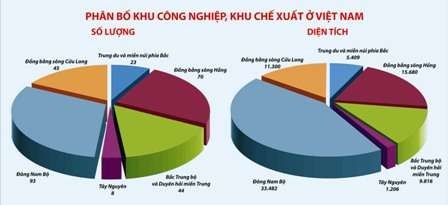
Orientation for development of industrial parks and export processing zones in the coming period
To continue promoting the achievements, overcoming difficulties and obstacles to the development of industrial parks, in the coming time, industrial parks need to build and develop according to the following basic orientations:
Improving the quality of industrial park planning
- Develop and implement industrial park planning in conjunction with the implementation of socio-economic development planning, land use planning, industrial development planning, urban planning, residential area planning, housing planning and sectoral planning.
- The master plan of EPZs and IZs needs to calculate the national potential and advantages, as well as correctly assess the potential and advantages of each locality and each industry to create a close connection that brings the highest socio-economic efficiency, ensures rapid and sustainable development, and enhances the competitiveness of IZs at the local and national levels.
- The development of the number and scale of industrial parks must be suitable and in harmony with the actual development conditions of the locality, ensuring the effective use of industrial park land, and resolutely not developing industrial parks on agricultural land with stable productivity.
Synchronous construction of industrial park infrastructure
- Improve the quality of industrial park infrastructure construction in the direction of synchronously building technical infrastructure systems with public facilities and utilities serving industrial parks; connecting infrastructure inside the fence to outside the industrial park fence, aiming to form many industrial parks with synchronous and modern infrastructure, enhancing competitiveness with countries in the region.
- Mobilize capital sources to invest in building housing for workers and facilities and utilities for industrial parks; adjust and supplement incentive mechanisms, support and promote local initiative in mobilizing social investment capital to serve the development of industrial park infrastructure.
Improve the quality of investment attraction in industrial parks
- Prioritize attracting industries and fields with advanced technology content, capital-intensive, environmentally friendly, industries identified as spearheads of development and advantages of Vietnam. Strengthen industry linkages in development
Developing industrial parks to form industry-linked industrial parks (clusters) to increase the competitive advantage of industrial parks and improve the operational efficiency of industrial parks, gradually forming supporting industries, contributing to the transformation of the local economic structure towards increasing the proportion of industrial value added in the total local value added.
- Develop a unified investment promotion plan and program nationwide, focusing on regional investment promotion to increase efficiency and avoid overlap. Implement investment promotion with focus and key points, prioritizing a number of large and important partners and Vietnam's advantageous industries and fields.
Strict control of environmental issues
- Strengthen supervision, inspection and examination of compliance with environmental laws in industrial zones, along with resolute and decisive handling of violations; at the same time, consider adjusting sanctions to ensure deterrence against violations of environmental laws.
- Improve the environmental management and technical capacity of agencies related to industrial parks (Industrial Park Management Board, Department of Natural Resources and Environment, Environmental Police) to create conditions for management agencies to have sufficient resources to perform tasks of environmental protection in industrial parks.
Caring for the material and spiritual life of workers
- Perfecting the system of policies and laws to improve working conditions, support the material and spiritual life of workers in industrial zones in accordance with the actual conditions of the country.
- Focus on vocational training for young people in rural areas, especially rural areas whose land has been reclaimed for industrial zones; develop a national overall strategy for human resource development to serve industrialization; build a workforce with industrial working style, qualifications, skills, and increasingly improved labor discipline.
Continue to improve mechanisms and policies for industrial park development
Adjust, supplement and perfect the current policy mechanism on industrial parks and economic zones in the direction of increasing decentralization and delegation of authority from the central to local levels, closely linked to the mechanism of clear and transparent assignment of responsibilities and coordination between central and local agencies; have a mechanism for regular monitoring, inspection and examination with appropriate sanctions for violations.
Strengthen the state management apparatus at the central and local levels to ensure sufficient authority and resources to manage industrial parks and export processing zones in a one-stop, one-stop manner, commensurate with the increasingly important role and position of industrial parks and export processing zones in the process of industrialization and modernization.