
+ The application of information technology in today's life has really proven its indispensable role. Reality has proven that the application of information technology in the management of the State budget in general and the management of State budget expenditures at the district level in particular will help save time in processing work, ensure accuracy, speed and consistency in data, creating a premise for effective professional reform.
- Objective factors:
The group of external factors includes: capacity of state budget resources, policy mechanisms, regulations on state budget management at district level, natural environment, socio-economy.
Maybe you are interested!
-
 State management of transport infrastructure construction from the State budget of Nghe An province - 13
 -
 State Budget Management in Ea Sup District, Dak Lak Province - 1
 -
 Current Status of Financial Management Mechanism of Financial Resources Mobilized Outside the State Budget for Public Universities
 -
 Perfecting the management of state budget expenditures in Thai Nguyen province - 16
 -
 Domestic Research on Project Investment Management Using State Budget Capital.
+ Natural conditions: Natural conditions show the scope and economic potential of the district. That is the basis for socio-economic development of the district. Natural resources are a very important factor for economic development, attracting investors to open production and business enterprises, increasing social products, providing essential needs to the market, increasing revenue and at the same time increasing tax obligations to the State. Geographical location is also a major factor affecting state budget revenue. When geographically favorable, the supply of goods increases rapidly, it is easy to attract investors to develop production and business, fulfilling obligations to the state budget. On the contrary, remote localities and regions with difficult transportation have a great impact on budget revenue.
+ Financial institutional factors. Financial institutions regulate the scope and objects of revenue and expenditure of all levels of government; regulate and prescribe the assignment and decentralization of spending tasks and expenditure management of all levels of government; regulate the process and content of budget preparation, implementation and settlement. Regulate the functions, tasks and authority of state agencies in the process of budget revenue and expenditure management and use of budget funds. Financial institutions regulate and prescribe the principles, regimes and norms of spending. Therefore, when talking about
Factors affecting budget revenue and expenditure management must first of all be mentioned about financial institutions.
+ Economic development level and income level. The management of revenue and expenditure of the budget is always influenced by the factors of economic development level and income level of the people in the area. When the economic level develops and the average income of the people increases, it not only creates favorable conditions for mobilizing budget resources and using them effectively, but it also requires policies, regimes, economic - financial norms, budget expenditure levels to change in accordance with economic development and income level, living standards of the people. Therefore, in our country as well as other countries in the world, people always pay attention to this factor in the process of managing and planning the State budget revenue and expenditure policy.
+ Reality shows that when the level of economic development and average income in the area is still low as well as the awareness of using expenditures is not at the right level, there is still a mindset of relying on the State, it will affect the effectiveness of state budget expenditure management. When we do well in budget collection issues in which there are many influencing factors but the living standards of the people are increasingly improved, then fulfilling obligations to the State can be very easy. In case the level and living standards are still low, tax collection will also face many difficulties.
1.3. Experience and lessons learned on state budget management at district level in Ea Sup district, Dak Lak province.
1.3.1. Experience in state budget management at district level in Ea Sup district, Dak Lak province.
- State budget management in Buon Ho Town.
In Buon Ho town, when the district People's Committee assigns the budget, the advisory agencies identify and manage revenue sources as an important task to help the locality ensure spending sources. Establish a Land Auction Council, build a force authorized to collect taxes for the
Wards, publicly implement the collection process at the headquarters of the Town People's Committee, ward halls, publicly announce on the radio the number of business households, tax rates so that people know how to participate in monitoring to ensure fair contributions, encourage and remind households to pay taxes, consider it a competition standard to recognize and commend the title of cultural unit and family. Thanks to that, the annual revenue of Buon Ho town is always guaranteed. In budget expenditure management, Party committees and authorities at all levels have closely and strictly directed and specialized agencies have strengthened guidance, inspection and supervision of expenditures to closely follow the budget estimate, ensuring a positive balance.
State budget management in Cu M'gar district, Dak Lak province.
In the work of budget collection management, the district has actively directed and implemented budget collection measures right from the beginning of the budget years, promoted propaganda, support, and legal advice on taxes to improve understanding and self-awareness in fulfilling tax obligations. Regularly monitor, inspect, and control tax declarations and promptly handle cases of incorrect or insufficient declaration of tax payable. Set out specific measures and roadmaps, striving to collect annual state budget exceeding the estimate assigned by the District People's Council. The Tax Department has decentralized tax collection management to communes to proactively direct and urge timely and effective implementation. In addition, strengthen measures to collect tax debts, limit newly arising tax debts. Promote collection of financial measures, especially auctioning land use rights, collecting land use conversion fees, increasing fines, and promptly auctioning confiscated assets to the State budget. In budget expenditure management: direct agencies, budget units, and communes to prepare, review, and allocate budget estimates in line with the actual situation and budget capacity. Each agency and unit must save on regular expenditures (except for salaries and other salary-related items) to implement the salary reform regime. Strictly implement the Action Program to prevent corruption, practice thrift, and combat waste. Strengthen the implementation of the financial autonomy mechanism stipulated in Decree 130/2005/ND-CP dated October 17, 2005 and
Decree 43/2006/ND-CP dated April 25, 2006 of the Government in all State administrative agencies and public service units.
1.3.2. Lessons learned on state budget management at district level in Ea Sup district, Dak Lak province.
Firstly, the decentralization of provincial budget management to Ea Sup district, Dak Lak province has been studied and adjusted to suit the characteristics of the socio-economic development situation of each locality and the management requirements of each stage of the district. From there, it creates conditions for the district and communes and towns to proactively exploit and foster revenue sources from available potential to increase revenue for their own budget as well as the higher level.
Second, the budgeting work has been paid attention to and built to ensure compliance with regulations and instructions from superiors. Especially the review and assessment of the main revenue sources of the local budget from taxes to make a budget close to reality, not to miss or lack revenue sources, to prevent revenue loss, and at the same time to strengthen the responsibility of communes and towns in budget collection.
Third, the implementation and settlement of the budget has been focused on, with strict management and supervision measures, effective organization of revenue collection from local sources; budget expenditures are guaranteed according to the annual assigned budget and are closely inspected and controlled by competent agencies from the district to the grassroots level to ensure correct, sufficient and effective expenditures.
Fourth, publicizing the budget finances of districts, communes and towns demonstrates responsibility to the people for mobilizing and using budget revenue sources; thereby strengthening the supervision of the people and officials over the management of the State budget in the area.
CONCLUSION OF CHAPTER 1 :
The thesis has systematized the scientific basis of basic theoretical issues related to district-level state budget management; the content of district-level state budget management through the stages of: budget preparation, budget execution, final settlement, inspection, and examination of district-level state budget. Factors affecting state budget management are specifically analyzed from two objective and subjective aspects. At the same time, the experiences of a number of localities are summarized to draw lessons that can be referred to and applied to state budget management in Ea Sup district, Dak Lak province. In other words, chapter one of the thesis is the theoretical basis, the premise for analyzing the current situation and proposing a system of solutions to improve state budget management in Ea Sup district, Dak Lak province in the following chapters.
Chapter 2:
CURRENT STATE OF STATE BUDGET MANAGEMENT IN EA SUP DISTRICT, DAK LAK PROVINCE
2.1. Natural characteristics and socio-economic situation of Ea Sup district
2.1.1. Natural characteristics
Ea Sup District, or Ea Suop, is a district of Dak Lak Province. The district is 85 km northwest of Buon Ma Thuot City along Provincial Road 1. To the east, it borders Ea H'leo and Cu M'gar districts. To the west, it borders Cambodia. To the south, it borders Buon Don district. To the north, it borders Chu Prong and Chu Puh districts of Gia Lai Province. The district has a sparse population in remote areas of the province, and people's lives still face many difficulties.
History of formation: After 1975, Buon Ho district was converted into Krong Buk district. On August 30, 1977, the Government Council issued Decision 230-CP. Accordingly, 6 communes: Ea Pok, Quang Phu, Ea H'dinh, Ea Sup, Krong Na, Cu Sue of Krong Buk district were separated to establish Ea Sup district.
Natural resources: Ea Sup district is also a place with quite rich natural forest resources, the total forest area in the area is 124,664.93 ha, forest coverage reaches 73%. Of which, natural production forest is 103,843.76 ha, natural protection forest is 6,359.11 ha, special-use natural forest is 14,462.06 ha.
Plant resources: Total wood reserves are estimated at over 9 million m3, in the area there are two main types of forests: Semi-evergreen tropical forest: is a small forest area, distributed mainly along the Ea H'leo river with dominant species such as: Lagerstroemia, Cam Xe, Dau Rai... some rare species of group I wood such as Cam Lai, Huong, Cate. Dipterocarpus forest accounts for the majority: this is a sparse forest type, broad-leaved trees often have a single layer, trees have few branches and leaves, the grass surface layer can still grow. Animal resources: The current area of Ea Sup district can be considered the capital of wild elephants. According to the judgment of functional sectors, the elephant herd in this area currently has over 30 animals, divided into many small and scattered groups.
3-5 individuals. They are mainly concentrated in the mountainous areas of Ia Lop, Ia Loi, Ia Rve communes near the Vietnam - Cambodia border.
Climate: Ea Sup district is located in the tropical monsoon climate zone, with a unique sub-climate, directly influenced by the tropical highland continental climate, high temperature, hot sun. The total temperature is the highest in the Central Highlands, each year there are two distinct seasons: the rainy season from May to November and the dry season from November to April of the following year.
Average rainfall: The average total rainfall is 1,420 mm/year. This is a region with low annual rainfall compared to other regions in the province. The heaviest rainfall is from August to October, with rainfall accounting for 93.5% of the annual rainfall. The dry season rainfall is insignificant and often droughts occur at the end of the season, with almost no rain in January, February and March.
Humidity: Average annual humidity is 78.7%, highest average humidity is 91.5%, lowest average humidity is 46.4%.
Temperature: The average annual temperature is 240C, the highest average temperature is 33.30C, the lowest average temperature is 18.20C.
Soil: In general, the soil in Ea Sup area is formed on shale, sandstone, ancient alluvium and newly formed alluvium. The mechanical composition is light to medium sandy loam, low soil fertility, so it is often compacted in drought and swampy in flood, with poor water absorption and retention capacity. In addition, the condition of laterite clumping at the bottom and exposed rock appears quite often.
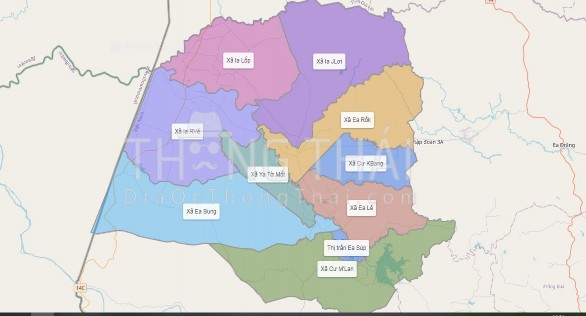
Source: https://easup.daklak.gov.vn/web
2.1.2. Overview of the socio-economic situation of Ea Sup district
2.1.2.1. Economic
- Agriculture, forestry and fishery sector
+ In 2020, the structure of the entire agriculture, forestry and fishery sector in the total GRDP of the province accounts for 38.5 - 39.5% and 19 - 20% in 2030. The average growth rate is 4.5 - 5%/year in the period of 2016 - 2020 and maintained at 4 - 4.5%/year in the period of 2021 - 2030.
+ Shifting the structure of agriculture, forestry and fishery towards rapidly increasing the proportion of livestock, fisheries, forestry (from planted forests) and agricultural services, and reducing the proportion of crop cultivation and natural forest exploitation.
+ Form and build agricultural sub-regions on the basis of promoting the potential strengths of natural conditions and natural resources of the province and advantages of key agricultural products in the area associated with processing industry.
+ Cultivation: Develop production and processing on a reasonable scale, focusing on advantageous agricultural products, improving quality, value and competitiveness.