
- Attract more and more workers to work at tourist facilities.
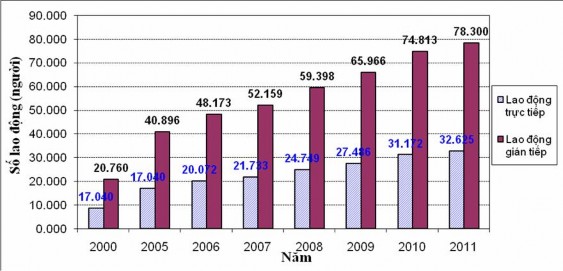
KTDL is an industry with a very high demand for labor, so every year the industry has attracted a relatively large number of workers, contributing to reducing pressure on the whole society. According to statistics from the Institute of Tourism Research and Development and the author's calculations, in 2000 KTDL in the North Central provinces solved 8,650 direct jobs and about 20,760 indirect jobs, by 2011 this number had reached 31,172 direct jobs and about 74,813 indirect jobs, an increase of 3.6 times in both direct and indirect jobs compared to 2000 (chart 3.9) , contributing significantly to reducing the pressure of surplus labor in society.
Chart 3.9 : Employment scale in tourism economy in the North Central provinces (2000-2011)
Source: - Institute of Tourism Research and Development
- Processing: Graduate student.
Every year, the rate of laborers participating in tourism in the North Central provinces has increased significantly compared to the total tourism labor force of the whole country. In 2000, the number of laborers in tourism in the North Central provinces was 8,650 people (accounting for 5.70% of the whole country), by 2005 it increased to 17,040 people (accounting for 6.20% of the whole country). By 2011 it increased to 32,625 people (compared to the whole country, that number accounted for 6.08%, an increase of 0.38% compared to 2000) (Table 3.5).
Table 3.5: Ratio of labor in tourism economy in North Central provinces compared to the whole country (2000 - 2011)
Unit: person
STT
Target | 2000 | 2005 | 2009 | 2010 | 2011 | |
1 | North Central Region | 8,650 | 17,040 | 27,486 | 31,172 | 32,625 |
2 | Nationwide | 151,754 | 274,839 | 474,715 | 509,346 | 536,595 |
3 | Percentage compared to the whole country | 5.70% | 6.20% | 5.79% | 6.12% | 6.08% |
Maybe you are interested!
-
 Characteristics of Tourism Economy in Key Economic Zones in International Integration
 -
 Improving the competitiveness of Vietnam's tourism industry in the period of international economic integration - 12
 -
 Demand, Capability and Perspectives on Mobilizing Investment Capital for Developing Human Resources for Vietnam Tourism in International Economic Integration to 2020
 -
 Tourism Development Meets the Requirements of International Economic Integration
 -
 The Impact of Tourism on Socio-Economic Development, Economic Restructuring and International Economic Integration
Source: Institute of Tourism Research and Development.
- The scale of investment for tourism development increases over time.
Attracting foreign investment: As of December 2011, the North Central region has attracted 203 FDI projects, with a total registered capital of 19.2 billion USD and charter capital of 4.1 billion USD, accounting for 1.5% of the number of projects and 9.7% of the total registered investment capital of the whole country. Foreign direct investment projects have contributed to improving the socio-economic situation of localities in the North Central region and are an important lever to support the development of tourism.
Attracting domestic investment capital: In recent years, the Government has paid special attention to supporting investment in upgrading and developing tourism infrastructure and facilities in the North Central provinces. In the period 2001 - 2009, the total state budget capital invested in developing tourism infrastructure and facilities in the region was about 794.5 billion VND, accounting for 19.2% of the total state budget capital for infrastructure and facilities.
- The system of tourism and has created an effective "push" to attract investment capital for tourism development from other economic sectors, especially the private sector.
Situation of attracting investment to develop tourist areas: In recent times, investment in developing tourist areas has also received attention. Up to now, the region has attracted domestic and foreign investors such as ITC Group - USA, Hong Kong International Investment Association, Saigon Tourist Corporation... to invest in exploiting and developing tourist destinations in the region. Notably, Vung Chua - Yen Island tourist area, Bang mineral spring tourist area, Dong Hoi - Nhat Le tourist area, Phong Nha - Ke Bang tourist area (Quang Binh), Cua Tung coastal eco-tourism area (Quang Tri), sea tourist area
Dien Thanh (Nghe An), Lang Xanh tourist area (Thua Thien - Hue) etc...
- KTDL activities have contributed significantly to the socio-economic development of the North Central provinces.
+ Regarding economy: Contribution to GDP, economic restructuring, export... KTDL creates momentum, attracting the development of other economic sectors and fields . From 2000 to now, the average budget income of the region is 7 - 8% per year, in which the service industry in general and KTDL in particular have made significant contributions. According to statistics of the General Department of Tourism, in 2000 KTDL in the North Central provinces contributed about 75 million USD to the budget income of the region, by 2010 this figure had reached 134 million USD, 1.8 times higher within 10 years.
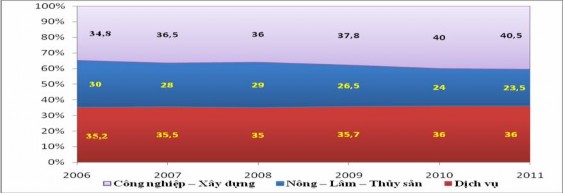
The development of tourism has contributed to the economic restructuring in a progressive direction. Up to now, in the North Central provinces, the economic structure has been and is being transformed in a positive direction. The proportion of the agricultural sector has been gradually decreasing, the proportion of the industrial and service sectors is increasing, in line with the general development trend of the whole country. In 2006, the GDP value of the service sector in the North Central provinces (including tourism) only accounted for 35.2% of GDP, by 2007 it was 35.5%, in 2009 it accounted for 35.7%.
% and in 2011 it was 36.0% of the region's GDP (chart 3.10) .
Chart 3.10 : Economic structure of sectors in GDP of the North Central region (2006 - 2011)
Source: - NGTK of North Central provinces in 2011
- Processing: Research student
The development of tourism has led to the development of other economic sectors in the region such as the development of handicrafts, transportation, and post.
telecommunications, construction, aviation... Tourists coming to the North Central provinces from many regions and many different countries, during their trip they can buy different types of transportation services, they can use many types of telecommunications services to contact friends and relatives; at the same time, after each trip they often want to bring back to their place of residence typical items of the place they visited as souvenirs or gifts for their relatives... For that reason, the development of tourism will be a factor promoting the development of many other economic sectors. In fact, in the North Central provinces in recent years, it has been shown that thanks to the development of tourism, the postal and telecommunications, handicrafts, transportation... sectors have made significant progress. However, on the contrary, the coordination and interaction of economic sectors in the region as well as effective international cooperation in the tourism sector have created momentum for tourism in the North Central provinces to access domestic and international markets for development.
+ Regarding society: Creating jobs, reducing unemployment; raising awareness among people and all levels and sectors in preserving historical and cultural values, protecting landscapes and environment, developing local tourism potential; creating motivation for new rural construction.
When tourism develops, the material life of local people is also improved, so they have the conditions to improve their education, improve their cultural and spiritual life. On the other hand, in places where tourism develops, tourists come from many different regions and countries, so local people have favorable conditions for cultural exchange. And it is the exchange between these cultural flows that has contributed to making the social life of localities more civilized and modern. For example, thanks to the development of tourism, the life of people in Sam Son (Thanh Hoa), Cua Lo (Nghe An), Thien Cam (Ha Tinh), Phong Nha (Quang Binh), Lang Co (Hue) ... has been significantly improved in terms of economy, culture and society.
3.3.2. Existing problems and limitations
Firstly , in terms of the market, although the structure of the tourist market has changed a lot in recent times, the North Central provinces have not yet attracted many tourists from high-end tourist markets, the proportion of pure tourists, long-term vacationers, and high spending is still low. The expansion and development of the market is still passive, heavily dependent on foreign international travel agencies and limited by air gateways. Road and waterway tourism is still limited by poor infrastructure. Although the growth rate of the number of tourists and income from tourists in the region is relatively high, the proportion compared to the whole country is still low, has not been improved and is not commensurate with the potential and comparative advantages of tourism of the whole region.
Due to the economic crisis and recession, the growth rate of domestic tourists slowed down somewhat in 2009. If in 2008 the number of international visitors to the North Central provinces increased by 13%/year compared to 2007, by 2009 that number had decreased to 9.8%/year (chart 3.1).
During the period 2000 - 2011, the proportion of international tourists to the North Central provinces only fluctuated around 5.8% - 6.0% of the total number of international tourists traveling in the country. Total revenue from tourists in the whole region during this period only accounted for an average of 3.9% compared to the whole country.
The development speed of tourism in the North Central provinces is still slow, not commensurate with the inherent potential of the locality: this is a region with advantages in potential for tourism development with relatively favorable traffic conditions, diverse and unique natural landscapes, and a long history of cultural traditions, creating favorable conditions for tourism development. However, at present, the development of tourism in the provinces is still slow: not attracting many international tourists, annual income from tourists has increased but has not created a breakthrough... In general, the development of tourism in the North Central provinces is not commensurate with the inherent potential of the region.
Second, the region's tourism products are not yet unique and their competitiveness is not high.
In recent times, the North Central provinces have had many policies to improve the competitiveness of tourism products in the international economic integration. However, the method of building tourism products in these provinces is still subjective, based on exploiting local available resources, lacking investment and not relying on the specific strengths of resource potential according to the specific needs of each market. The development of tourism products is still "each person doing their own thing", leading to tourism products still being "overlapping, similar to each other", lacking specific and unique tourism products. On the other hand, one of the very important factors in the competitive strategy of tourism products in the domestic and international markets is the price of tourism products. In fact, the price of tourism products in the North Central provinces in recent times is still quite high. Therefore, the tourism industry of the region has missed many favorable opportunities to attract domestic and especially international visitors.
Third, although the economic structure has shifted in a positive direction, the speed of shift is still slow and not as expected.
According to chart 3.9, we can see that the shifting trend of service industries is: 2006: 35.2%, 2007: 35.5%, 2009: 35.7%, 2011: 36%. The numbers
This proves that the shift in economic structure is still slow. In that shift in economic structure, tourism contributes a small proportion, not commensurate with the inherent potential of the region. At the same time, the structure of economic components also has a shift in capital from state-owned and collective economic components to private and foreign-invested economic components. State-owned tourism enterprises are shifted in the direction of equitization. However, that shift is still very formalistic, many tourism enterprises after the shift are still in the state of "old wine in new bottles".
Fourth, the tourism business activities of tourism enterprises in the North Central provinces are still weak and unprofessional, with low business efficiency, and weak competitiveness and ability to reach out to foreign markets.
Currently, the professional capacity of most travel agencies in the North Central provinces is still limited. The level of management staff in many travel agencies is still low, they have not had good access to modern knowledge and management styles; the organizational structure of state-owned enterprises is still too cumbersome, not dynamic and flexible. International tourists to the region are currently mainly exploited by travel agencies in the two major tourist distribution centers of Hanoi and Ho Chi Minh City. Local travel agencies only organize partial services, so business efficiency is not high. For domestic tourists, travel agencies mainly carry out connecting tours and provide some services locally.
Fourth, the ability to integrate international tourism is still limited.
The competitiveness of capital for tourism in the North Central provinces is still low. Most tourism enterprises in the North Central provinces are small enterprises, with charter capital of less than 5 billion VND and no more than 30 employees. Therefore, these tourism enterprises will have difficulty competing with large competitors. Technology applied in tourism is changing at a slow pace and is not synchronous. Although the provinces have their own websites, the provinces in the region have not exploited them effectively to promote the destination brand for the locality. Many tourism enterprises do not have their own websites or have them only as a formality, a movement, and have not been put into operation to reduce transaction time and costs.
State management capacity on tourism is still limited. Currently, the work
State management of tourism in many localities in the North Central provinces is still lax. In the Departments of Culture, Sports and Tourism, the organizational structure is not commensurate with the role of the key economic sector. The phenomenon of discrimination between state-owned tourism enterprises, state-owned enterprises and private and joint venture enterprises is still
still exist, creating unreasonable impacts on the business environment among tourism enterprises.
3.3.3. Causes of problems and limitations
- Objective reasons
+ KTDL activities in the North Central provinces are subject to fierce competition from many rivals.
Vietnam's tourism industry in general, including tourism in the North Central provinces, opened at a time when the world's tourism industry developed at a high level in many aspects. Many tourists are used to visiting countries with unique tourism products and highly developed tourism. Therefore, many of the requirements of international tourists, Vietnam's tourism industry in general and in the North Central provinces in particular, have not been met, such as: standard swimming pools, golf courses, entertainment venues, exploration, unique tourism products, souvenirs, fast means of transportation... This is one of the reasons why tourism in the North Central provinces is not attractive enough to attract international tourists.
+ Tourism resources are not concentrated.
One difficulty for the development of tourism in the North Central provinces is that tourism resources are not concentrated but scattered throughout the region. This is the reason why, although the North Central region is relatively rich in tourism resources, both natural and human tourism resources, the development of tourism is not commensurate with the inherent potential of the region. Unconcentrated tourism resources are a major obstacle in the planning and investment of tourism development and at the same time cause difficulties in the travel of tourists.
+ Infrastructure and services in the North Central provinces are not yet uniform.
Due to limited capital, investment in new construction, maintenance, repair, and renovation of some roads and domestic waste treatment systems... is still fragmented, so the quality of some roads is patchy and poor, and the domestic waste treatment system is still lacking and not guaranteed.