
- Operator: operator
- Senior Front Desk Agent: senior front desk agent
- Bell captain: Head of the reception team at the door
- Bellman: bellman
- Baggage porter: baggage handler
- Doorman: employee who opens the door for guests
d. Human resource characteristics of the front office department
Direct labor resources account for a large proportion: the front office is the place to meet, contact and handle work directly with customers, so most of the job titles of the front office in the hotel are mainly direct labor such as receptionists, customer care staff, customer relations staff, tour guides, luggage porters, etc.
High specialization: the front office has many different specialized teams such as reception team, customer care team, driver team, room reservation team... the work is clearly divided and the specifics of the work are also different. The needs of high-end tourists require perfect service quality, so the specialization in the work is very high. High specialization creates many advantages for the work. The skill level of employees in the department is increasingly improved, thereby increasing labor productivity and work efficiency, all aimed at meeting and satisfying customers. However, specialization makes it difficult to arrange and replace each other among employees in the front office as well as between the front office and other departments.
Low mechanization and automation: Hotel products are service products that cannot be stored in warehouses. The production and consumption of hotel products depend on the time and space of consumption of customers. Hotel products are intangible and are evaluated by the perception of customers, without any stereotypes. On the other hand, the nature of the front office department's work
The lobby is the place to communicate, exchange and solve work directly with hotel guests, this requires the lobby staff to be agile, flexible, sensitive, and intelligent in dealing with customers. All of these jobs cannot be done by any machine or equipment.
Workers are under high psychological pressure: Workers in hotels in general, and in the lobby in particular, are those who regularly come into direct contact with guests. Customers are very diverse, and their diverse and complex demands put a lot of pressure on employees. Each guest comes from a different country, requiring different service styles depending on the customs and psychology of each guest. Each customer has a different personality and mood. Employees must always satisfy customers.
Psychological pressure from family and society also affects the psychology of hotel staff, family matters, children... Managers need to pay attention to the psychological situation of employees to promptly encourage them to have the best mentality to serve guests, creating high-quality human resources in the hotel.
Most of the human resources in the front office have a low average age: Due to the nature of the work (being the face of the hotel, needing quickness and flexibility...) of the front office, the workers must be in good health, agile, active, and youthful, so the average age of the front office staff is low, usually from 20 to 30 years old, for those who serve directly with guests, while managers are around 35 years old or older. Therefore, hotels in general or the front office department in particular have a young labor structure, which also increases the turnover rate, making it difficult for management.
Working hours depend on customer consumption time: Employees' working hours are often interrupted and correspond to the arrival and departure times of customers. Employees' working hours do not follow a certain rule, lasting 24/24 hours, workers have to work on Sundays and holidays.
Tet, this causes difficulties for the life of employees and their families. The organization of labor in hotels must be divided into shifts, making it difficult for managers when dividing labor, they must pay attention to the psychological factors of each gender, the life and family of employees, especially female employees, to divide appropriately.
High turnover ratio: from the above characteristics, it is easy to see that the turnover ratio of the hotel's front office staff is high.
Let H be the labor turnover coefficient then:
H = Total number of employees turned over (in a period)/Average number of employees (in that period).
1.2 Theoretical basis of front office staff remuneration policy in hotel business
Human resources are the main value for the tourism industry, this value includes low commitment between human resources and users, high labor turnover and easy labor shortage during peak seasons. The tourism industry needs to ensure the labor turnover is at the lowest level and maintain the highest level of human resources. The strategy of using human resource treatment policies can help increase employee motivation, maintain human resources, flexibility in human resource management, improve the quality of employees in the organization and can reduce the labor turnover (Davies etal, 2001). According to Wiley (1997) the top five factors that motivate employees in the workplace
They are: good salary, comprehensive assessment of work performance, safe work, promotion and development in the organization and enjoyable work . 6. Based on the characteristics of human resources of the front office department to build appropriate and effective employee treatment policies is an important task of human resource managers in hotels.
6 according to Jeremy Buultjiens, Grant Cairncross, Lance Pike – Southern Cross University – The use of employee rewards in New South Wales registered Clubs
1.2.1. Concept
There are many ways to interpret the meaning of the phrase "human resource treatment", for example: " Treatment is the recognition and recognition of the enterprise for the efforts of employees. It is the process of compensating for the labor costs of employees both materially and spiritually [13, p. 12].
Nguyen Huu Than in his book Human Resource Management defined: " Salary and compensation refer to all types of rewards that an individual receives in exchange for his or her labor " [16, p. 372].
Thus, human resource treatment policy is a set of policies and activities related to the treatment, treatment and remuneration of enterprises for employees for their contributions to the existence and completion of the enterprise's goals . The process of human resource treatment represents the most basic human relations between employers and employees. Therefore, it can be affirmed that this is an activity that determines the psychology and work performance of employees, thereby directly affecting work efficiency, product quality (or service) and the goals of the enterprise.
1.2.2 Classification of human resource treatment policies
In enterprises, human resource treatment policies are expressed in two basic forms: financial treatment policies and non-financial treatment policies.
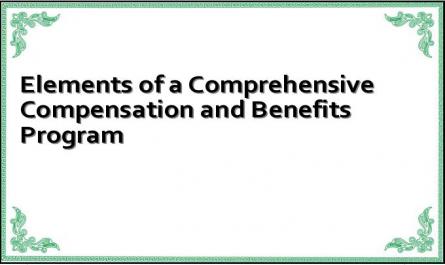
Table 1.1 Elements of a Comprehensive Compensation and Benefits Program
Salary and benefits | ||||
Finance | Non-financial | |||
Lip | Direct | Indirect | The work itself | Working environment |
Daily wage Monthly salary Rose Bonus | Insurance Social Security Retirement benefits, welfare, compensation, subsidies, education, services Paid absences for summer, holiday, sick leave | Fun Tasks to Strive For Responsibility Opportunity to be recognized by superiors Sense of accomplishment Promotion opportunities | Reasonable Policy, Skillful Inspection, Friendly Colleagues Appropriate status symbol Comfortable working conditions "Share the work Select benefit type Work from home via computer | |
school | ||||
beside | ||||
in | ||||
& Lip | ||||
school | ||||
beside | ||||
outside | ||||
Maybe you are interested!
-

 Distinguishing the Judicial Remedy of "Return of Property, Repair or Compensation for Damages" from a Monetary Penalty
 -
 Two Elements A And B Are In Two Consecutive Main Groups In The Periodic System. In Their Pure Substance State, A And B Do Not React With Each Other. Total Number Of Protons
 -
 Building a Policy for Developing Corporate Human Resources
 -
 Building Requirements and Rules of Human Resource Treatment Policy
 -
 The Role of Trade Promotion Policy in Product Consumption of a Provincial Locality
Source: quoted from Nguyen Huu Than, Human resource management, page 373 according to R. Wayne Mondy
andRobert M.Noe, p.433
We often simply assume that to promote production and motivate employees, managers must stimulate them with material and spiritual incentives. Material incentives include salaries and bonuses, while spiritual incentives include certificates of merit and entertainment. The above concept is correct but not enough. In the context of Vietnam from the 1990s to the 2000s, the above concept temporarily holds because our country is still poor and backward, with many unemployed people. Therefore, stimulation with salaries and bonuses is the most basic and important source of motivation. 7 But in the 2000s
Vietnam's economy, including the tourism industry, is constantly changing and developing, and many issues will change and arise. Therefore, managers need to grasp the elements of salary and benefits policies.
7 Human Resource Management, Nguyen Huu Than, vol. 374, Labor - Social Publishing House, 2007
The salary and benefits policy includes two parts: financial salary and benefits policy and non-financial benefits policy. Direct financial policies include: daily wages, monthly wages, commissions and bonuses. Indirect financial policies include: life insurance, health insurance, accident insurance, social benefits; benefits include retirement plans, social security, subsidies for workers working in hazardous environments, working in shifts, working overtime, working on holidays, etc.; educational subsidies, pay in cases of absence due to summer vacation, holidays, illness, maternity, etc.
But compensation and benefits policies are not simply financial, but also non-financial. After nearly a century, management theorists have discovered that in industrialized countries, material things like salaries and bonuses are only one side of the problem. In many places, non-financial compensation policies are becoming more important: the work itself and the working environment. Is the work itself interesting, is it challenging, are employees assigned responsibilities, do workers have the opportunity to be recognized by their superiors, do they feel happy when they complete their work, and do they have opportunities for advancement?
The work environment is also an important factor in today's world society: it includes reasonable policies, skillful supervision, compatible colleagues, suitable status symbols, comfortable working conditions, flexible working hours (flextime), condensed workweek, job sharing, choice of benefits.
Despite all the financial and non-financial factors mentioned above, a subjective and biased employee compensation policy will fail. Therefore, the compensation and benefits policy must be fair, externally fair and internally fair. Externally fair means that the salary
Compensation and benefits in other places should be similar to those in the company, without too much difference. Internal equity means that compensation and benefits must be fair to everyone in the company, regardless of age, gender, race or relationship.
1.2.3 Factors determining and influencing the remuneration policy Diagram 1.2: Factors determining and influencing the remuneration policy
financial benefits
The work itself
Job Evaluation
Labor market:
- Market salary
- Cost of living
- Union
- Society
- Economy
- Law
Determine the level of treatment for each individual
The employee himself:
- Work completion rate
- Seniority
- Experience
- Loyal member
- NV's potential
Corporate environment
- Policy
- Cultural atmosphere
- Organizational structure
- Affordability
(Source: according to Nguyen Huu Than, Human Resources Management, page 377)
A company's compensation policy is influenced by four groups of factors: the job itself, the employee himself, the company's environment, and the labor market.
a. The job itself: The job is the factor that affects a compensation program. Through determining the true value of each job using a job description and job analysis and, most importantly, job evaluation.
b. The employee himself: Salary and other benefits depend on the employee's work performance, seniority, loyalty, potential, and even political ideology.
c. Corporate environment: The corporate environment with factors such as policy, cultural atmosphere, organizational structure and affordability have an impact on the decision of a comprehensive employee benefits program.
d. Labor market: When deciding on a salary and benefits program, managers need to study factors such as market wages, cost of living, unions, society, economy and laws which can be broadly understood as the labor market.
1.3. Practical experience on front desk staff remuneration policies at some 4-5 star hotels in Vietnam.
1.3.1. At 4-star hotels in Ha Long
1.3.1.1. Develop and apply a salary regime based on capacity, position and seniority
Currently, in the hotel industry, there is a group of hotels that pay their employees based on an agreement, estimated at the market income level. This form of salary payment causes a lot of trouble for hotels because they have to resolve the grievances of some employees, even leading to negative consequences such as labor disputes, resignations, etc. More systematically, most other hotels apply the state's salary scale (salary scale
A.1 and salary table B.15), with some adjustments to suit the characteristics of the service industry, but inevitably there is a certain "deviation". Building a separate salary scale and salary table based on the provisions of the Law on salary regime is considered the most effective solution so that labor wages truly become a positive economic lever for employees, encouraging employees to stay with the hotel for a long time.