
Special rules and procedures will be given priority. In addition, the unity of the mechanism is demonstrated through the dispute settlement body headed by the DSB, through the unified two-level adjudication process. The legality of the WTO dispute settlement mechanism is also demonstrated by the fact that the bodies with the power to make decisions in dispute settlement include independent members and rely only on previously agreed rules, the procedural steps from the establishment of the Panel, through the Panel report, the Appellate Body report are almost automatic, no member country can hinder this process according to its subjective will. In addition, the WTO dispute settlement mechanism, with the priority goal of encouraging the disputing parties to find appropriate, satisfactory measures, avoiding confrontation in order to quickly resolve the dispute, still maintains the provision allowing parallel negotiation procedures (brokerage, mediation, conciliation) to be conducted at any time during the proceedings. This makes the mechanism more effective, in line with the purpose of ensuring safety for the multilateral trading system.
With the above positive changes, although there are still certain limitations, the provisions of the DSU have demonstrated the set goal of preventing unilateralism in resolving international trade disputes, creating and maintaining a suitable legal corridor to resolve disputes arising from which helps ensure a level playing field for member countries. In practice, the effectiveness of applying WTO dispute settlement mechanisms is demonstrated through the number of complaints notified to the WTO, the number of cases resolved and the enforcement of judgments. However, the assessment results are based only on the notifications sent by the parties to the WTO. The dispute settlement results are also considered successful when the WTO finds no errors by the complained party and does not require any action from the WTO [3].
In terms of quantity, according to WTO statistics, from January 1, 1995 to July 12, 2007, in more than 10 years, the total number of complaints notified to the WTO was 366 cases, of which 31 cases are being resolved, 102 reports have been approved, and the
The number of disputes that were resolved or not brought was 30 and the total number of multilateral solutions was 58. Thus, in just over 10 years, the number of disputes brought to the WTO for settlement was much higher than the total number of 344 disputes that were resolved during the nearly 50 years of GATT's existence. The number of cases brought peaked in 1997 and 1998, then gradually decreased and now averages around 20 cases per year. The total number of disputes resolved under the WTO mechanism is listed in the following table (see Table 1).
TABLE 1- TOTAL NUMBER OF DISPUTES SETTLED UNDER THE WTO MECHANISM (FROM 1995 TO JULY 12, 2007)
Year
„95 | „96 | „97 | „98 | „99 | 2K | 01 | 02 | 03 | 04 | 05 | 06 | 7/07 | Total | |
Number service | 25 | 39 | 50 | 41 | 30 | 34 | 23 | 37 | 26 | 19 | 12 | 20 | 10 | 366 |
Maybe you are interested!
-
 Assessment of the World Trade Organization's Dispute Settlement Mechanism for Developing Countries
 -
 Settlement of Disputes of Developing Countries under the Dispute Settlement Mechanism of the World Trade Organization
 -
 Dispute Settlement under the Trade-Related Investment Measures Agreement (TRIMs) - 2
 -
 Developing lending to small and medium enterprises at Vietnam Joint Stock Commercial Bank for Industry and Trade - Bac Ninh Branch - 12
 -
 The Impact of Financial Integration on Poverty in Developing Countries in Asia.
Source: http://www.wto.org/english/tratop_e/dispu_status_e.htm
Regarding the participation of member countries, in a total of 366 disputes brought to the WTO for settlement, developed countries participated as plaintiffs in 235 cases, accounting for 60%, while developing countries filed lawsuits in about 140 cases, accounting for nearly 30%. As defendants, developed countries were sued in 236 cases, accounting for about 63%, while developing countries were sued in 135 cases, corresponding to 37%. Among the disputes brought to the WTO for settlement, developed countries accounted for nearly 2/3 in terms of both the total number of lawsuits and the number of lawsuits, and were mainly concentrated in two major economic centers: the United States (82 cases as plaintiffs, 106 cases as defendants) and the European Union (72 cases as plaintiffs, 67 cases as defendants). Developing countries participating in this mechanism mainly focus on a few countries such as Brazil with 35 cases (22 cases as plaintiffs and 13 cases as defendants), India with 34 cases (17 cases as plaintiffs and 17 cases as defendants), Mexico with 30 cases (16 cases as plaintiffs and 14 cases as defendants)... Other developing countries participating in the WTO dispute settlement mechanism are limited to about 40% of the number of disputes with the complainants being developing countries.
The participation of each group of countries in the cases brought under the WTO mechanism is shown in the following table (See Table 2).
TABLE 2 - NUMBER OF DISPUTES BROUGHT TO WTO BY COUNTRY GROUP
(FROM 1995 TO 12/7/2007)
Capacity
Water
Plaintiff | Defendant | |||
Number of cases | Rate (%) | Number of cases | Rate (%) | |
Developing countries | 131 | 32% | 140 | 37% |
Developed countries | 235 | 68% | 226 | 63% |
Total | 366 | 100% | 366 | 100% |
Source: http://www.wto.org/tratop_e/dispu_e/dispu_by_country_e.htm
In terms of nature, the most disputes brought to the WTO for settlement are those relating to the implementation of the Agreement on Trade in Goods, the Agreement on Subsidies and Countervailing Measures (SCM), the Agreement on Agriculture and the Agreement on Anti-Dumping (AD). Among the disputes, there are also a number of cases where the content of the dispute is not within the scope of the WTO Agreement and therefore, the Panel, after consideration, could not reach a conclusion.
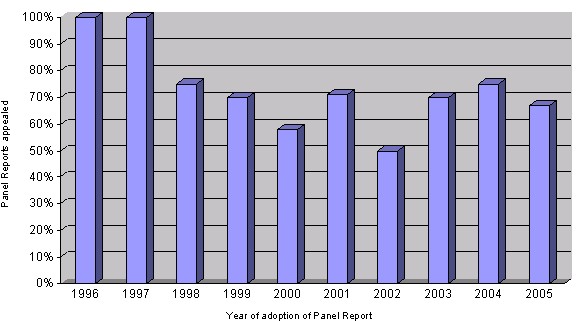
Regarding the quality of dispute settlement, many disputes have been resolved satisfactorily during the consultation stage, accounting for nearly 50% of the total number of disputes. For cases that must be resolved through panels/appellate bodies, the reports of the panels and the appellate bodies adopted by the DSB have become increasingly transparent and consistent. Many complex cases have been resolved and although many cases have been delayed for certain reasons, there have been cases that have been resolved quickly in a relatively short period of time (13-15 months). In addition, the reports of the panels and the appellate bodies have also demonstrated their role in clarifying the rights and obligations of members under the covered agreements cited. The rate of panel reports that have been appealed is shown in the following chart:
CHART 1: RATE OF JURY REPORTS THAT WERE APPEALED (1996-2005)
Source: http://www.wto.org/english/tratop_e/dispu_status_e.htm
The above figures show that the WTO dispute settlement mechanism has created at least enough trust for member countries to be willing to invoke and apply this mechanism in resolving trade disputes. It can be said that the positive changes in the structure and procedures of the dispute settlement mechanism from GATT to WTO have brought about the effectiveness and efficiency of applying the rules in dispute settlement. These changes are still being reflected in the Doha round of negotiations. In this round, there were the addition of new issues, such as agriculture, services, trade-related investment measures and intellectual property rights, and so far, about one-third of the disputes are related to these “new” issues. The expansion of the legal power of the multilateral trading system has significantly affected the effectiveness of the dispute settlement procedure. Therefore, the parties also agreed to negotiate improvements and clarifications to the DSU in the Doha round of negotiations. However, the results achieved so far are unclear.
Thus, on the basis of inheriting the advantages and learning from the limitations of the dispute settlement mechanism under GATT, the WTO has built and maintained
maintain a more advantageous international trade dispute settlement mechanism, a system that is rule-oriented, eliminates unilateralism and ensures more effective and reliable dispute settlement. In fact, the positive changes in the WTO dispute settlement mechanism have helped the WTO fulfill its function of settling disputes satisfactorily, achieving the goal of creating a fairer playing field for member countries. The WTO dispute settlement process since its establishment has shown that the WTO dispute settlement body itself has become one of the most powerful institutions in the world. This statement is evidenced by the fact that even superpowers such as the US and the EU have to accept to submit their disputes to the WTO mechanism and accept to implement the decisions of the dispute settlement body, something that even the International Court of Justice of the United Nations cannot always do [11].
CHAPTER 2. DEVELOPING COUNTRIES IN THE WTO DISPUTE SETTLEMENT MECHANISM – FROM THEORY TO PRACTICE
2.1 The position of developing countries in the WTO
The WTO does not provide a specific definition of what a developing country is, but this status is self-declared by the countries themselves. Despite making up the vast majority of the WTO – two-thirds of the total number of WTO members – developing countries have always been in a weaker position compared to developed industrial countries. Previously, in the GATT, developing countries were a group of countries with weak coordination and played only a very small role [14]. At that time, because they did not see the GATT as an institution through which they could achieve benefits in international trade, these countries did not actively participate in negotiations and shape the agenda. As a result, many of their legitimate interests were ignored. It was not until the Uruguay Round that developing countries realized the potential and the need to protect their interests in multilateral negotiation processes and began to actively participate in those processes. The results of the Uruguay Round have brought real benefits to developing countries in the WTO. However, due to their inferior position in relation to developed countries, developing countries have only enjoyed the results of the Uruguay Round in a very limited way. To date, the negotiating power in the WTO has always been tilted towards the developed industrial countries.
There are many reasons why developing countries are at a disadvantage in the WTO, including typical reasons such as: Firstly, due to their low level of development, developing countries cannot initiate and shape agendas and actively participate in negotiations; Secondly, the scarcity of human and technical resources of poor countries has adversely affected their position in the WTO, leading to their passive status in negotiations (currently, more than 20 least developed countries are not represented in Geneva, although there are about 40 to 50 meetings).
Third, developing countries are often silent in many cases where their legitimate interests are violated, due to their lack of expertise in WTO law and their inability to pursue costly, protracted, and politically charged disputes under the WTO dispute settlement mechanism. Finally, major powers often see themselves as the masters of the world trading system, overlooking the role of developing countries. Rich countries have created an uneven playing field by making agreements that benefit themselves without taking into account the development needs of poorer countries. The widening development gap between rich and poor countries has also weakened the position of developing economies in the WTO [15].
However, the power of developing countries has been increasing and their position in the WTO has gradually improved. This is reflected in the fact that more and more developing countries have become important partners in the world economy. The Doha Round, which deals with important issues of interest to developing countries such as trade liberalization in agriculture and textiles, although progressing very slowly, has shown that developing countries are increasingly playing an important role in setting the negotiating agenda. In the Uruguay Round as well as in recent WTO negotiations, many developing countries have become active participants. They have shown determination to promote their proposals and to restrain threats to their interests. The fact that developing countries are the majority in the WTO means that their voices will not be easily ignored if they unite. In addition, the accession of China, a developing country with strong potential in the Asian region, to the WTO has also provided a great impetus for the voices of developing countries to be more weighty. Currently, more and more poor countries are using the WTO dispute settlement mechanism to protect their interests and proactively make proposals to reform the processes of the WTO.
WTO. For example, Jamaica has proposed an initiative to allow third parties the right to litigate and participate fully in the adjudication process.
Like all other WTO Agreements, the DSU has provisions specifically for developing and least-developed countries in the settlement of international trade disputes. These are preferential provisions aimed at ensuring a more equal mechanism for countries in a weaker position through special and differential treatment.
2.2 Special and differential treatment for developing countries under the DSU
Recognizing the special conditions due to the weaker position of developing and least-developed countries in the WTO, the DSU has provided for special and differential treatment for this group of countries in the dispute settlement process. However, the preferential special and differential treatment here does not mean the reduction of obligations or the increase of rights in terms of content, but rather special and differential treatment in terms of time limits, restrictions on measures that may affect the economic interests of developing countries and incentives in terms of assistance and legal advice. The incentives for developing countries are provided for in Articles 3.12, 4.10, 8.10, 12.10, 12.11, 21.2, 21.7, 21.8, 24 and 25.
27.2 of DSU.
2.2.1 General offers
Article 3.12 of the DSU provides that a developing country Member may initiate a dispute against a developed country Member under the GATT General Council Decision of 5 April 1966 (BISD 14S/18). Under this Decision, the time limit for a panel to decide a case is much shorter than the normal procedure prescribed by the DSU. When applying the procedure prescribed by this Decision, the panel must submit its report within 60 days of receipt of the request for dispute settlement, unless the panel considers that the time limit prescribed in the said Decision is too short.