
On September 2, Mong New Year, April 30 - May 1 holidays, the number of visitors to Moc Chau national tourist area is not less than 50,000 people.
Number of visitors to Moc Chau for the following purposes:
Need for relaxation, closeness to nature, outdoor activities
The need to explore the treasure trove of folk art and culture
The need to learn about the lives of agricultural residents
Need for practical experience
The need to learn about traditional festivals, local products...
2.3.3 Current status of using technical facilities and infrastructure for agricultural tourism development .
The infrastructure system and technical facilities serving tourism in Moc Chau National Tourist Area are being increasingly built and improved. Currently, in the National Tourist Area, there are large corporations investing and building accommodation facilities serving tourism, hotels and motels are appearing more and more to meet the needs of tourists visiting (Table 2)
Table 2:
TT
Number quantity | Unit | Year 2016 | Year 2017 | Compare | ||
+/- | % | |||||
1 | Total room | Room | 1256 | 1347 | 91 | 107.91 |
2 | Total bed | Bed | 2306 | 2749 | 443 | 119.21 |
3 | Base stay | Base | 139 | 150 | 11 | 107.25 |
Maybe you are interested!
-
 Car body electrical practice - 8
zt2i3t4l5ee
zt2a3gs
zt2a3ge
zc2o3n4t5e6n7ts
If the voltage is out of specification, replace the wire or connector.
If the voltage is within specification, install the front fog light relay and follow step 5.
Step 5 Check the front fog light switch
- Remove the D4 connector of the fog light switch
- Use a multimeter to measure the resistance of the front fog light switch.
Measurement location
Condition
Standard
D4-3 (BFG) -D4-4 (LFG)
Light switchFront Fog OFF
>10kΩ
D4-3 (BFG) -D4-4 (LFG)
Front fog light switchON
<1 Ω
- Standard resistor
D4 connector is located on the combination switch assembly.
If the resistance is out of specification, replace the combination switch (the fog light switch is located in the combination switch).
If the resistance is within specification, follow step 6.
Step 6 Check wiring and connectors (front fog light relay-light selector switch)
- Disconnect connector D4 of the combination switch assembly
- Use a voltmeter to measure the voltage value of jack D4 on the wire side.
Measurement location
Control modecontrol
Standard
D4-3 (BFG) - (-) AQ
TAIL
11 to 14 V
D4 connector for the wiring of the combination switch assembly
If the voltage does not meet the standard, replace the wire or connector.
If the voltage is within standard, there may have been an error in the previous measurements.
Step 7 Check the front fog lights
- Remove the front fog light electrical connector.
- Supply battery voltage to the fog lamp terminals
Jack 8, B9 of front fog lamp on the electrical side
blind first.
Power supply location
Terms and Conditions
Battery positive terminal - Terminal 2Battery negative terminal - Terminal 1
Fog lightsbefore morning
- If the light does not come on, replace the bulb.
If the light is on, re-plug the jack and continue to step 8.
Step 8 Check wiring and connectors (relay and front fog lights)
- Disconnect the B8 and B9 connectors of the front fog lights.
- Use a voltmeter to measure voltage at the following locations:
Measurement location
Switch location
Terms and Conditions
B8-2 - (-) AQ
Electric lock ON TAIL size switchFog switch ON
11 to 14 V
B9-2 - (-) AQ
Electric lock ONTAIL size switch Fog switch ON
11 to 14 V
B8 and B9 connectors on the front fog lamp wiring side
Voltage is not up to standard, repair or replace the jack. If up to standard, there may have been an error in the measurement process.
2.2.4. Procedure for removing, installing and adjusting fog lights 1. Procedure for removing
- Remove the front inner ear pads
Use a screwdriver to remove the 3 screws and remove the front part of the front inner ear liner
-Remove the fog light assembly
+ Disconnect the connector.
+ Use a screwdriver to remove 3 screws to remove the fog light cover
2. Installation sequence
-Rotate the fog lamp bulb in the direction indicated by the arrow as shown in the figure and remove the fog lamp from the fog lamp assembly.
-Rotate the fog light bulb in the direction indicated by the arrow as shown in the figure and install the light into the fog light assembly.
- Use a screwdriver to install the fog light cover
-Install the electrical connector
Attention: Be careful not to damage the plastic thread on the lamp assembly.
- Install the front inner ear pads
Use a screwdriver to install the front inner bumper with 3 screws.
3. Prepare the vehicle to adjust the fog light convergence. Prepare the vehicle:
- Make sure there is no damage or deformation to the vehicle body around the fog lights.
- Add fuel to the fuel tank
- Add oil to standard level.
- Add engine coolant to standard level.
- Inflate the tire to standard pressure.
- Place spare tire, tools and jack in original design position
- Do not leave any load in the luggage compartment.
- Let a person weighing about 75 kg sit in the driver's seat.
4. Prepare to check the fog light convergence
a/ Prepare the vehicle status as follows:
- Place the car in a dark enough place to see the lines. The lines are the dividing line, below which the light from the fog lights can be seen but above which it cannot.
- Place the car perpendicular to the wall.
- Keep a distance of 7.62 m between the center of the fog lamp and the wall.
- Park the car on level ground.
- Press the car down a few times to stabilize the suspension.
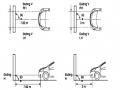
Note: A distance of approximately 7.62 m is required between the vehicle (fog lamp center) and the wall to adjust the convergence correctly. If the distance of 7.62 m cannot be achieved, set the correct distance of 3 m to check and adjust the fog lamp convergence. (Since the target area varies with the distance, please follow the instructions as shown in the figure.)
b/ Prepare a piece of thick white paper about 2 m high and 4 m wide to use as a screen.
c/ Draw a vertical line through the center of the screen (line V).
d/ Set the screen as shown in the picture. Note:
- Keep the screen perpendicular to the ground.
- Align the V line on the screen with the center of the vehicle.
e/Draw the reference lines (H, V LH and V RH lines) on the screen as shown in the figure.HINT:
Mark the center of the fog lamp on the screen. If the center mark cannot be seen on the fog lamp, use the center of the fog lamp or the manufacturer's name mark on the fog lamp as the center mark.
H line (fog light height):
Draw a line across the screen so that it passes through the center mark. Line H should be at the same height as the center mark of the fog light bulb.
Line V LH, V RH (center mark position of left fog lamp LH and right fog lamp RH):
Draw two lines so that they intersect line H at the center marks.
5. Check the fog light convergence
a/ Cover the fog lamp or remove the connector of the other side fog lamp to prevent light from the unchecked fog lamp from affecting the fog lamp convergence test.
b/ Start the engine.
c/ Turn on the fog lights and make sure that the dividing line is outside the standard area as shown in the drawing.
6. Adjust the fog light convergence
Use a screwdriver to adjust the fog light to the standard area by turning the toe adjustment screw.
Note: If the screw is adjusted too far, loosen it and then tighten it again, so that the last rotation of the light adjustment screw is clockwise.
3. Self-study questions
1. Describe the operating principle of the lighting system with automatic headlight function
2. Describe the operating principle of the lighting system with the function of rotating headlights when turning
3. Draw diagram and connect lighting system on Hyundai Porter car
4. Draw diagram and connect lighting system on Honda Accord 1992
5. Draw the lighting circuit on a 1993 Toyota Lexus
LESSON 3 MAINTENANCE AND REPAIR OF SIGNAL SYSTEM
I. IMPLEMENTATION GOAL
After completing this lesson, students will be able to:
- Distinguish between types of signals on cars
- Correctly describe common symptoms and suspected areas causing damage.
- Connecting signal circuits ensures technical requirements
- Disassemble, install, check, maintain and repair the signal system to ensure technical requirements.
- Ensure safety in work and industrial hygiene
II. LESSON CONTENT
1. General description
The signal system equipped on cars aims to create signals to notify other vehicles participating in traffic about the vehicle's operating status such as: stopping, parking, braking, reversing, turning...
Signals are used either by light such as headlamps, brake lights, turn signals….. or by sound such as horns, reverse music….
Just like the lighting system. A signal system circuit usually consists of: battery, fuse, wire, relay, electrical load and control switch. Only some switches of the signal system are on the combination switch. The switches of other signals are usually located in different locations such as in the gearbox or brake pedal……
2. Maintenance and repair
2.1. Turn signals and hazard lights
The installation location of the turn signal is shown in Figure 3.1. The turn signal control switch is located in the combination switch under the steering wheel. Turning this switch to the right or left will make the turn signal turn right or left.
The hazard light switch is used when the vehicle has a problem while participating in traffic. When the hazard light switch is turned on, all the turn signals on the vehicle will light up at a certain frequency. The hazard light switch is usually placed separately from the turn signal switch (some old cars integrate the hazard and turn signal switches on the same combination switch cluster).
Figure 3.1 Turn signal switch Figure 3.2 Hazard switch
The part that generates the flashing frequency for the lights is called a turn signal relay. The turn signal relay usually has 3 terminals: B (positive power supply); E (negative power supply); L (providing the turn signal switch to distribute to the
lamp)
2.1.1. Circuit diagram
To generate the frequency for the turn signal, a turn signal relay is used in the turn signal circuit. The current from the turn signal relay will be sent to the turn signal switch assembly to distribute the current to the turn signal lights for the driver's purpose.
Figure 3.3. Schematic diagram of a turn signal circuit without a hazard switch
1. Battery; 2. Electric lock; 3. Turn signal relay; 4. Turn signal switch; 5. Turn signal lamp; 6. Turn signal lamp; 7. Hazard switch
Figure 3.4 Schematic diagram of turn signal circuit with hazard switch
1. Battery; 2. Combination switch cluster; 3. Turn signal;
4. Turn signal light; 5. Turn signal relay
Today's cars no longer use three-pin turn signal relays (B, L, E) but use eight-pin turn signal relays (figure 3.5) (pin number 8 is used for hazard lights).
For this type, the current supplying the turn signal lights is supplied directly from the turn signal relay to the lights.
div.maincontent .p { color: black; font-family:"Times New Roman", serif; font-style: normal; font-weight: normal; text-decoration: none; font-size: 14pt; margin:0pt; } div.maincontent p { color: black; font-family:"Times New Roman", serif; font-style: normal; font-weight: normal; text-decoration: none; font-size: 14pt; margin:0pt; } div.maincontent .s1 { color: black; font-family:"Times New Roman", serif; font-style: normal; font-weight: normal; text-decoration: none; font-size: 13pt; } div.maincontent .s2 { color: black; font-family:"Times New Roman", serif; font-style: italic; font-weight: normal; text-decoration: none; font-size: 14pt; } div.maincontent .s3 { color: black; font-family:"Times New Roman", serif; font-style: normal; font-weight: normal; text-decoration: none; font-size: 14pt; } div.maincontent .s4 { color: black; font-family:"Times New Roman", serif; font-style: normal; font-weight: normal; text-decoration: none; font-size: 13pt; } div.maincontent .s5 { color: black; font-family:"Times New Roman", serif; font-style: normal; font-weight: normal; text-decoration: none; font-size: 13pt; vertical-align: 1pt; } div.maincontent .s6 { color: black; font-family:"Times New Roman", serif; font-style: normal; font-weight: normal; text-decoration: none; font-size: 11pt; } div.maincontent .s7 { color: black; font-family:"Times New Roman", serif; font-style: normal; font-weight: normal; text-decoration: none; font-size: 14pt; vertical-align: -9pt; } div.maincontent .s8 { color: black; font-family:"Times New Roman", serif; font-style: normal; font-weight: normal; text-decoration: none; font-size: 11pt; } div.maincontent .s9 { color: #008000; font-family:"Times New Roman", serif; font-style: normal; font-weight: normal; text-decoration: none; font-size: 14pt; } div.maincontent .s10 { color: black; font-family:"Times New Roman", serif; font-style: italic; font-weight: normal; te
Car body electrical practice - 8
zt2i3t4l5ee
zt2a3gs
zt2a3ge
zc2o3n4t5e6n7ts
If the voltage is out of specification, replace the wire or connector.
If the voltage is within specification, install the front fog light relay and follow step 5.
Step 5 Check the front fog light switch
- Remove the D4 connector of the fog light switch
- Use a multimeter to measure the resistance of the front fog light switch.
Measurement location
Condition
Standard
D4-3 (BFG) -D4-4 (LFG)
Light switchFront Fog OFF
>10kΩ
D4-3 (BFG) -D4-4 (LFG)
Front fog light switchON
<1 Ω
- Standard resistor
D4 connector is located on the combination switch assembly.
If the resistance is out of specification, replace the combination switch (the fog light switch is located in the combination switch).
If the resistance is within specification, follow step 6.
Step 6 Check wiring and connectors (front fog light relay-light selector switch)
- Disconnect connector D4 of the combination switch assembly
- Use a voltmeter to measure the voltage value of jack D4 on the wire side.
Measurement location
Control modecontrol
Standard
D4-3 (BFG) - (-) AQ
TAIL
11 to 14 V
D4 connector for the wiring of the combination switch assembly
If the voltage does not meet the standard, replace the wire or connector.
If the voltage is within standard, there may have been an error in the previous measurements.
Step 7 Check the front fog lights
- Remove the front fog light electrical connector.
- Supply battery voltage to the fog lamp terminals
Jack 8, B9 of front fog lamp on the electrical side
blind first.
Power supply location
Terms and Conditions
Battery positive terminal - Terminal 2Battery negative terminal - Terminal 1
Fog lightsbefore morning
- If the light does not come on, replace the bulb.
If the light is on, re-plug the jack and continue to step 8.
Step 8 Check wiring and connectors (relay and front fog lights)
- Disconnect the B8 and B9 connectors of the front fog lights.
- Use a voltmeter to measure voltage at the following locations:
Measurement location
Switch location
Terms and Conditions
B8-2 - (-) AQ
Electric lock ON TAIL size switchFog switch ON
11 to 14 V
B9-2 - (-) AQ
Electric lock ONTAIL size switch Fog switch ON
11 to 14 V
B8 and B9 connectors on the front fog lamp wiring side
Voltage is not up to standard, repair or replace the jack. If up to standard, there may have been an error in the measurement process.
2.2.4. Procedure for removing, installing and adjusting fog lights 1. Procedure for removing
- Remove the front inner ear pads
Use a screwdriver to remove the 3 screws and remove the front part of the front inner ear liner
-Remove the fog light assembly
+ Disconnect the connector.
+ Use a screwdriver to remove 3 screws to remove the fog light cover
2. Installation sequence
-Rotate the fog lamp bulb in the direction indicated by the arrow as shown in the figure and remove the fog lamp from the fog lamp assembly.
-Rotate the fog light bulb in the direction indicated by the arrow as shown in the figure and install the light into the fog light assembly.
- Use a screwdriver to install the fog light cover
-Install the electrical connector
Attention: Be careful not to damage the plastic thread on the lamp assembly.
- Install the front inner ear pads
Use a screwdriver to install the front inner bumper with 3 screws.
3. Prepare the vehicle to adjust the fog light convergence. Prepare the vehicle:
- Make sure there is no damage or deformation to the vehicle body around the fog lights.
- Add fuel to the fuel tank
- Add oil to standard level.
- Add engine coolant to standard level.
- Inflate the tire to standard pressure.
- Place spare tire, tools and jack in original design position
- Do not leave any load in the luggage compartment.
- Let a person weighing about 75 kg sit in the driver's seat.
4. Prepare to check the fog light convergence
a/ Prepare the vehicle status as follows:
- Place the car in a dark enough place to see the lines. The lines are the dividing line, below which the light from the fog lights can be seen but above which it cannot.
- Place the car perpendicular to the wall.
- Keep a distance of 7.62 m between the center of the fog lamp and the wall.
- Park the car on level ground.
- Press the car down a few times to stabilize the suspension.
Note: A distance of approximately 7.62 m is required between the vehicle (fog lamp center) and the wall to adjust the convergence correctly. If the distance of 7.62 m cannot be achieved, set the correct distance of 3 m to check and adjust the fog lamp convergence. (Since the target area varies with the distance, please follow the instructions as shown in the figure.)
b/ Prepare a piece of thick white paper about 2 m high and 4 m wide to use as a screen.
c/ Draw a vertical line through the center of the screen (line V).
d/ Set the screen as shown in the picture. Note:
- Keep the screen perpendicular to the ground.
- Align the V line on the screen with the center of the vehicle.
e/Draw the reference lines (H, V LH and V RH lines) on the screen as shown in the figure.HINT:
Mark the center of the fog lamp on the screen. If the center mark cannot be seen on the fog lamp, use the center of the fog lamp or the manufacturer's name mark on the fog lamp as the center mark.
H line (fog light height):
Draw a line across the screen so that it passes through the center mark. Line H should be at the same height as the center mark of the fog light bulb.
Line V LH, V RH (center mark position of left fog lamp LH and right fog lamp RH):
Draw two lines so that they intersect line H at the center marks.
5. Check the fog light convergence
a/ Cover the fog lamp or remove the connector of the other side fog lamp to prevent light from the unchecked fog lamp from affecting the fog lamp convergence test.
b/ Start the engine.
c/ Turn on the fog lights and make sure that the dividing line is outside the standard area as shown in the drawing.
6. Adjust the fog light convergence
Use a screwdriver to adjust the fog light to the standard area by turning the toe adjustment screw.
Note: If the screw is adjusted too far, loosen it and then tighten it again, so that the last rotation of the light adjustment screw is clockwise.
3. Self-study questions
1. Describe the operating principle of the lighting system with automatic headlight function
2. Describe the operating principle of the lighting system with the function of rotating headlights when turning
3. Draw diagram and connect lighting system on Hyundai Porter car
4. Draw diagram and connect lighting system on Honda Accord 1992
5. Draw the lighting circuit on a 1993 Toyota Lexus
LESSON 3 MAINTENANCE AND REPAIR OF SIGNAL SYSTEM
I. IMPLEMENTATION GOAL
After completing this lesson, students will be able to:
- Distinguish between types of signals on cars
- Correctly describe common symptoms and suspected areas causing damage.
- Connecting signal circuits ensures technical requirements
- Disassemble, install, check, maintain and repair the signal system to ensure technical requirements.
- Ensure safety in work and industrial hygiene
II. LESSON CONTENT
1. General description
The signal system equipped on cars aims to create signals to notify other vehicles participating in traffic about the vehicle's operating status such as: stopping, parking, braking, reversing, turning...
Signals are used either by light such as headlamps, brake lights, turn signals….. or by sound such as horns, reverse music….
Just like the lighting system. A signal system circuit usually consists of: battery, fuse, wire, relay, electrical load and control switch. Only some switches of the signal system are on the combination switch. The switches of other signals are usually located in different locations such as in the gearbox or brake pedal……
2. Maintenance and repair
2.1. Turn signals and hazard lights
The installation location of the turn signal is shown in Figure 3.1. The turn signal control switch is located in the combination switch under the steering wheel. Turning this switch to the right or left will make the turn signal turn right or left.
The hazard light switch is used when the vehicle has a problem while participating in traffic. When the hazard light switch is turned on, all the turn signals on the vehicle will light up at a certain frequency. The hazard light switch is usually placed separately from the turn signal switch (some old cars integrate the hazard and turn signal switches on the same combination switch cluster).
Figure 3.1 Turn signal switch Figure 3.2 Hazard switch
The part that generates the flashing frequency for the lights is called a turn signal relay. The turn signal relay usually has 3 terminals: B (positive power supply); E (negative power supply); L (providing the turn signal switch to distribute to the
lamp)
2.1.1. Circuit diagram
To generate the frequency for the turn signal, a turn signal relay is used in the turn signal circuit. The current from the turn signal relay will be sent to the turn signal switch assembly to distribute the current to the turn signal lights for the driver's purpose.
Figure 3.3. Schematic diagram of a turn signal circuit without a hazard switch
1. Battery; 2. Electric lock; 3. Turn signal relay; 4. Turn signal switch; 5. Turn signal lamp; 6. Turn signal lamp; 7. Hazard switch
Figure 3.4 Schematic diagram of turn signal circuit with hazard switch
1. Battery; 2. Combination switch cluster; 3. Turn signal;
4. Turn signal light; 5. Turn signal relay
Today's cars no longer use three-pin turn signal relays (B, L, E) but use eight-pin turn signal relays (figure 3.5) (pin number 8 is used for hazard lights).
For this type, the current supplying the turn signal lights is supplied directly from the turn signal relay to the lights.
div.maincontent .p { color: black; font-family:"Times New Roman", serif; font-style: normal; font-weight: normal; text-decoration: none; font-size: 14pt; margin:0pt; } div.maincontent p { color: black; font-family:"Times New Roman", serif; font-style: normal; font-weight: normal; text-decoration: none; font-size: 14pt; margin:0pt; } div.maincontent .s1 { color: black; font-family:"Times New Roman", serif; font-style: normal; font-weight: normal; text-decoration: none; font-size: 13pt; } div.maincontent .s2 { color: black; font-family:"Times New Roman", serif; font-style: italic; font-weight: normal; text-decoration: none; font-size: 14pt; } div.maincontent .s3 { color: black; font-family:"Times New Roman", serif; font-style: normal; font-weight: normal; text-decoration: none; font-size: 14pt; } div.maincontent .s4 { color: black; font-family:"Times New Roman", serif; font-style: normal; font-weight: normal; text-decoration: none; font-size: 13pt; } div.maincontent .s5 { color: black; font-family:"Times New Roman", serif; font-style: normal; font-weight: normal; text-decoration: none; font-size: 13pt; vertical-align: 1pt; } div.maincontent .s6 { color: black; font-family:"Times New Roman", serif; font-style: normal; font-weight: normal; text-decoration: none; font-size: 11pt; } div.maincontent .s7 { color: black; font-family:"Times New Roman", serif; font-style: normal; font-weight: normal; text-decoration: none; font-size: 14pt; vertical-align: -9pt; } div.maincontent .s8 { color: black; font-family:"Times New Roman", serif; font-style: normal; font-weight: normal; text-decoration: none; font-size: 11pt; } div.maincontent .s9 { color: #008000; font-family:"Times New Roman", serif; font-style: normal; font-weight: normal; text-decoration: none; font-size: 14pt; } div.maincontent .s10 { color: black; font-family:"Times New Roman", serif; font-style: italic; font-weight: normal; te -
 Current Status of Facilities Management, Ensuring Equipment for Self-Study Activities
 -
 Current Status of Credit Risk Management at Vietnam Bank for Agriculture and Rural Development
 -
 Current Status of Medium and Long Term Credit Risks at Vietnam Bank for Agriculture
 -
 Assessment of the current status of land use rights mortgage activities at the Vietnam Bank for Agriculture and Rural Development, Dien Bien province branch - 2

(Source: Moc Chau National Tourist Area Management Board)
From Table 2, we can see that as of 2017, Moc Chau district had 150 accommodation establishments, with a total of 1,347 rooms and 2,749 beds, an increase compared to 2015 and 2016. Of which, there was 1 five-star hotel, 1 four-star resort, and 2 three-star hotels. In general, the overall hotel business system
Hotels and motels in Moc Chau National Tourist Area are in the initial stages of construction and development, ensuring accommodation conditions for tourists during the peak tourist season. However, there are still many limitations, some hotels and motels have not strictly complied with the star rating requirements according to regulations, taking advantage of customers' trust to provide unworthy services, so they need to be overcome and managed more closely in the future.
Hotels, motels, and even homestays are increasingly appearing in Moc Chau. Many households have built private motels to meet the accommodation needs of tourists. In addition, there are also 1-star to 5-star hotels of large corporations and investment companies that are gradually appearing more and more.
2.3.4. Current status of human resources serving tourism
With many potentials and advantages in terms of climate, possessing natural landscapes, mysterious and majestic caves along with diverse and unique cultures of ethnic communities, Moc Chau plateau has attracted an increasing number of tourists, contributing to the development of the tourism industry. However, according to experts and travel companies, in order for Moc Chau tourism to promote its potential and advantages, in addition to continuing to invest and perfect infrastructure planning, Moc Chau needs to strengthen training and fostering to improve the quality of tourism human resources. In recent years, the tourism industry of Moc Chau district has had rapid growth in both quantity and revenue from tourism services; attracting many investors to survey and develop tourism and tourism infrastructure. In order to create a fundamental change in improving the professionalism, reputation and quality of tourism services in the area, in 2017, the Department of Culture and Information of Moc Chau district coordinated with Hanoi College of Tourism to organize 4 training courses to improve awareness and skills in welcoming and serving guests; awareness of community tourism; management skills of tourist accommodation establishments for hundreds of officials, civil servants, owners, employees at hotels, restaurants, accommodation establishments, tourist areas and spots in the district; training tour guides, tour guides at points, tours, routes... Along with that, to ensure human resources
In order to serve tourism, the district also trains staff of specialized departments to create resources for the district when there are groups of visitors, enough human resources to meet the requirements. In addition, from 2015 to present, the Department of Culture and Information of Moc Chau district has coordinated with Pha Luong Moc Chau Tourism Joint Stock Company to organize 3 competitions to find tour guides and tour guides. Through that, 8 tour guides and tour guides have been searched and trained to serve at tourist routes and destinations.
Training human resources is a job that requires time, a specific roadmap and plan. The Party Committee, the government and tourism businesses in Moc Chau have done so far, although modestly, but it is a very important foundation. Through training courses and professional development, organizations and individuals in the tourism and service business have changed their awareness, constantly tried and made efforts to learn from experience in service manners, communication skills, and customer care to improve the quality of service to tourists. In the coming time, Moc Chau district will continue to coordinate with professional and experienced units to open training courses and professional development; have mechanisms and policies to prioritize recruitment and attract a team of professional tour guides and interpreters at tourist areas and spots, contributing to promoting the development of the district's tourism industry.
2.3.5 Current status of investment promotion work
Son La Tourism Promotion Information Center has launched many activities to promote, advertise and develop tourism in the province.
In 2016, the Center developed publications, published 4,000 brochures promoting Moc Chau and Van Ho tourism, 2,000 Son La tourism maps, and 3,000 leaflets for the 2017 National Tourism Year. Regularly updated news and events on the Son La tourism website about traditional festivals typical of each region; linked and exchanged links with the Tourism Promotion Information Centers of the provinces and related units; posted articles about Son La tourism on the common website of the 8 expanded Northwestern provinces; regularly changed images, banner content, and tourism trailers on the Son La tourism website, attracting over 1.4 million visits (an increase of 280% compared to 2015); maintained a specialized page,
column "Son La Tourism" on the province's mass media; coordinate with Netviet Joint Stock Company to organize the production of reports, columns and clips on Son La tourism on VTC10 foreign television channel; complete the renovation and repair of 9 tourist signboards.
To welcome the Lao Cai - Northwest National Tourism Year 2017, the Center continues to strengthen tourism promotion information with the provinces, striving to reach 1.5 million visits to exploit information via the website; design, produce items, publish tourism publications; strengthen information, propaganda, promote the image, attractive destinations of the province; participate in tourism fairs and exhibitions within the cooperation framework of 8 expanded Northwest provinces, the Cultural - Sports and Tourism Exchange Festival of Vietnam - Laos border provinces; train and coach tourism skills and profession for restaurant and hotel staff; survey the tourism route of Bac Yen district, coordinate spiritual tourism tours along the Da River of 8 expanded Northwest provinces...
In 2017, Moc Chau Tourism Association has done a good job of promoting tourism, linking, cooperating in business and expanding the tourism market. Actively participating in building the product Moc Chau - Super school garden, with a commitment to reduce service prices for tourists.
At the same time, mobilize members to participate in the International Tourism Fair in Hanoi and participate in tourism activities of the district such as: Moc Chau Ethnic Culture Festival; Het Cha Festival; Tea Festival; Fruit Picking Festival; Dairy Cow Beauty Contest... Organize to welcome hundreds of tourism companies and travel agencies to survey and build tours and routes to introduce to domestic and foreign tourists to Moc Chau... contributing to welcoming over 1.15 million visitors to visit and travel in Moc Chau.
Currently, Moc Chau Tourism Association strengthens the connection between member businesses; organizes professional training courses, in which priority is given to receptionists and tour guides. Mobilizes businesses to actively participate in tourism promotion activities, focusing on the market for young people, students and pupils according to the Moc Chau - Super School Garden Project; strengthens coordination with agencies
Authorities inspect, monitor and propose measures to stabilize the market...
Investment opportunity
Moc Chau National Tourist Area is planned with a total natural area of 206,150 hectares, located in two districts of Moc Chau and Van Ho (Son La). Moc Chau plateau is vast, with an average altitude of 1,050 m, a fresh temperate climate, especially with many beautiful landscapes, historical relics; ethnic villages, traditional festivals such as: Hoa Ban Festival, Nao Song Festival, Harvest Festival, Moc Chau Ethnic Cultural Festival, Miss Dairy Cow Contest... along with vast grasslands and tea hills. Moc Chau also has a large, fertile natural land area, favorable for the development of agriculture, forestry and livestock farming. The harmonious combination of agricultural development and tourism will bring economic efficiency, creating a highlight for Moc Chau tourism "natural, green, clean, beautiful and colorful ethnic culture".
According to the policy of Moc Chau district, units, businesses and families have renovated their campuses to plant flowers and trees, creating a fresh and close-to-nature space. Currently, the main roads in the center of Moc Chau district have been decorated with flower pots, hung national flags and renovated urban campuses, and cleaned up alleys. People in Son La province are eagerly waiting for the Festival to announce the Prime Minister's Decision approving the "Master plan for the development of Moc Chau National Tourist Area to 2020, with a vision to 2030" to open their hearts to invite tourists to visit and find investment opportunities.
2.4 Comments, reviews
2.4.1 Advantages, positive
Moc Chau Plateau is a land blessed by nature with charming landscapes, each season has its own beauty that captivates the hearts of many tourists. Implementing the Resolution of the Party Congress at all levels for the 2010-2015 term on tourism planning and development, Moc Chau has been exploiting its potential, promoting and effectively developing the smokeless industry.
The number of visitors to Moc Chau has increased steadily over the years, creating jobs and increasing income for the people. In 2017, the district developed a plan to connect
Developing tourism with agricultural development by growing crops that not only bring economic benefits to the people in the highlands, but also bring beautiful scenery to serve tourism development. The locality also identifies this as a new step for the people in the highlands to improve their lives through tourism development.
The district has rich, diverse and attractive agricultural tourism resources, formed by the combined characteristics of geological, topographic, climatic, and flora and fauna factors. With this richness of resources, the district has the ability to develop many types of tourism, including agricultural tourism.
In recent years, the district has issued many separate policies on tourism development and strengthened management of the tourism business environment. In addition, the district has focused on improving the investment environment, enhancing the quality of management, reforming administrative procedures, shortening the processing process, reducing the number and simplifying documents, reducing the time and cost of implementing administrative procedures to create a favorable business environment for enterprises and investors.
With its tourism potential, Moc Chau has been planned by the Prime Minister to develop into Moc Chau National Tourist Area according to Decision No. 2050/QD-TTg dated November 12, 2014, including 3 areas: Moc Chau Eco-tourism Center; Moc Chau Entertainment Area; Moc Chau Resort Center (currently planned by the Ministry of Culture, Sports and Tourism as Moc Chau Tourist Area). Moc Chau District has proactively worked with a number of potential investors and has attracted 3 enterprises to invest in Moc Chau National Tourist Area, including: Muong Thanh Trade Center - Hotel Complex Project; Thao Nguyen II Hotel and Entertainment Complex Project of Moc Chau Construction Investment Joint Stock Company; Ecological Rest Area and Perennial Planting Project of Arena Agricultural Tourism Joint Stock Company. In 2014, Moc Chau completed updating destinations, road names, and street names in Moc Chau district on the world map.
2.4.2 Difficulties and limitations
With favorable conditions for eco-tourism and humanities, Moc Chau has a lot of potential for tourism development. However, in recent years, this land
There are still many limitations. Specifically: Tourism products are still poor, monotonous, and have low competitiveness; infrastructure still has many shortcomings, and lacks capital compared to development requirements. The reason for this situation is that financial resources for investment are still limited, and the business and investment environment is not really attractive...
Although infrastructure has been invested in, due to economic difficulties, it is still weak and there are no conditions for solidification. This limits the development speed of all aspects of socio-economic sectors. The road network is still lacking and outdated, the technical scale of many roads has not met standards, has exceeded the renovation cycle, the quality of the roads is still low, mainly dirt roads, especially agricultural roads. In particular, overcoming damage caused by rain and floods causing landslides, traffic jams, destruction of road surface structures, drainage systems for provincial roads and agricultural roads faces many difficulties in capital. This is a very disadvantageous point of Moc Chau. The main roads in the area (national highways, provincial roads, district roads) are all single routes, there are still many locations that have to use overflow roads, deep underground roads, so when the rain and floods last for a long time, the flood water rises, these areas are often isolated, divided, greatly affecting people's lives and local socio-economic development.
However, most travel agencies when surveying Moc Chau tourism said that tourism services do not meet the needs, the team of tour guides and tour guides is both lacking and weak.
Despite significant progress, Moc Chau tourism still has many limitations and weaknesses in general. Agricultural tourism products are still poor, monotonous, and not very competitive. The reason is that there is not yet a good overall strategy with steps and methods suitable to the conditions and strengths of Moc Chau, which is a matter of awareness that requires specialized knowledge and practical experience of both state management agencies, businesses and people. The infrastructure of Moc Chau district in general and tourism in particular still has many shortcomings and deficiencies compared to the current requirements of tourism development. This situation is largely due to the limited financial resources for investment, the business environment, and tourism investment are not really attractive. Infrastructure, although
has been invested in, however, due to economic difficulties, it is still weak and has not had the conditions to solidify. This limits the development speed of all aspects of the socio-economic sectors. The work of propaganda, promotion and tourism promotion is still weak. Many travel businesses, tourists, especially foreign tourists, lack information about Moc Chau due to the lack of financial resources and a team of professional tourism staff.
The results of hunger eradication and poverty reduction are not really sustainable, the risk of falling back into poverty is high, a part of the population still lacks land for production; the quality of education, vocational training, and health services is still low. The team of leaders and managers in many communes is weak in capacity; the role of the entire political system to promote economic development has not been promoted well.
- society. Security in ethnic minority areas and border areas has many potential complex factors, with illegal migration, encroachment, illegal trading and transportation of forest products. In addition, Moc Chau also has difficulties, such as resource mobilization is still limited. Environmental sanitation is still inadequate. Forms of association in production are not tight, product consumption is slow...
Chapter 2 Summary
Chapter 2 has introduced an overview of Moc Chau district - Son La, the resources exploited for tourism development here. In particular, it has assessed the conditions and current status of exploiting agricultural tourism in Moc Chau district - Son La. Although there are many conditions to develop this new type of agricultural tourism, it has not attracted much attention from the community and there are still many limitations. Therefore, in chapter 3, the author will propose solutions with the hope that agricultural tourism activities in Moc Chau will develop more effectively.